Trade and Industry, Political Economy, Development. (Cambridge, Geneva, Islamabad.) Tweets personal views; RTs not endorsements; More on LinkedIn/Insta)
I had a fascinating exchange with Robert Wade regarding my piece on the World Bank's new report on industrial policy.
Wade, who I mention in the piece, is one of the foremost scholars on industrial policy in East Asia, has worked for the World Bank, and also studied the Bank from an anthropological lens.
He has given me permission to share some thoughts he had on the piece and some of the wider thoughts on the World Bank's shift on industrial policy — with the caveat that he wrote this on a small laptop while travelling.
Here are Wade's thoughts, unedited:
Jostein’s essay is prompted by the World Bank’s publication, in 2026, of an almost 300 page report called Industrial Policy for Development, the Bank’s first-ever report on this subject (at least since 1980). The report is one in a wave of official reports on the same subject, which have in common that instead of asking, as in the past, “why industrial policy?” and answering “in the real world industrial policy will not work”, the question now is “how can industrial policy be done well rather than (as often in the past) badly?” So the IMF’s World Economic Outlook 2025 has a chapter called “Industrial Policy”, the first time the IMF has grappled with the subject at an official (as distinct from Working Paper) level. The British government has issued a national industrial strategy, which nobody pays attention to. The Icelandic Prime Minister’s office issued “Industrial policy of Iceland: growth plan to 2035” on Friday 10 April 2026, a document which boasted that this was Iceland’s first-ever industrial policy.
These and related events constitute a dramatic movement of the “window of discourse” (or “Overton window”), meaning the range of ideas which at any point in time is acceptable for discussion in popular or elite circles. Ever since the early 1980s the very phrase “industrial policy” or “industrial strategy” has been outside the Overton window, as I know to my cost. I worked in the World Bank as an economist in the 1980s and again in the second half of the 1990s, having earlier lived in and done research on the industrial policies of South Korea and Taiwan. My Bank work was on other subjects. But I was dismayed that even during the 18 months I worked in the central Trade Policy Division my colleagues emphatically did not want to talk about industrial policy. Their interest was limited to how East Asian countries had managed to promote manufactured exports -- not even extending to how they made the manufactures to be exported. Any mention of industrial policy was terminated with airy assertions that “government can’t pick winners” and “all governments are predatory”.
Jostein argues, correctly in my view, that “the neoliberal project [which pressed developing country governments to liberalise, privatise, and rely on “market forces”] was never simply about “freeing” markets. It was about constructing an architecture of international rules that locked in the dominance of wealthy nations and made it difficult [for developing country governments] to pursue the kinds of industrial policies that the rich world had itself relied upon historically”. The neoliberal agenda (or Washington Consensus agenda) would lock most of those developing countries into a role of commodity suppliers to western markets, with the justification that this was their “comparative advantage” (implicitly, static comparative advantage). Having most of them locked into commodity production would ensure that the income and technology gap between them and the minority of western economies would not much reduce — and so also the power gap would not much reduce. Western countries would continue to rule the main multilateral economic organizations like the IMF, the World Bank, and most of the other regional development banks, and hence rule the advice they gave to developing country governments in return for loans.
In this context one can appreciate the dilemma faced by the chief authors of the World Bank’s The East Asian Miracle, 1993. The Bank was forced by the Japanese Ministry of Finance (in charge of the government’s relations with the World Bank) to undertake the research on economic performance of East Asian economies across the whole region, with particular attention to the role of government industrial policy. The ministry put $1.2 mn on the table to cover costs, so the Bank had to pay almost nothing out of its own resources. Why did the ministry do this? Because it was angry at the strong and frequent criticism coming from the top of the Bank of Japan’s aid programs in East Asia, and specifically the use of subsidised credit to boost selected industries (this policy tool was operated from the Ministry of Finance). The top of the Bank lectured the ministry — with all the conviction of the Vatican — that subsidised credit distorted financial systems and impaired economic development, including the Bank’s own aid. The Ministry of Finance did not appreciate being talked down to in this way. Hence the $1.2 million to force the Bank to do what it had never done, make a comprehensive examination of the whole range of East Asian development experience and the role of government industrial policy.
The chief authors had to navigate between the Bank’s certainty that industrial policy did not work, and Japan’s conviction that it had worked well in Japan itself and in other East Asian countries — and not incidentally that the subsidised credit programs run by the Ministry of Finance had played an important role, though its contribution to Japan’s own miracle had been overlooked with all the praise going to its rival the Ministry of International Trade and Industry (MITI) . The chief authors' own careers in the Bank were at stake. So the body of the text affirms that industrial policy does not work (with a few qualifications). But the president’s preface — which was written by the chief authors and which they knew would not have to receive approval from high up the Bank’s hierarchy, unlike the text itself — affirmed that East Asian experience showed that selective promotion of certain industries could be effective. That brief statement from the president was what the Japanese paid $1.2 million for. (See my essay “Japan, the World Bank, and the Art of Paradigm Maintenance” In New Left Review 1996.)
Why has industrial policy returned to the window of discourse? Not mainly because of new evidence that, after all, it did work. The main reason is the change in geo-political-economy. As Jostein says, “Western nations now actually need industrial policy to compete, especially with China.” Now that some of them, including the US, are practicing industrial policy on a large scale in order to survive against Chinese imports, for them to condemn industrial policy outright for developing countries — as in “why do industrial policy, we know it doesn’t work” — would be taking organised hypocrisy too far, even for them.
That said, the new geo-political-economy context has opened the way to more empirical and theoretical studies that earlier would have been either rejected from the start or completed but relegated to the margins. Two of the leading analysts of this new wave are, ironically, IMF economists, Reda Cherif and Fuad Hasanov, who have used their marginal status to write a series of path-breaking research papers. Two recent ones are “Industrial policy, Asian Miracle style”, 2025, Journal of Economic Perspectives 39 (4), and “Institutions for industrial policy: the foundation of economic development”, 2026, IMF Working Paper 2026/063. They are pushing beyond standard questions about appropriate and inappropriate policy tools, to new questions about appropriate and inappropriate institutional arrangements for industrial policy — especially about the industrial policy pilot agency at the core of the state and its coordination with other ministries and its networks with private sector associations.
I end on a question. How long will “industrial policy” or “industrial strategy” remain within the “window of discourse”?
"China’s ascent during the age of globalization is not just one economic story amongst many. It is the single most dramatic development in world economic history, bar none."
- Adam Tooze
@ansukhera Well played, Sir! An impeccable knock!! May you continue to retain the health, spirit and motivation for even more success ahead! All the best 💐
Economist Ha-Joon Chang: "[Mainstream] economics has become like Catholic theology in medieval Europe. It has become the language of the rulers"
"They are not going to let you 'speak' it... unless you belong to the priesthood... or are from an extremely privileged background"
@ESPNcricinfo #Umpire did not call it immediately. If @imVkohli was insisting, why was the no-ball not referred to the third umpire? Technology is there for a reason. All would have been sorted. Unnecessary controversy. Even #commentators played it down. Poor show! @ICC#INDvPAK2022#INDvPAK
My 10th grade Urdu teacher insisted that this sheyr/ghazal written by Siraj Aurangabadi 270 years ago, was possibly amongst the best ever written. I have now listened to it for 40+ yrs; am just beginning to understand what he meant; why it just may be so.
It’s #Pakistan today, it can be any other tomorrow. Colour of skin or eyes; ‘it won’t happen to us’; or ‘they somehow deserve the divine intervention’ should not determine how we deal with #climatechange . A brilliant piece in @NewYorker https://t.co/yk0YHZtY0V
The world may never witness another like him! Friends, family, foes alike have nothing but respect for the man - humility, compassion and elegance of a classy human being - an inspiration for millions. Farewell, and thank you @rogerfederer #Federer https://t.co/on3VJcIwZm
The only appropriate response to the climate catastrophe in Pakistan is to unconditionally cancel the country's external debts. These resources should be used to support people and ecosystems rather than to service foreign capital. It is a minimal first step toward reparations.
Nayyara Noor, a beautiful, melodious voice that captured the hearts of millions across generations in Pakistan! May God bless her soul!
اے جزبہ دل گر میں چاہوں ہر چیز مقابل آ جائے
منزل کے لئے دو گام چلوں اور سامنے منزل آ جائے
Rest in Peace #NayyaraNoor, #nightingaleofpakistan
Honored to share ideas on trade research with #wto Chairs at their Annual Conf, including the newly apptd Pak Chair, Dr Azam Ch, Lhr School. Thanks to DG @NOIweala for supporting this key capacity bldng prog. @naveedqamarmna @ItcLahore @Lahore_School@Fahdhusain@PakMission_WTO
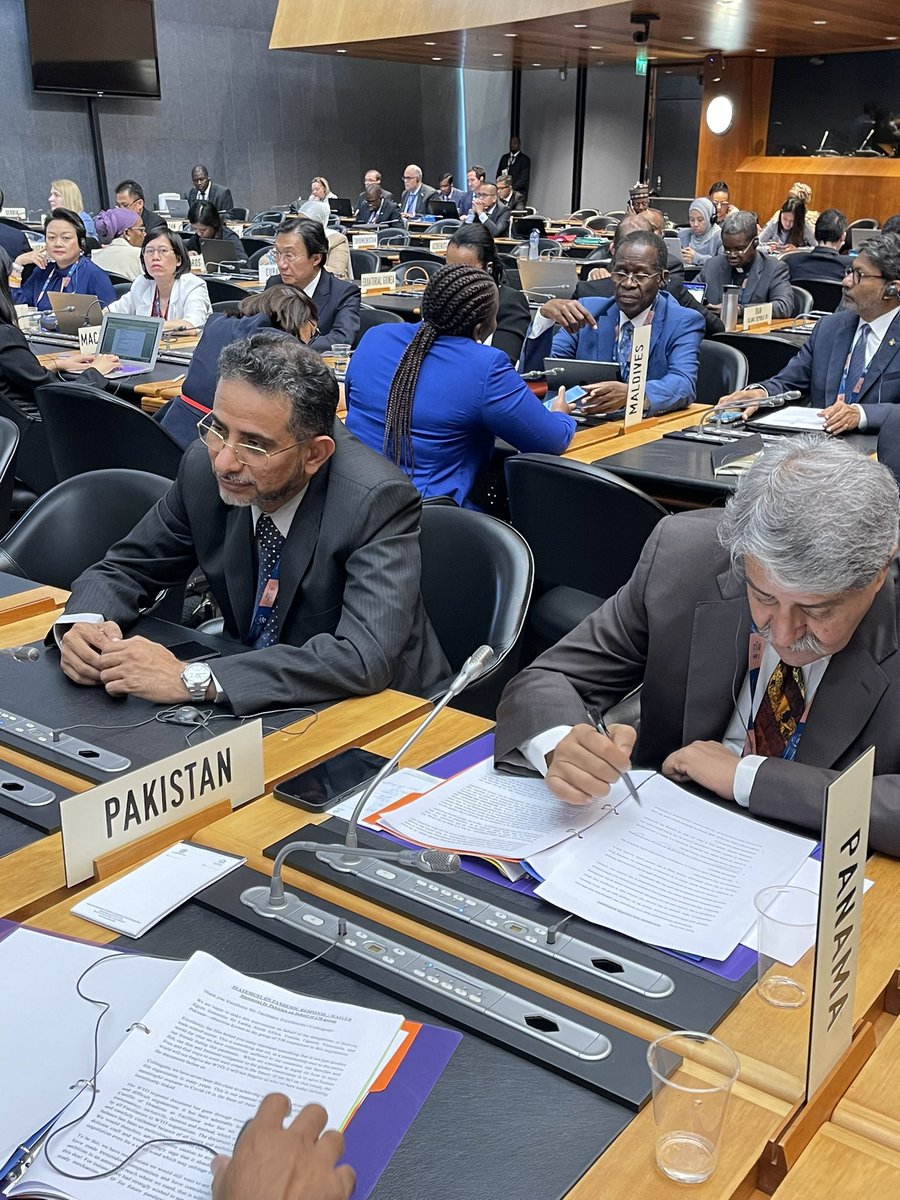
#Pakistan delegation led by @naveedqamarmna and participated actively at #MC12@wto. Put emphasis on criticality of developmental policies esp in wake of Covid and its aftermath. Intense negotiations extended for 2 days to achieve results. @mincompk