The companies that get great at "No" or "Kill it" are the ones that will win 🤔. We're back to Lean Startup, basically. But most corporates just can't handle working like that. Million dollar projects or GTFO.
@gummibear737 I don't WANT ai to create things like this. The reason this is great is that the artist put soul to the music, created the story & worked with other talent to create this wonderful thing. And the joy of the performers shines through. It's real.
GPU Pixels aren't the same
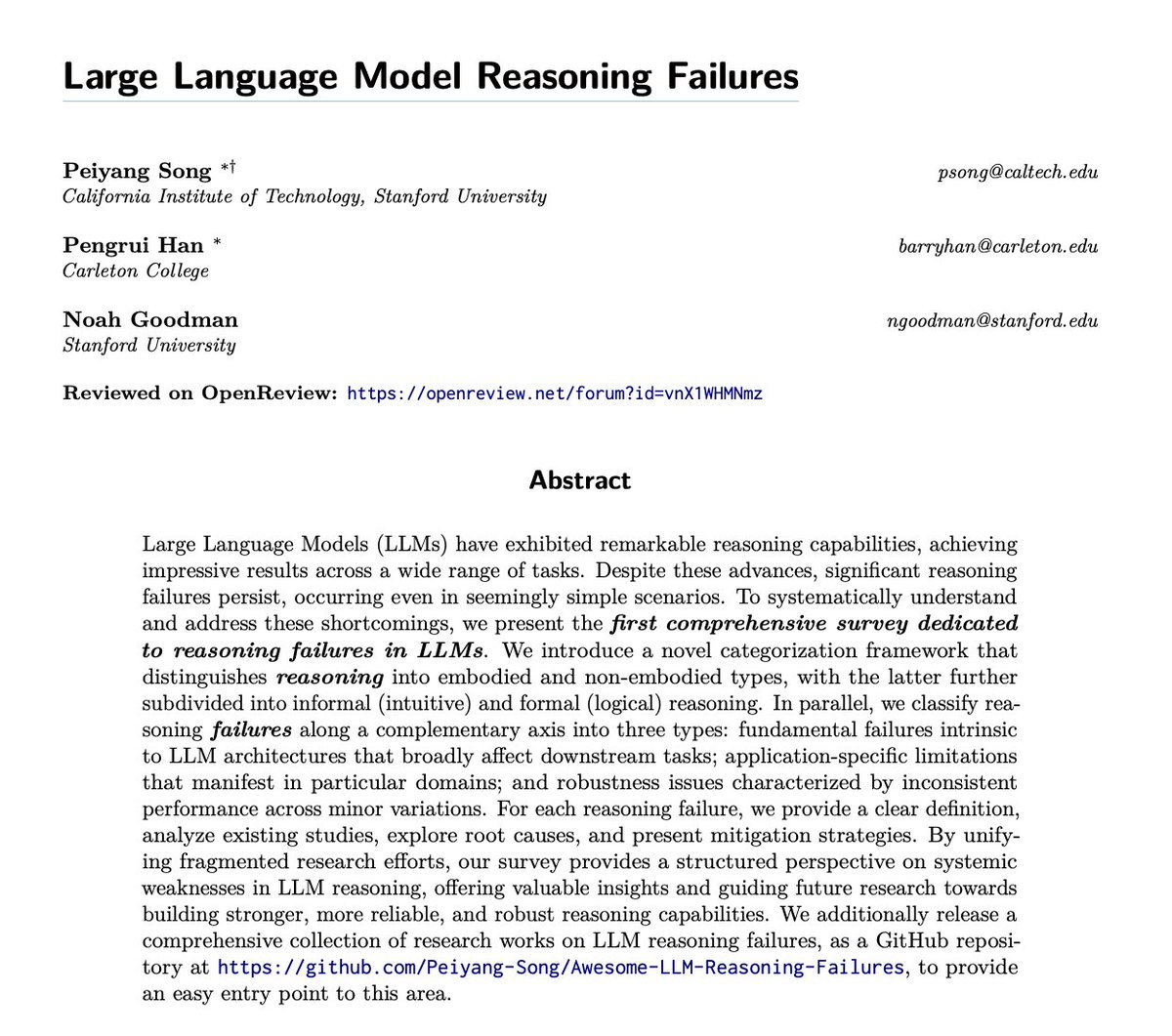
🚨 Holy shit… Stanford just published the most uncomfortable paper on LLM reasoning I’ve read in a long time.
This isn’t a flashy new model or a leaderboard win. It’s a systematic teardown of how and why large language models keep failing at reasoning even when benchmarks say they’re doing great.
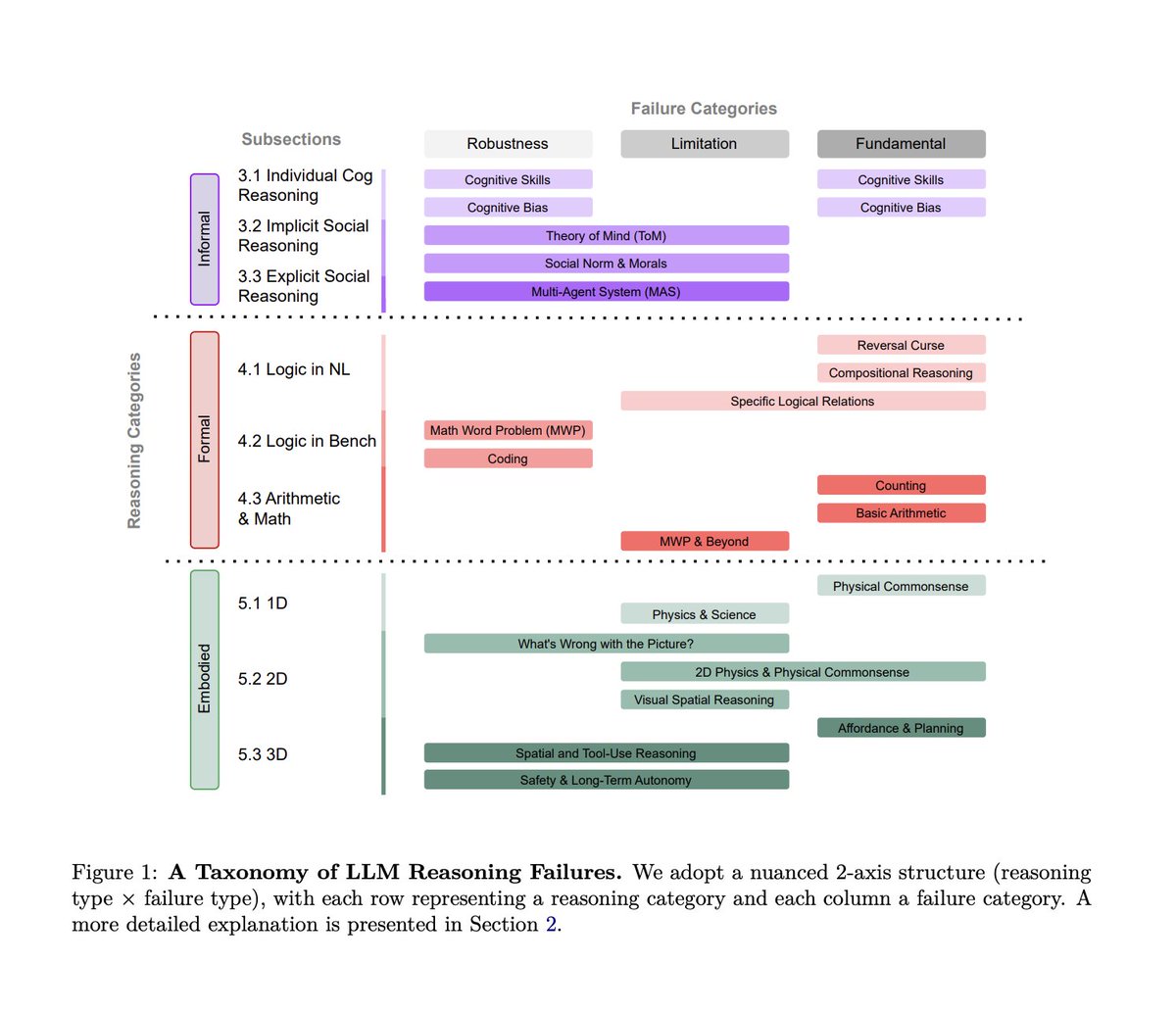
The paper does one very smart thing upfront: it introduces a clean taxonomy instead of more anecdotes. The authors split reasoning into non-embodied and embodied.
Non-embodied reasoning is what most benchmarks test and it’s further divided into informal reasoning (intuition, social judgment, commonsense heuristics) and formal reasoning (logic, math, code, symbolic manipulation).
Embodied reasoning is where models must reason about the physical world, space, causality, and action under real constraints.
Across all three, the same failure patterns keep showing up.
> First are fundamental failures baked into current architectures. Models generate answers that look coherent but collapse under light logical pressure. They shortcut, pattern-match, or hallucinate steps instead of executing a consistent reasoning process.
> Second are application-specific failures. A model that looks strong on math benchmarks can quietly fall apart in scientific reasoning, planning, or multi-step decision making. Performance does not transfer nearly as well as leaderboards imply.
> Third are robustness failures. Tiny changes in wording, ordering, or context can flip an answer entirely. The reasoning wasn’t stable to begin with; it just happened to work for that phrasing.
One of the most disturbing findings is how often models produce unfaithful reasoning. They give the correct final answer while providing explanations that are logically wrong, incomplete, or fabricated.
This is worse than being wrong, because it trains users to trust explanations that don’t correspond to the actual decision process.
Embodied reasoning is where things really fall apart. LLMs systematically fail at physical commonsense, spatial reasoning, and basic physics because they have no grounded experience.
Even in text-only settings, as soon as a task implicitly depends on real-world dynamics, failures become predictable and repeatable.
The authors don’t just criticize. They outline mitigation paths: inference-time scaling, analogical memory, external verification, and evaluations that deliberately inject known failure cases instead of optimizing for leaderboard performance.
But they’re very clear that none of these are silver bullets yet.
The takeaway isn’t that LLMs can’t reason.
It’s more uncomfortable than that.
LLMs reason just enough to sound convincing, but not enough to be reliable.
And unless we start measuring how models fail not just how often they succeed we’ll keep deploying systems that pass benchmarks, fail silently in production, and explain themselves with total confidence while doing the wrong thing.
That’s the real warning shot in this paper.
Paper: Large Language Model Reasoning Failures
“Don’t say anything if you can’t say something kind” is in my mind.
But… this screams enthusiastic engineering solution in search of a problem.
Upgrade path
Debris and radiation
Cooling
Latency
Maintenance
Cost!
So much easier… y’ know… on the ground… Space is *hostile*
🚀@LumenOrbit (YC S24) is building a network of megawatt-scale data centers in space, scalable to gigawatt capacity.
Congrats on the launch, @johnstonphil, @ezrafeilden, and @adioltean!
https://t.co/VfVjcwJrbe https://t.co/ycOvFSQP4N
A turd in the hand is worth… billions in profits!
As OFWAT allows massive bill rises to reward @thameswater’s continued failure, here’s what my experience of standing in a river full of shit has taught me about the sewage crisis, it’s origins & what we must do to fix it 🧵
ehm, chat... this is big
they put a BCI in a rat’s brain, modeled its movements, and predicted the neural activity across behaviors with stunning accuracy, basically merging biomechanics with ai
so now we could do the same with a human (@ModdedQuad , could you help us out since you already have the neuralink?), put the modeled human in a virtual environment, load an llm, have it embodied, speed the simulation up, and get to agi.
@JamesTCobbler Agree on Timpson branding, phones and also… smart watch battery renewal? My Garmin already needs a new battery and I’d be tempted with a walk-in or overnight service.
This week's newsletter: Tech has looted the internet, making every platform actively hostile to the user, turning Facebook, Google Search, Instagram into products that no longer provide a service while making them hundreds of billions of dollars.
https://t.co/jKhd1clLI4