To understand Omarchy's potential, paste this into your AI:
Research Omarchy's current stack through the lens of Unix and early AWS: programmable, composable primitives. What can humans and AI agents build together? Explain layer by layer with one concrete workflow, distinguishing built-in features from possibilities.
I appreciate that folks on the right are excited about new institutions in Linux land that aren't captured by clowns and nonsense. But Omarchy isn't anti anything in its foundation. It's PRO having fun with beautiful, agentic computers without turning it all into politics.
‼️ A malicious package on the Arch User Repository is handing attackers root access to developer machines over Tailscale.
'hyprland-fixes' ships a working Hyprland config as cover. Per an analysis on Arch's aur-general list, its install script harvests the sudo password, joins the machine to the attacker's private Tailscale network, and opens root sshd on ports 3333/4444.
It then wipes journald and shell history. On a Arch dev workstation, nothing flags a running tailscaled. It's the same tool half the users already run.
Concern yourselves more with the needs of others, with the needs of all humanity, and you'll have peace of mind. Selfishness creates a distance between us and other people, leading to suspicion and mistrust, ultimately resulting in loneliness. Think of others' well-being and you’ll be happy.
I am a proud Bitcoin Maxi, as defined by @saylor below:
“Bitcoin Maximalism is the conviction that Bitcoin represents a fundamental economic breakthrough: the strongest digital property, the most credible monetary network, and an instrument of economic empowerment for billions of people. It can be grounded in ethics—the defense of property rights—and in utility—the ability to preserve and transfer capital without dependence on an issuer.”
Do you want to learn AI? Doing a study session on Pi
1. Read the pi repo
2. Setup pi on your machine
3. Setup a free model or local model
Recommended:
https://t.co/gIJ4KkQVKy <-- free
https://t.co/40ikepCkPy <-- local
Do this by 2PM CET today and join:
https://t.co/v8V4Ly54QH
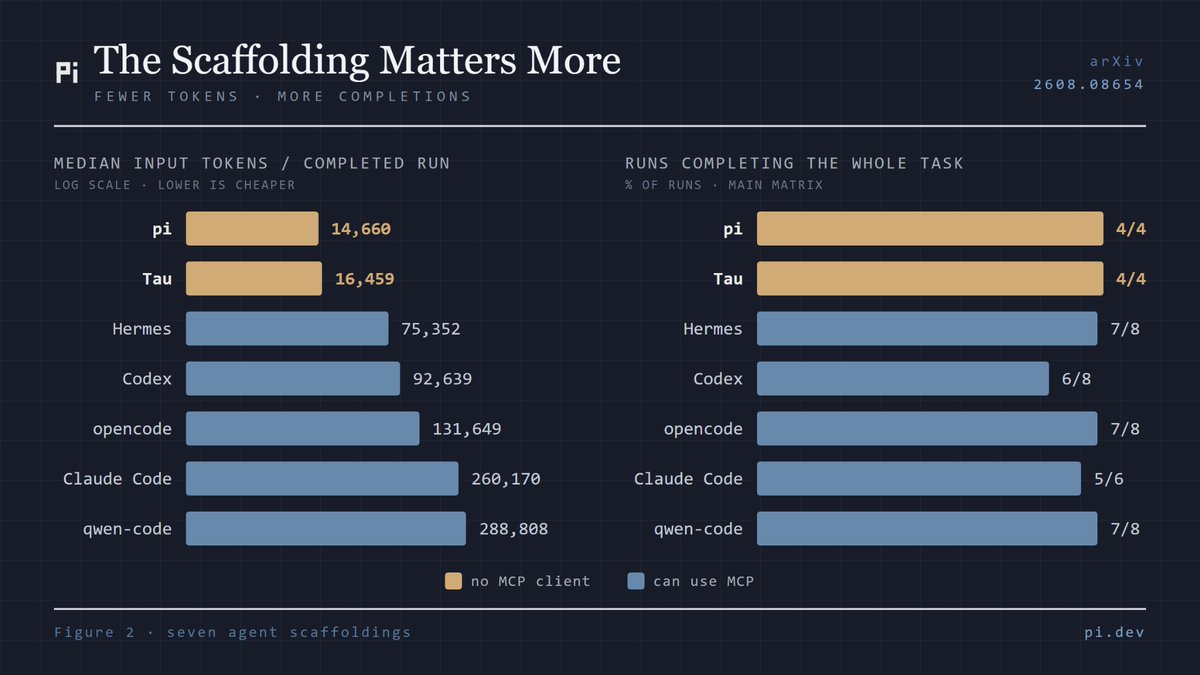
This week we read research from a team of academics that ran a software task across 7 agents and 5 models.
They found that in domains with a mature CLI ecosystem, agents without MCP baked in completed the task just as reliably and were 5-28x cheaper.
Full arXiv paper below
Last week I posted a new paper with Patrick Norrick: “Terra Incognita: The Economics of a Shrinking World.”
We chose the title deliberately. No society in history has experienced the fertility levels now seen in South Korea, China, Thailand, Colombia, Chile, and many other countries. Our knowledge of the causes (and of the economic consequences) remains far more limited than most public discussion acknowledges. Much of what we write is, at best, educated conjecture.
The paper also struggles against a space limit. We wrote 20,000 words, far from the 250,000 or so we would need to address some issues in more detail (if I had the time and resources to hide away for a year, I could do that, but not now). That means some ideas are only sketched.
Nonetheless, we emphasize several important points.
First, fertility has fallen very fast everywhere: rich and poor countries, east and west, north and south, conservative and liberal societies, religious and non-religious societies (with the exception of the Jewish population of Israel; fertility has also collapsed among the Muslim population within the pre-1967 borders), you name it. Even in sub-Saharan Africa we see fast and unprecedented drops in fertility (alas, from a high initial level).
Second, and this is really interesting, the fertility collapse has been concentrated in poor and lower-middle-income countries much more than in rich countries. By now, income per capita and fertility are positively correlated within OECD countries. We conjecture this will hold globally in a few decades.
Third, and related to the second point, the fertility collapse has been concentrated among poor and lower-middle-income women within countries. In countries such as the U.S., the rich and highly educated now have more children than the poor and less educated.
Fourth, we document why we do not understand the data from the U.N. World Population Prospects. See, for example, Tables A.1 and A.2.
Fifth, we explain why some proposed mechanisms struggle when confronted with the data.
A more subtle point is at work here. Many commentators do not seem to understand the difference between proximate causes and ultimate causes. Yes, births might have gone down because fewer women are in long-run relationships. That is the proximate cause. But you need to explain why fewer women are in long-run relationships (the ultimate cause), and saying that they spend more years in school, to take one example, does not get us very far. Why do they spend more years in school? Once you start down the whole chain of reasoning, things become much harder than they seem.
The paper can be found here:
https://t.co/VrCHr0lBPa
Comments always welcome!
¡BRUTAL! La Universidad de Harvard ha publicado CS50x doblado al ESPAÑOL.
Uno de los mejores cursos de Introducción a la Ingeniería de Software que existen. Sin coste.
12 clases completas, desde cero, con certificado:
→ https://t.co/7H82kFv3RI
Impartido por el grandísimo David J. Malan.
Te enseñan C, Python, Algoritmos, Python, SQL, JavaScript y mucho más.
Civil liberties are in decline globally...but how did we get here? Check out The Museum of Civil Liberties from @Logos_network who are retracing the steps with their virtual exhibit.
“I am a typical loner in my daily life... my awareness of belonging to the invisible community of those who strive for truth, beauty, and justice has prevented me from feelings of isolation.”
— Albert Einstein
Un youtuber brasileño le acaba de clavar un puñal a la suscripción de Photoshop.
Se llama PhotoGIMP: un parche gratuito (GPL-3.0) que convierte GIMP en una copia idéntica de Photoshop.
Misma interfaz, mismos paneles, mismos atajos de teclado y muchísimo más espacio para tu lienzo. Tus manos ya saben usarlo sin aprender nada nuevo.
Por qué está explotando?
- $0 en vez de $276 al año
- Sin cuenta Adobe ni login
- Todo se guarda en tu PC (nada en la nube)
- Compatible con Windows, Mac y Linux
- Se desinstala borrando una carpeta (sin rastro)
Instalación ridículamente fácil: copias 9 archivos y listo. +8.8k estrellas en GitHub y traducciones de la comunidad.
Uso personal y comercial 100% gratuito.
Enlace abajo