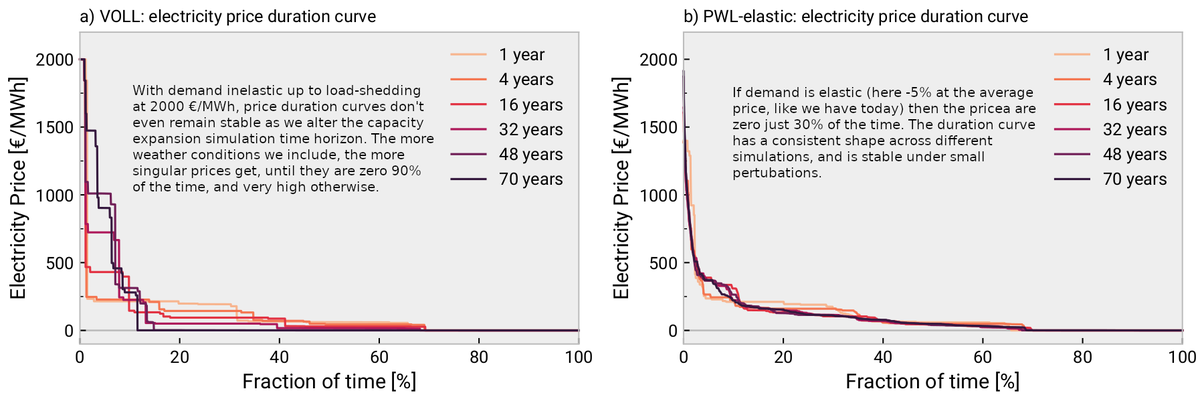
How a small amount of demand elasticity stops wild prices with wind and solar: new pre-print with theory and examples
https://t.co/hDuj6Yy1bu
Co-authors: @fneum_ & @IegorRiepin
TL,DR: compare prices with inelastic demand on left to right with -5% elasticity (at average price)
@maurerchr@M13_energy@khyranius@EU_ACER Sollte das (zumindest konzeptionell) nicht im FBMC berücksichtigt sein? Wahrscheinlich viel zu grob durch die Auswahl der critical lines, der Bestimmung der GSKs und des Base-Case, aber prinzipiell schon?
In Ep. 228, Jessica Lu of @pe_coalition shares her team’s research on what messages get people interested in taking action on climate, and what don’t.
We believe all climate communicators need to hear this episode, so we have put it outside our paywall.
https://t.co/vNRIyMi6sE
Solar panels are mounted on one of the rooftops in Nobelparken last week. They are crowdfunded by students and staff at @AarhusUni as an outcome of an EU project @AURORA_H2020 to demonstrate a successful energy community engaging citizens and the university.
So eine Grafik ist schwierig @handelsblatt
1) in Zentraleuropa gibt es keine eindeutigen bilateralen Austausche mit Nachbarländern. Im Market Coupling werden nur Länder/Gebotszonenbilanzen bestimmt. Die bilateralen Austausche werden danach „festgelegt“.
Die Expertenkommission zum Energiewende-Monitoring hat heute ihren ersten eigenen Monitoring-Bericht an BMWK-StS Nimmermann übergeben. 392 Seiten Daten, Analysen und Empfehlungen. @andreasloeschel @weidich_anke @GrimmVeronika https://t.co/gORjhHKeMW
Apply to join us in Freiburg:
Full Professorship (W3) for Sustainability Assessment of Technical Systems
at our Faculty of Engineering
Deadline: June 11, 2024.
Details
https://t.co/EQLETZ96Gs
Great to see the @IEA embrace #opensource energy modelling tool PyPSA
used for hourly modelling in their new report on future flexibility needs on different scales (hourly, seasonal, inter-annual)
@openmod#freethemodels
https://t.co/cq5eo3Eabw
@Helmut_Lehmeyer@LeonhardProbst@Kl_Stone@Newsaholic_82 Weiterhin sollte man bei der Interpretation der Daten zu grenzüberschreitendem Stromhandel als "bilateralen Handel zwischen Ländern" etwas vorsichtig sein, siehe die Diskussion hier: https://t.co/wim2mfGnyF
So eine Grafik ist schwierig @handelsblatt
1) in Zentraleuropa gibt es keine eindeutigen bilateralen Austausche mit Nachbarländern. Im Market Coupling werden nur Länder/Gebotszonenbilanzen bestimmt. Die bilateralen Austausche werden danach „festgelegt“.
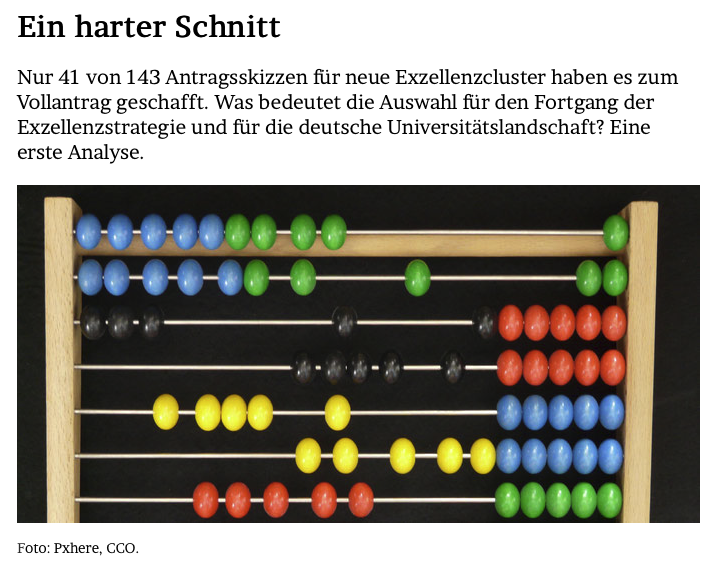
Ein harter Schnitt
Nur 41 von 143 Antragsskizzen für neue Exzellenzcluster haben es zum Vollantrag geschafft. Was bedeutet die Auswahl für den Fortgang der #Exzellenzstrategie und für die deutsche Universitätslandschaft? Eine erste Analyse.
Im Blog: https://t.co/xHtkzHc04c
💾 New data release! 🚨
Our Global Transmission Database is now available on @ZENODO_ORG tracking over 800 cross-border transmission projects.
Download now 👉 https://t.co/4cy1BhGbia
#ExStra-News: Das Expertengremium berät ab 30.01. bis 01.02. über die Vorauswahl aus 143 Antragskizzen für neue #Exzellenzcluster. Die Ergebnisse werden am Freitag, 02.02., gegen 9:30 Uhr von #DFG u. @WissRat u.a. hier veröffentlicht. Alle Details➡️ https://t.co/ml4uCJaKvA
Europäische Ökostromzertifikate ermöglichen es, erneuerbare Energien aus Ländern wie Island mehrfach anzurechnen. Nach kurzzeitigem Exportstopp für Grünstrom-Herkunftsnachweise aus Island wurde dieser nun dauerhaft aufgehoben. Teil 1 einer Recherche. https://t.co/sQswcT5Vvf
If you're a student doing research in energy systems, we're working on a grant that would let us support you in developing open data wrangling & software development skills. This short survey will help us better understand your needs (ends Fri, Feb 2nd)
https://t.co/VoCTZw9zlk
Find out more about electricity markets, policies & trends around the world in @IEA’s Electricity 2024 report, which we just released today
The full report is freely available on our website ⬇️ https://t.co/LiO7Ns2dBO
SOON | The EU saw renewables like solar and wind producing a record 1/5 of electricity in 2022, rising to more than 1/4 by mid-2023 ☀️🌪️
Has the EU’s energy transition picked up pace since then? Find out in our upcoming #EER24