Islamic finance is a trillion dollar economy and growing. I had the pleasure to participate in the dialogue kudos to the master @Asmali77 and Radio generation for creating the platform.
Prediction: In the AI age, taste will become even more important. When anyone can make anything, the big differentiator is what you choose to make.
https://t.co/3GQUlfH58t
If you're going to spend a lot, buy things that won't decrease in value. Not because you expect to sell them later, but because if you don't you're a mark.
We have a lot of exciting launches related to Codex coming over the next month, starting next week. We hope you will be delighted.
We are going to reach the Cybersecurity High level on our preparedness framework soon. We have been getting ready for this.
Cybersecurity is tricky and inherently dual-use; we believe the best thing for the world is for security issues to get patched quickly. We will start with product restrictions, like attempting to block people using our coding models to commit cybercrime (eg ‘hack into this bank and steal the money’).
Long-term and as we can support it with evidence, we plan to move to defensive acceleration—helping people patch bugs—as the primary mitigation.
It is very important the world adopts these tools quickly to make software more secure. There will be many very capable models in the world soon.
OpenAI spends $3.30 to make $1.00.
Google spends $0.00 in supplier margin.
This single fact explains everything happening in AI right now, and almost nobody sees it.
The math:
OpenAI pays NVIDIA 75% gross margins on GPUs.
Then pays Microsoft markup on Azure.
Then covers its own costs.
Total: $66B spend on $20B revenue.
Google designed its own TPUs.
Owns its own data centers.
Pays only electricity and depreciation.
The gap: 30-44% permanent cost advantage.
Every query OpenAI serves, the disadvantage compounds.
Every query Google serves, the moat deepens.
This is why:
ChatGPT US traffic down 35% in November.
Gemini hit 650M users growing 62% in 5 months.
Marc Benioff publicly defected after 3 years.
This is why OpenAI just added ads to ChatGPT.
This is why Sam Altman declared "Code Red" in December.
This is why all 4 original GPT paper authors have left.
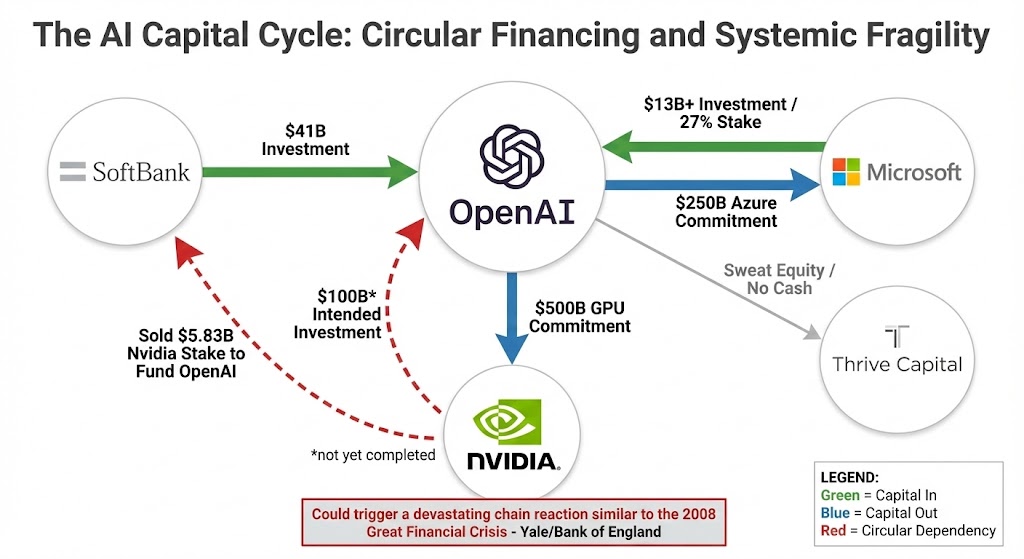
But here's what makes this a 2008-level systemic risk:
SoftBank sold $5.83B in NVIDIA stock to invest $41B in OpenAI.
NVIDIA intends to invest $100B in OpenAI while OpenAI commits $500B to buy NVIDIA GPUs.
Microsoft's $135B stake depends on OpenAI's $250B Azure commitment.
The customer funds the supplier who funds the customer.
Yale researchers called it: "Could trigger a devastating chain reaction similar to the 2008 Great Financial Crisis."
The catalyst has a date: April 27, 2026.
Musk v. OpenAI goes to jury trial.
Damages sought: $79-134 billion.
OpenAI's cash reserves: $64 billion.
The judge already ruled there's "plenty of evidence" of fraud.
Hedge fund positioning in AI infrastructure: 93rd percentile long.
When this reprices, the exits won't fit the bodies.
Google is to OpenAI what Microsoft was to Netscape.
The capability is comparable. The cost structure is fatal.
Bookmark this.
I see a lot of people posting about replacing their CRM with something they vibe coded.
That’s cool. I love it.
But what I haven’t seen yet is someone actually reimagining what a CRM should be in an AI world.
Right now everyone is just rebuilding Salesforce with prettier buttons.
I don’t want a better interface.
I don’t want more dashboards.
I don’t want another place to click around.
I want a completely different way to interact with my business.
I don’t want to:
- search for a customer
- open their record
- pull up their estimate
- copy/paste my line items
- checkbox attachments
- click send
I want to pull out my phone and say:
“Send John Smith an estimate for 3 acres at tier 2 brush density and tier 1 terrain.”
And it just does it.
Or:
“Follow up on all pending estimates for the next 30 minutes. Give me a quick summary of each job and connect the call.”
Or:
“Which customers haven’t paid in 14 days? Text them a reminder and flag the ones that don’t respond.”
Or:
“Who are my top 10 repeat customers? Draft a thank-you email and a referral offer.”
Or:
“What jobs next week need equipment mobilized? Notify the operators and update the schedule.”
That’s the CRM I want. I don’t want a Salesforce clone.
I want someone to take this to the next level.
There are some absolute killers out there right now building insane things. Someone is going to crack this.
Build that please.
Something I've been thinking about a lot lately: Code gen tools will have a ton of impact over what dev tools (libraries, APIs, BaaS, IaaS, etc) thrive and suffer.
IMO one potential artifact of code gen is that the quality of the dev tool experience matters less, because the agent can code around it.
Effectively, you are now acting as a PM, and most PMs don't actually have much impact on what underlying tools are used for the job. They care less about the dev experience, and more about performance.
(cc @AstasiaMyers)
This kinda exploded.
The consensus: stop testing if someone can write code. AI can do that. Start testing if they can work with AI, know when it's wrong, and make good architectural decisions.
The most interesting ideas from the replies:
1️⃣ Real codebase work
2-3 hour sessions implementing a feature in your actual repo. AI tools allowed.
2️⃣ Discuss trade-offs instead of watching them code
Pick parts of their solution and dig into why they made certain choices. You learn way more about their understanding.
3️⃣ Paid short-term trials
Work with 2-3 candidates part-time on real tasks. Pay them properly. Then decide.
The questions you should be asking:
• Can they prompt effectively?
• Do they know when AI output is garbage?
• Can they handle ambiguity?
• Do they understand architecture and trade-offs?
• Can they debug and iterate on generated code?
System design interviews got more valuable because AI is great at implementation but terrible at making higher-level decisions (not sure for how long).
Behavioral stuff matters more now. References. Past work. How they talk about their decisions.
So our plan: live coding session (implement something real with AI tools) + deep dive on past work + system design discussion.
Still figuring this out, but the replies helped a lot. Thanks everyone!
Wait so Google patented the Transformer architecture and then, instead of enforcing the patent, just allowed its competition to grow into a trillion-dollar industry? What?
Scaled from 1,000 to 100,000 users. Here's what broke.
At 5,000 users:
- Single database became the bottleneck
- Added read replicas
At 20,000 users:
- Session storage overwhelmed Redis
- Switched to JWT tokens
At 50,000 users:
- File uploads killed our servers
- Moved to S3 with presigned URLs
At 75,000 users:
- Search became unusable
- Implemented Elasticsearch
At 100,000 users:
- DNS became single point of failure
- Multi-region with Route53 failover
Every stage felt like the final architecture.
None of them were.
Scaling isn't a destination. It's a continuous series of bottleneck discoveries.
① Install the skill:
$ npx add-skill vercel-labs/agent-skills
② Paste this prompt:
Assess this repo against React best practices. Make a prioritized list of quick wins and top fixes.
③ Review and prompt to "make the fixes"
Every vertical SaaS platform is built on a relational database.
This made sense when data was expensive and structure was necessary for retrieval.
It doesn't make sense anymore.
The next generation of SMB software won't organize data into tables. It will remember interactions.
The system won't store a quote. It will remember that the customer asked for hardwood, hesitated on price, and mentioned their daughter's wedding in June.
The system of record is shifting from structured data to memory.
That changes everything about how vertical software gets built. When you share memory across applications instead of syncing databases, you can build twenty apps that feel like one.
The customer doesn't need to re-enter information. The system already knows.
At @elevenlabs, we crossed $330M in ARR at the end of 2025. This was our revenue growth in 35 months:
▪️ $0-100M took us 20 months
▪️ $100-200M needed a further 10 months
▪️ $200-300M was reached within 5 months
The best thing: Enterprise is our fastest-growing segment, accounting for almost half of revenues. And we are only getting started 🚀
A while ago I made a startup prediction that every AI application startup was likely to fail due to the rapid expansion of the foundational model providers.
I'd like to elaborate on that, since many people interpreted it in only one way - and there are TWO main ways they are likely to be killed.
The first one is like the quoted post below: a foundational model provider releases a new feature that does what the startup does, and the startup dies.
Many people interpreted it that way, and so plenty of people offered their objections citing examples in the past where nimble startups had disrupted platform incumbents.
The second cause is more subtle: the rapid expansion of capabilities by foundational model providers causes a roiling sea of constant market chaos that disrupts the orderly growth of small- and medium-sized startups.
Large ships can survive a huge storm, small ships stand no chance just because the waves are too high. Some of the storm is caused by the large ships, but not necessarily even in a way that benefits them. They are struggling to keep up in their own race.
Growing businesses prefer stability (or at least orderly chaos), and my claim is that the level of economic chaos and its rate of change is too high for application startups to survive. I mean, we're literally entering the Singularity now.
The foundational model providers are throwing off so much overhang (untapped value) that individual programmers - their numbers unleashed by vibe coding - will be able to constantly disrupt growing startups as those startups try to make their way from small to medium and beyond: after their initial founding moment and achieving PMF, they now have to stabilize and scale by building distribution channels. This is where they will be constantly vulnerable. (God help them if they aren't unit profitable, and many AI startups have huge capex)
One counter-argument was startups who represent a unique set of valuable training data. The thesis is that if you can discover, encode, and label a set of valuable training data that no one else has, you can create a service for that. Maybe.
The question will be whether that's enough to sustain becoming a generational company. You might still be better selling out in 18 months for the bag of cash.
Software is about to go through the same transition that stock trading did when algorithmic traders entered the market.
AI will not be good for bootstrappers. They will be wrecked like retail traders were.
There used to be many crevices of the market that large software companies couldn’t reach.
Bootstrappers and small caps built nests there.
But with AI, large software companies will start to look like multi-vertical hedge funds.
With 1000 AI tentacles, they will suck the alpha out of every crevice.
While one crevice may not have been appetizing enough to go after before, 1000 will be.
Software will begin to have something like “market makers” who make money on everything.
A small number of hedgefund-like software companies may come to own everything.
10 days into 2026:
- Terence Tao announces GPT & Aristotle solve Erdős problem autonomously
- Linus Torvalds concedes vibe coding is better than hand-coding for his non-kernel project
- DHH walks back “AI can’t code” from Lex podcast 6 months later
An acceleration is coming the likes of which humanity has never experienced before
Software engineers will be fine.
AI creates an entire new market that enables anyone to generate personal software on demand.
However, all these people will soon realize the opportunity cost of "building your own app," and the $9 monthly subscription for a SaaS will look much better soon.
When you buy a SaaS subscription, you pay a skilled team to provide you with an app that works and you don't have to maintain. That's the benefit of a SaaS.
You buy a Pocket subscription to write better. You don't spend 2 weeks building Pocket from scratch instead of writing.
You use a tool to assist your craft. You don't make the tool your craft.