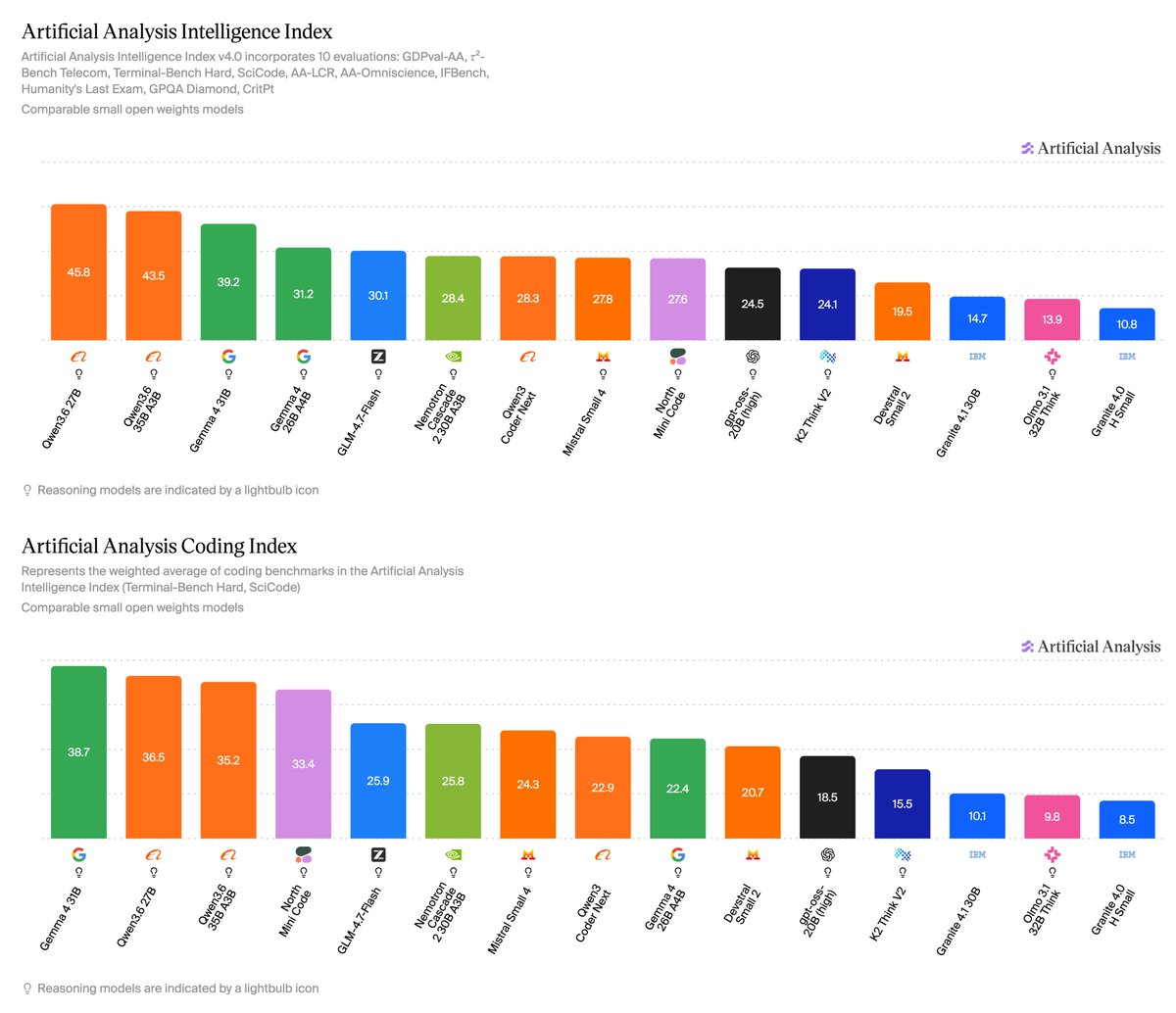
Cohere just released North Mini Code, a small 30B parameter (3B active) open weights coding model that scores 27.6 on the Artificial Analysis Intelligence Index
Less than a month since @cohere's last model release, Command A+, has launched another open weights model that is optimized for coding, and much smaller at 30B total parameters and 3B active parameters.
Key Takeaways:
➤ Achieves 27.6 on the Artificial Analysis Intelligence Index, above gpt-oss-20B (high) at 24.5 and just below Mistral Small 4 (119B parameters, 6.5B active) at 27.8
➤ Scores competitively on the Artificial Analysis Coding Index (weighted average of Terminal-Bench Hard and SciCode) against open weights models in its size class, scoring 33.4, significantly above GLM-4.7-Flash at 25.9, and below Qwen3.6 35B A3B at 35.2. However, it underperforms on non-coding agentic tasks, scoring 14% on GDPval-AA and 37% on 𝜏²-Bench Telecom
➤ On Cohere’s API, North Mini Code is faster than several comparable open weights models of its intelligence and size class (~199 output tokens per second)
➤ North Mini Code is a text-only 30B total parameter and 3B active parameter model, and is open-sourced under the Apache 2.0 license
Building super fast experiences with Gemma just got easier.
Gemma 4 MTP is now officially merged into llama.cpp. Developers can now pair MTP with Gemma 4 QAT for a fast, lightweight setup.
Building a custom chatbot can be tricky, especially if you want to keep the info private & efficient.
So here, @atuo_elabonga teaches you how to create a local Retrieval-Augmented Generation application using Ollama & ChromaDB in R.
By the end, you'll have a Shiny interface for your chatbot that fetches relevant info while staying private.
https://t.co/w95H9sYioD
More Gemma 4! New QAT Gemma 4 checkpoints with similar performance while using ~4x less memory!
It comes with a new mobile quantization format that reduces memory footprint of Gemma 4 E2B to just 1GB.
Quantization-Aware Training (QAT) simulates low-precision operations during training to allow loss-less quantization afterwards for smaller, faster models while maintaining accuracy.
Available on @huggingface and directly runnable.
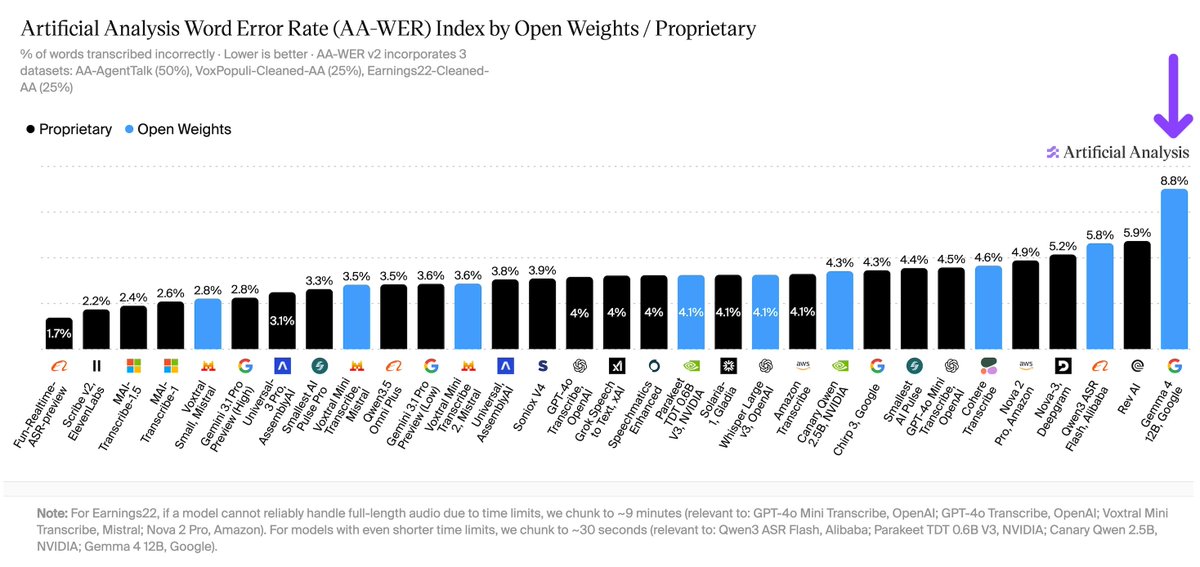
Google’s newly released open weights model, Gemma 4 12B, supports transcription but is far from the frontier, scoring 8.8% on AA-WER (#58)
Gemma 4 12B is the latest release from @GoogleDeepMind in the Gemma 4 family. With a score of 8.8% on AA-WER, it is able to capture a reasonable amount of conversation context, but underperforms compared to transcription-focused open weights models like Voxtral Mini Transcribe 2 (3.6% WER, with 4B parameters) and slightly larger open weights language models like Voxtral Small (2.8% WER, with 12B parameters). The new model launched alongside their local dictation app, Eloquent, available on MacOS and iOS.
Gemma 4 12B is the largest in the Gemma 4 family to support transcription, alongside Gemma 4 E4B and Gemma 4 E2B, with Gemma 4 31B and Gemma 4 26B A4B supporting text, image and video input only. These models are available on a variety of platforms including Hugging Face, Ollama and LMStudio.
We are currently running Gemma 4 12B through the full Artificial Analysis Intelligence Index and will share results soon.
LiteRT-LM support for Flutter is coming soon to the flutter_gemma package 💖
This will enable you to run powerful on-device AI models like Gemma 4 across devices, all while helping to ensure peak performance with GPU and NPU acceleration across all of Flutter’s stable platforms.
MiniMax-M3 is now the best open-source model on the AAI
It's ahead of Kimi-K2.6, GLM-5.1 and DeepSeek-V4-Pro
On the Coding Index it's slightly behind V4-Pro and K2.6, but it's beating them on the Agentic Index
CritPt scores are a bit worrisome.
But the biggest highlight here is probably its reasoning efficiency compared to other open models.
(but still miles behind closed models)
Higgs Audio v3 TTS is here.
Built for voice AI that speaks, not just reads:
• 100 languages with single-digit WER/CER
• inline control over emotion, style, prosody, and sound effects
• API, Workspace, and open weights
• Blog 👉 https://t.co/C8frDlfO5D
Watch the demo 👇
Key features:
• Free historical data
• Includes walk forward analysis
• A super-fast backtesting engine
• Create and execute trading rules across different assets
Get it here:
https://t.co/UxIYOTosfE
Meet Gemma 4 12B!
A unified, encoder-free multimodal model designed to bring high-performance intelligence directly to your laptop, and released under an Apache 2.0 license.
Bridging the gap between edge efficiency and advanced reasoning. Here is what’s new with Gemma 4 12B: 👇
The Twelve Years of Creality: AI Ecosystem
12 years of creating with Makers worldwide — thank you for being part of the journey.
Today is Filament Explorer Day
For Makers who love testing materials, fine-tuning settings, and discovering the full potential of every filament, creativity starts before the print. With the Creality ecosystem, every spool becomes a tool for turning ideas into reality.
To celebrate our passionate Filament Makers, we’ve prepared a special giveaway.
Giveaway Prize: Choose Any 4 Rolls of Creality Filament
How to Enter:
Follow @crealityfilament & @Creality3dP
Like this post
Share this post to your story for a higher chance to win
Winners will be selected across all social media platforms on June 8th.
Discover More: https://t.co/UI2WCkOdov
Thank you for creating with Creality — and cheers to the next chapter of making together.
#12YearsOfCreality #MakeWithCreality #crealityfilament #filament #3DPrinting
🌞This is big Local AI news! A new open-source Computer-Use LLM has just launched.
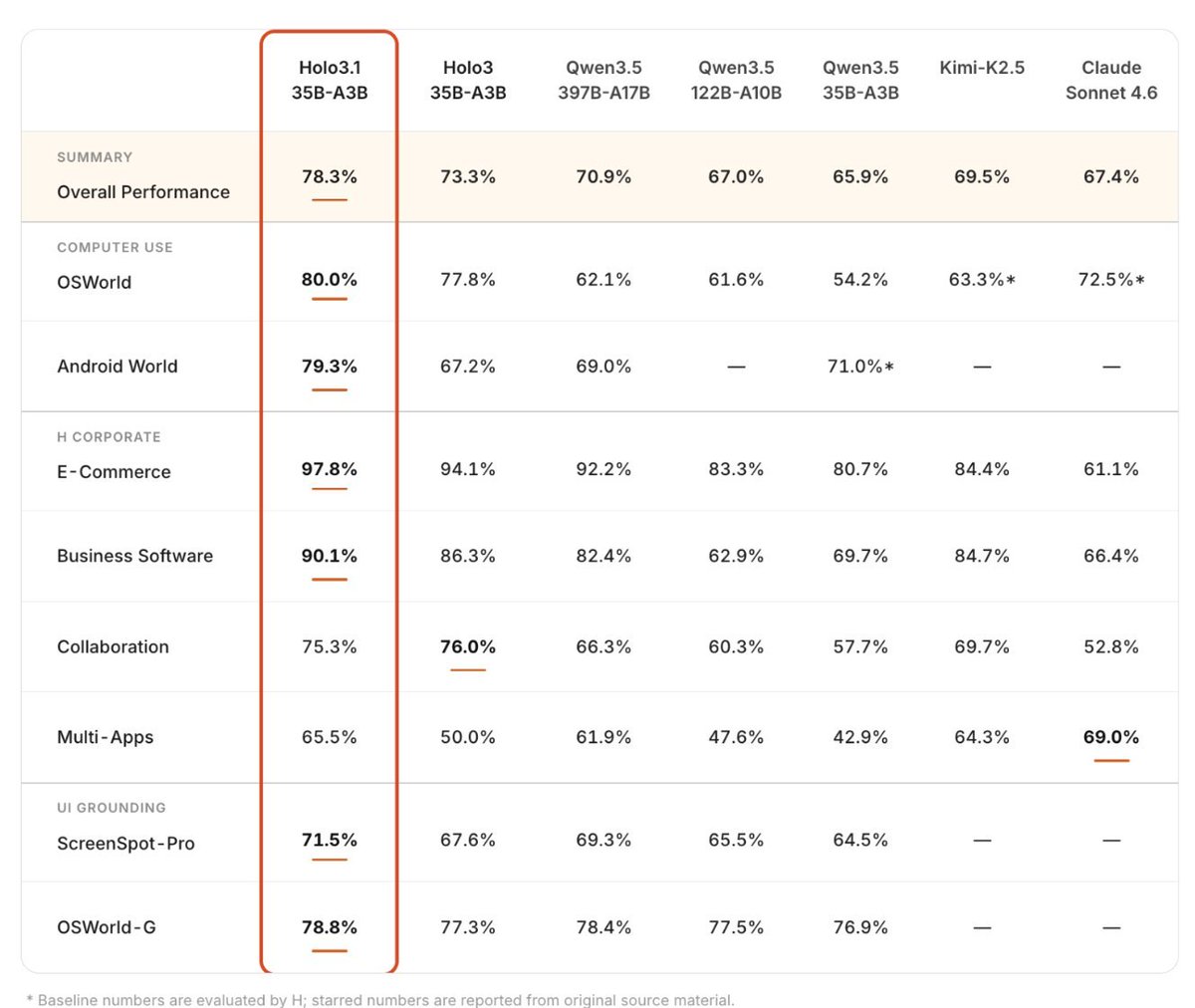
Holo 3.1 is H Company’s (🇫🇷) new local computer-use agent model that beats Qwen3.5-397B, Kimi-K2.5, and Sonnet 4.6!
Since it is built for local deployment →
⬩ Runs fully on your machine (MacBook, Windows PC, DGX Spark, RTX Spark)
⬩ Based on Qwen architecture, specialized for GUI understanding & computer control
⬩ Optimized checkpoints: NVFP4, FP8 & Q4 GGUF (0.8B to 35B sizes)
⬩ Strong gains: 79.3% on AndroidWorld benchmark (35B model)
💻 Comparison to Qwen3.5:
Holo 3.1 is fine-tuned specifically for computer-use agents (screen understanding, planning, clicking, navigation). Better at real GUI tasks than general-purpose Qwen3.5, especially when running locally.⚡
Qwen3.6 35B A3B can't fill out a paper form on its own. But give it NVIDIA's LocateAnything-3B — the #1 trending model on HuggingFace — as its eyes, and the two small models get it done together.
(The test: place each element at the right pixel position on a blank form image, not type into a field.)
Setup:
> Qwen is the brain (main model), LocateAnything is the eyes (helper model acting as a tool).
> I gave Qwen a new tool: ask "where's the email field?" and LocateAnything returns the exact x, y, width, height.
> The blue boxes on the screen are its detections. Look how tight they are — it nails every field.
Result:
> Qwen3.6 35B A3B + LocateAnything-3B: form completed, all info correct.
> Name, DOB, ID, gender, marital status, nationality, email, phone, address, postal code: all landed in the right field areas.
> Character-box alignment still a touch loose, but every value is where it belongs.
> 9m10s, 224.5k input, 24.3k output, 21 turns.
Why it matters:
> Qwen alone can't finish this test. Bolt on a 3B model that does exactly one thing > locate > and suddenly it can.
> A combination of small models can do the work of a single large one.
MOSS-TTS-v1.5 just reached #1 on Hugging Face Trending for Text-to-Speech, with 20.6K downloads.
A multilingual, controllable TTS model with stable voice cloning, long-form generation, and precise pause control.
MOSS-TTS-v1.5 is now officially supported by vLLM-Omni and SGLang-Omni.
Built by OpenMOSS-Team.
Try it:
GitHub: https://t.co/mSlALD6Fzy
Hugging Face: https://t.co/qTv7xu1MZ5
ModelScope: https://t.co/NzAXgAzagL
Seven new models launching at Build: let’s go!
Reasoning. Code. Image. Transcribe. Voice.
Built from scratch on a clean data lineage, designed for efficiency, working seamlessly as a family of models
Thread 🧵
#MSBuild
Most neural nets are still based on the model of a neuron as proposed in the 1950's: u = activation(w·x + b)
In a new paper, researchers propose a more accurate model of a biological brain neuron and found that it has quite a few advantages, like needing less training data.