someone open-sourced 15TB of physics simulations that would take a national lab and millions in supercomputer time to reproduce.
it's called The Well, a massive collection of 16 datasets covering:
→ turbulent fluid dynamics
→ magneto-hydrodynamic extra-galactic simulations
→ supernova explosions
→ acoustic scattering
→ active matter (biological systems)
→ 11 more physical domains
backed by Flatiron Institute + 11 universities (Cambridge, Princeton, NYU, Tokyo, Berkeley, Los Alamos).
every dataset is built to train PDE surrogate models, the neural nets that replace million-dollar physics solvers with a single forward pass.
running these simulations yourself needs weeks of supercomputer time and grant-funded HPC access most researchers will never touch.
this is 16 physics domains' worth of that, already done, ready to drop into a DataLoader.
100% Open Source.
If you’re a software engineer who got into Agentic AI, you might wanna start looking into RL. As coding agents are improving, developing custom harnesses and tools becomes much easier, but the real challenge lies around behaviour control, consistency, memory and correction.
Traditional RL methods have been working with “agents” as an entity long before LLM agents came on to the scene. A right intersection of the two makes for a fruitful exploration both in terms of research and products.
Here’s a paper to get the feel for it
I wrote 934 pages on how to build every layer of a large language model from scratch. Many of these concepts were new to me a year back.
Tokenizers, attention, KV cache, MoE, RLHF, quantization, serving. 35 projects. Every chapter has a section where you break the thing you just built.
Everything I use to build TamilLM is in this book. If you have been following the journey and want to understand what is actually happening under the hood, start here. It also ties in to my previous papers as well in the various chapters.
35 copies sold so far.
https://t.co/9hANb7VaLc
Let's go. 🙏
new post on harness engineering for AI self-improvement: https://t.co/ZYvGfVs61k
It is hard to forecast how much the future of RSI will rely on harnesses. Likely harness engineering will evolve in the direction of self-improvement and enable auto-research, and, in turn, smarter models keeps harnesses simple.
Even when many harness improvement get eventually internalized into core model, the need to specify goals and context will not disappear.
Un youtuber brasileño le acaba de clavar un puñal a la suscripción de Photoshop.
Se llama PhotoGIMP: un parche gratuito (GPL-3.0) que convierte GIMP en una copia idéntica de Photoshop.
Misma interfaz, mismos paneles, mismos atajos de teclado y muchísimo más espacio para tu lienzo. Tus manos ya saben usarlo sin aprender nada nuevo.
Por qué está explotando?
- $0 en vez de $276 al año
- Sin cuenta Adobe ni login
- Todo se guarda en tu PC (nada en la nube)
- Compatible con Windows, Mac y Linux
- Se desinstala borrando una carpeta (sin rastro)
Instalación ridículamente fácil: copias 9 archivos y listo. +8.8k estrellas en GitHub y traducciones de la comunidad.
Uso personal y comercial 100% gratuito.
Enlace abajo
THIS IS THE MOST HONEST ML INTERVIEW GUIDE ON THE INTERNET RIGHT NOW
A Research Scientist who landed offers from DeepMind, Meta, Cohere, and Isomorphic Labs just published the guide most people wish they had before starting the process.
her honest bar for even getting callbacks at top labs: 3+ first-author papers plus at least one internship or industry role.
what the actual rounds look like:
→ recruiter screen, then 3-8 technical interviews
→ leetcode-style coding, plus ML implementation - attention, backward passes, debugging broken training loops
→ ML theory and system design
→ behavioral questions, including research-style ones like where the field is heading
her prep:
→ self-written physical flashcards, not downloaded decks
→ ~150 leetcode mediums, breadth over depth
→ mock interviews with Claude before every real one, with surprisingly high overlap to actual questions
→ implementing a transformer, attention, flash attention, and the backward pass from scratch under time pressure
the part most guides skip - the emotional toll. she couldn't sleep or eat before interviews, blanked mid-round, and had to remind herself her worth wasn't decided by an interview panel.
on negotiation - some companies asked for proof of competing offers before moving their numbers at all.
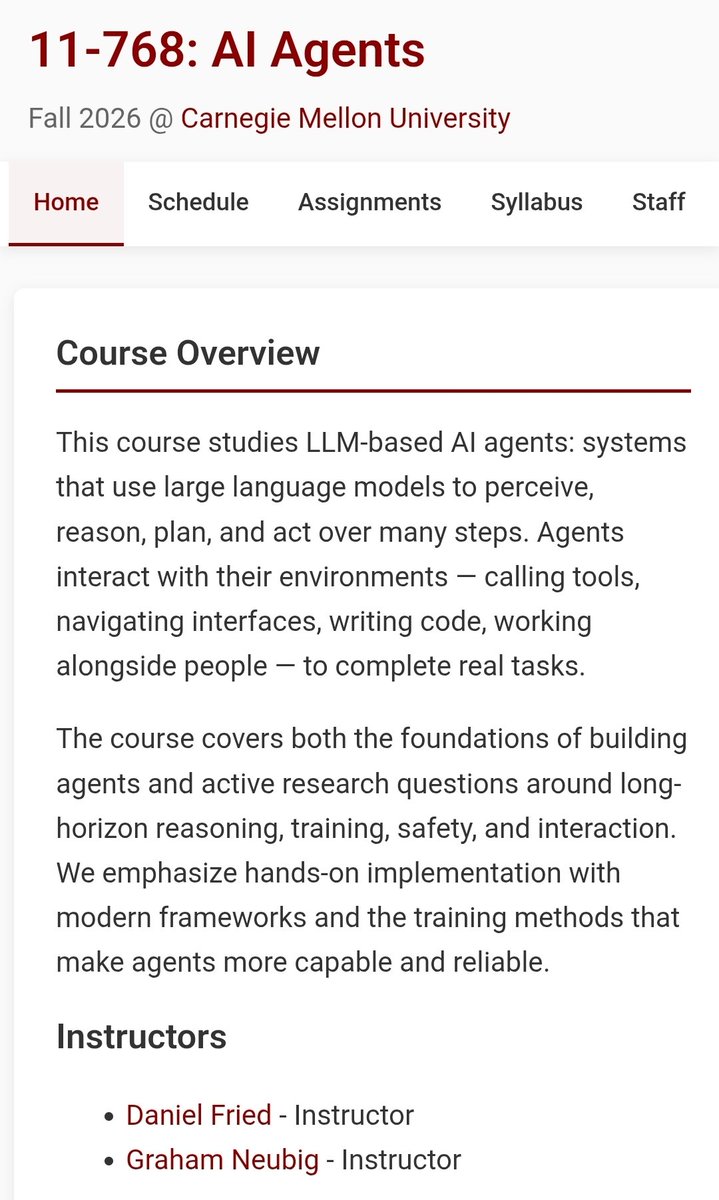
Carnegie Mellon University's 11-768: AI Agents is one of the most comprehensive free courses on building LLM-based agents. 🚀
📚 Course Schedule
Week 1: Introduction to AI Agents & LLM Foundations
Week 2: Prompting, Tool Use & Function Calling
Week 3: Planning & Reasoning (ReAct, Tree of Thoughts)
Week 4: Memory & Long-Term Agent Architectures
Week 5: Retrieval-Augmented Generation (RAG)
Week 6: Multi-Agent Systems
Week 7: Training & Fine-Tuning Agents
Week 8: Evaluation & Benchmarks
Week 9: Safety, Alignment & Guardrails
Week 10: Building Production AI Agents
Week 11: Advanced Research Topics
Week 12: Final Project & Presentations
Course: https://t.co/NHQHNZ7pEc
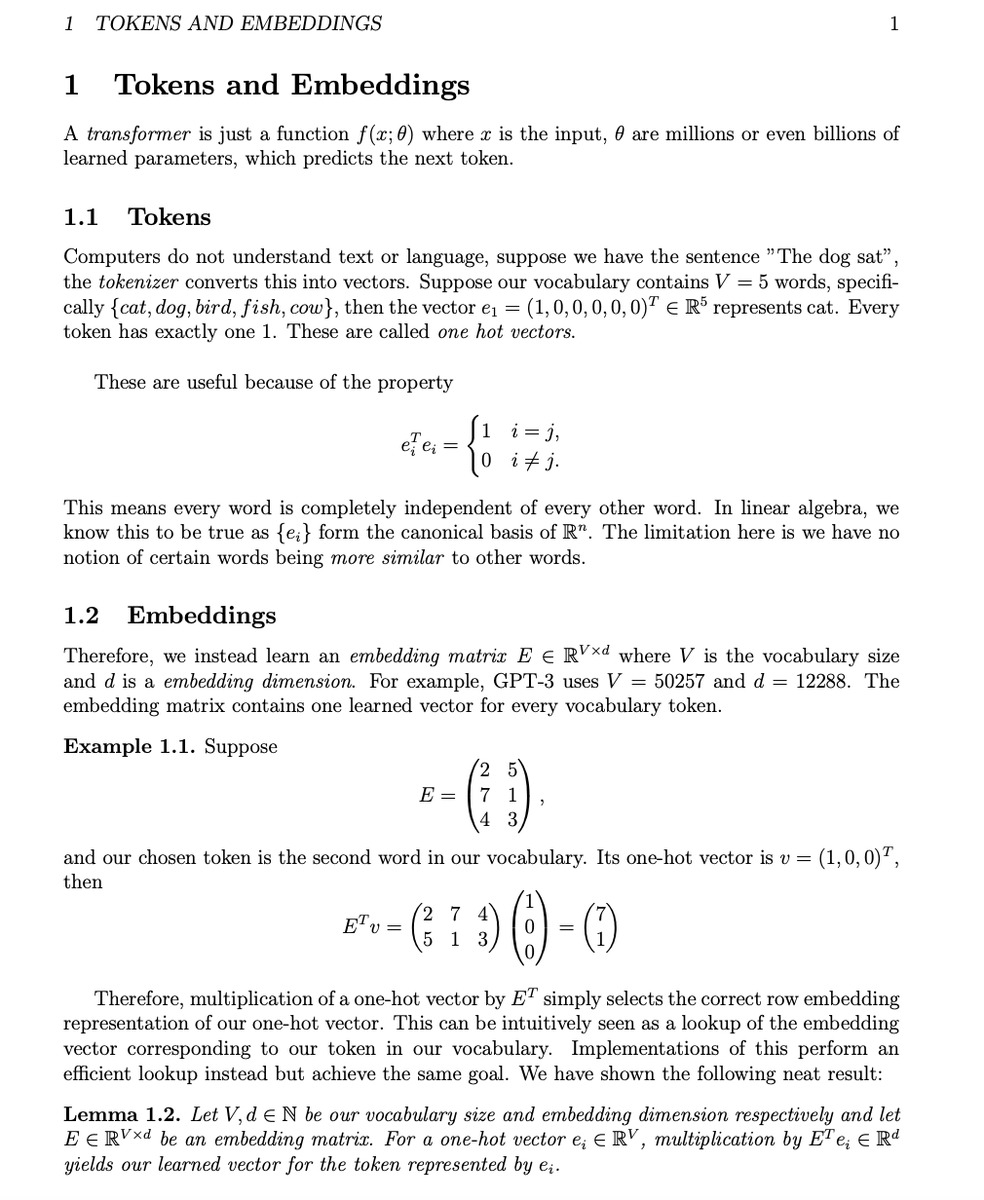
A Derivation Of The Transformer Architecture by Brandon Sandhu
The paper develops an intuitive, mathematical understanding of tokenization, embeddings, queries, keys, values, self-attention, multi-head attention, MLPs, residual connections, and backpropagation, with the aim of making these concepts more accessible without sacrificing mathematical rigor.
Prerequisites are basic linear algebra, multivariable calculus, probability theory, and some information theory.
Note: Positional encodings are intentionally omitted to simplify the presentation and focus on understanding the core architecture, rather than constructing a fully functional Transformer.
Find the PDF here: https://t.co/ri12pUtT5g
We took a 30B model and split it in two to write tokens in parallel instead of one at a time.
Introducing Nemotron-Labs-TwoTower: a diffusion language model from NVIDIA Research adapted from Nemotron-3-Nano-30B-A3B. Here’s how it works: one half holds the context, the other writes the tokens, with both reusing the pretrained model instead of training a new one from scratch.
We found it kept 98.7% of the original model’s quality at 2.42× faster generation.
@DesiKing_ It is not really. The first properly recorded is the one that Rishi Sandeepani ran at Ujjain.
Lord Krishna, who doesn't need anything, went to this university so that Rishi Sandeepani could get recognition for his work.
A guy who was the number one ranked machine learning competitor on Earth, twice, looked at how universities teach AI and decided they had the entire thing backwards.
So he built a free course that has turned more people into working AI practitioners than most graduate programs.
Jeremy Howard was the guy who made the course and it is called Practical Deep Learning for Coders.
Here is the argument that drives the whole thing.
Universities teach AI top-down. First you sit through linear algebra. Then calculus. Then probability. Then, maybe, a year later, you are finally allowed to touch a model. Howard watched this approach destroy motivated people. Most never made it to the part where it gets interesting. The math wall killed them first.
He thinks that is exactly wrong. His view is that you do not teach someone baseball by drilling the physics of a curveball for a year before letting them hold a bat. You let them play, then explain the physics once they care.
So his course inverts it. In the very first lesson, before any heavy theory, you train a working image classifier that actually runs. You build something real on day one. The theory comes later, pulled in piece by piece, exactly when you finally need it to go deeper.
Harvard Business Review said fast AI can take motivated students all the way to building industrial-grade AI systems.
The whole course is free. No paywall, no signup tricks.
It assumes you can code a little and remember some high school math. That's the bar.
The people who actually break into AI almost never start with the equations.
https://t.co/ea9S8yk1Cl
KARPATHY JUST KILLED THE PROMPT ERA WITH A SINGLE DOCUMENT
prompts are easy. loops are hard. and writing fifty prompts a day is the work nobody does twice.
he shifts the burden to the harness.
you define the contract once. the model writes, reviews, restarts, and reconciles. you keep judgment. it keeps the loop.
the throughline is the same in every rule: the human owns the spec and the boundary. the model owns the execution and the bookkeeping.
planner never touches code. generator never grades itself. state lives on disk, not in context.
9 rules. start with one feature, not ten. most people are still typing prompts. this turns Claude into an agent that finishes the job on its own.
here is the official document from Karpathy explaining the architecture
We want to see 100+ more HackerFabs
“How to build your own HackerFab” - we are organising a webinar tomorrow, 28th June, 5pm on GMeet - will cover everything that’s needed- and follow up with a QnA.
It��s much easier than it sounds and every college should have one!
Link below