AI, Cloud Native. ex-IBMer. Technology Enthusiast. Prefer being close to Nature. What I see, I capture through my Lens:-). Opinions expressed here are my own.
This is the new Intel.
Focused. Executing. Building across the full AI stack.
With new products, deeper partnerships, and purpose-built solutions for the AI era.
https://t.co/px7Ho5MTgf
It must have been around 2003–04. We were at a beach resort in Langkawi, Malaysia.
Most mornings, my husband, our young son, and I preferred a leisurely breakfast on our deck, but that day we had booked a six-seater speedboat for snorkelling at a nearby island, so we headed to the resort’s breakfast area instead of waiting for room service.
Years of travel teach you small tells. In a resort breakfast area, you can often identify the Europeans, particularly the British and Australians, not by accent, but by their plates: generously, almost anxiously loaded, as if the concept of ‘all you can eat’ might be revoked without notice.
One particular man, in shorts and flip-flops, his plate already piled high with fruit, bakery items and cereals, seemed in a tearing hurry.
My husband stepped aside, making an exaggeratedly polite gesture - please, go ahead.
The man did. Without a glance, without a word of thanks, he moved ahead and loaded his plate even further.
Back at our table, my husband simply rolled his eyes.
At the jetty, as we boarded the speedboat, we found ourselves face to face with the same man and his partner.
And then it began. My first and only experience of passive-aggressive racism.
It started small. As the boat lurched and I slid along the bench, I let out an ‘oops!’
After that, every time the boat swayed, jolted, or a splash of water hit us, he echoed it back. Mocking, exaggerated, and unmistakably deliberate.
Then came the insinuation. Had we opened their bag when they returned to the boat a few minutes after us post-snorkelling? The absurdity of it was almost surreal.
The boat driver, a big, burly Malay who had barely spoken till then, intervened quietly but firmly. Neither he nor we had touched their belongings.
By the time we reached the anchoring point late afternoon, the couple disembarked with little more than a dismissive wave to the driver.
As we got off, he turned to us, apologised on their behalf, and offered us a complimentary tour the next day.
We took it.
That morning was full of fun and relaxed and it helped wash away much of the sourness from the day before.
So yes, there are all sorts.
We Indians, for our part, are not without our own excesses.
We are noisy, often conducting phone calls in permanently activated long-distance mode. We share food enthusiastically, across aromas and consistencies.
Our children develop a special public whine precisely when denied something they have been told not to eat.
And there is almost always an obliging uncle, aunt, or didi ready to plead their case. Entirely human, but also very public.
Every nationality comes with its own idiosyncrasies and oddities. Taken together, they form the texture of travel.
And travel, after all, is also about choice. How you plan it, where you place yourself, and what you seek from it. You can lean into the mix or curate your distance.
When it turns embarrassing, as it sometimes does, you can simply step aside. Observe, disengage, move on.
You don’t have to claim ownership of everything that looks like you.
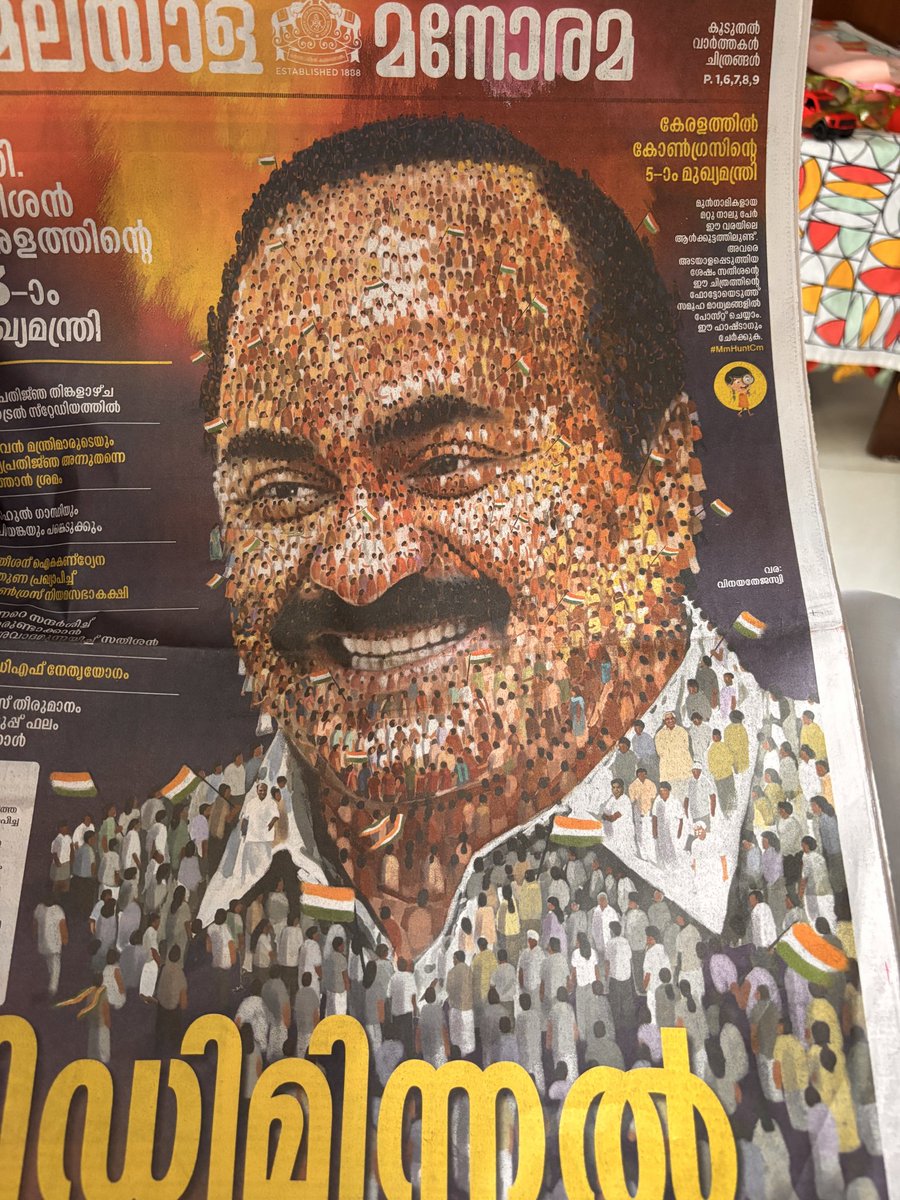
This is how newspapers beat AI, digital media and everything else thrown at it. By sheer talent and art. By using institutional memory. You can spot AK Antony, K Karunakaran and Oommen Chandy in this. Any guess on who's the fourth person hiding? Hint: he's also a former CM.
Sir David Attenborough and a boy from Kanniyakumari
Few people live to see their centenary. Sir David Attenborough is among those fortunate enough to do so.
The advent of television channels introduced me to him. In many ways, I feel we share common interests. But I was born in a small village in Kanniyakumari and educated in Tamil, my mother tongue, though I was deeply passionate about birds, animals, and fish.
My father often warned my brothers and me when we poked our hands into holes in trees searching for parrots, mynas, and other birds.
“One day, you will become victims of a snake bite,” he would say.
He had reason to worry. His first cousin had died of a snake bite after putting his hand into a crevice where a viper had trapped a bird in its jaws.
I, too, have climbed down into many wells in search of sparrow chicks. Sparrows often preferred the crevices inside wells for nesting. My brothers, friends, and I were frequently ridiculed by others.
“These boys are always catching fish, chasing birds, and climbing trees,” people would say.
By the time I joined an undergraduate course in Botany, I already knew a great deal about plants, birds, insects, and fish. But I could not express my ideas properly in English.
Sir Attenborough’s documentaries on pitcher plants were a revelation. I already knew that plants suffering from nitrogen deficiency trapped insects to compensate for the lack of nutrients, but I did not have the language skills to explain it in English.
When I listened to him speak about the domineering character of the giant water lily, or Victoria lily, I was enthralled. It also brought back memories of the teachers who had taught me about the plant.
I also knew that eels were no longer migrating to the sea for reproduction, even though my Zoology teacher insisted that they still did. My lack of fluency in English prevented me from disputing her claim. I knew that dams and other barriers were obstructing their migration. I had seen juvenile eels in the irrigation tanks of my village. They were born in freshwater and grew there itself.
My brother kept rabbits and pigeons, and we reared many chickens at home. At my aunt’s house, there were buffaloes, and we used to take them for baths. I would often ride them. Yet, despite not being afraid of snakes, I was terrified of the leeches in the water.
When I shared these experiences with the late Dr. Robert Grub, an ornithologist and student of Salim Ali, he remarked, “What a wonderful childhood you had.”
But growing up, I was mostly ridiculed and discouraged. In our world, what mattered was the marks you scored in school and college.
For the last three years, a startup in Bangalore has been obsessed with a pursuit that typically invites raised eyebrows, naked skepticism, and accusations of stealing from sci-fi:
@dognosis is training dogs to detect cancer.
And until you've spent time at their facility - a former pomegranate farm in the outskirts of Bangalore - perhaps skepticism is the rational response.
But Dognosis isn't betting on some pie-in-the-sky idea or some charming novelty act, they're betting on evolution.
@akadogluk and @Itamar_Bitan based their company on the fact that the dog's nose - a product of fifteen millennia of co-evolution with humans - can detect the faint chemical trace of cancer in your breath at a resolution that our machines, algorithms, and laboratory tests have never come close to matching.
We've known this fact for decades. We've consistently failed to do anything meaningful with that knowledge.
The missing link has been figuring out what the dog's nose knows, and applying it in a standardised, scalable, and clinically validated way.
Dognosis is building this missing piece of the equation i.e. the translation layer that allows the dog's nose to speak a language medicine can understand, enabling us to harness an ancient biological intelligence and plug it into our modern medical infrastructure.
Maybe you've read the paragraphs above and retained your skepticism. That's fair. But this past Friday, the Journal of Clinical Oncology - the world's most influential cancer journal - opted to make life much harder for the skeptics.
On Friday, the JCO published Dognosis' landmark study on breath-based multi-cancer detection - the largest of its kind ever conducted - showing that a team of trained dogs, equipped with sensors and AI, could detect multiple cancers from breath alone at 90%+ accuracy - including at Stage I, when it matters most - for $2 a test.
According to Akash, it proved "that everything we’ve known about the dogs is true".
Needless to say, it's a genuine milestone for Indian healthcare, health-tech, deep-tech, and, uh, dog-tech, that deserves far more attention than it's gotten so far.
To help change that, we were lucky to have Akash stop by the Tigerfeathers editorial desk this past week to unpack the Dognosis journey - helping us understand what they're building, how they're doing it, why it matters, and what comes next.
From where we're sitting, Dognosis is an n-of-1 Indian startup with an n-of-1 story that everyone in the Indian tech ecosystem should be aware of. If you've been intrigued by what you've read so far and you're keen to go deeper, dive into our piece here👇
https://t.co/limlGrgxJ1