Just speculating here.
25$B AWS investment in Anthropic gives Anthropic financial power.
Anthropic states they want meaningful capacity in 3 months. And Trainium3 (NVL72x2) are liquid cooled.
Liquid cooled Childress + colocation time to compute = $IREN x Anthropic?
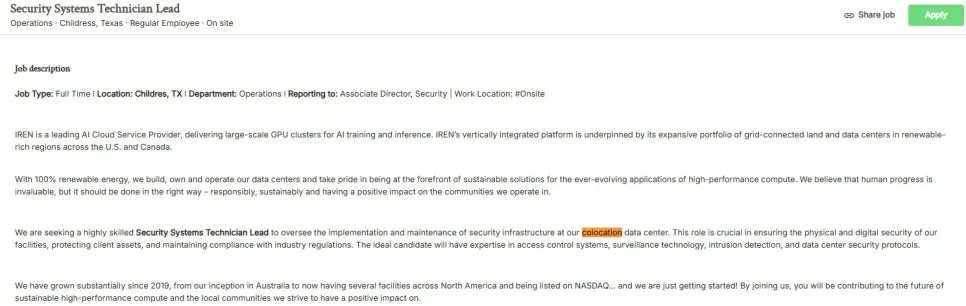
Found this about $IREN. Job opening from april 21 mentioning 'colocation DC' and 'protecting client assets'.
Makes me think they will, after all, put open parts of Childress for colocation. Revealing this change of strategy during earnings call may 7th?
Less ARR, less CAPEX.
Found this about $IREN. Job opening from april 21 mentioning 'colocation DC' and 'protecting client assets'.
Makes me think they will, after all, put open parts of Childress for colocation. Revealing this change of strategy during earnings call may 7th?
Less ARR, less CAPEX.
Just as lagging effects of shelter kept inflation higher than real for a year, the now arriving lower shelter that will lag again, will keep inflation statistics masked while oil is high.
In other words, lagging low shelter inflation arriving just now will have a canceling out effect on the immediate impact of higher oil. This will last for around 6 months so we better figure out Strait of Hormuz within 6 months.
@jiahanjimliu Indeed Jim. The damage that has been done to oil logistics will inevitably create inflation both on oil and energy costs, but also on other consumer goods because they need to be transported during export/import. This comes with a lag. Weird people aren't aware yet.
@MarkosAAIG It seems to me that packaging and qualification will be crucial points to watch going into 16
/20 layered HBM4. While historically SK Hynix has been putting down superior yield, the gap is closing.
@SunvMikey Yes I read them since early november. Following you since you just released the DD. Very impressive! Indeed I thought they were going to report Q results. But I was wrong. 13th of january they do smth else. Greets from Belgium! Recommend any accounts ab ASPI to follow?
@SunvMikey This is what I found online: On January 13, 2026, ASP Isotopes (ASPI) will pay cash for fractional entitlements to holders of their CDIs (CHESS Depositary Interests) as part of the Renergen acquisition
@SunvMikey Oh I’m not invested in the stock. Just researching it out of interest in the subject of nuclear energy. I’m thinking they also give a Q update january 13 but I’m not sure. Know anything ab that?
One wat to do this, consists of not only mapping the technoligical advantages each player has, but also looking into which mgmt teams ace deadlines, deliver more, deliver earlier, … What track record do they have?
Impressive reasoning @OptimusAAIG! Liked the part about ‘science project becoming asset build out’. As you mentioned, it’s important to follow the constraint. Will need to look out for who can effectively bridge the gap between policy goals and operational reality!
In order to answer your question, the first thing I separate with validation of HALEU is existence from continuity. We already know it can be produced. That question was answered years ago, mostly outside the West. What has not been answered yet is whether the West can run HALEU production as a repeatable process, not as a special event. That difference shows up in operations, not announcements.
Centrus ( $LEU ) is the early signal. The 900 kg per year cascade is often quoted as a number, but the number itself is not the point. What matters is whether the cascade operates as a stable campaign. Did it run consistently. Did material flow through enrichment, cylinder handling, and delivery without ad hoc fixes. Did the cylinder shortages that showed up early get resolved structurally or just patched. Can cascades be duplicated without reopening every regulatory discussion and it is economically viable. Can financing move from DOE-backed demonstration to something that looks like asset buildout. That is the point where enrichment stops being a science project and starts being infrastructure.
Urenco sits slightly further out on the curve but is just as important. The move into LEU plus is not interesting because of the extra percentage points. It is interesting because it tests whether the regulatory system is comfortable with sustained operation above the legacy 5% ceiling. Then the chain moves downstream, which is where a lot of people stop paying attention too early. HALEU does not show up at a reactor as enriched gas. It has to be deconverted, processed, fabricated, and qualified. Each of those steps has its own engineering problems.
Fuel fabrication is where qualification becomes real. TRISO X is a particularly important milestone because it represents Category II fuel fabrication. When a facility like that is built, it does two things at once. It de-risks a specific reactor pathway and it creates regulatory precedent. After the FOAK, expansion becomes cheaper and better.
Fuel qualification itself has two clocks running in parallel. One is the irradiation clock. Fuel has to survive real conditions and produce data regulators trust. The other is the supply clock. If test fuel and production fuel are not materially the same, qualification does not scale. A real milestone is when developers stop qualifying boutique fuel and start qualifying the exact fuel they expect to buy repeatedly.
Transport is another quiet gate. Early HALEU movements required bespoke handling and limited certified packages. That is normal at the beginning, but it cannot persist. A mature fuel cycle is one where HALEU moves the way LEU moves today: planned, scheduled, and dull.
The most telling signals, though, are commercial rather than technical. Multi-year offtakes that extend beyond first cores are where belief shows up. When a developer signs fuel contracts that explicitly cover second and third core requirements, it means they believe enrichment, conversion, fabrication, and transport will exist when needed. It also means suppliers believe demand will still be there. That mutual commitment is what allows private capital to step in without relying entirely on government bridges.
This is also where downblending quietly fades into the background if things are working. Downblended material should get early projects across the line and then disappear from the marginal supply story. If it keeps showing up as a recurring solution, that is a warning sign. A bridge that stays in use too long usually covering for a missing foundation.
So, this is how I see the next few years. The real HALEU qualification milestones are not single events. They are patterns. Sustained enrichment campaigns. Licensed fuel fabrication produces repeatable lots. Transport that no longer needs special handling. Contracts that assume fuel will exist without government allocation. When those pieces line up, HALEU is in a state of continuity instead of existence.
From a market lens, that keeps my focus where the bottleneck lives. $LEU as the most direct exposure to whether enrichment execution actually happens. $BWXT where fuel forms, fabrication, and nuclear services intersect. $ASPI as a bet on a new technology (laser enrichment instead of cascades to add new enrichment capacity tied to long dated HALEU demand. And $CCJ and $UUUU less as spot uranium trades and more as upstream positioning if fuel security continues to reprice from commodity logic to strategic logic.
@OptimusAAIG But that combo of support + gigantic demand could breed managerial slack. For now, goodwill & demand bottlenecks give players breathing room. But over time, execution risk will materialise and competitiveness becomes key. Need to watch each player's timelines & delivery closely.
@OptimusAAIG Another clean write up! If I may add to the topic of HALEU, time lines & execution; along the way to scalable industrial HALEU solutions, gov't has a big role: easing regs & providing demand. Paired w/ the coming structural shortage, this gives producers serious pricing power 1/2