Morgan Stanley says GPU cloud business is extremely profitable.
"We see hyperscaler GPU rental businesses generating 70% incremental margins and 30%+ ROIC"
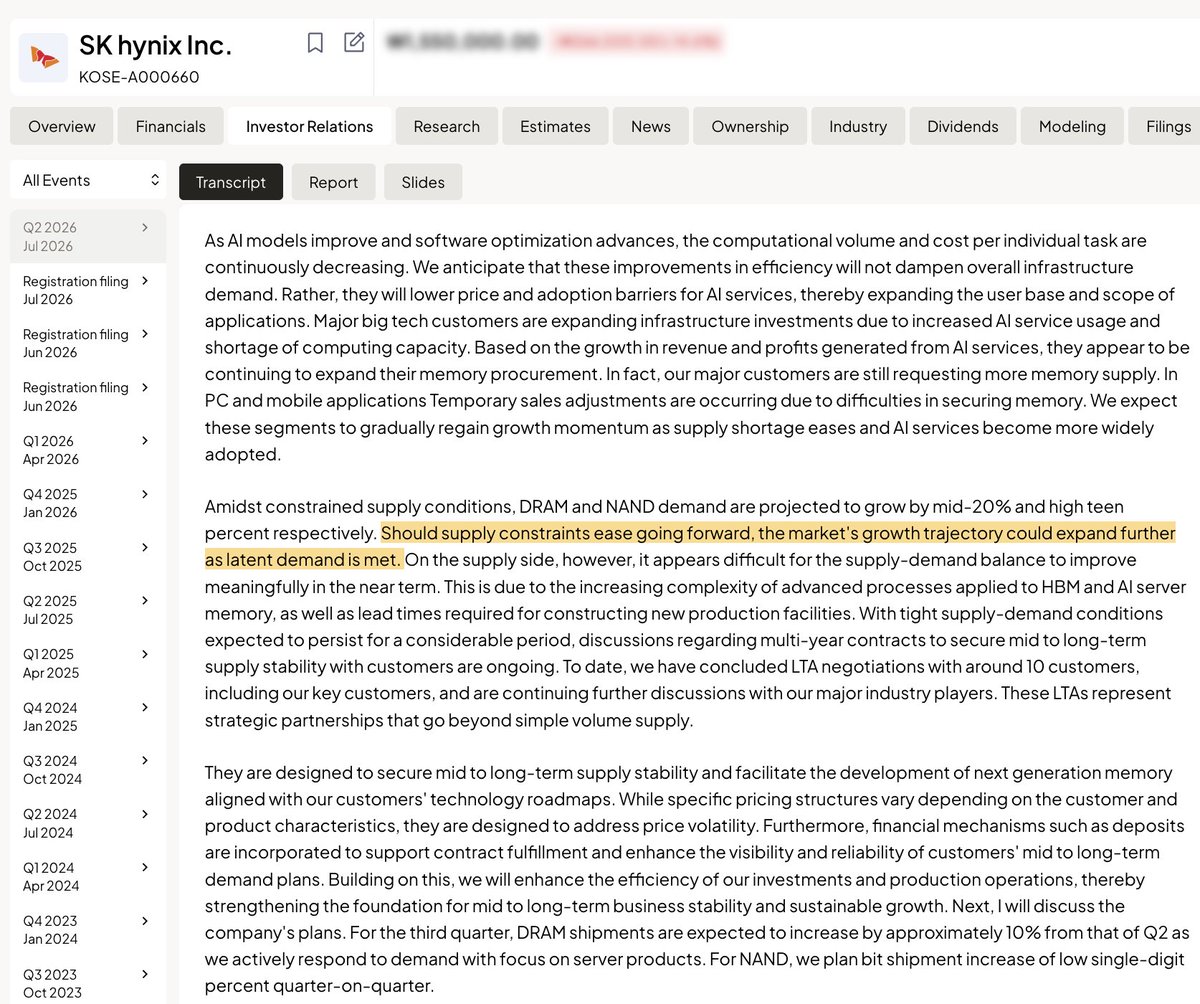
$SKHY SK Hynix Exec: Memory supply-demand tightness should persist
"On the supply side, however, it appears difficult for the supply-demand balance to improve meaningfully in the near term. This is due to the increasing complexity of advanced processes applied to HBM and AI server memory, as well as lead times required for constructing new production facilities. With tight supply-demand conditions expected to persist for a considerable period, discussions regarding multi-year contracts to secure mid to long-term supply stability with customers are ongoing"
DONALD TRUMP JUST DID IT AGAIN
HE KEEPS TELLING YOU WHICH STOCKS TO BUY TO GET RICH
SO FAR HE CALLED:
$INTC AT $20 → +600%
$DELL AT $230 → +90%
$MU AT $740 → +70%
NOW HE’S CALLING:
$ALOY AT $7.25
$USAR AT $13.75
$MP AT $40.49
“I’LL TELL YOU HOW TO MAKE MONEY, DO MAGNETS”
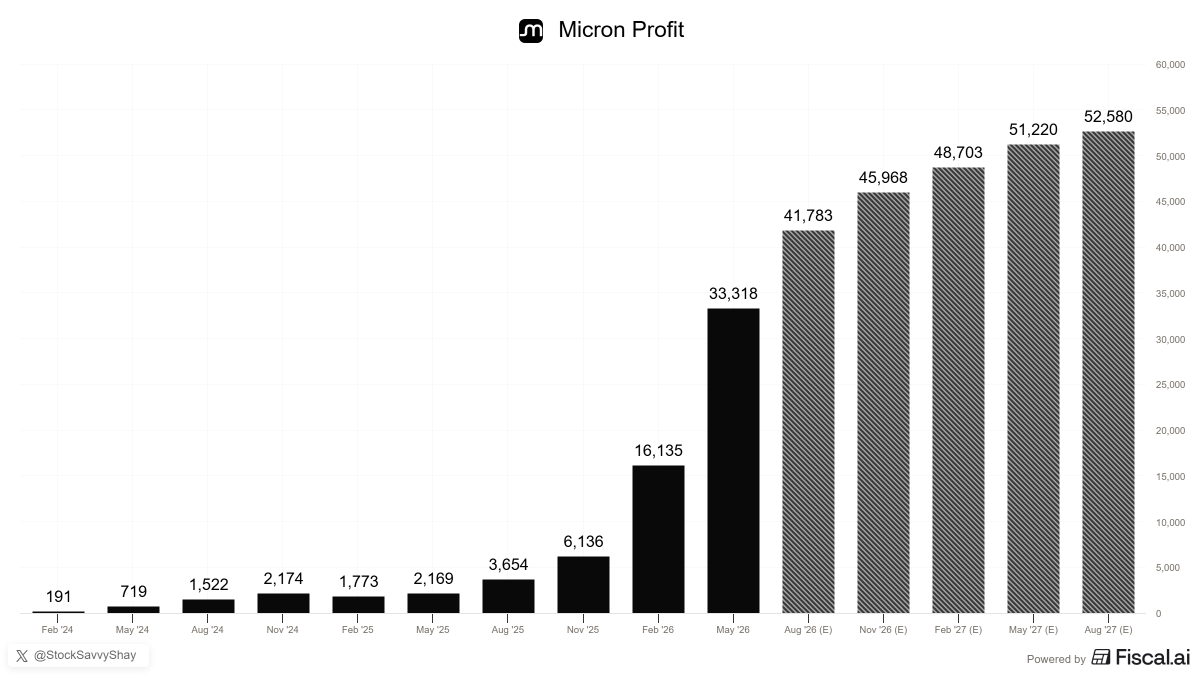
$MU is valued at ~$900B at $800 per share.
What's wild is that Micron is expected to generate cumulative profit equal to its entire market cap over the next four to five years 🤯
Around a month ago, a couple of hedge fund friends pitched me on $SNDK, $MU, $SKHY , and the rest of the memory names as their best ideas. The thesis was compelling, and the guys are very smart. Their main argument was simple: these companies were incredibly cheap. P/E of 10. P/E of 8. Some even lower.
The interesting part is that not a lot has changed fundamentally since then, yet many of these stocks are down around 50%.
We can extrapolate that, since nothing fundamentally changed and the stocks have been cut in half, sentiment is more important than multiples, and you never want to buy at peak sentiment, no matter how cheap the deal looks.
Read more about it in my post below, “The Myth of P/E Ratios.”
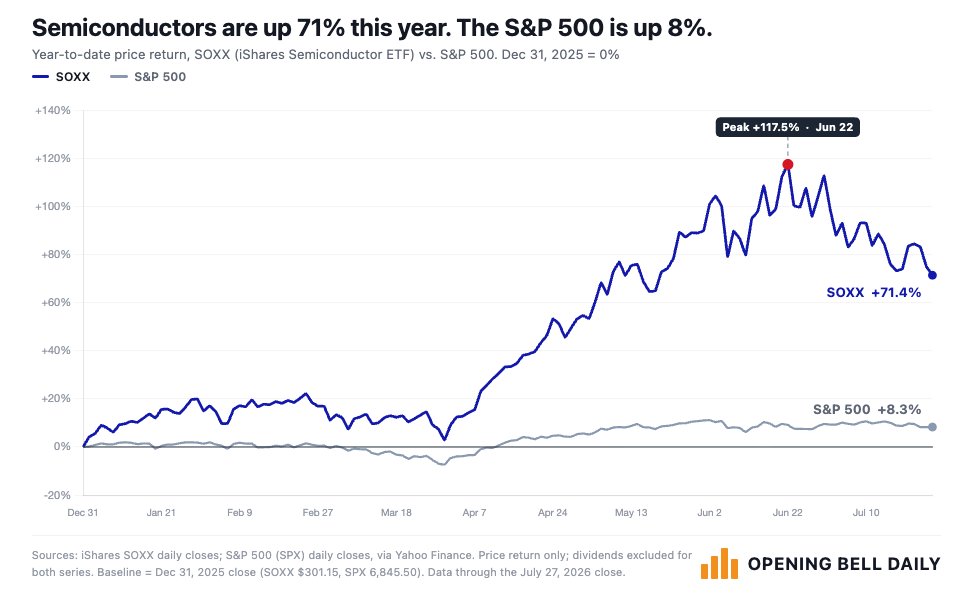
Chip stocks have fallen into a bear market but the iShares Semiconductor ETF $SOXX is still up 9x the S&P 500.
- Semiconductors +71%
- S&P 500 +8%
Zoom out to remind yourself AI is fueling a generational bull run.
Added more $MU today.
The thesis is pretty simple...buy low, sell high!
When I can buy a stock with a forward PE of ~5, that means even if the forward profits deteriorates by 50%, and they simply get a PE of 10, they could still maintain their current stock price. How many companies could have 50% decline in expected future profits and would maintain their price if they got a PE of 10!? 🤯
But even more interesting, is that there is no evidence that their estimated profits will deteriorate. All the evidence, such as $GOOGL increasing CapEx, $100 Billion worth of long-term contracts with huge deposits, and the rapid increase of AI adoption across the world, point to continued demand for AI and memory.
So the question is: what happens if Micron's profits continue to grow for the next couple of years?
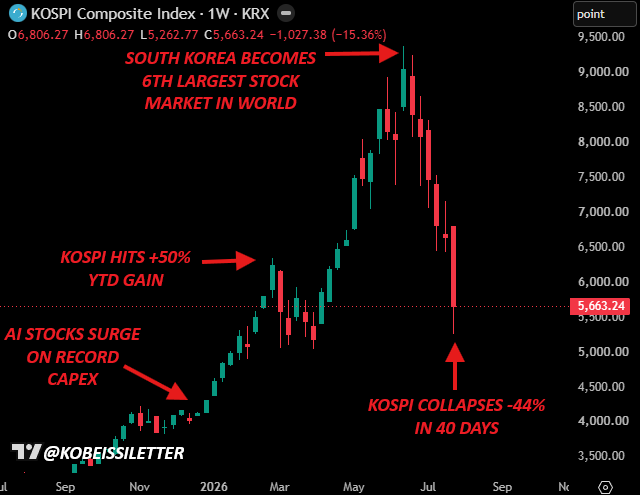
JPMorgan says the forced selling in Korea is largely finished.
Its latest Korea Equity Strategy note estimates de-leveraging is now about 90% complete. The KOSPI has fallen nearly 40% from the June 22 peak.
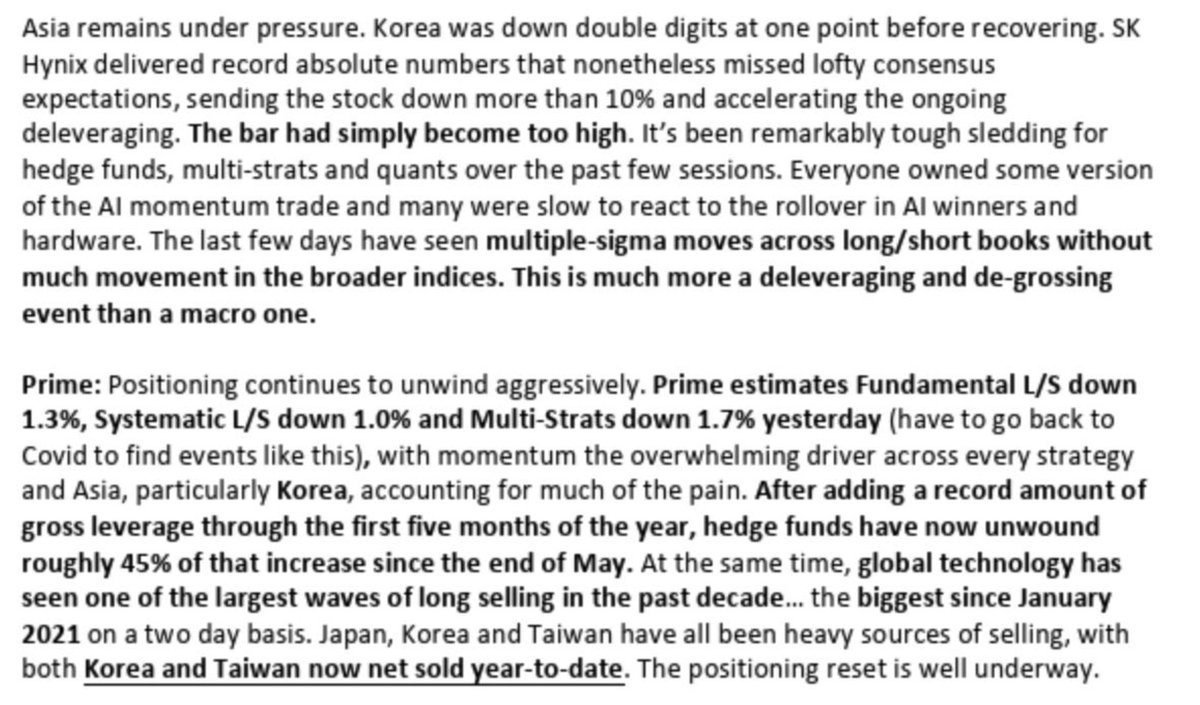
Early fundamental worries and sector rotation were heavily amplified by leveraged ETFs, then accelerated by hedge-fund unwinds.
Two charts make the shift clear. Leveraged ETF assets under management rose from around $10 billion earlier this year to a peak near $50–52 billion in early July.
They have since dropped sharply to $16–18 billion. JPMorgan calls the current level no longer problematic.
Cumulative inflows into broad-market, offshore, and single-stock leveraged products have also stalled or begun to reverse.
Tighter rules, including higher cash requirements, have slowed the rush of new money.
Forced-selling pressure has eased. Positioning looks cleaner and valuations more attractive against still-supportive earnings.
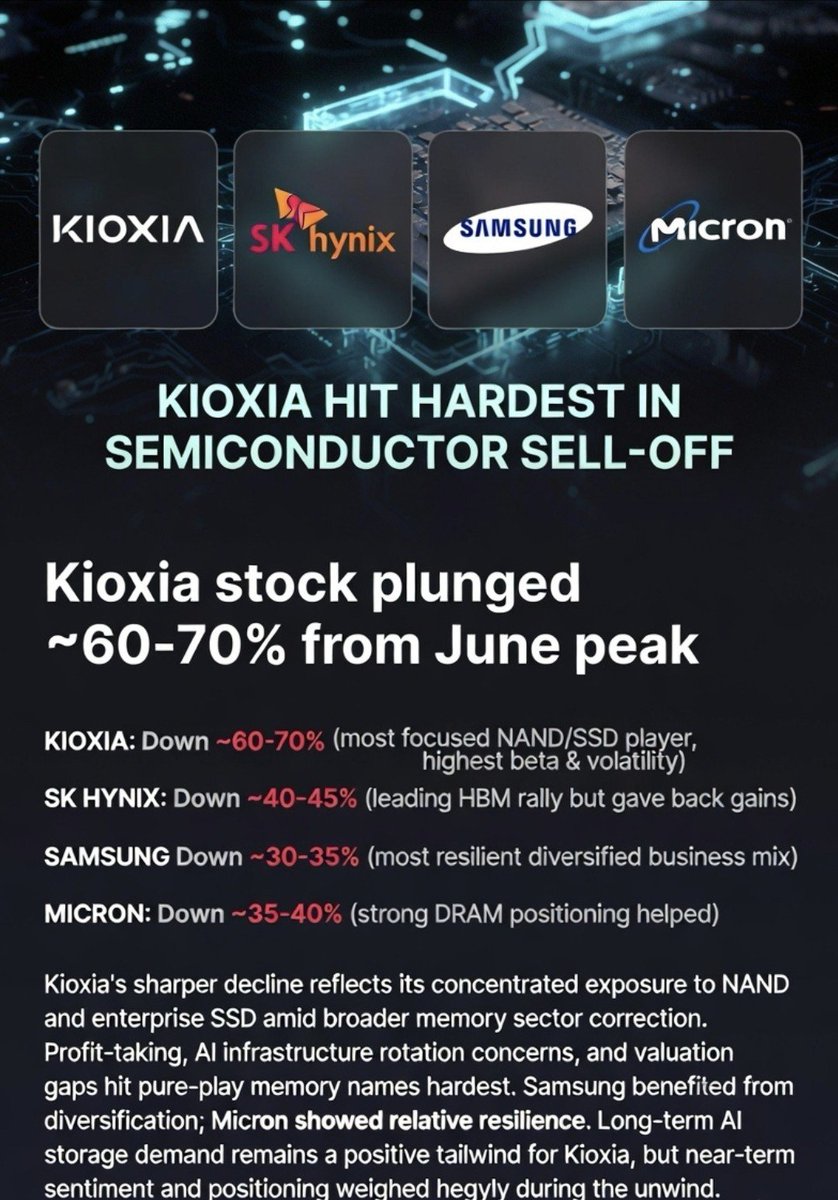
Kioxia has been hit hard in the recent semiconductor sell-off.
Its stock dropped roughly 60–70% from the June peak, one of the sharper declines among major memory names.
For context, here is how the others performed over the same period:
- SK Hynix: Down around 40–45% from its June high. It led the earlier rally on strong HBM momentum but gave back a large portion amid leveraged unwinds and broader AI rotation concerns.
- Samsung Electronics: Down roughly 30–35%. The decline was meaningful but less severe than pure-play memory peers, helped by its diversified business mix across memory, foundry, and consumer electronics.
- Micron: Down about 35–40%. It participated in the sell-off but has shown relatively better resilience compared to Kioxia, supported by its stronger positioning in certain DRAM segments and U.S. market listing dynamics.
Kioxia, as a more focused NAND and enterprise SSD player, experienced amplified volatility during the correction.
The broader sector unwind exposed valuation gaps and heightened sensitivity to any perceived slowdown in AI infrastructure spending.
While all names corrected sharply, Kioxia’s larger percentage drop reflects its higher beta to memory cycle sentiment and thinner diversification.
Long-term AI storage demand remains a tailwind, but near-term positioning and sentiment have weighed heavier on it.
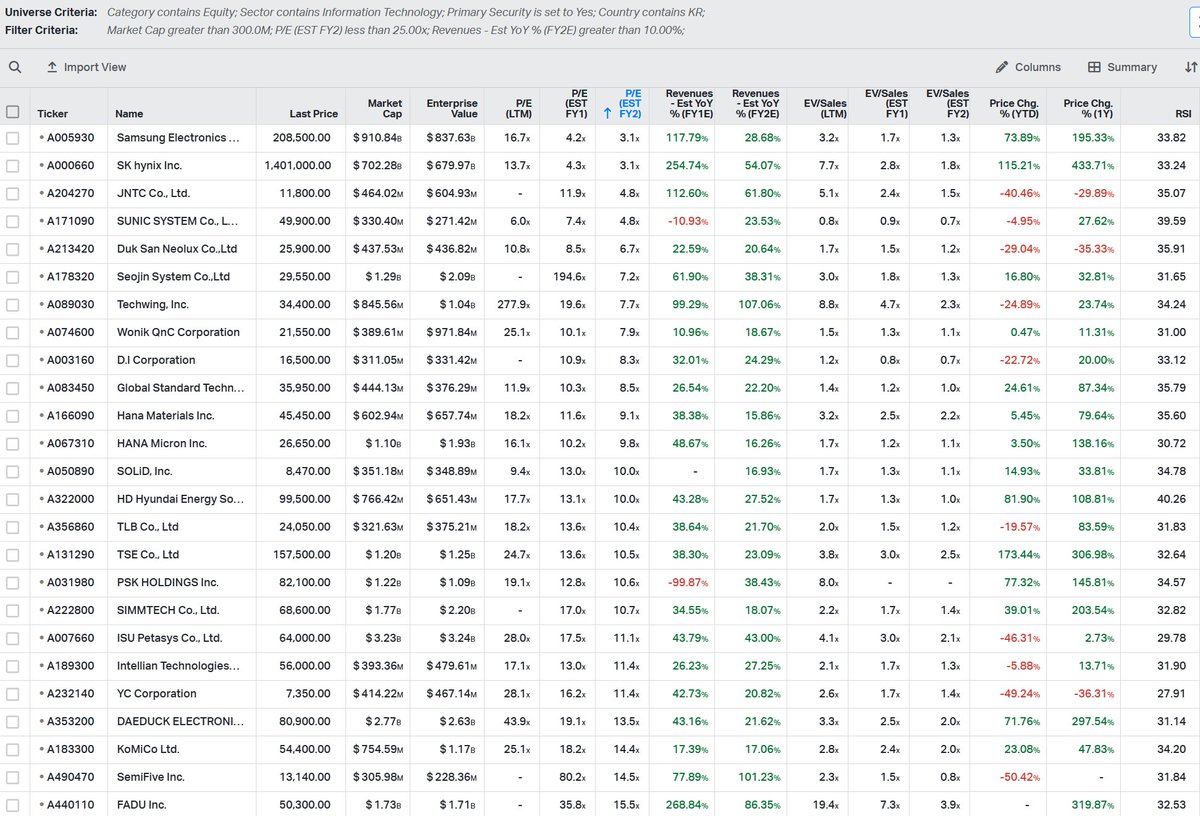
South Korea is arguably an inverse bubble right now. A bunch of companies posting very strong double-digit growth are trading for low-double-digit 2027 EPS multiples or less thanks to margin calls and deleveraging. Any snapback move could be violent.
Goldman on the leverage unwind. A lot of forced selling dislocation happened this month. If you have longer duration capital and can withstand ST vol, there are very attractive opportunities now as AI fundamentals are about to improve dramatically over the next 6–9 months from RSI.
The valuations for the HBM memory names are going to look silly in the coming year.
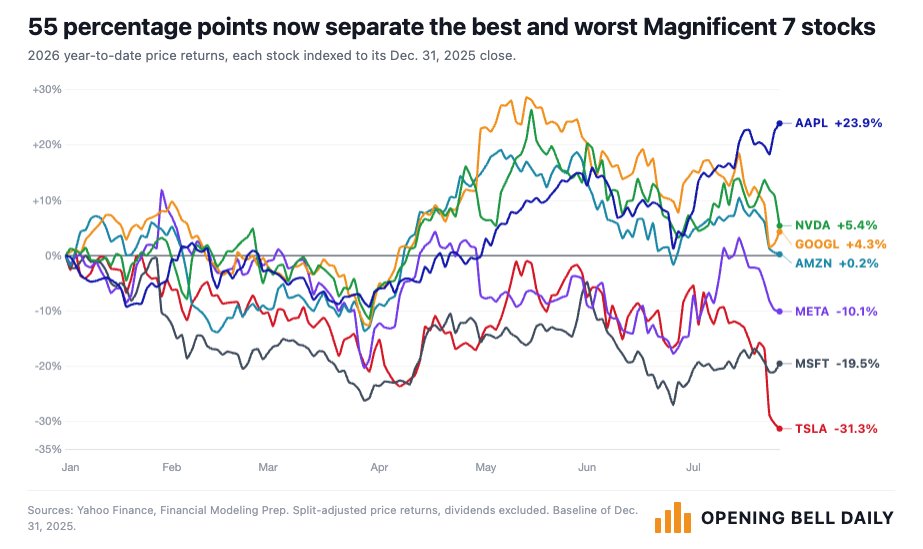
Magnificent 7 stocks in 2026:
$AAPL +24%
$GOOG +5%
$NVDA +4.3%
$AMZN +1.9%
$META -8%
$MSFT -17%
$TSLA -30%
Massive dispersion within what was once a single trade.
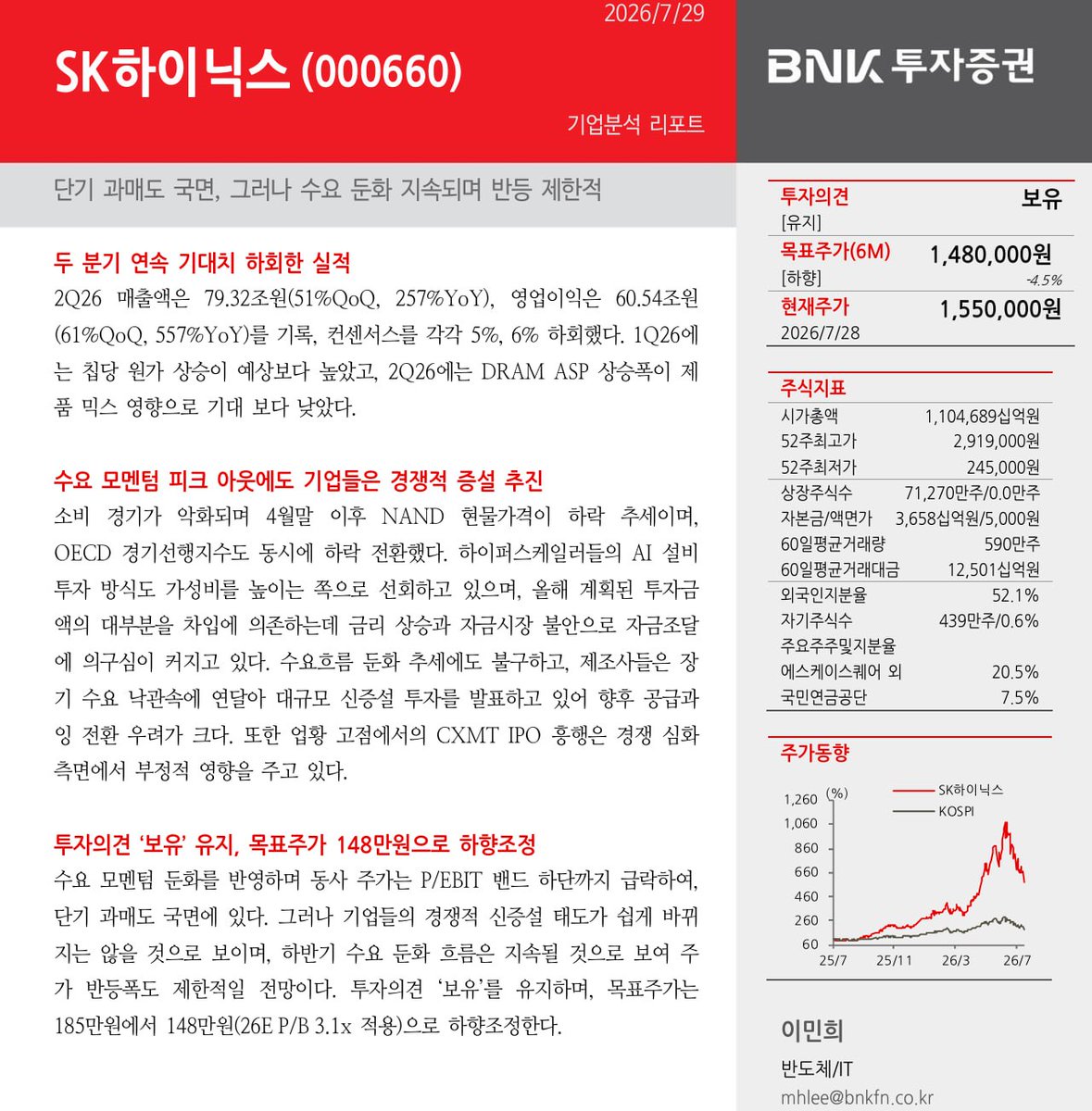
BNK Investment & Securities, the local Korean brokerage that foreshadowed the KOSPI’s decline by cutting its price target for SK hynix to KRW 1.85 million when the index was at 7,700, lowered its target again today to KRW 1.48 million. (In Korea, issuing an outright Sell report is virtually impossible, so a price-target cut effectively amounts to a Sell call.)
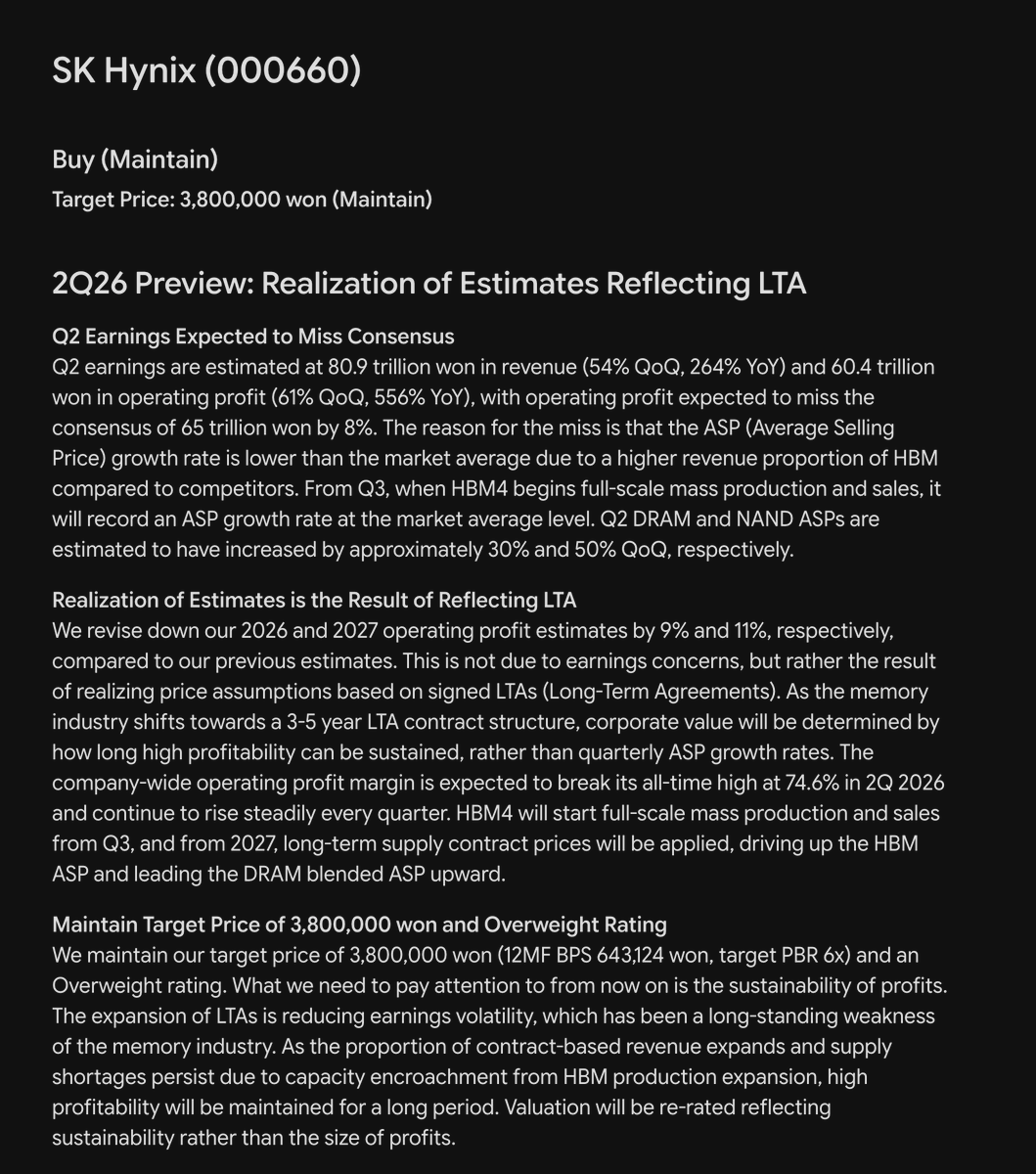
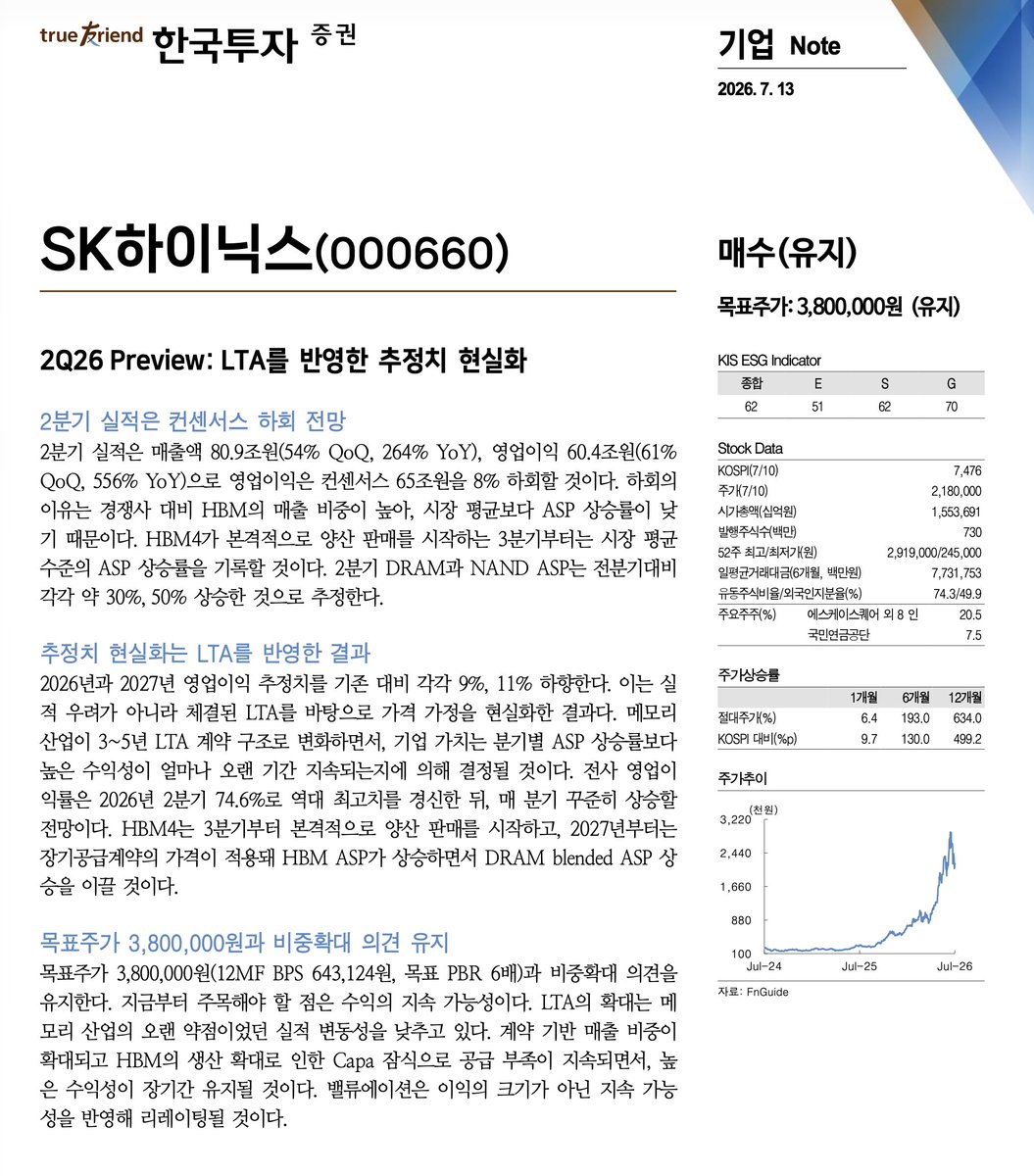
SK Hynix missing numbers is BULLISH for SK Hynix. I'm serious. Hear me out.
The Korean analyst who predicted the Q2 miss said it happened because SK Hynix has a higher HBM mix.
HBM is the more durable, higher-moat business that should command a higher multiple. HBM is in major shortage the next several years. SK Hynix is number one in HBM. Just see how Dario, Sam, Hock, and Jensen appeared to greet HBM makers in SF last week.
In the short term, the higher DRAM-mix players benefit, but long term it's a detriment as China will eventually enter the DRAM space one to two years out with more capacity. China will be no where in HBM.
So a Q2 miss caused by more HBM mix actually means SK Hynix is BETTER positioned in the long run. Don't listen to me, listen to the Korean axe who has a Buy rating, a very high PT, and nailed the mechanics of this quarter.
Great read, really recommend it.
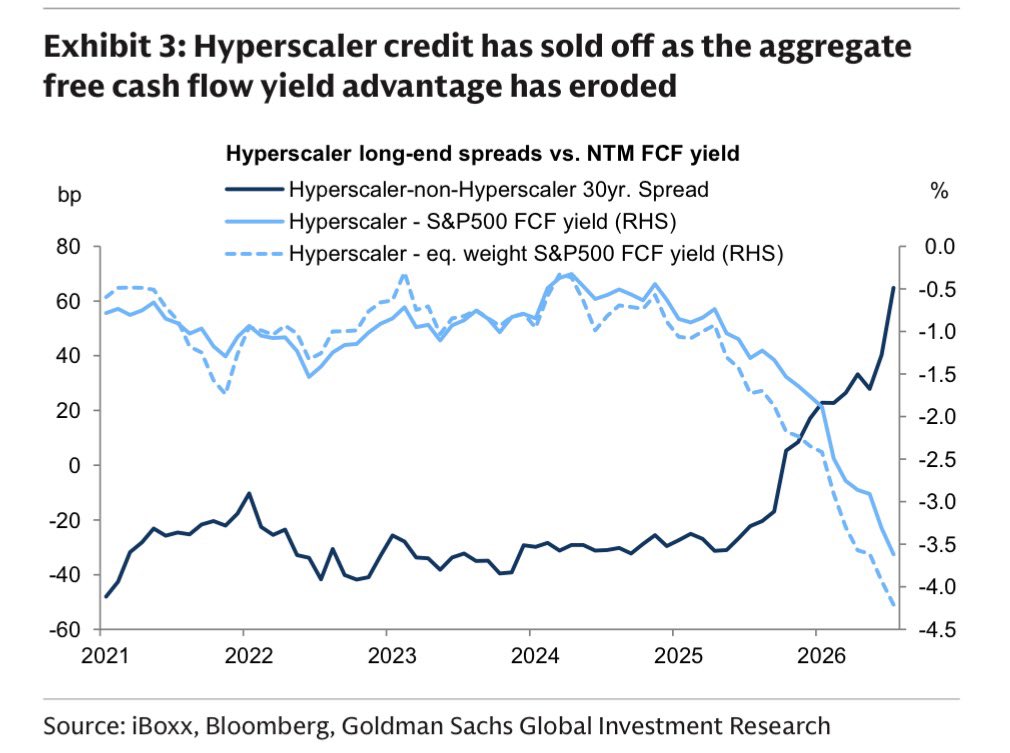
I would like to add smth Goldman talked about today as well:
As hyperscalers have accelerated AI spending, their long-end bond spreads have widened while forward free cash flow yields have steadily deteriorated. In other words, the debt market is becoming increasingly cautious about the near-term cash impact of the AI investment cycle, even as equity markets remain focused on long-term AI upside.
So if hyperscalers begin generating stronger cash flow while maintaining aggressive AI investment, both bond and equity markets, could become more constructive. But if free cash flow improves only because companies slow AI spending, that would likely be welcomed by credit investors while raising questions for AI infrastructure equities.
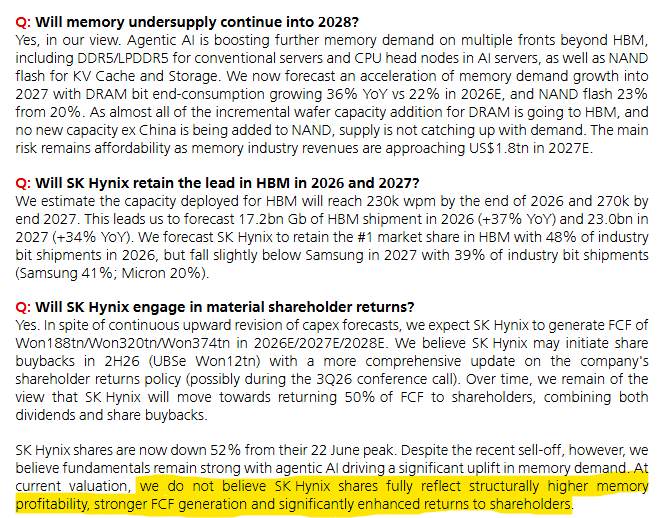
UBS' take: SK Hynix's recent selloff looks disconnected from its fundamentals - PT down slightly from Won 3,200,000 to Won 3,000,000
Despite the sharp correction, UBS argues the long-term thesis remains intact (like the entire FinX does lol).
Nicolas Gaudois continues to see agentic AI driving broader memory demand beyond HBM, revised LTAs improving earnings visibility, and HBM negotiations for 2027 progressing. He also expects SK Hynix to begin share buybacks in 2H26, supported by substantial free cash flow generation
UBS furthermore still believes the memory cycle is actually strengthening. It now forecasts DRAM bit demand growth accelerating to 36% in 2027, while virtually all new DRAM wafer capacity continues to be allocated to HBM, leaving conventional DRAM supply tight. Combined with continued LTA adoption and stable NAND demand, UBS argues the market is underestimating the durability of the current memory upcycle
$SKHY $MU $SNDK
JPMorgan warns next round of selling will hit indexes beyond just single stocks:
"Focus remains firmly on the AI/Tech/MOMO unwind. Key concerns include competitive threats from China — open-source models and DUV production, even as China SPEs are down again today — as well as circular financing and the role of leverage. The widening in NVDA CDS, as the receiver of capex with rising FCF, is more concerning than the move in hyperscalers’ CDS.
We maintain factor hedges because crowding risk has not fully cleared on our books. It is worth considering whether another leg lower from here could come with a more pronounced pickup in index correlation."
- JPM Market Intel
Absolutely incredible.
In an unprecedented move, South Korea's stock market just collapsed -44% in 40 days, erasing -$2 trillion in market cap.
Now, South Korea's finance ministry has announced plans to "stabilize" the market.
What is happening? Let us explain.
(a thread)