"Yes, Peter wept - and wept bitterly. He wept so that, with his tears, he might wash away his sins. And you, my friend, if you want to obtain pardon, wash away your sins with your tears."
- St Ambrose of Milan
@TacticoolOrtho@TheOtherPaul2 True, but Origen never said "you can't be holy if you don't do it!" In fact, later on in his life he repudiated self-castration and not to mention that Jerome actually praised Origen for castrating himself.
@Danteyrz1r@UntoldFortune https://t.co/ur1KqOUKan
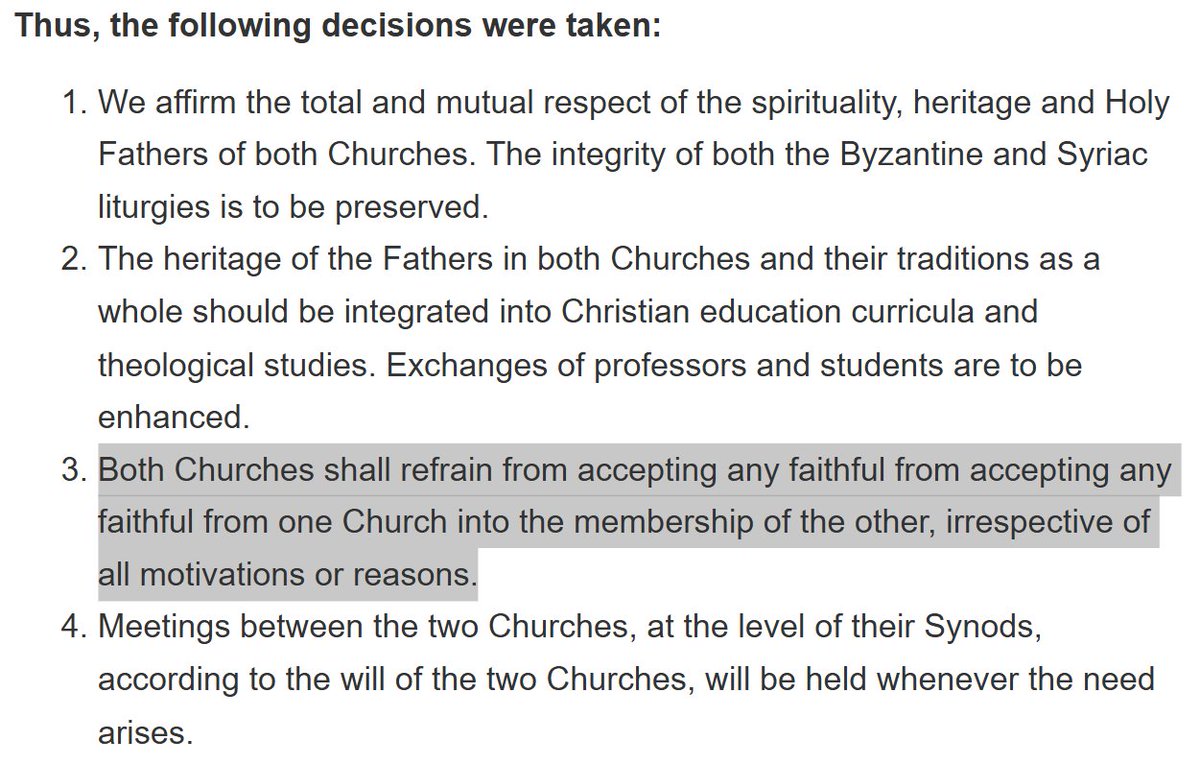
Pat. Ignatius IV (EO) in 2014 also just straight up said to not accept converts, not merely forbid proselytism.
@LowStudies@UntoldFortune I think people are forgetting that proselytism, in contrast with the older meaning, nowadays means converting people through "wrong means" e.g. bribing. It does not at all forbid conversion or evangelization.
@LowStudies@UntoldFortune I think people are forgetting that proselytism, in contrast with the older meaning, nowadays means converting people through "wrong means" e.g. bribing. It does not at all forbid conversion or evangelization.
@OrthoTexan70@papism101 Timothy did not formally assent to it. He and the Egyptian delegation objected to the canon. Cyril was ignorant of the creed when Nestorius mentioned it and neither was it also mentioned at Ephesus. Dioscorus too seems to have ignored its ecumenical status. Fr. Shenouda Ishak:
@OrthoTexan70@papism101 Canon 7 did not have Const. 1 (and it’s creed) in mind. In fact, neither Ephesus nor Cyril accepted the council and Alexandria only did so post-Chalcedon.
@ortho_no “But the iconoclast claim that reverence towards images did not go back to the golden age of the fathers, still less to the apostles, would be judged by impartial historians today to be simply correct.”
— Fr. Richard Price
@agusofpare@Scholarius1 Accepted as what? Gregory the great is the first to enumerate 5 councils, all popes before him only mention 4 and Pelagius II seems to argue against the Istrians that the council didn't touch matters of faith.
@agusofpare@Scholarius1 This is true, I think the definition of an ecumenical council must be rethinked to accommodate certain events wherein the council met opposition (e.g. Ephesus and Chalcedon)
@Scholarius1@agusofpare The formula only required accepting the fact Nestorius was deposed. That doesn't mean the council was formally accepted, that also doesn't make sense in light of John's view of the twelve chapters. It is also a bit doubtful if Vigilius accepted Const. 2
@agusofpare@Scholarius1 Yes... until about 449. Neither John nor Domnus accepted Ephesus, they only accepted the Formula of Reunion which did not require acceptance of the council.