New @Nature study maps the genetic risk shared across psychiatric disorders.
In News & Views, I discuss what it means when that genetic risk overlaps with normal traits, including education-related outcomes.
News & Views: https://t.co/Y4mP2wyBEj
Study: https://t.co/RnrnGXolMr
This went live today, on Thanksgiving, which feels quietly special.
This article is about one of my favorite topics: how human genetics is being used to shape drug development. It’s a synthesis of ideas and lessons that have emerged over many years, brought together into a single narrative.
I’m grateful for the opportunity to give structure to these thoughts — and excited about where human genetics–driven drug development is headed next. The future here feels genuinely promising.
Many thanks to the editors at @WorksInProgMag — @bswud and @salonium — for the opportunity and for helping edit this article into its best possible version.
Hope you enjoy this light read on Thanksgiving Day :)
🧬 Nature’s laboratory
https://t.co/X9Z2joGLgv
Few biomedical researchers are weighing in on whether we’re truly on the right track.
I’d like to share some thoughts, from the perspective of a scientist, on why reform and recalibration may be needed... 🧵
New Research: Association between suicidal ideation and tandem repeats in contactins: Background
Death by suicide is one of the leading causes of death among adolescents. Genome-wide association studies (GWAS) have identified loci that… https://t.co/OREQWBGBIs #Psychiatry
The field of human genetics is evolving at a rapid pace. Much of this progress is driven by our recent ability to link common DNA variants to complex traits with genome-wide association studies (GWASs) 🧬
For both newcomers and seasoned geneticists, good review papers can be very helpful in introducing oneself to the field and in keeping up to date with the progress.
Here's an overview of key review papers, arranged chronologically:
2005 in @NatureRevGenet: Genome-wide association studies for common diseases and complex traits
A primer on the approach at the dawn of this revolution: https://t.co/9XZaIOt6QP
2008 in @NatureRevGenet: Genome-wide association studies for complex traits: consensus, uncertainty and challenges
A deep dive into the early statistical procedures of GWASs: https://t.co/znnZxxW0O3
2009 in @NatureRevGenet: Validating, augmenting and refining genome-wide association signals
On refining and replicating GWAS results: https://t.co/L6QqD0HaNO
2010 in @NatureRevGenet: Genotype imputation for genome-wide association studies
All about genotype imputation, enabling interrogation of untyped genetic variation: https://t.co/sTEOCVcHjO
2010 in @NatureRevGenet: New approaches to population stratification in genome-wide association studies
Tackling false positives in GWASs due to ancestry differences: https://t.co/KuUvVZaC20
2016 in @NatureRevGenet: Dissecting the genetics of complex traits using summary association statistics
Delving into downstream analyses of GWAS signals: https://t.co/hdCkMSCoDi
2019 in @NatureRevGenet: Benefits and limitations of genome-wide association studies
Exploring the pros, cons, and controversies surrounding GWAS: https://t.co/O8UCWBS2R2
2021 in @MethodsPrimers: Genome-wide association studies
A comprehensive look at GWAS and subsequent analyses: https://t.co/b1dHIIiBtQ
2021 in @NatureHumBehav: Dissecting polygenic signals from genome-wide association studies on human behaviour
Understanding GWAS signals in human behavioural outcomes: https://t.co/FAoWmyMM88
And finally, a series of reviews charting the progress in the field every five years in @AJHGNews
2012 - 5 years of GWAS discovery: https://t.co/5MeRmy5D0c
2017 - 10 years of GWAS discovery: Biology, Function, and Translation: https://t.co/Q8bwoCF3mp
2022 - 15 years of GWAS discovery: Realizing the Promise: https://t.co/pSBPK2U6Lc
Had a great time presenting my research at #WCPG2023 this week! A big thank you is owed to my mentors Dr. @FrankWendt10 and Dr. Esteban Parra (@UofT_Anthro, @UTM_Anthro), and co-authors @n_brendann and Dr. Frida Lona Durazo! Now on to the manuscript writing…
Our new study led by @AntoDeLillo is out on @HumanGenomics. Leveraging #BiobankJapan, @uk_biobank, @FinnGen_FI, we investigated polygenicity variation across health domains in East Asian and European populations, observing ancestry-specific patterns
https://t.co/crDi1awk2U
I am thrilled to share my mini-review of the role of tandem repeats in #braindisorder research! 🧠 Out now in @PPPublishing's Emerging Topics in Life Sciences #ETLS. Huge thanks to @FrankWendt1! @UTM, @UofT, @UofT_Anthro Dive into the paper here: https://t.co/CpQTcqlhhM
PhD candidate @cristina_abba95 is first author of a new publication in Forensic Genomics: From #Genetic Association to #Forensic Prediction: Computational Methods and Tools for Identifying Phenotypically Informative Single Nucleotide Polymorphisms. https://t.co/r2UybMTZcO
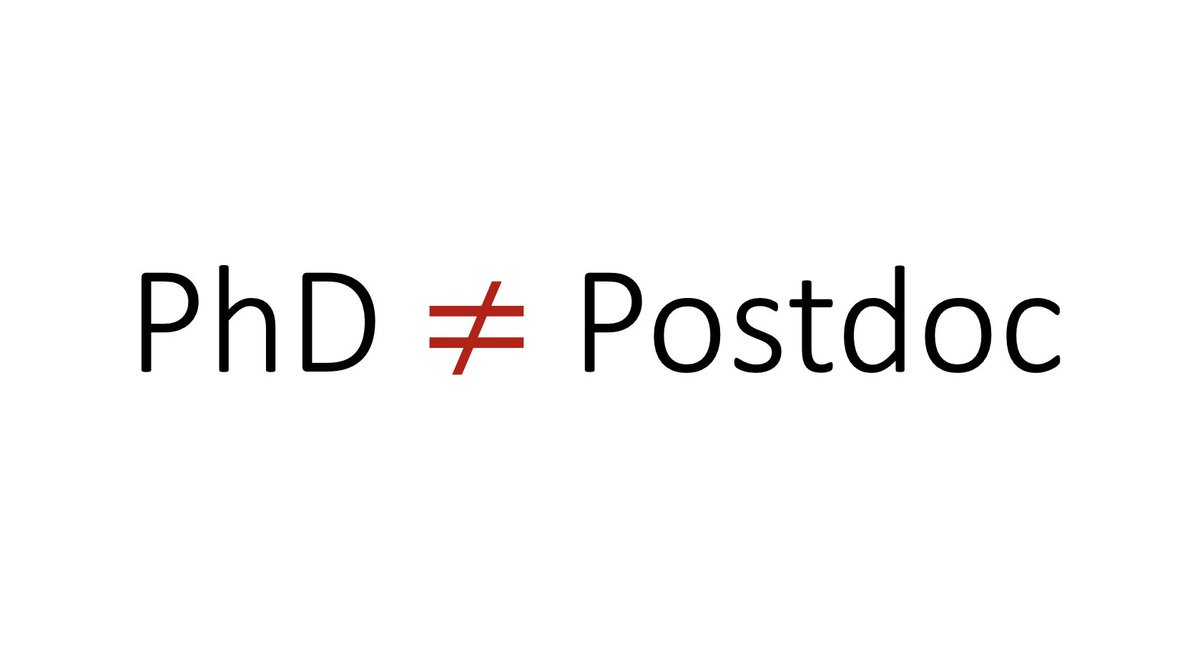
Postdoc is conceptually different from a #PhD position. Below are some key points to keep in mind before starting postdoc.
1️⃣ The harsh reality of being a postdoc:
1. Postdoc is a contractual (not educational) position. Your postdoc duties are defined by your contract & agreement with your advisor.
2. Usually, a contract is given for 1 year and renewed annually. It does NOT offer the same job security that PhD students enjoy. Be prepared to start searching for a new position in 1st year and leave anytime.
3. Postdoc is inherently a position for academia (with a few exceptions like in bio). Often, companies will assume that you’ve chosen an academic track, not industry. They’d rather hire a fresh PhD graduate from the same field than a postdoc. So, your job search outside academia may become challenging, especially if you do fundamental research.
4. If you want to be a faculty, your postdoc may require a lot more efforts than you originally expected, making it the most intense time of your life. Be prepared.
_________
2️⃣ If you take postdoc because you want to be more competitive for senior academic positions, keep in mind that:
0. Choosing the right lab & advisor is statistically MORE important than simply working hard and publishing papers during postdoc (esp. in the U.S.). However, working with an advisor who can write an excellent recommendation letter does NOT mean that you will also get prepared for a faculty life and become a great scientist. Your advisor should be a good mentor for this.
1. As the competition for faculty positions can easily reach over 1/300 and you have ~1 year before applying for positions, postdoc time often turns into a “race”. The worst part is that hard work does NOT necessarily lead to success.
2. Postdoc is NOT a must for being a faculty. Some students secure professor positions at the end of their PhDs (esp. at the top universities in the U.S.).
3. Postdoc lasts 1-3 years. If you’re a first-year postdoc and apply for faculty positions, committees will be OK with you showing your PhD work during interview. But starting from your 2nd year, they expect you to show successful postdoc results.
4. Some committees expect that a 3-year postdoc should complete as much work as a 5-year PhD student. It’s like a fast-track PhD.
5. Often (esp. in STEM), the expected number of “postdoc papers” is on average 1 paper per 1 year, unless the work is unusually complex. NOT 10 papers/year.
6. Publishing a lot of papers is normally viewed negatively. Coauthoring tens of papers will send a RED flag to the committee. For decent universities, it's (almost always) quality over quantity.
7. Doing a second postdoc is rarely helpful in landing a faculty position.
8. Ideally, postdoc should be in a different field than your PhD. Switching fields is viewed positively and can be helpful in landing a faculty position. But it is much more challenging because your time is very limited but you must do outstanding research. Also, I know many people who didn’t change fields but became faculties nonetheless.
Good luck!
#AcademicTwitter #AcademicChatter
Just Online: https://t.co/c3VkP4wBze. We conducted the largest GWAS of addiction to date by combining information across substance use disorders. A thread on a GWAS of addiction in >1 million individuals across two ethnicities #GWAS#MedTwitter#PsychTwitter#Addiction (1/9)
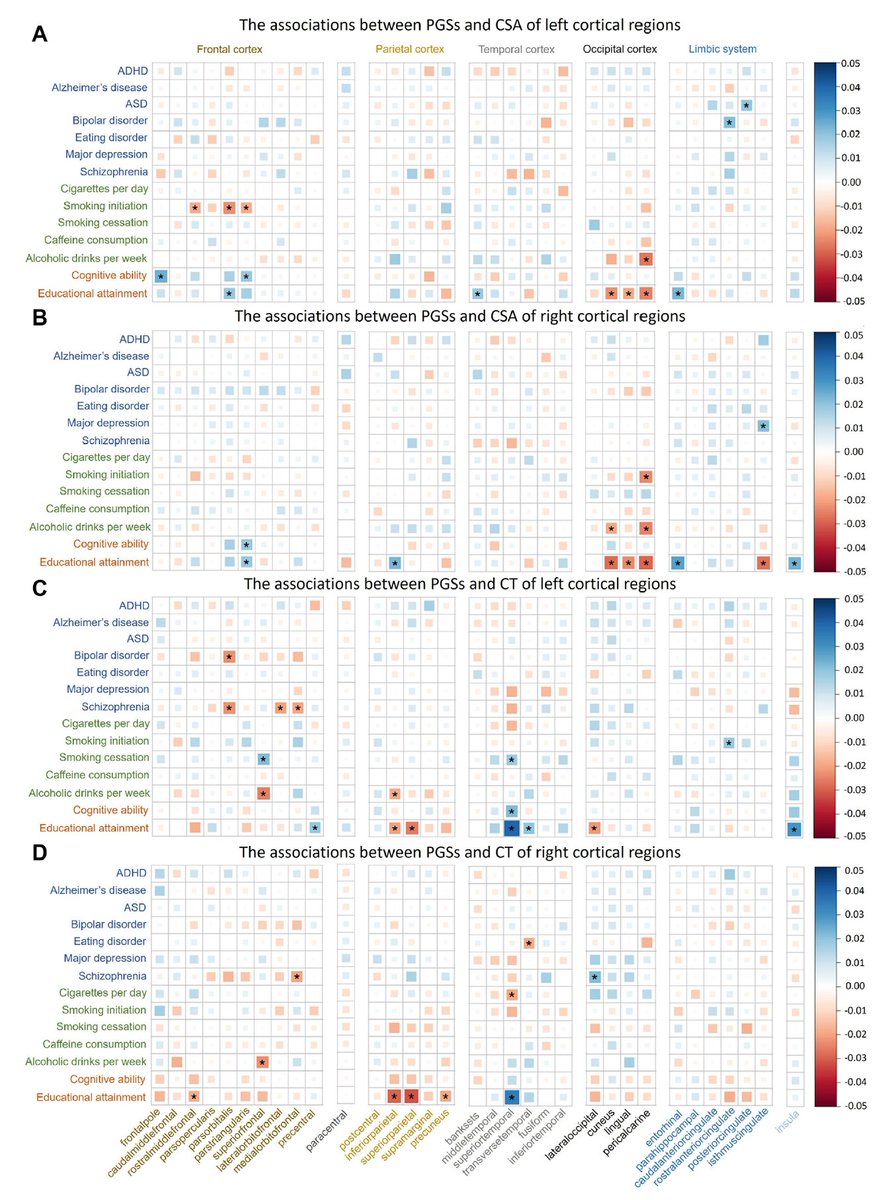
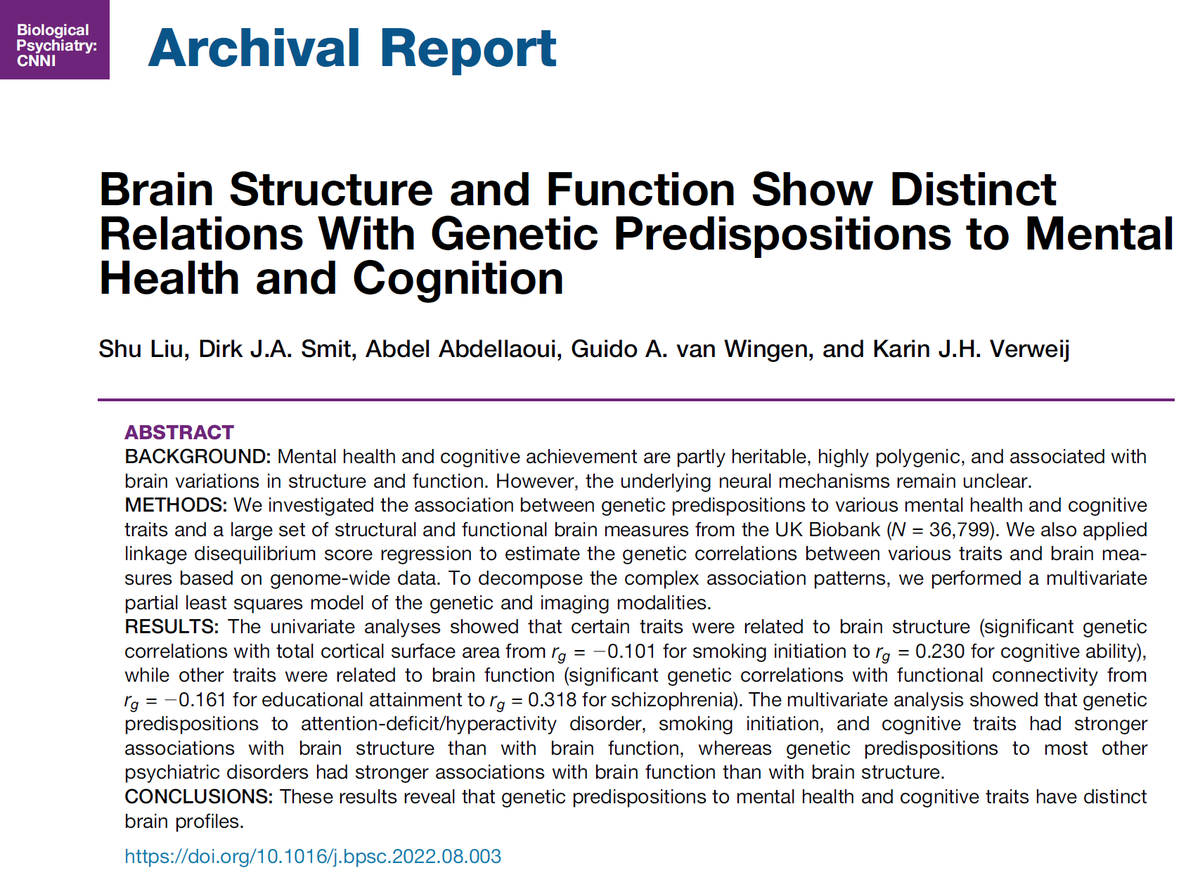
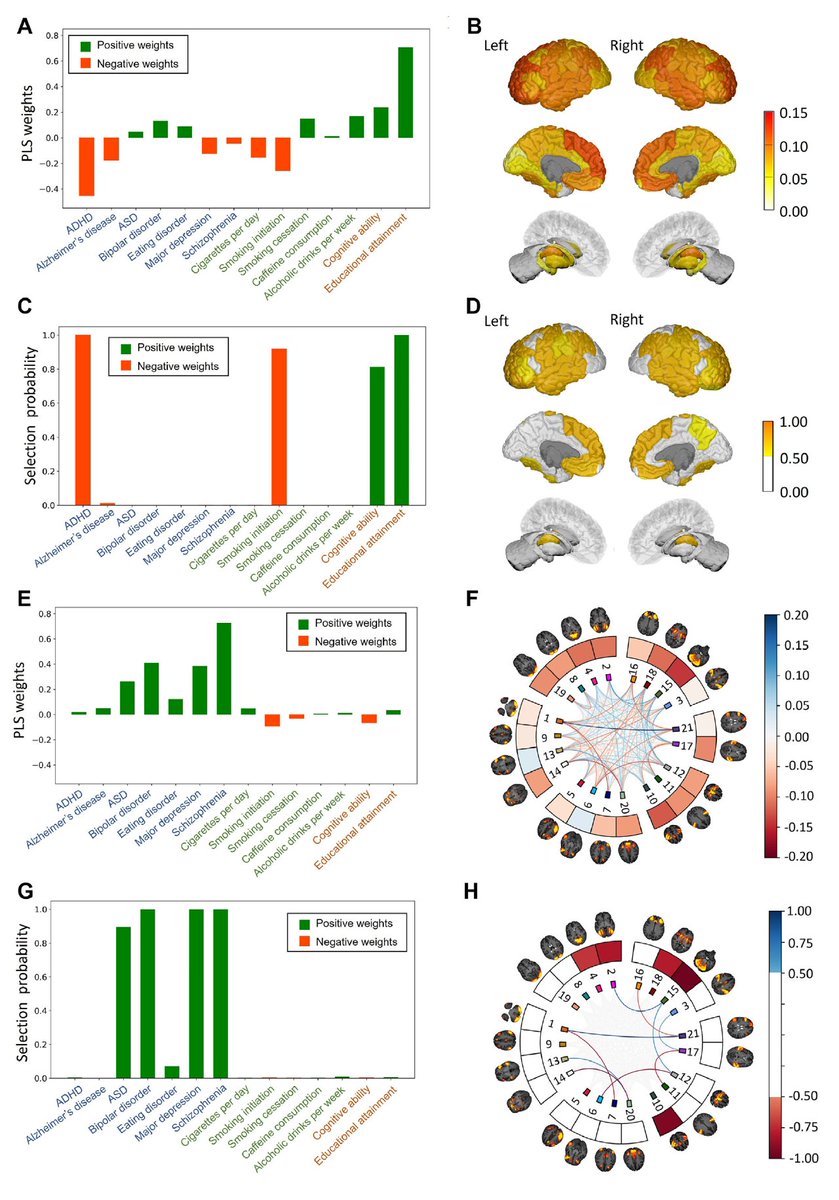
ADHD & cognitive polygenic scores reveal stronger ties to brain structure, while polygenic scores for other psychiatric conditions lean more towards brain function associations 🧬🧠
Out now in @BiologicalPsyc1: https://t.co/maHrR70XjH
How does #DNA affect our fingerprints and eye colour? U of T Evolutionary #Anthropology PhD student Cristina Abbatangelo @cristina_abba95 recently published a "Curious Kids" article with Conversation Canada: 👁️🧬 https://t.co/EzjsNsGXLB
Highly anticipated, unlike anything else at #AGBT23, I revealed the novel sequencing methodology behind Illumina Complete Long Reads. Land-marked technology at the single molecule scale generates highly accurate long reads & eliminates pain points, cost and complexity.