It's a delight to share that my article on "Modifying Headers In HTTP(s) Requests In UI Automation Testing" got published.
https://t.co/GMdrJZRxjF via @smashingmag
@gamesover@RequestlyIO It has not been released yet. We submitted it on Monday. It should be released by Friday. Takes around 2-4 days in edge store. In chrome store, its quicker (around 1-2 days).
@gamesover@RequestlyIO No, there have been no rejection in edge store. After migrating to MV3, Requestly was not stable in edge. So we decided to stick to MV2 extension (v24.5.8) in edge and firefox as it was more stable.
We stabilized the MV3 extension last week and plan to release today.
@gamesover@RequestlyIO Alternatively, you can try Requestly's blocklist feature to block Requestly on that particular website. Refer here: https://t.co/93oBK8f9ah
@gamesover@RequestlyIO Ah. I got it. Can you please try the extension v24.11.25 from https://t.co/QML45yx69x
(I think edge allows installing extension from chrome store)
Meanwhile, we will release the latest extension in edge add-ons store.
just found out about http interceptors and how they allow us to inject mock data in live responses.
feels like an efficient way to test frontends for edge cases without relying on backend changes or setting up accounts and APIs to simulate scenarios.
definitely spending some more time today exploring it and also skimming @RequestlyIO's code to see how they actually do it ... seems pretty fun.
here's the source code, in case you are interested
https://t.co/8uszUiqBPK
We just launched @RequestlyIO on @ycombinator's Launch YC!
Requestly is an Open-Source API Mocking & Testing Tool for Developers 🚀
Think of a better alternative to Postman + Charles Proxy
Check out 👇https://t.co/V7xVRDnhIo
Our Browser Extension and Desktop App now talk to each other.
Inspect + Modify + Debug HTTPs Traffic from your Chrome/Firefox smoothly.
Drop in your feedback 👇
Recently, a student asked me why they have to learn trigonometry which doesn’t have real life applicability. My response wasn’t convincing. Here is Stanford alumni, Hamza Alsamrae, a math major, who responds as it should be…
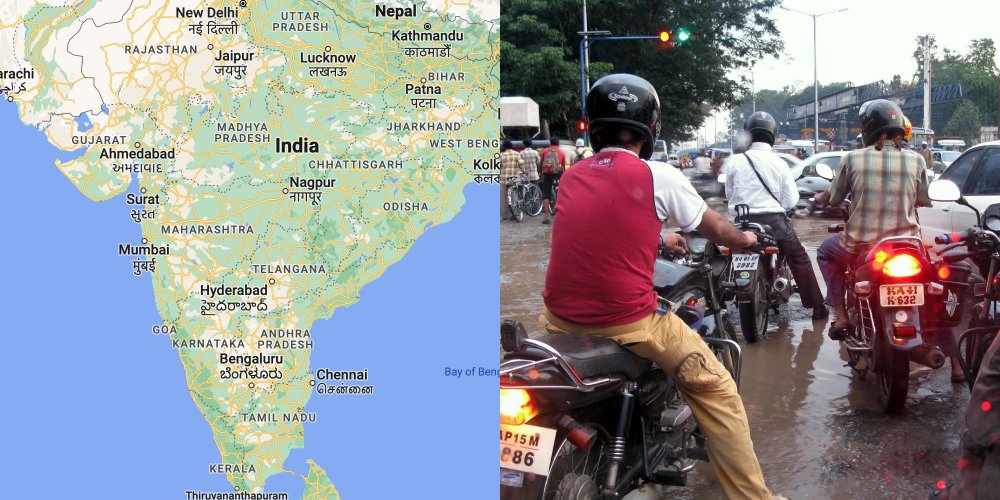
In 2008, Google Maps launched in India.
But we quickly ran into a problem:
Nobody used street names.
And street names were the foundation of Google Maps.
The team had to make some big adaptations.
15 years later, the changes have stood the test of time.
Here's how the team came up with creative solutions to adapt Google Maps to work in India:
–––
When Google Maps launched in India, turn by turn directions were unusable.
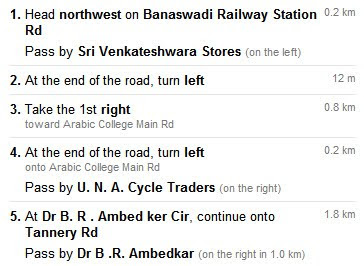
Because there were no road names, directions looked like this:
This was before real time, accurate GPS in phones had become mainstream.
In short, directions were pretty much useless in India.
–––
We could have left the product as it was.
We could have assumed it was good enough, would get better over time, or that eventually people would adapt.
But India was a massive potential market and we wanted the product to thrive.
The solution wasn’t just a case of acquiring and cataloging street names.
Many streets either didn’t have names, had multiple names, or weren’t known by their official names.
So we had to find an alternative.
We already knew that many communities around the world relied on landmarks (rather than street names) for navigating.
e.g. “Turn left at the park, head towards the water”
We knew this was also true in India.
But we had to confirm landmark based navigation would work.
And if it did, how we could make it work.
–––
So we dove in.
We started to explore how Google Maps could work if it oriented around landmarks.
But we needed to understand 2 key questions:
1. How did people use landmarks to navigate in India?
2. What types of landmarks were good for navigating?
This is where user research came in.
At the time, Google had robust support for user research.
There were research labs on campus with eye tracking technology and one-way mirrors.
There was a team dedicated to recruiting research participants.
But in this case, my friend and researcher extraordinaire, Olga (@okhroust) simply focused on how she could best answer these key questions.
She put together a creative and scrappy research plan.
And then she and Janet, the designer, hopped on a plane to India.
–––
What followed was nimble, on the ground field research to understand, first-hand, the answers to these questions.
They creatively explored various approaches including:
• Calling businesses and asking them for directions to their stores
• Asking people to draw diagrams of routes to familiar places
• Following people around as they navigated unfamiliar places
• Recruiting people to keep track of directions they gave or received + later interviewing them on their experiences
• Sharing early designs of landmark based directions and asking for feedback
Rather than relying on sophisticated technologies or being bounded by formal research methods, they creatively tried several different tactics to understand how locals navigated their way through India.
Olga and Janet found that people used landmarks to navigate in a few key ways:
• Orientation: “Head towards the water”
• Description of a turn: “Turn just past the Big Bazaar”
• Confirmation of the right path: “You'll see a petrol station on the right”
• Error correction: “If you get to the roundabout, you've gone too far”
Landmarks that were used for navigating included parks, monuments, shopping centers, notable buildings, stores, petrol stations, roundabouts, etc — basically anything that anyone would notice while on the road.
And so the team reworked turn-by-turn street directions to include navigational landmarks to help orient people, signal turns, confirm direction, and error correct.
The team worked through several iterations before landing on a final solution that emphasized landmarks, but also subtly included road names (when available):
–––
The research drove the product changes that helped transform Google Maps into the dominant navigational product for India.
A lot has changed in the last 15 years with the pervasiveness of location-enabled mobile phones, cheap mobile data, and generally how locals navigate in India.
But the use of landmarks to help people navigate through India has stood the test of time.
–––
What I love about this story and my 2 biggest takeaways are:
1. Research is a critical tool for ensuring you’re building a good product
2. Research can be as simple as just talking to people to answer your questions
tl;dr: If you are looking for answers, go talk to people.
For more on design + tips for early stage founders, follow @elizlaraki
🚀Recently, @Requestly we shipped “Test this rule”. Now it's easier check when your rule is executed.
🎯The next step is to integrate it with session replay to obtain network and console log details when the rule is executed on the webpage.
#debugging#FrontEnd#webdevelopment
Yay, we did it!
🏆 #1 Product of the Day for Session Replays by Requestly
🎉 Thank you so much for your support and love! With your help, we were able to achieve this feat.
💬 We couldn't have done it without our amazing community. Your feedback and support have been invaluable to us, and we are grateful for each and every one of you.
#ProductHunt #SessionReplay
We’re now live on @ProductHunt with Session Replays
🎥A Modern way to capture, report, debug & fix bugs faster in web applications.
🎁 We’re giving FREE Lifetime deal only on the launch today.
🔗https://t.co/qfrB4owoEN
#ProductHunt#SessionReplay