most of what you see on x are “what” tweets. like what happened. what launched. what someone said, etc.. surface level observations that are easy to consume & easy to share.
this is because very few ppl can consistently operate from the lens of “why.” cuz “why” is much harder.
understanding why something matters, grows, collapses, or spreads usually requires historical context, pattern recognition, incentive mapping, cultural intuition, technological understanding, & second order thinking all fused together. i.e. it requires seeing the invisible structure underneath the visible event.
this is what insight truly is. the why behind stuff is much much more interesting & to boot it acts like a dopamine hit for anyone who reads it.
I’m beginning to think that people don’t really want to work at companies. what they really want is to work at a research lab or a creative studio or a think tank or some other communal setup where likeminded people can do interesting things together
building ambient software is one of the most difficult problems on the planet.
the dominant paradigm for product dev has always been relatively straight forward, e.g. user expresses intent & system executes. it’s readable, debuggable, & falsifiable.
ambient fundamentally inverts this contract because the system has to infer intent from context the user never explicitly surfaced, & be right often enough that the inference itself feels like a feature rather than an intrusion.
traditional pm/eng optimizes for “did the user accomplish the thing they asked.” ambient optimizes for “did we model the user’s latent state well enough that they didn’t have to ask.” the former rewards explicitness, instrumentation, & funnels. the latter rewards a kind of editorial restraint that looks like doing less.
this is why there have been very few if any companies that have ever been remotely successful here.
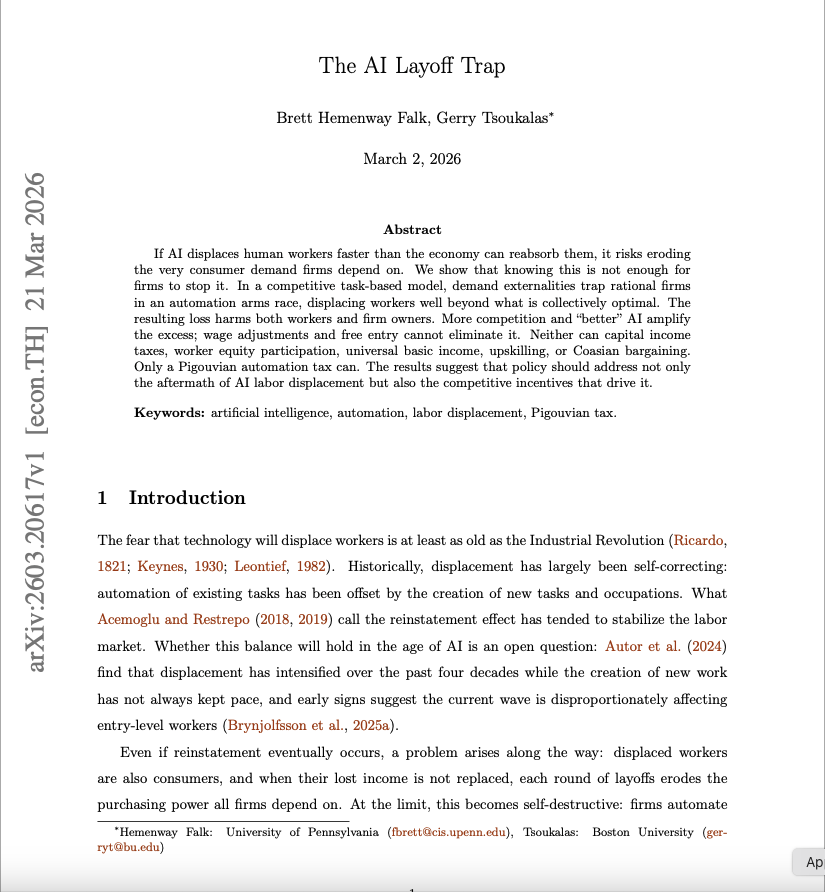
Two economists just published a mathematical proof that AI will destroy the economy.
Not might. Not could. Will — if nothing changes.
The paper is called "The AI Layoff Trap." Published March 2, 2026. Wharton School, University of Pennsylvania. Boston University. Peer reviewed. Mathematically modeled.
The conclusion is one sentence.
"At the limit, firms automate their way to boundless productivity and zero demand."
An economy that produces everything. And sells it to nobody.
Here is how you get there.
A company fires 500 workers and replaces them with AI. A competitor fires 700 to keep up. Another fires 1,000. Every company is behaving rationally. Every company is following the incentives correctly. And every company is building a trap for itself.
Because the workers who were fired were also customers.
When they lose their jobs faster than the economy can absorb them, they stop spending. Consumer demand falls. Companies respond by cutting costs — which means automating more workers — which means less spending — which means more falling demand — which means more automation.
The loop has no natural exit.
The researchers tested every proposed solution. Universal basic income. Capital income taxes. Worker equity participation. Upskilling programs. Corporate coordination agreements.
Every single one failed in the model.
The only intervention that worked: a Pigouvian automation tax — a per-task levy charged every time a company replaces a human with AI, forcing them to price in the demand they are destroying before they pull the trigger.
No government has implemented this. No major economy is seriously discussing it.
Meanwhile the numbers are already tracking the curve. 100,000 tech workers laid off in 2025. 92,000 more in the first months of 2026. Jack Dorsey fired half of Block's workforce and said publicly: "Within the next year, the majority of companies will reach the same conclusion."
Nobody is doing anything wrong. Companies are following their incentives perfectly. That is exactly the problem.
Rational behavior. At scale. Simultaneously. With no mechanism to stop it.
Two economists built the math. The math leads to one place.
Source: Falk & Tsoukalas · Wharton School + Boston University ·
https://t.co/4m8E9jQNYm
your chatgpt history is your unfiltered cognition, the stuff you wouldn’t even tweet.
your browsing history is your raw curiosity trail.
your photos are frozen intimacy & accidental self portraiture.
your messages are emotional telemetry.
your mail is the transactional skeleton of your life.
your calendar is the architecture of your past & future.
your location history is where you actually go vs. where you say you go.
your notes are a private brain dump, unpolished truths.
once ai understands all of these at scale, it will unlock the most spiritual experience of your life. like an existential journey into the inner most *you*.
the winner of health + ai will look like:
“i understand you better than your doctor,
i notice patterns you can’t see,
i tell you why things matter,
i help you act today,
i make it feel worth doing tomorrow.”
biggest market on earth. infinite edge cases.
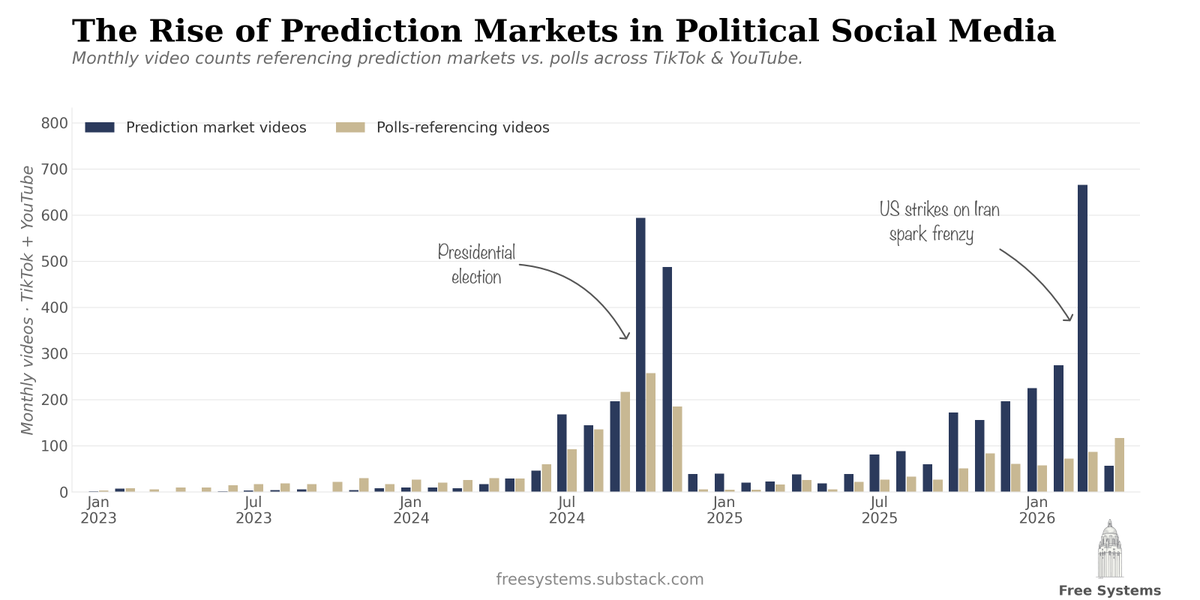
In the clip economy, prediction markets are replacing polls as the source of truth.
My new research with @PairieK: TikTok and YouTube videos about politics now cite prediction markets more than polls.
To "monitor the situation" we need real-time info on many topics. Prediction markets have the speed and breadth for up-to-the-minute clipping for social media---polls don't.
What will this mean for our information environment? We should design prediction markets to be the most reliable information source for political events we can. That's what we've been working on, and we'll be releasing the latest version of our Bellwether system this coming week.
You can check out the full post on our new research on prediction markets and the clip economy below.
most ppl fail to realize that every social relationship almost always requires context as it’s foundation. this can be a shared institution, ritual, geography, or even mutuals.
w/o this you’re just sampling from a distribution of strangers & hoping for some overlap. aka effective gambling. & you’ll get gambling odds as a result.
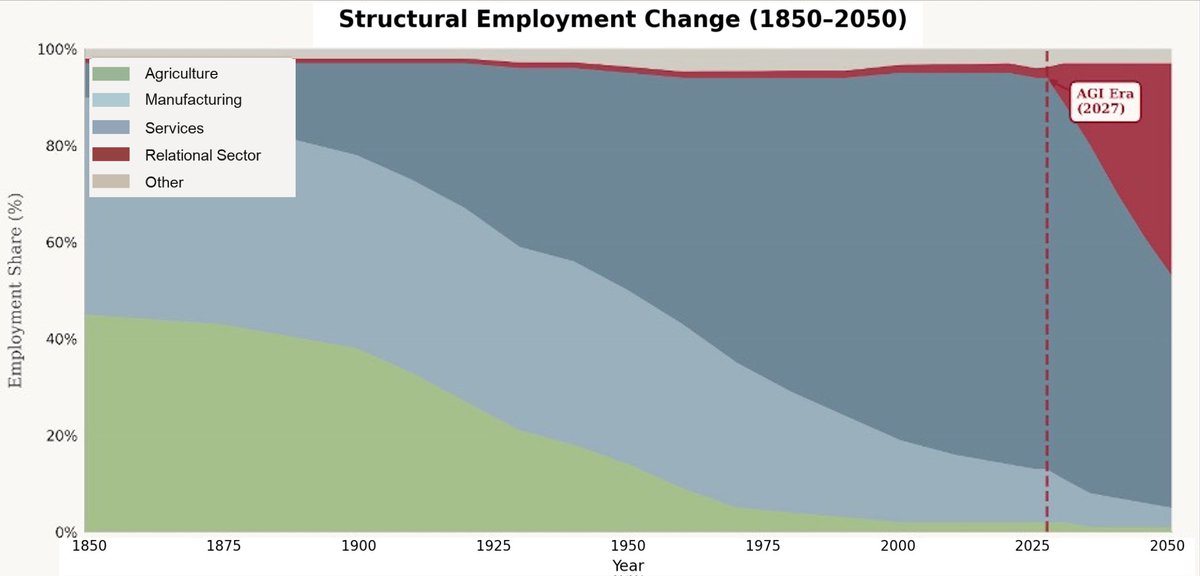
New essay on the economics of structural change and the post-commodity future of work.
1. Almost any question about the impact of advanced AI on the economy needs to start at the same place: what is still scarce? Answer that, and the analysis becomes pretty straightforward. This essay explores what becomes scarce if AI really can replicate most of what humans do in production, and what this mean for the future of jobs.
2. My conjecture, working through the economics: labor reallocates across sectors, and the sector it reallocates to has properties that keep labor a meaningful share of the economy. Ultimately this is about the structure of demand itself. For this, we have to go back to Girard, Augustine and Rousseau: once people's base needs are met, their preferences shift to comparative motives (e.g., status, exclusivity, social desirability). This motive is inherently non-satiated.
4. The key paper is Comin, Lashkari, and Mestieri (Econometrica 2021). As people get richer, they don't buy proportionally more of everything. They shift spending toward sectors with higher income elasticity. They estimate income effects account for 75%+ of observed structural change.
5. The ironic consequence: the sector that gets automated becomes a smaller share of the economy, not a larger one. Agriculture got massively more productive and its share of employment collapsed. Manufacturing too. The "stagnant" sectors absorb the spending and the jobs.
6. So the question is: which sectors have high income elasticity in a post-AGI world? I argue it's what I call the relational sector. Categories where the human isn't just an input into production, it is part of the value.
7. Why does the relational sector have high income elasticity? Because human desire has a mimetic, relational dimension. We don't just want things for their intrinsic properties. We want what others want, and we want it more when others can't have it. Girard, Rousseau, Augustine, and Hobbes all saw this.
8. In work with Kristóf Madarász, we showed this experimentally: WTP roughly doubles when a random subset of others is excluded from the good. And in new work with Graelin Mandel, AI involvement kills the premium. Human-made art gains 44% from exclusivity; AI-made art only 21%.
9. This all comes together for the core argument. The sector that absorbs spending as AI makes commodity production cheap is one where human provenance is part of the value, and demand for it grows faster than income. Exactly the profile that keeps labor meaningful.
10. To be clear about the claim: I'm NOT saying aggregate labor share must rise. It may fall. The claim is about sectoral composition, i.e., where expenditure and employment go once commodities get cheap, and the fact that the sector that will absorb reallocated labor maps to a substantial component of human preferences and desire.
11. If you're interested in the formal model, a linked companion technical note works out all the economics.
Read the essay here: https://t.co/NcjVgn2o8g
The Smart-Person Trap
The smarter you are, the better your bad ideas will sound.
You won’t see the trap because you’re the one who built it. You won’t feel the danger because the logic checks out. You won’t hit resistance until it’s too late.
This is how smart people fail. Not by being wrong. By being convincing.
Examples That Prove the Pattern
Theranos didn’t fool the uninformed. It captured the informed. The vision overwhelmed the questions. The tech didn’t need to work. Not yet. It just needed to sound like it almost did. No one wanted to be the small thinker in the big room.
Quibi had the money, the founders, the talent. They skipped the test because they had the credentials. No one paused to ask if the consumer needed what they were building. The idea worked on paper. The market never showed up.
Google Glass didn’t flop because of the tech. It flopped because it made people uncomfortable. You can’t wear surveillance on your face and expect society to adjust. The product made sense. The context said no.
The Deeper Problem
Smart people don’t usually fail from stupidity. They fail from insulation. They build airtight logic inside broken systems. They over-rely on narrative. They outpace friction. They justify tradeoffs no one else gets to see.
The strategy looks sound. The risk feels managed. The failure becomes obvious only in hindsight. It all looked clean, until it met the real world. And by then, it’s too late to ask the obvious questions.
How to Escape the Smart-Person Trap
1) Rebuild your feedback loop. If no one’s telling you what feels off, you’re already too far inside.
2) Watch behavior, not belief. What people do is always more honest than what they say.
3) Make your smartest people test their ideas in public. Logic should survive contact.
4) Reward the dumb question that stops the runaway train. Not the smart answer that makes it go faster.
5) Assume the system is wrong. Then go prove it’s not.
This isn’t about slowing down. It’s about staying connected. The goal isn’t to prevent failure. It’s to keep failure small and obvious, before it becomes expensive and systemic.
For the CEOs, Founders, and Execs
If your company is full of smart, articulate, high-agency people then this trap is already forming. You’ll hear great answers. You’ll see tight decks. You’ll get strong alignment.
And none of it will matter if the foundation is wrong.
Great companies avoid the trap by designing environments where truth has an edge.
This isn’t a startup problem. It’s a leadership problem. And it starts with you.
I launched 20+ startups using the following playbook:
Audience → Problem → Idea → Validation → Waitlist → SEO → One Feature MVP → Iterate → Marketing → Success.
See a full breakdown of each step 🧵 :
Principle 3:
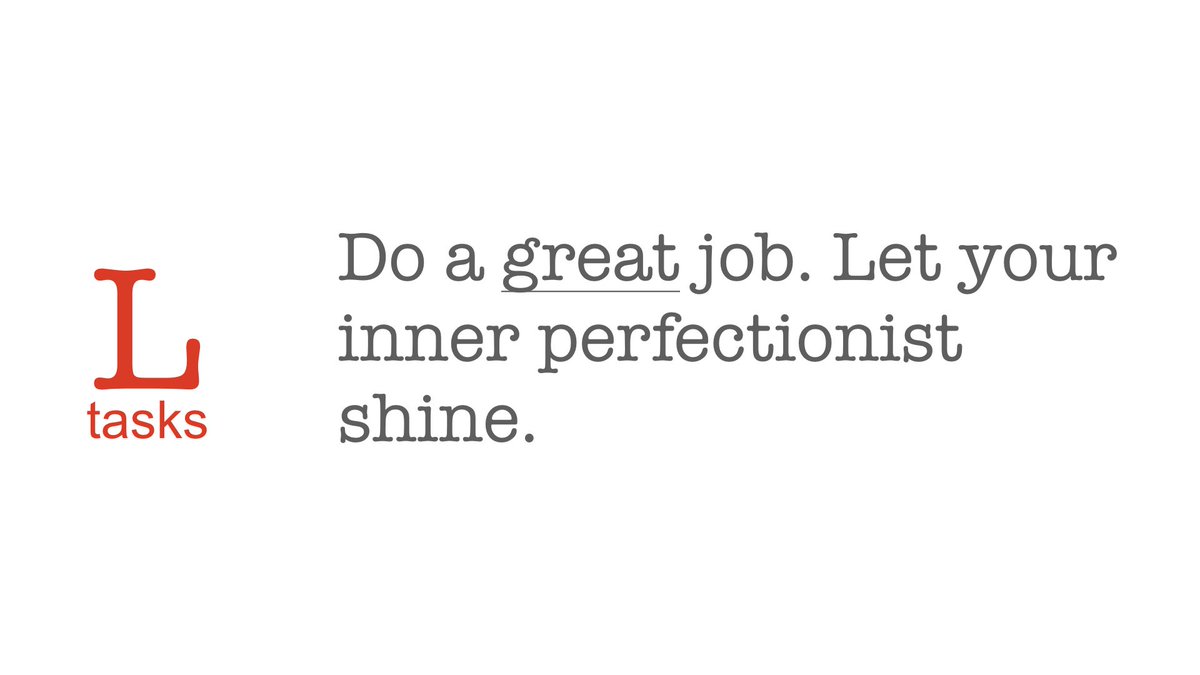
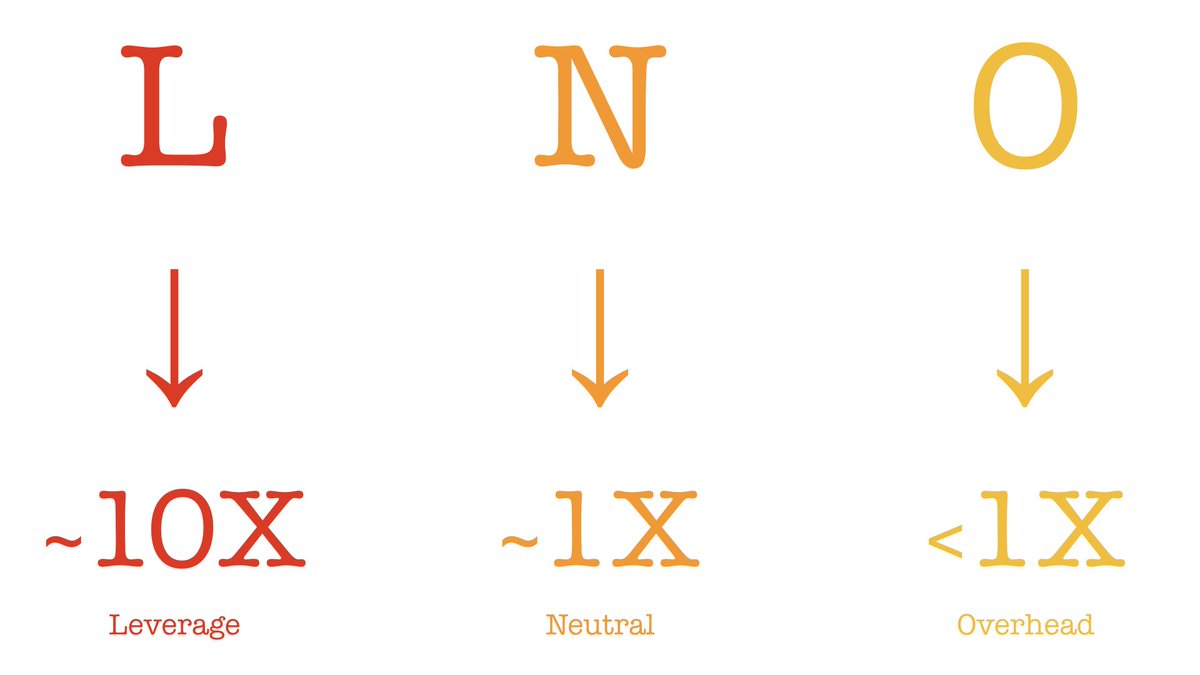
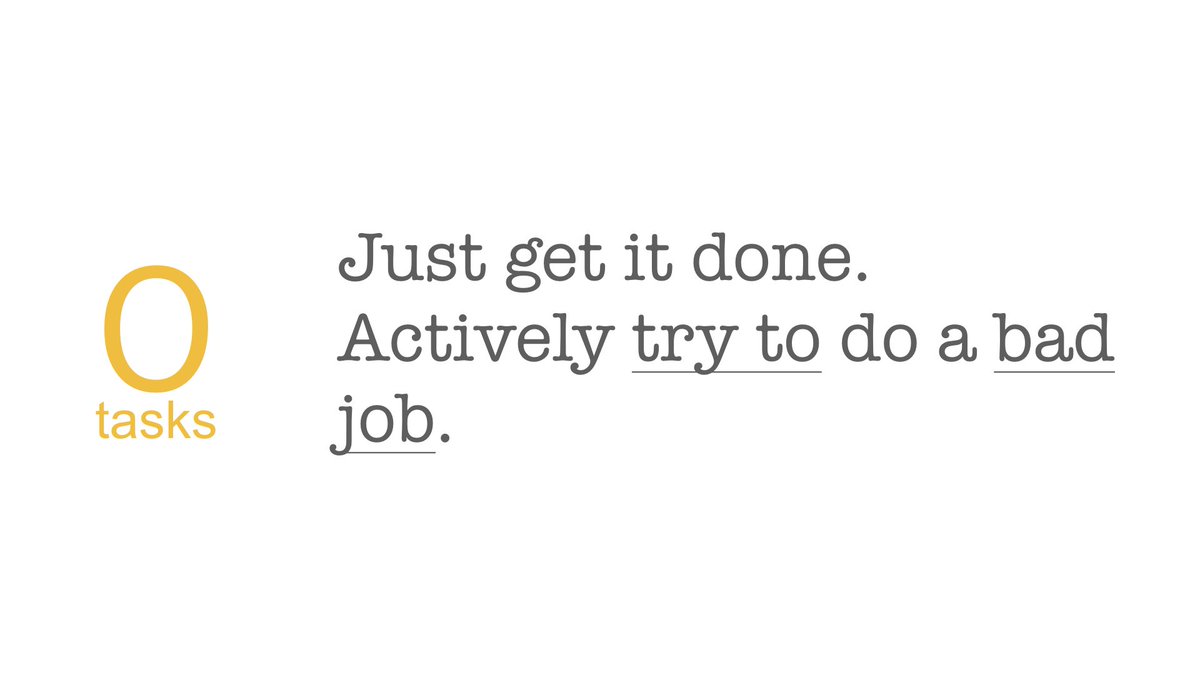
All your tasks are not created equal. Doing great work doesn't mean that you put in your best effort for every task
Understand the difference between Leverage tasks, Neutral tasks, and Overhead tasks, and aim for a different degree of quality for each type of task: