(1/15) Today, I'm proud to share Neurospectrum, a #DeepLearning framework for neural dynamics, out in Neurocomputing! Neurospectrum is a graph-based network that represents brain activity as graph wavelets and then uses an autoencoder to dimensionality-reduce this representation while preserving geometry and trajectories. The trajectories are then characterized by a series of geometric and topological descriptors for regression and classification tasks, including classification of OCD.
https://t.co/zrX5jPQa26
13/n Finally, we need to distinguish between superstition, scams, quackery vs genuine efforts using traditional or hypermodern knowledge, where data generation is planned and truth will become known. In the end data will speak for medicine and consumers will speak for experience
Oh, so this is why we mapped out all 166,000 of the male fruit fly's neurons. Check out the big community effort to show just how much these tiny fly brains are capable of 🪰🧵
Visualization of the Navier-Stokes blowup solution: left- and right-handed swirls (blue and purple) wind up while the axial flow (brown) shrinks, but slower. As a result, the vortex core develops a singularity.
The news today of progress on resolving the Navier–Stokes problem, one of mathematics’ great longstanding challenges concerning the equations that govern the flow of fluids, represents a milestone advance in human knowledge. This story began with Navier, Stokes, Leray, and Ladyzhenskaya and has culminated in the recent breakthroughs of Córdoba and Martínez-Zoroa, then — assisted by new technologies — Alpöge and Buckmaster, with the final steps taken by OpenAI mathematicians. The purpose of mathematics is human understanding, and this achievement, and the process that led to it, will bear fruit for a long time to come.
Ravi Vakil, President of the AMS, and John Meier, CEO of the AMS
Read more. Link in comments.
While walking to work, I just had a chat with ChatGPT to make sure I understood what the claimed singular solution to Navier-Stokes would mean *physically.* Here's a tweet thread it generated for me. Hope you find it helpful. (I rewrote it a bit to clarify what's surprising.)
A spider, a web, and a handful of Mathematical constraints.
Each step actually pulls on the silk, redistributes tension, and deforms the network.
Geometry, mechanics, simple rules.
A company called eka care messaged us out of the blue, with a copy of our childs doctors prescription.
We checked the website, and they're an "AI Native Ambient Healthcare platform" for "patient context".
So our childs data is being collected in an ambient manner and used for AI? without verifiable consent by the doctor.
We certainly don’t want patient context to be developed around our child by this platform. Eka’s privacy policy explicitly says that they retain the right to: “programmatically use Your data to give You contextual Services.” The DPDP Act also says and despite parental consent, there should be no behavioral monitoring of the child. health data over time is behavioral data.
Their privacy policy was written for the IT Act, not DPDPA.
It doesn’t have purpose limitation, which means that they claim that they can use the data for any purpose, which could include AI training.
Their website also doesn’t mention any Data Protection Officer. They also disclaim any liability for data breaches, which is a red flag.
They also say that withdrawal of consent will not be retroactive. DPDP gives us the right to erasure.
the website points towards their terms of use, which on their website point to the privacy policy which points towards terms of use (which don't exist).
I've drafted and sent a withdrawal of consent notice to the doctor and told him that he's the data fiduciary, and hence responsible for taking parental consent, and what they do with the data... the liability will fall on him and he's dealing with childrens data.
sharing a new long-form blog post: ai chip architectures
it covers the leading chip architectures (nvidia, amd, tpus, trainium, cerebras, groq) across architecture, scaling (scale-up and scale-out), and software stacks.
it helps build an intuition for the architectures and their trade-offs.
https://t.co/7eZMh3ddZS
3/ Each community is a social network of agents with different personas.
They discuss questions ranging from math problems to statements like: “Nuclear power is essential for clean energy.”
Agents talk with their neighbors and update their opinions across multiple rounds.
New work I'm very excited about: Physics of Agents!🤖
As AI agents become more prevalent, they'll interact and influence one another.
Can we predict the collective behavior that emerges?
Surprisingly, their dynamics follow compact, predictive laws of statistical physics🧵
🚨 Bhubaneswar-based Serendipity Space (@serendipityind) has successfully tested India’s first autonomous pharma factory, Alchemy, on a near-space mission.
It crystallized drug compounds and preserved them during recovery, testing key tech for future microgravity manufacturing.
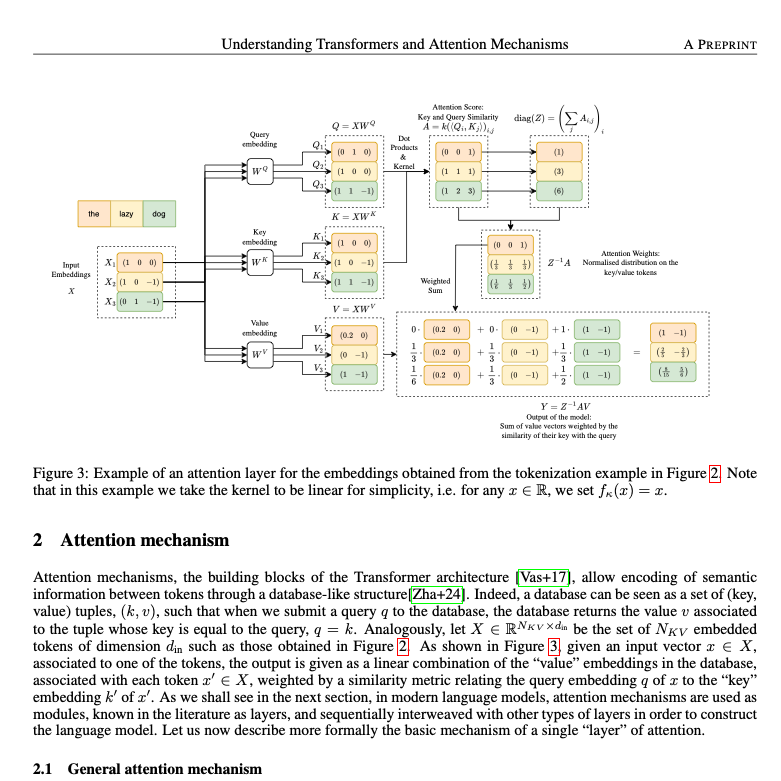
"Understanding Transformers and Attention Mechanisms" is a very interesting paper that presents the Transformer architecture from the perspective of applied mathematics.
It starts by representing text as vectors and explains mathematically how the attention mechanism processes these vectors to encode contextual information. It then develops Multi-Head Attention and shows how the main components of the Transformer architecture are constructed.
The paper also discusses more recent methods designed to reduce the computational and memory costs of attention, including KV caching, Grouped Query Attention, and Latent Attention. I think it is a useful reference for anyone interested in understanding Transformers beyond their high-level architecture and in seeing the linear algebra behind modern language models.
https://t.co/Rlun9QT7zx
I finally have all 1.2 million raw image files from my latest mission to ISS! Here is a sample of one of my favorite Milky Way photos, taken from the Cupola with Nikon Z9, Arri Zeiss 15mm lens, T1.8 with custom sidereal drive that cancelled out star motion relative to our orbit.
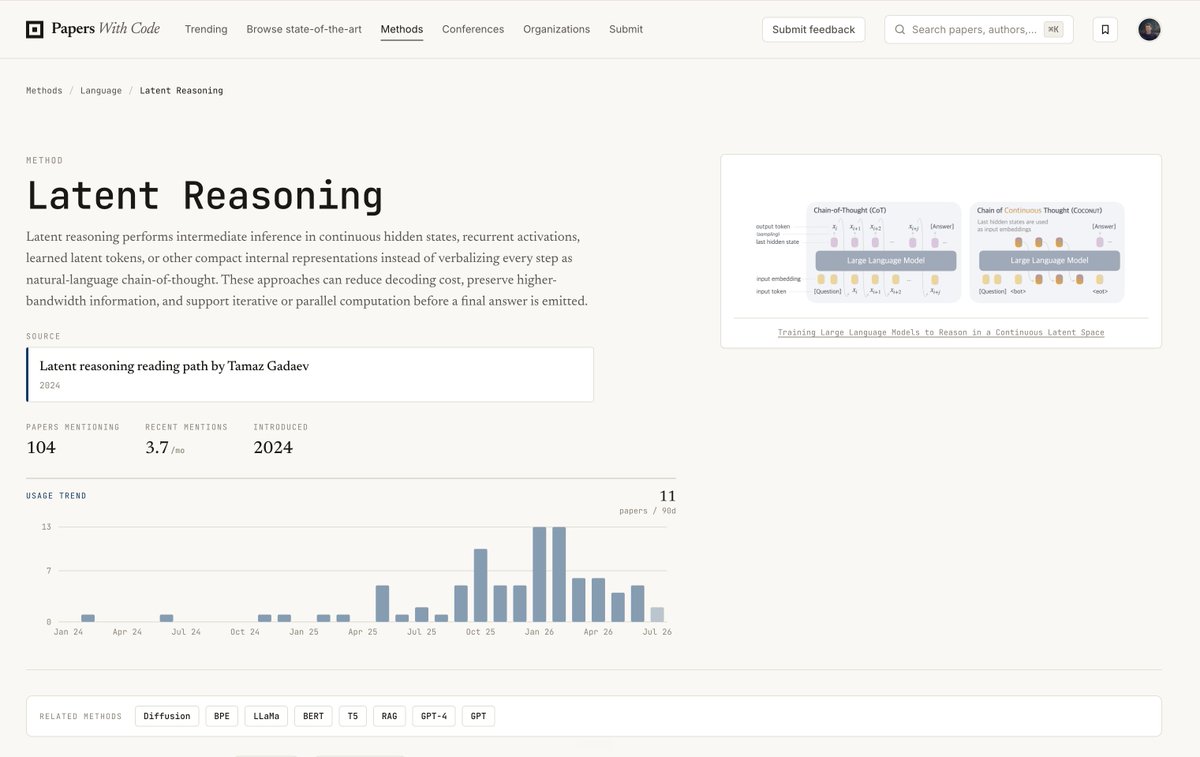
Latent reasoning is quite a hot topic.
What is it? Latent reasoning performs intermediate inference in continuous hidden states, recurrent activations, learned latent tokens, or other compact internal representations instead of verbalizing every step as a natural-language chain-of-thought. These approaches can reduce decoding cost, preserve higher-bandwidth information, and support iterative or parallel computation before a final answer is emitted.
Learn more here, alongside all papers that use it: https://t.co/b7oND61vFR
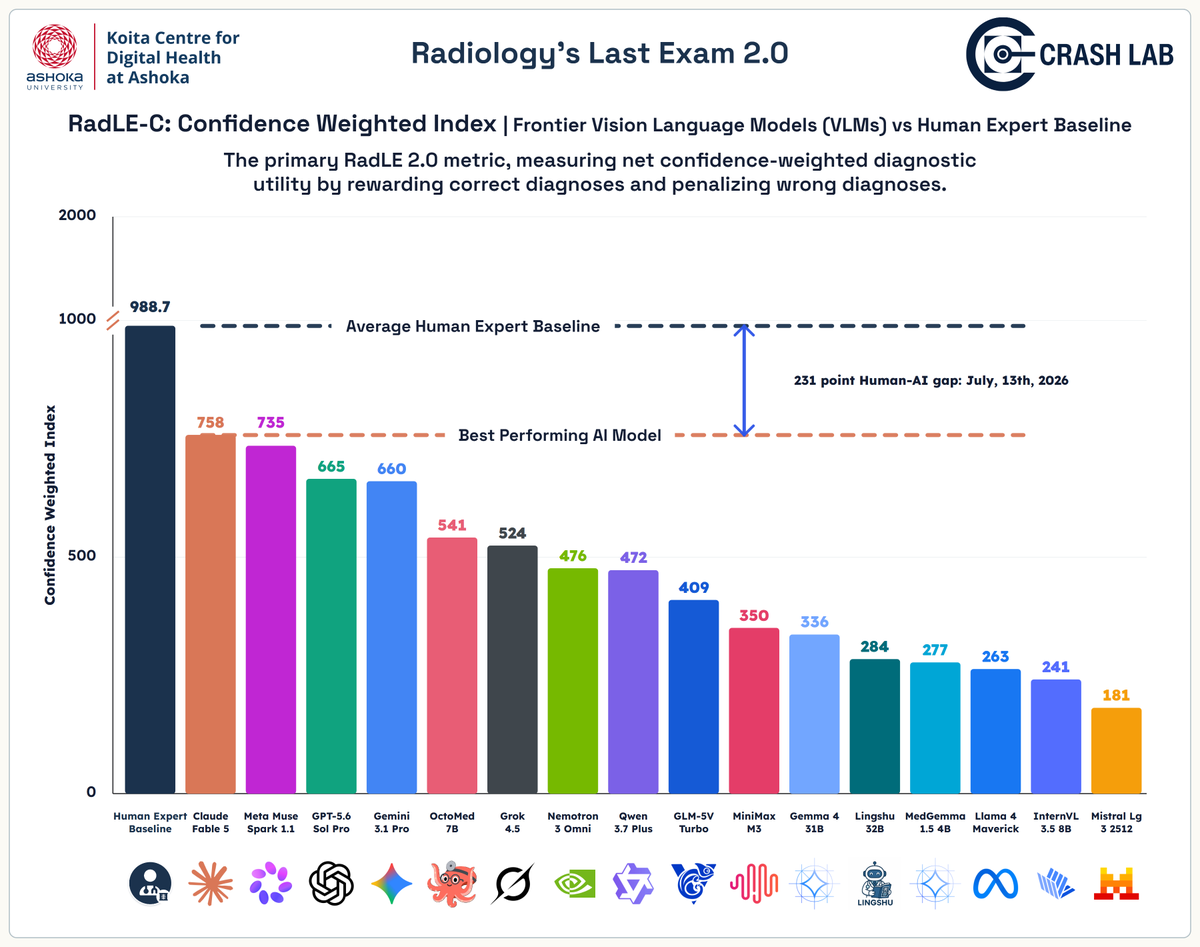
🔥Today, we are releasing one of the first visual reasoning benchmarks for autonomous AI diagnosis in healthcare!
🚀Introducing Radiology’s Last Exam 2.0 (RadLE 2.0) from @CRASHLabAI, an uncertainty-aware benchmark for autonomous diagnosis in radiology!
✅In the last few days, the AI frontier has moved significantly. @OpenAI launched GPT-5.6 Sol. @Meta launched Muse Spark 1.1. @xAI dropped Grok 4.5.
🙌We’ve benchmarked all frontier, open-source and medical VLMs in RadLE2.0 and the leaderboard is now LIVE!
🚨 Before AI models are handed autonomy, one question matters more than any accuracy score: Do they know when to STOP and hand over to a human?
⚠️ A confident wrong diagnosis is far more dangerous than an honest “I don’t know.” Yet most models are bad at admitting the latter!
🚀 We release five RadLE 2.0 Scores: Confidence Weighted, Reliability, Accuracy, Safety and Handover Readiness and we find that models from @OpenAI@AnthropicAI@MetaAI@GoogleDeepMind@xAI@nvidia@Alibaba_Qwen@MistralAI@MiniMax_AI all score very differently as they optimize for different metrics!
🚨But most importantly, NONE of the Models have been able to reach the average human expert baseline!
⚡️A thread on what we found and which models aced our metrics! Link to the leaderboard and technical report at the end of the thread!