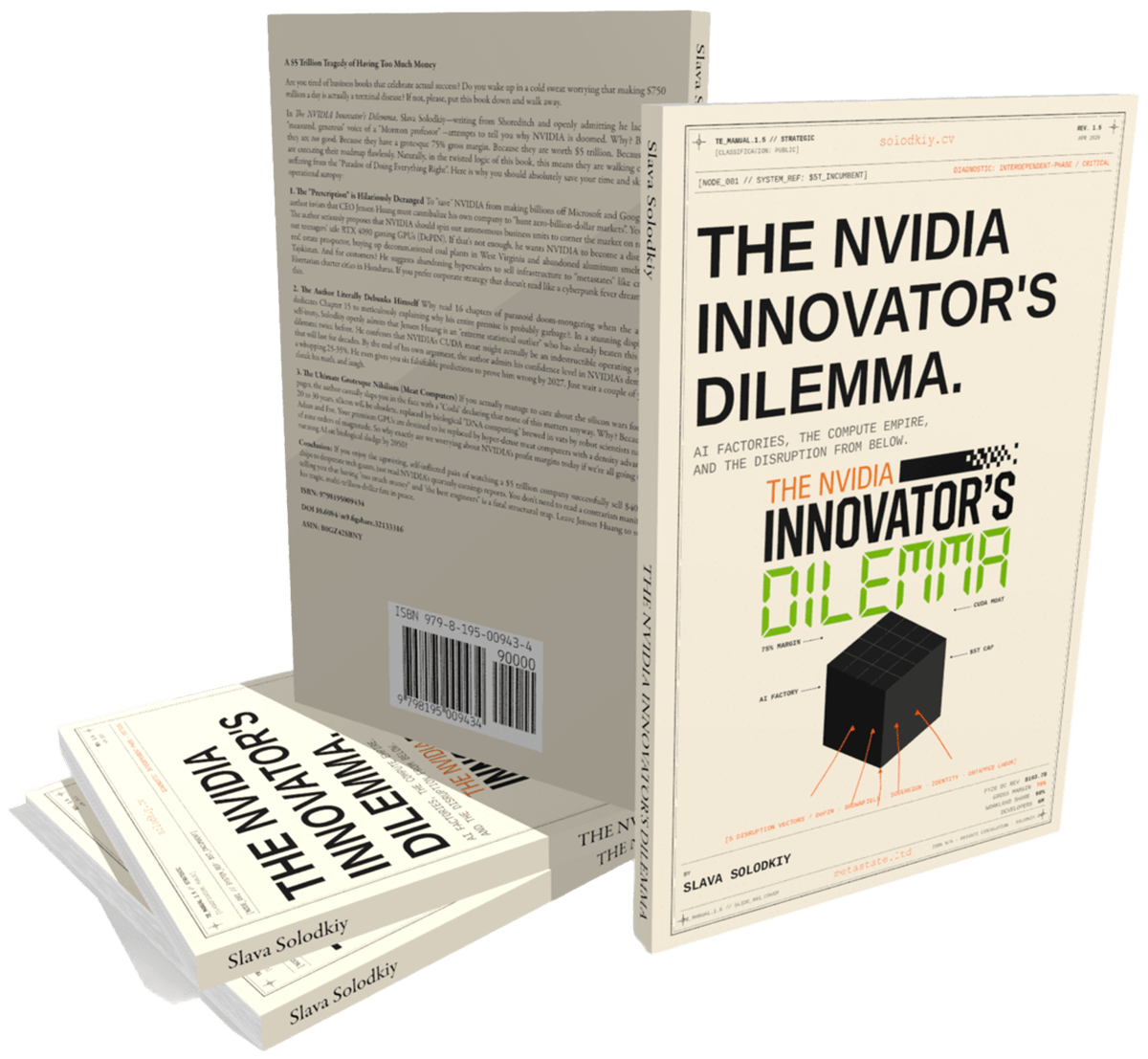
Elon Musk's Metastate of Mega-Tunnels — complete with spreadsheets, politics, etc: https://t.co/3Xlv99eHw0
@boringcompany is still my favorite adjective 🔥 @elonmusk your next 13 Boring Company projects just got pitched O_o
@elonmusk
Just built you the ultimate @boringcompany sequel:
13 “impossible” (not for your imagination!) mega-tunnels turned into a full 'Elon Musk's Metastate' — complete with civic hype, and investable moonshots:)
https://t.co/lWkV0p2GFY next #metastate of tunnels is waiting 👀
The Compute Standard: Why the AI Token is Eclipsing the Silicon Empire?
In the 1930s, the Technocracy movement proposed a radical economic paradigm shift: abolishing traditional fiat money to replace it with a currency backed entirely by physical energy. Supporters of this vision, most notably Elon Musk's grandfather Joshua Haldeman, advocated for an economy where the fundamental unit of exchange was measured in ergs, joules, or kilowatt-hours. In this system, prices would reflect the exact energy required to produce goods, effectively eliminating arbitrary inflation because the money supply would be anchored to the immutable laws of physics.
Nearly a century later, this esoteric vision is materializing not through political revolution, but through the structural evolution of artificial intelligence. In 2026, the global economy is quietly transitioning to a new standard of value: the AI token.
NVIDIA sits at the apex of this transition with a staggering $5 trillion valuation, acting as the de facto central bank of the early AI era. Yet, the company is walking into a classic innovator's trap engineered by its own perfection. The architecture of NVIDIA's dominance is built upon a 75% gross margin, which essentially functions as a massive tax on the hyperscalers and frontier labs purchasing their hardware.
The nature of AI computation, however, has fundamentally changed. The industry's center of gravity has shifted from training massive frontier models—a task requiring maximum precision and bandwidth—to inference, which is the continuous, high-volume process of serving these models in production. Inference is relentlessly cost-sensitive. The primary metric of success is no longer raw supercomputing power, but the cost, latency, and power consumption required to generate a single token.
Because of this shift, the "AI token" is evolving into a form of programmable money. We are witnessing the rise of Decentralized Physical Infrastructure Networks (DePIN), which operate as an "Airbnb for AI". These decentralized networks aggregate millions of idle prosumer GPUs and convert them into a unified, fluid inference network. By leveraging amortized hardware, DePINs can offer compute capacity at 30% to 50% of the cost of traditional centralized hyperscaler clouds.
The bedrock of this new tokenized economy is energy, specifically brownfield energy assets. The binding constraint on AI scaling is no longer the supply of silicon chips, but the sheer availability of electrical power. To bypass decade-long grid interconnection queues, operators are acquiring retired industrial sites, such as decommissioned coal plants and aluminum smelters, to co-locate compute directly at the power source. This fusion of stranded energy assets and decentralized compute capacity creates the ultimate substrate for minting the new currency: raw electricity converted seamlessly into inference tokens.
NVIDIA is structurally paralyzed and unable to participate in this decentralized financialization of compute. The company's internal resource allocation and public-market valuation are entirely tethered to defending its premium 75% gross margins. Pursuing DePIN orchestration or operating at the 20% to 30% margins of the decentralized compute market would require an autonomous spin-out unit, an organizational leap that comfortable incumbents almost never survive.
Meanwhile, universal software abstraction layers like OpenAI's Triton and vLLM are making the AI software stack hardware-agnostic, bypassing the lock-in of NVIDIA's once-impenetrable CUDA ecosystem. The inference workload is becoming entirely portable. When inference is portable, the token becomes a liquid, interchangeable asset.
The future belongs not to the monopolists of the silicon wafer, but to the orchestrators of the compute standard. As envisioned by early proponents of energy-backed economies, the integration of physical energy generation and digital labor is forging a reality where the kilowatt-hour and the AI token are fundamentally indistinguishable. NVIDIA built the forge, but they are structurally priced out of adopting the very currency it mints.
Wes Anderson should make #Hašek's 'The Good Soldier Švejk': https://t.co/6FLENL6QSm Why the hell not?
Pastel trenches. Symmetrical court-martials. #Švejk’s cheerful “yes sir” weaponized into bureaucratic Armageddon while the empire collapses in perfect dollhouse symmetry, and modern geopolitical assymetry. Andersonian in form. Hašekian in content. Malicious compliance never looked this stylish.
@AccidentalWes@QuotingWes@WesAndersonfc@rWesAnderson@SvejkSoldat@Svejk@GoodSvejk@chmnkhbt what do you think?:) there is notable X-post from 2023 by a Catalan publisher account @LesMalesHerbes that explicitly compares a book (Miràbilis) to the styles of both #WesAnderson and #JaroslavHašek
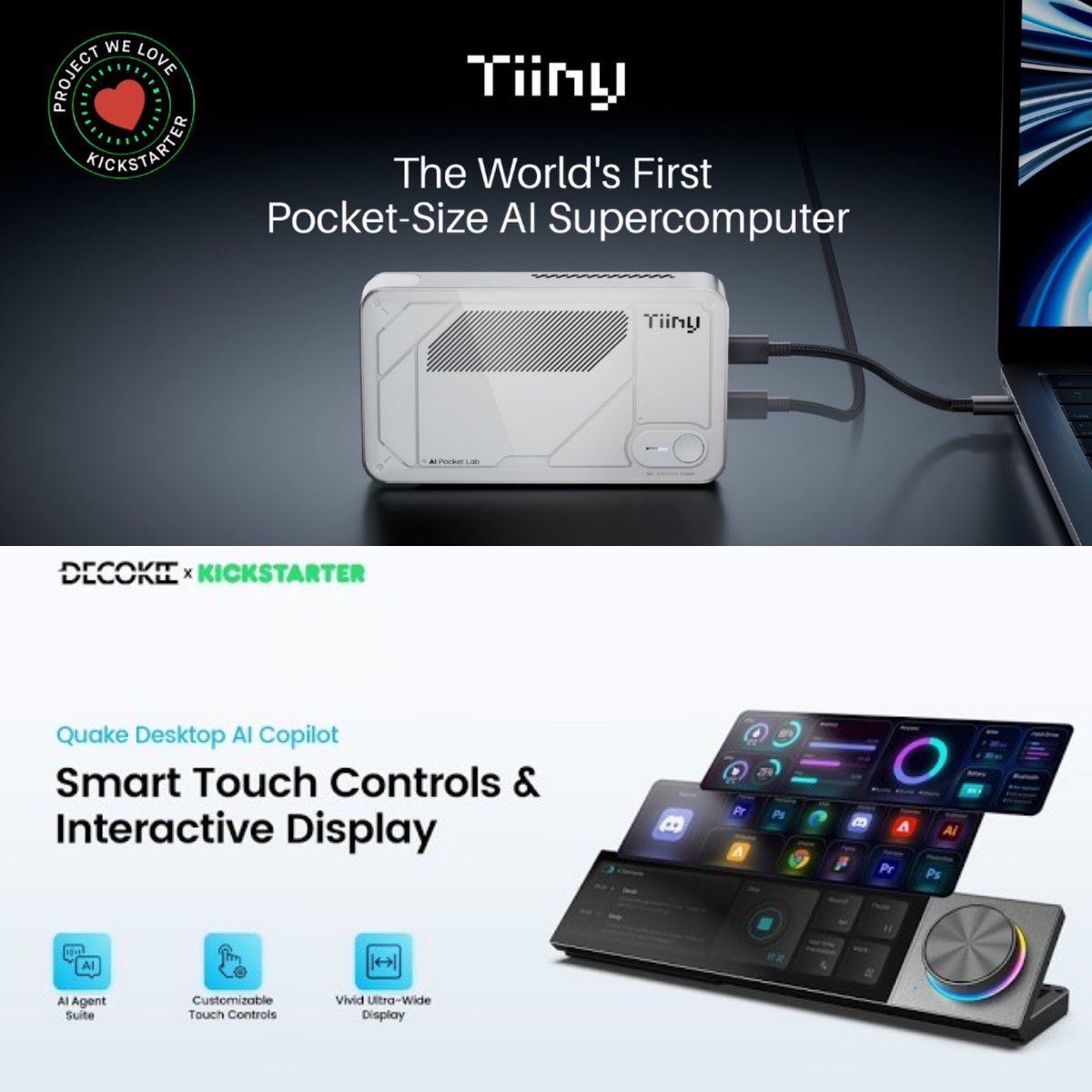
Buy TWO #AI gadgets on @Kickstarter: Wake up with a secret THIRD one for free:)
@TiinyAILab Tiiny Pocket Lab does the heavy uncensored thinking. @DecoKeeTech Decokee Quake becomes its face, hands and soul.
No laptop. No cloud. Just a book-sized offline AI station that actually belongs to you.
I already explained the cheat code 👇
https://t.co/pQnEq5DNWt
My #OlaresOne just landed in London, and I actually need to take a second to thank the @Olares_OS founders and the team behind it.
You can always tell when tech is built by people who genuinely care about the DETAILS. From the physical packaging down to the UX with LaresPass, it’s just incredibly well thought out. The device itself looks like a piece of art sitting on my desk.
With my new friend, this 'remote smart active personal AI-first/focused server,' the reality is that while it’s clearly built for hardcore AI enthusiasts, it’s completely painless (!) for a curious beginner like me who just wants to learn without breaking things.
The weirdest (and coolest) part? I already feel like I’m part of a community. I don’t even fully know what that community is yet, but the vibe is definitely there:) That’s what happens when real people build things for other people.
Huge thanks to the real humans at Olares for the brainpower and hard work you put into this!
(P.S. If you are ever curious about how the setup and daily use actually feels from a total newbie's perspective, hit me up — I’d be happy to write down some 'dummy' feedback)
@Olares_OS Hi team! My @Kickstarter pledge for #OlaresOne dropped due to a temporary card glitch (fixed now). I secured the early $50 deposit and promoted your campaign across X, IG, FB, LinkedIn & Medium. Can you help reinstate my Super Early Bird spot? Backer #596. Thanks! 🚀
Same “high-end” bracket. Two completely different souls 🔥https://t.co/habP5OLDFS:
@AorusOfficial@NVIDIAGeForce RTX 5090 INFINITY → raw, overkill, “I might melt your PSU” energy (32GB GDDR7 + 600W) by @GIGABYTEUSA@ASRockInfo Radeon RX 9070 XT Taichi White 16GB OC → clean, elegant, “I have an LCD screen and still sips power” vibes / & @AMD Radeon RX 7900 XTX
One is the flex. One is the flex that doesn’t bankrupt you.
Which one you riding with? https://t.co/eAOsfKyXue
#RTX5090 #RX9070XT #RX7900XTX @nvidia
#PocketNuke vs desktop apocalypse 🔥@TiinyAILab Pulse running 120B models in your jeans, fully offline, zero cloud cope → #TiinyAI https://t.co/bXvVvRfOeb → You decide who’s the real local AI king.
#LocalAI#PocketSupercomputer#CloudIsDead
Which one you riding with? Tiiny AI vs Olares One vs Apple Mac Studio M4 vs Nvidia Jetson: https://t.co/D9nwVMF7Jx