🚨New paper released today:
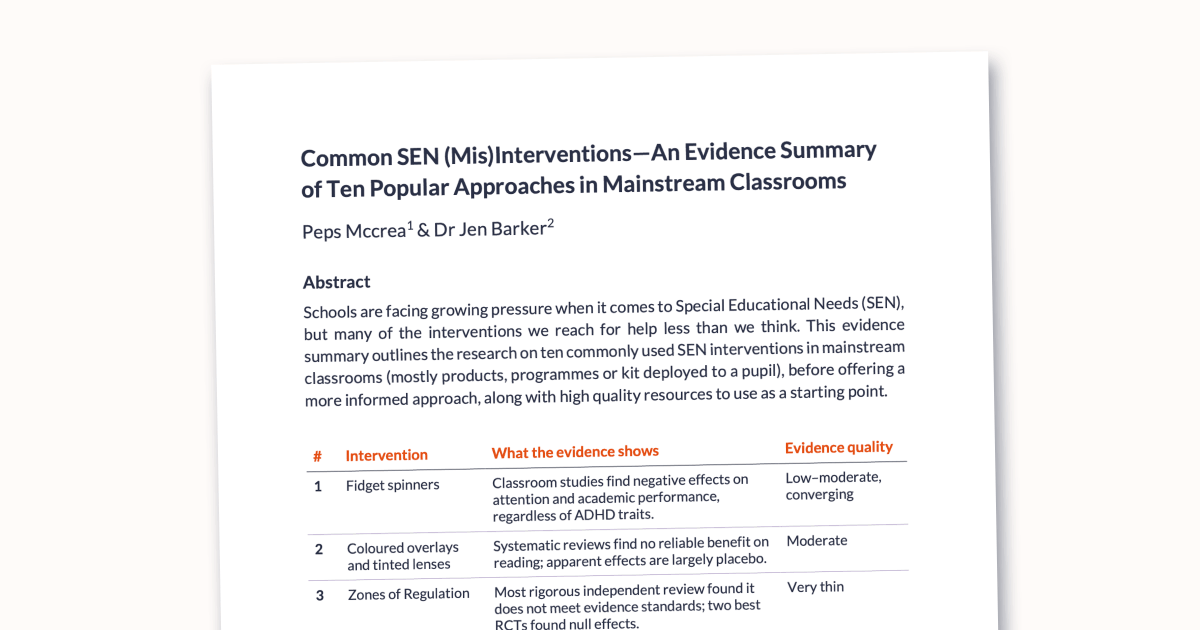
10 Common SEN Mis(Interventions)—An Evidence Summary
https://t.co/8lQNH00Co4
Supporting students with Special Educational Needs (SEN) is a vital and growing challenge for schools. But it’s not straightforward. Learning is complex, marketing claims are confident, and the evidence is often hard to access. As a result, we can sometimes end up adopting approaches which are less effective than we initially think.
For some, this may well be uncomfortable reading. As a profession, many of us have put time, effort and belief into these things, and lots will have seen students who looked like they were getting something from it. However, it’s essential that we temper our intuition with evidence, because ultimately: our most vulnerable students deserve it.
This new paper co-authored with @Barker_J is an attempt to raise the visibility of the best available evidence around several commonly used SEN interventions. For each, we provide an overview of what the research says, offer a more informed approach, and provide a suite of rigorous links to help you get started.
We hope it will serve as a useful resource and over time: push us to be even more 'evidence demanding' as a profession.
As ever, let me know what you think. If you have pushes or suggestions for how this paper could be better, hit reply and give it to me straight.
👊
ATTENTION ALL SENIOR LEADERS
There's something you're probably getting wrong, and it's leading to your middle leaders being miserable. Adam Robbins outlines it perfectly here. Listen in, and if it's challenging that's because it's true!
“…we’ve told young people ‘do whatever you want, be whatever you want, just make yourself happy’. But it actually made them unhappier. The secret… is just stop thinking about yourself. We’re overindulging them.”
Overindulging is a form of ‘low expectations’ masked as empathy.
Two years ago today I published this article making the case for phone-freee schools. The case is far stronger today, now that so many schools are getting great results, esp. hearing noise and laughter in the hallways again.
https://t.co/psleaVTUIL
4 reasons why wait times could be cut short in the classroom are:
📈 The Action Bias
🦸♂️ The Superman Complex
🧠 The Curse of Expertise
🤔 Misconceptions about what learning looks like
To learn what these are and how they would affect you, click here 🡇
https://t.co/Y4qosq1Lxg
"We found remarkably little published evidence on the impact of practical science"
Gatsby, good practical science report
On practical work in science:
There is no serious and robust evidence to support it as an educational intervention that improves:
A. Academic outcomes
B. Long term enjoyment of science
C. Greater takeup at university
D. Transferable skills
There are good reasons to doubt its effect on these things, given what we know about cognitive load and transfer.
We need to be honest about that.
In addition, students saying they enjoy practicals is not a sufficient inclusion criteria. We wouldn't apply that to anything else.
This doesn't mean we *shouldn't do* practicals as part of the way we teach.
There are philosophical ways to justify their inclusion without reference to any of the points above. We just need to be honest about the evidence, and responsible in our claims.
We also need to be clear-eyed about the costs involved. Practicals are expensive, and make science departments generally the biggest budget department in the school. Again, I am not saying that shouldn't be the case, just that it isn't obvious that it should be the case. There are also academic costs. If it's the case that practicals *don't* achieve all sorts of outcomes, then it means we are spending time doing something that is less effective at promoting those outcomes.
In sum:
Let's be honest about the evidence, and have a conversation about them that doesn't involve making claims that aren't grounded.
And again, I am not saying that we should not do practicals.
For more reading:
How to execute practicals effectively: https://t.co/f11Mu7Yspp
Also here: https://t.co/tajg2qbp7e
Theory: https://t.co/HSox5qopnd
There's also lots in my book.
(I'll be offline for Shabbat in a minute, so looking forward to a barrage of lovely replies in 25 hours)
I believe that advice about behaviour management should be:
Concrete (i.e., specific things to do)
Actionable (i.e., possible to do for most teachers in most contexts without a massive workload increase)
Observation-informed (i.e., I've seen it work many times)
Experience-informed (i.e., I've done - and do - it myself)
Compassionate (i.e., does not blame the teacher)
Expectations-led (i.e., does not lower the bar for students)
Humane (i.e., respectful of students and their fundamental dignity as autonomous beings)
Example at the link and extensively on the blog at the "behaviour" tab, and if you want CPD or training you can sign up for updates here https://t.co/1KIWuItNhc
Two of the biggest myths about direct instruction:
1. Pupils are passive while the teacher talks endlessly.
2. The teacher tells pupils everything so pupils don’t think for themselves.
These are completely wrong. 🧵 1/
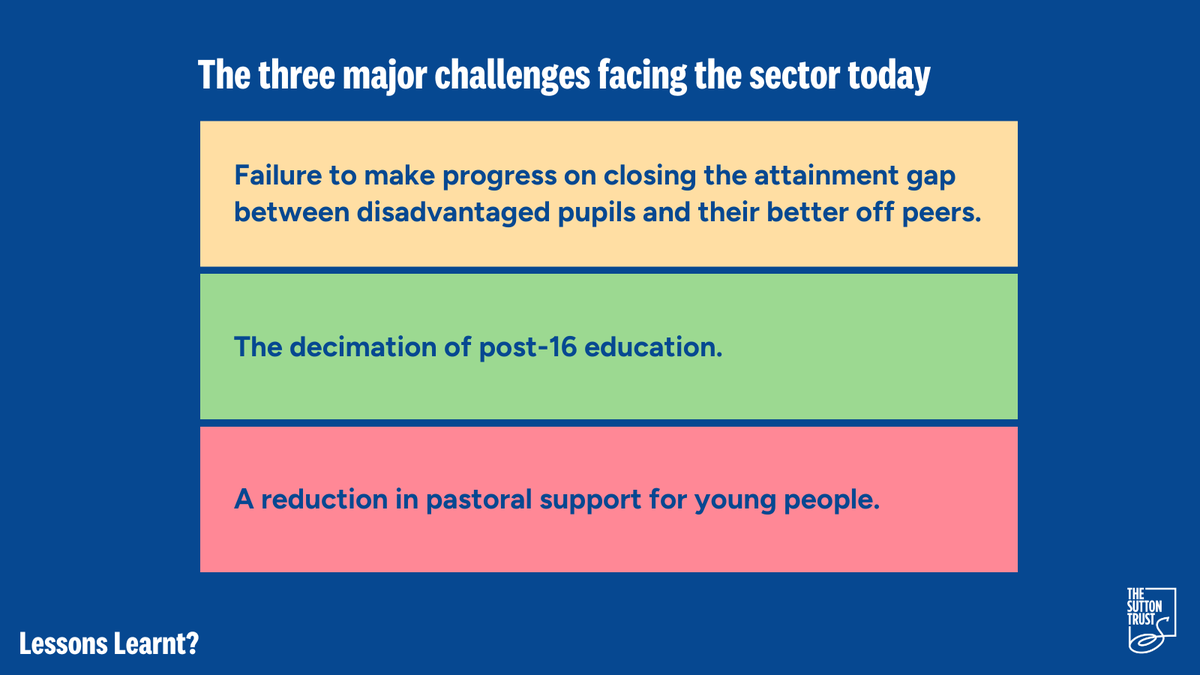
🚨Our new report by @Samfr reflects on school policy over the last two decades.
It sets out three major challenges facing the sector over the coming years ⬇️
Spaced practice works.
“Although spaced practice has a beneficial effect on its own, research also shows that if spaced practice sessions involve retrieval, its impact on learning is much greater than if they are dedicated to restudying.”
—@hruizmartin, #HowDoWeLearn p53
NEW - Retrieval Practice is one of the most well replicated learning strategies from research. BUT, which type of quizzing is best for which level of expertise?
Check out our sketchnote to see our suggestions. For teacher professional learning informed by research, contact us [email protected]
Lovely fellow teachers I need to pick your brains please!!! I’m organising a CSI event for science week and want some activities for each year group to do that will help collect some sort of evidence to identify who the criminal is that stole the school trophies.
💡 Special Educational Needs in Mainstream Schools
Five evidence-based recommendations to support pupils with SEND, providing a starting point for schools to review their current approach and practical ideas they can implement. 💡
Download: https://t.co/RNT8qmnsCk
CALLING ALL SCIENCE TEACHERS
The government has recently launched a Curriculum and Assessment Review. It is crucial that our voices are heard. I have written a submission below, and you are welcome to be a co-signatory!
https://t.co/D12YMt5XHE