Well-done Faseeh Rajput. Approximately after 37 years you seem to have resolved the mystery of the ill fated flight of PK-404. Kudos to you young man. The nation is proud of you.
Now the government needs to respond ASP.
“This house does stink man”@AlvinTedjo election worker caught on camera insulting while leaving election canvassing material at a home in Churchill Meadows. #Mississauga#Mayor#Election
1. کراچی کا کچرا کنڈی اور 9 سالہ شاہد
لیاری، کراچی۔ 9 سالہ شاہد۔ قد اتنا چھوٹا کہ کچرے کے ڈرم میں جھانکنے کے لیے بھی اینٹ پر کھڑا ہونا پڑتا تھا۔ باپ نشے کی حالت میں مر چکا تھا، ماں لوگوں کے گھروں میں برتن دھوتی تھی۔
گھر میں بس ایک ہی خواب تھا: 17 سالہ بڑی بہن سدرہ ڈاکٹر بنے۔ سدرہ نے بارہویں جماعت میں پوزیشن لی تھی۔ دماغ کمپیوٹر جیسا، مگر فیس کے پیسے نہیں تھے۔
صبح 5 بجے شاہد بوری لے کر نکلتا تھا۔ کچرا کنڈیاں، گلیاں، دکانیں۔ پلاسٹک، لوہا، ردی چنتا تھا۔ شام کو کباڑی کو بیچ کر 80 سے 100 روپے ملتے تھے۔
2. باجی کی کتابیں اور بھائی کی بوری
سدرہ کا میڈیکل میں داخلہ ہو گیا۔ سالانہ فیس 2 لاکھ روپے۔ ماں رو پڑی: "بیٹی، مجھے معاف کر دینا، ہم غریب ہیں۔"
شاہد نے ماں کی گود میں سر رکھا: "امی، آپ نہ روئیں۔ باجی ڈاکٹر بنے گی، میں ہوں نا!"
اگلے دن سے شاہد نے دو شفٹیں لگا لیں۔ صبح 4 سے 8 بجے تک کچرا، پھر اسکول۔ پھر شام 4 سے رات 10 بجے تک دوبارہ کچرا چننا۔ رات کو اسٹریٹ لائٹ کے نیچے بیٹھ کر خود بھی پڑھتا تھا۔
سدرہ روتی تھی: "بھائی، تم پڑھو، میں کام کر لوں گی۔"
شاہد ہنس کر کہتا: "باجی، دو دماغ خراب کرنے سے بہتر ہے ایک ڈاکٹر پکا بن جائے۔ آپ بس پڑھیں۔"
3. سردی، طعنے اور ضدی بھائی
سردی کی رات تھی۔ شاہد کو 104 بخار تھا، پھر بھی بوری اٹھا کر نکل گیا۔ کباڑی نے کہا: "مر جاؤ گے پاگل!"
شاہد نے جواب دیا: "چاچا، جب میری باجی کے ہاتھ میں اسٹیٹھوسکوپ ہوگا تب ہی میرا بخار اترے گا۔"
محلے والے طعنے دیتے تھے: "کچرا چننے والا، بہن کو ڈاکٹر بنائے گا؟ خواب دیکھنا چھوڑ دو!"
شاہد کچھ نہ کہتا۔ بس ہر شام سدرہ کی فیس کے پیسے گنتا اور شکر ادا کرتا۔
4. آٹھ سال بعد، سول اسپتال
8 سال گزر گئے۔ شاہد اب 17 سال کا ہو چکا تھا۔ خود میٹرک میں پوزیشن لی، مگر کالج نہیں گیا۔ "باجی کا فائنل ایئر ہے۔"
نتیجہ آیا۔ سدرہ نے MBBS میں ٹاپ کیا۔ پورے کراچی میں نام ہو گیا۔ اخبار میں تصویر چھپی: "کچرا چننے والے کی بہن ڈاکٹر بن گئی۔"
سول اسپتال میں پہلی نوکری ملی۔ پہلی تنخواہ 85 ہزار روپے۔ سدرہ نے وہ لفافہ شاہد کے ہاتھ پر رکھا اور زار و قطار رونے لگی۔
"یہ تمہاری کچرے کی کمائی ہے، بھائی! میرے ہاتھ میں جو اسٹیٹھوسکوپ ہے، اس کی ڈوری تمہاری بوری سے بندھی ہے۔"
5. آج
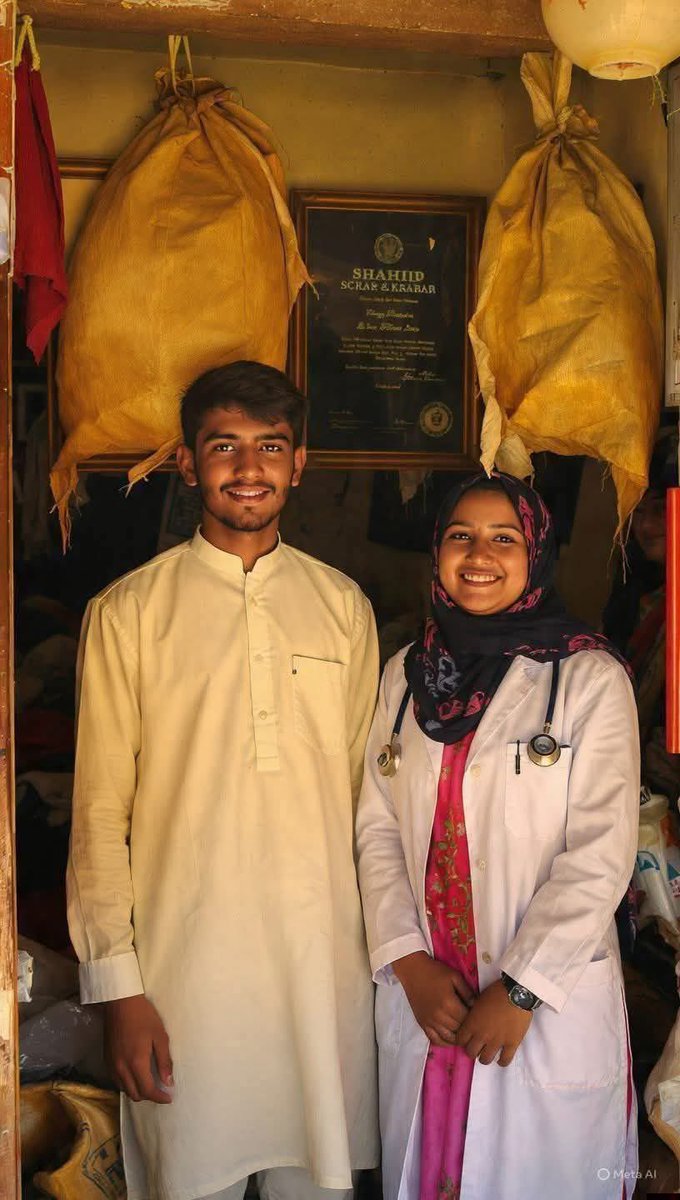
آج ڈاکٹر سدرہ لیاری میں "شاہد کلینک" چلاتی ہے، جہاں غریبوں کا مفت علاج ہوتا ہے۔
اور شاہد؟ اس نے کچرا چننا نہیں چھوڑا، مگر اب اس کی اپنی کباڑ کی دکان ہے۔ 20 بچے اس کے پاس کام کرتے ہیں، مگر ایک شرط ہے: "دن میں 2 گھنٹے میری دکان پر پڑھو گے، فیس میں دوں گا۔"
دیوار پر ایک فریم لگا ہے۔ ایک طرف سدرہ کی ڈگری، دوسری طرف شاہد کی پھٹی ہوئی بوری۔
نیچے لکھا ہے:
"کچرے سے کامیابی تک کا سفر — اگر محبت ہو تو منزل ضرور ملتی ہے۔"
شاہد کہتا ہے: "لوگ کہتے ہیں میں نے بہن کو ڈاکٹر بنایا، مگر سچ یہ ہے کہ باجی کے خواب نے مجھے انسان بنایا۔"😳
Canada posted its first current account surplus in four years, led by strong gains in goods exports, including energy products.
Some of you are overly pessimistic about the US trade war; some of you are overly pessimistic about Canada’s ability to build and develop resources. Let me tell you that Canada will produce and export more potash, uranium, copper, oil, natural gas and gold next year and in the years following. It’s baked in already. The only question is how much global market share we will gain.
Dear Thomas Friedman:
Get Real About Iran.
I get it. You are frustrated. A war launched without a plan, a president who sounds unhinged every morning before breakfast, and an alliance fraying at the edges. The urge to rally NATO and the Western world around a familiar villain — Iran's "malign regime" with its "poisonous ideology" — must feel like solid ground in a swamp. I understand the temptation.
Now get over it.
Because that narrative, the one your column breathes like oxygen, is precisely the poisonous ideology that has driven four decades of failed Western policy toward Iran. It is the same caricature that sold sanctions that didn't work, regime-change fantasies that didn't materialize, and wars that left the region in ruins. And here you are, reaching for it again.
Let us start with your language. Iran's regime is "malign." Its ideology is "poisonous." Its leaders are "lunatics." Its regional vision is "a kiss of death." You deploy these words not as analysis but as incantation - the verbal equivalent of closing your eyes and refusing to look. It is the language of a man who has already decided what Iran is and arranged the facts accordingly. It is, in a word, propaganda. And it has consequences. For decades, this very framing has misled American and European policymakers into believing that enough pressure, enough sanctions, enough isolation, enough war would eventually cause Iran to buckle or collapse. It never did. It never will. A country of ninety million people, sitting astride one of the world's most strategic waterways, with a civilisation older than the concept of the nation-state, does not disappear because Thomas Friedman calls it malign.
What does the Iran you refuse to see actually look like? It looks like a country that, despite forty-five years of the most punishing sanctions regime ever imposed on a non-belligerent state, has produced a film industry that wins international prizes. It looks like a country where women constitute more than half of university students and have built careers in medicine, engineering, law, architecture and the arts. It looks like a country with a pharmaceutical sector that manufactures over ninety percent of its own medicines domestically, a feat of industrial self-reliance that most developing nations could only dream of. It looks like a country with a car industry, a steel industry, a space program, a vibrant startup ecosystem in Tehran that its young people have built in the teeth of every obstacle the West could contrive. You wouldn't know any of this from reading Western coverage, which confines itself to a narrow repertoire of images designed to confirm a verdict already reached.
You write admiringly of the Dubai model — a "noncorrupt, responsible bureaucracy," openness to the world, moderate Islam, economic dynamism. You present it as the antithesis of the Iranian model. But let us be honest about what the Dubai model actually rested on: American military bases. The Persian Gulf states, for decades, outsourced their security to Washington and built their gleaming towers on the foundation of that rented protection. This was not a model of sovereign development. It was a business plan predicated on the illusion that you could ring Iran with hostile military infrastructure, participate in its economic encirclement, reject every peace initiative it extended, and somehow build a stable, prosperous future. The current war, the one that is frightening away foreign investors and burdening these states with "huge new defense bills," as you yourself acknowledge, is the receipt for that illusion. The Dubai model did not fail because of Iran. It failed because it was built on the assumption that Iran's security concerns could be permanently ignored. You cannot build lasting prosperity on a foundation of your neighbour's insecurity.
And Iran did extend its hand, repeatedly. The Hormuz Peace Endeavour, which Iran proposed to bring Persian Gulf states into a framework of collective regional security, was brushed aside by countries that preferred to keep betting on Washington to solve their "Iran problem" for them. That bet has now been called. The question is whether they will place it again.
Which brings us to the Strait of Hormuz and to the charge that Iran is trying to "set up a tollbooth" on the world's critical oil lifeline. Let me offer you a different frame. The Strait of Hormuz passes through Iranian territorial waters. Before this war, that waterway operated under what amounted to unregulated free transit — a transit regime that, in practice, allowed the United States to supply and reinforce military bases across the Arabian Peninsula and to project force directly at Iran. It allowed the launching of a war that your own president described in terms of ending Iranian civilisation. It allowed attacks on Iranian infrastructure that, if visited upon any NATO state, would have triggered Article Five before the smoke cleared. You call Iran's response to this a "tollbooth." Iran calls it the elementary right of a nation not to watch its territorial waters serve as the logistical artery of its own destruction. International waterways are meant to be neutral corridors connecting high seas. The Persian Gulf is currently not neutral. It is a military perimeter constructed by the United States, with one wall facing Iran. No sovereign nation — not France, not the United States, not any country whose right to self-defence you would recognise without blinking — would accept that arrangement.
The legal architecture governing international straits makes this point with precision. Under Article 39 of UNCLOS, transit passage is explicitly conditioned on refraining from "any threat or use of force against the sovereignty, territorial integrity or political independence of States bordering the strait." This is a binding obligation, not a courtesy. The transit passage regime was designed to balance freedom of navigation with the sovereign rights of littoral states, not to strip those states of any means of self-defence while foreign navies use the same waterway as a forward-deployment corridor. No principle of international law — not transit passage, not freedom of navigation, not the customary law of the sea — confers upon any state the right to convert a littoral nation's territorial waters into the supply line for that nation's destruction. When transit passage is operationalised as a mechanism to arm one shore of a strait against the state whose waters constitute the other, it has ceased to function as a neutral navigational right and become an instrument of belligerency. Iran invoking its rights as a littoral state in response to precisely that situation is not a violation of international law. It is what international law was designed to prevent.
But then, a narrative that has spent four decades casting Iran as a permanent exception to civilised norms would struggle to concede that international law might, on occasion, apply in Iran's favour too.
Iran is a regional power. It was one before this war, and it is a greater one after it. The countries that line the Persian Gulf need to absorb that reality, not as a threat, but as a geographic and historical fact around which a stable order can be built, if they choose to build one. Iran's patience over these past decades was not weakness. It was the patience of a state that understood the long game and believed, perhaps naively, that its neighbours would eventually tire of arrangements that served Washington's - and Israel's - interests rather than their own. Some of them are now beginning to do exactly that.
So here is my appeal, not to NATO navies, but to the columnists, strategists and policymakers who have spent forty years misreading their own country. Drop the caricature. Retire the "malign regime" and the "poisonous ideology" narrative. Recognise that Iran has legitimate security concerns, a genuine weight in the regional order, and real interests that any durable settlement must accommodate. Persuade the Persian Gulf states that the time has come to respond seriously to the extended hand they have spent decades swatting away.
That is the harder argument to make. It requires admitting that a narrative you helped construct was wrong. But it is the only argument that has any chance of producing something other than permanent instability.
The necessary is still possible. But not if you keep reaching for the same broken tools.
Newly released video taken by Artemis II commander Reid Wiseman captures an “Earthset” — as our planet slips behind the Moon and disappears from view in space — like a sunset here on Earth.
Did these people think they’d get table-side seats to discussions to end a war? I flew 21 hours to be here & knew exactly what I was getting into — there’s no news until there’s news; that’s how these things work. This is unfair to Pakistan, which has been a gracious host.
How Pakistan made the world over 3 trillion dollars richer
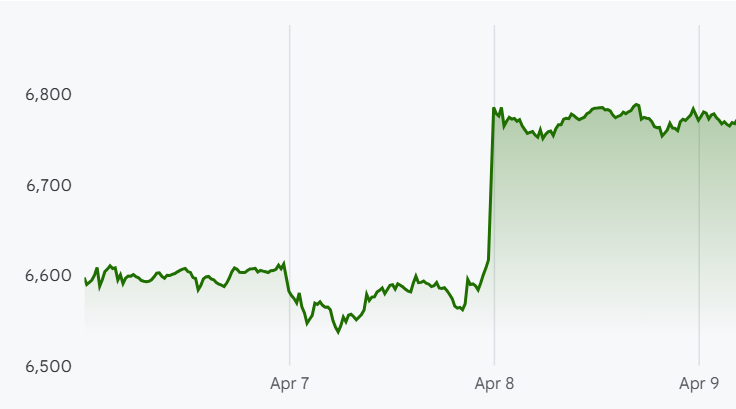
On April 7, the world edged toward Trump's 8pm ultimatum that "a whole civilization will die tonight." By mid-afternoon, Polymarket gave less than a 5% chance for a ceasefire. But then in a flurry of last-minute diplomacy led by Pakistan's PM Shehbaz Sharif, ceasefire odds shifted from near-impossibility to 100%, as both U.S. and Iranian leadership publicly acknowledged the important role played by Pakistan.
The sharp shift in probability of ceasefire from near-zero to certainty, allows us to estimate cleanly the market value of Pakistan's successful diplomacy. There was a sharp jump of 2.9% in S&P500 around the ceasefire announcement. The reaction was similar the world over.
Global markets represent about $125T, so a 2.9% jump represents a gain of 3.6 trillion dollars for the world. Pakistan helped create TEN times its own GDP for the world!
For me, the best part is not the trillions of dollar, but seeing Pakistan on the world stage as a peace maker.
I hope Pakistan runs with this new identity by promoting peace not only abroad, but also at home. That means moving away from politics of division and exclusion, and treating every citizen as its own.
From @WSJopinion: Pakistan has put itself back on the diplomatic map. Its army chief consolidates his power at home by brokering a cease-fire between Iran and the U.S., writes @dhume.
https://t.co/sr1SuwDbWO
“71 Slaughterhouse” , my documentary on non-Bengali genocide in 1971 :
Urdu English version:
https://t.co/oCsmuEz2Nx
Bangla dubbed version :
https://t.co/r8w1S4slmD
It is the untold story of Indian sponsored genocide in East Pakistan in 1971 conflict, when thousands of Muslims were methodically massacred for siding with Pakistan. This is the first documentary on this subject that presentes “the other side of the story” in this conflict, the side that has been oppressively snubbed for half a century by India and Awami League collaborative narrative.
In this documentary, I bring eyewitness accounts of genocide survivors including Biharis, West Pakistanis and pro-Pakistan Bengalis, analysis from Bangladesh and Pakistan, representative of Mukti Bahini as well as Al-Badar and Razakars on situation which led to this untold genocide.
71 Slaughterhouse is a story of political deceptions, social and international treachery, war crimes, crimes against humanity and the plight of Biharis living as stateless community, with a stigma of being “Razakar” in Bangladesh for half a century.
#71Slaughterhouse #Documentary #AishaGhazi #Pakistan #Bangladesh #BangladeshCrisis #IndiaOut #indiaout #iResist
Dear Tariq Rahman, you not only owe a respect, rather you owe an apology to the martyrs of most heinous genocide that started from 7 March 1971 and the whole communities of Biharis and other non Bangalis were wiped out in brutal and systematic genocide designed by India and carried out by Mukti Bahini until Pakistan army was forced to opt for operation against genociders.
The gruesome details of Bihari and non-Bangali genocide in East Pakistan will shock the world if they ever came to the light. There were slaughterhouses set up and butchers hired to kill, there were rooms full of the bodies of young children who had been killed by smashing them in the wall, thousands killed and bodies thrown in rivers and genociders went in boats around the rivers looking for any signs of life in the bodies they had dumped in rivers so anyone found breathing could be killed with spears. Genociders raped the Bihari women and left Bangladesh flag stuck in their raped dead bodies. There were trains full of deadbodies, not just killed, but they were systematically cut to make them bleed to death. The kind of brutality that was perpetrated against non-Bangalis has hardly any equivalence in history and according to Tariq Rahman, it was all done by “unarmed people of Bangladesh”. No ! They were armed proxies of India working on bringing Bengali Muslims back in Indian shackles and it happened. Bangladesh has been a vassal state of India since 1971.
Regarding “teachers and intellectuals” killed on 25th March, the question remains intact: when the whole country was in complete chaos and universities were closed for weeks, what were the “intellectuals and teachers” still doing in hostels? And why non-Bangali women had been found locked in the custody of those “intellectuals”? Why Bengali documentary filmmaker Zahir Rehan was abducted from streets of Dhaka in early 1972, never to be seen again, just for questioning the narrative of these “intellectual killings”. Just because he was looking for evidence of Indian involvement in these killings? You are Prime Minister now. At least open the case of Zahir Rehan again to give him justice.
Let me enlighten you a bit more about the actual darkness of this history episode where whole Bihari communities were wiped out.
Just one example is Isfahani Jute mill community, where all the men were separated, killed and dead bodies were dumped in the river next to it while all the women and children were massacred in the hall of Isfahani Jute Mill. There were only two children survivors that Pakistan army pulled out alive from the rubble of dead bodies. One of these two survivors is still alive, living in Canada and suffers from a severe form of PTSD. When genocide started, this is the same community that paid security money to your so called first prime minister in exile, Tajjudin Ahmed, on his demand.
In People’s More mill community, there was not even a single survivor and the water reservoir beside the mill was full of deadbodies. When water dried in summer, there were thousands of severed heads of Biharis lying on ground, telling the story of what happened there. The same massacre was carried out in every corner of East Pakistan, specially in the areas bordering India. Your Kanchan river water turned red due to the blood of Biharis killed by Bengali agents of India.
Dear Tariq Rahman, the irony is that Genociders have audacity to observe Genocide day without any remourse because they know the world doesn’t know the scale of genocide perpetrated by their own brethren against the non Bangalis. I have spent more than three years in researching Bihari genocide, I have extensively travelled to meet survivors and cross check their stories. I can write pages and pages on this forgotten genocide but for now, this beginner course is enough to enlighten you who do you owe respect and apology.
Recent reports and research indicate that India is a significant source of online Islamophobia, with some studies ranking it as having the highest volume of anti-Muslim content, especially in discourse around Gaza, UK and now Iran.