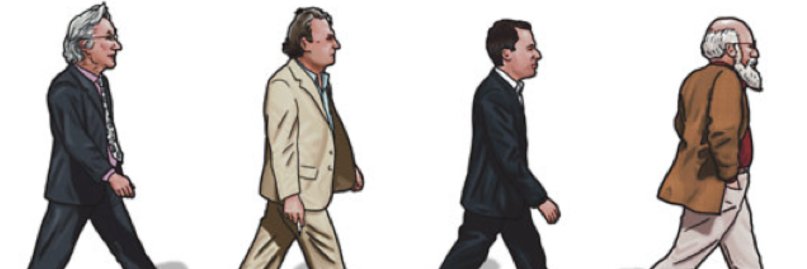
One of my favorite academic feuds is mid-2010s Judea Pearl vs. Guido Imbens (on the usefulness of causal graphical models), which peaked with them absolutely going at it in the comment section of Pearl's blog (Comments 7 through 13):
https://t.co/ZyNATu9h7P
We got attacked by secret unreleased proprietary models and defended ourselves with an open model, more precisely the @nvidia quantized version of GLM 5.2 coming from @Zai_org.
Banning any open model would hurt first cyber security defenders, startups, small companies, researchers and everyone who's not a frontier lab and need on-prem affordable controlable models to compete and protect themselves. Let's not do that!
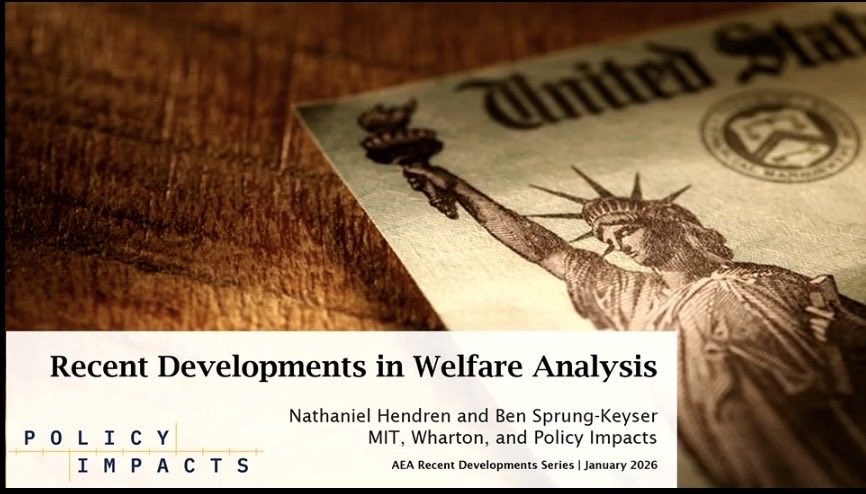
The AEA has posted eight "Recent Developments" lectures exploring highly topical issues in economics, presented by the best scholars in the field: https://t.co/mxuAF6ycKg
Well worth a watch!
Einstein, Curie, Bohr, Planck, Heisenberg, Schrödinger… how many Nobel Prize laureates can you spot?
Some of the world’s most notable physicists participated in the 1927 Solvay Conference. In fact, 17 of the 29 scientists attending were or became #NobelPrize laureates.
Mildly obsessed with what the "highest grade" pretraining data stream looks like for LLM training, if 100% of the focus was on quality, putting aside any quantity considerations. Guessing something textbook-like content, in markdown? Or possibly samples from a really giant model? Curious what the most powerful e.g. 1B param model trained on a dataset of 10B tokens looks like, and how far "micromodels" can be pushed.
As an example, (text)books are already often included in pretraining data mixtures but whenever I look closely the data is all messed up - weird formatting, padding, OCR bugs, Figure text weirdly interspersed with main text, etc. the bar is low. I think I've never come across a data stream that felt *perfect* in quality.
1/ AI doesn’t need a sci-fi upgrade to upend the economy—current models, and the cheaper, more capable versions already in the pipeline, are set to disrupt nearly every corner of the labor market.
Cool demo of a GUI for LLMs! Obviously it has a bit silly feel of a “horseless carriage” in that it exactly replicates conventional UI in the new paradigm, but the high level idea is to generate a completely ephemeral UI on demand depending on the specific task at hand.
I am profoundly saddened and alarmed by @Columbia University and @PaulWeissLLP law firm's capitulation to the increasingly dictatorial Trump administration.
Hortense Fong and I are hiring a full-time predoc in Marketing at Columbia Business School. If you're strong in data science, NLP, and ML and interested in pursuing a PhD in business, apply here: https://t.co/WFYe2iWHEJ #predoc#hiring#AcademicResearch
Finally took time to go over Dario's essay on DeepSeek and export control and to be honest it was quite painful to read. And I say this as a great admirer of Anthropic and big user of Claude*
The first half of the essay reads like a lengthy attempt to justify that closed-source models are still significantly ahead of DeepSeek. However, it mostly refers to internal unpublished evals which limit the credit you can give it, and statements like « DeepSeek-V3 is close to SOTA models and stronger on some very narrow tasks » transforming in a general conclusion « DeepSeek-V3 is actually worse than those US frontier models — let’s say by ~2x on the scaling curve » left me generally doubtful. The same applies to the takeaway that all discoveries and efficiency improvements of DeepSeek have been discovered long ago by closed-models companies, this statement mostly resulting from a comparison of DeepSeek openly published $6M training numbers with some vague « few $10M » on Anthropic side without providing much more details. I have no doubts the Anthropic team is extremely talented and I’ve regularly shared how impressed I am with Sonnet 3.5 but this longwinded comparison of open research with vague closed research and undisclosed evals has left me less convinced of their lead than I was before I reading it.
Even more frustrating was the second half of the essay which dive into the US-China race scenario and totally misses the point that the DeepSeek model is open-weights, and largely open-knowledge due to its detailed tech report (and feel free to follow Hugging Face’s open-r1 reproduction project for the remaining non-public part: the synthetic dataset). If both DeepSeek and Anthropic models had been closed source, yes the arm-race interpretation could have make sense but having one of the model freely widely available for download and with detailed scientific report renders the whole « close-source arm-race competition » argument artificial and unconvincing in my opinion.
Here is the thing: open-source knows no border. Both in its usage and its creation.
Every company in the world, be it in Europe, Africa, South-America or the USA can now directly download and use DeepSeek without sending data to a specific country (China for instance) or depending on a specific company or server for running the core part of its technology.
And just like most open-source library in the world are typically built by contributors from all over the world, we’ve already seen several hundred derivative models on the Hugging Face hub created everywhere in the world by teams adapting the original model to their specific use cases and explorations.
What's more, with the open-r1 reproduction and the DeepSeek paper, the coming months will clearly see many open-source reasoning models being released by teams from all over the world. Just today, two other teams, AllenAI in Seattle and Mistral in Paris both independently released open-source base models (Tülu and Small3) which are already challenging the new state-of-the-art (with AllenAI indicating that its Tülu model surpasses the performance of DeepSeek-V3).
And the scope is even much broader than this geographical aspect. Here is the thing we don’t talk nearly enough about: open-source will be more and more essential for our… safety!
As AI becomes central to our lives, resiliency will increasingly become a very important element of this technology. Today we’re dependent on internet access for almost everything. Without access to the internet, we lose all our social media/news feeds, can’t order a taxi, book a restaurant, or reach someone on WhatsApp. Now imagine an alternate world to ours where all the data transiting through the internet would have to go through a single company’s data centers. The day this company suffers a single outage, the whole world would basically stop spinning (picture the recent CrowdStrike outage magnified a millionfold).
Soon, as AI assistants and AI technology permeate our whole life to simplify many of our online and offline tasks, we (and companies using AI) will start to depend more on more on this technology for our daily activities and we will similarly start to find annoying or even painful any downtime in these AI assistants from outages.
The most optimal way to avoid future downtime situations will be to build resilience deep in our technological chain.
Open-source has many advantages like shared training costs, tunability, control, ownership, privacy but one of its most fundamental virtue in the long term –as AI becomes deeply embedded in our world– will likely be its strong resilience. It is one of the most straightforward and cost-effective ways to easily distribute compute across many independent providers and to even run models locally and on device with minimal complexity.
More than national prides and competitions, I think it’s time to start thinking globally about the challenges and social changes that AI will bring everywhere in the world. And open-source technology is likely our most important asset for safely transitioning to a resilient digital future where AI is integrated into all aspects of society.
*Claude is my default LLM for complex coding. I also love its character with hesitations and pondering, like a prelude to the chain-of-thoughts of more recent reasoning models like DeepSeek generations.
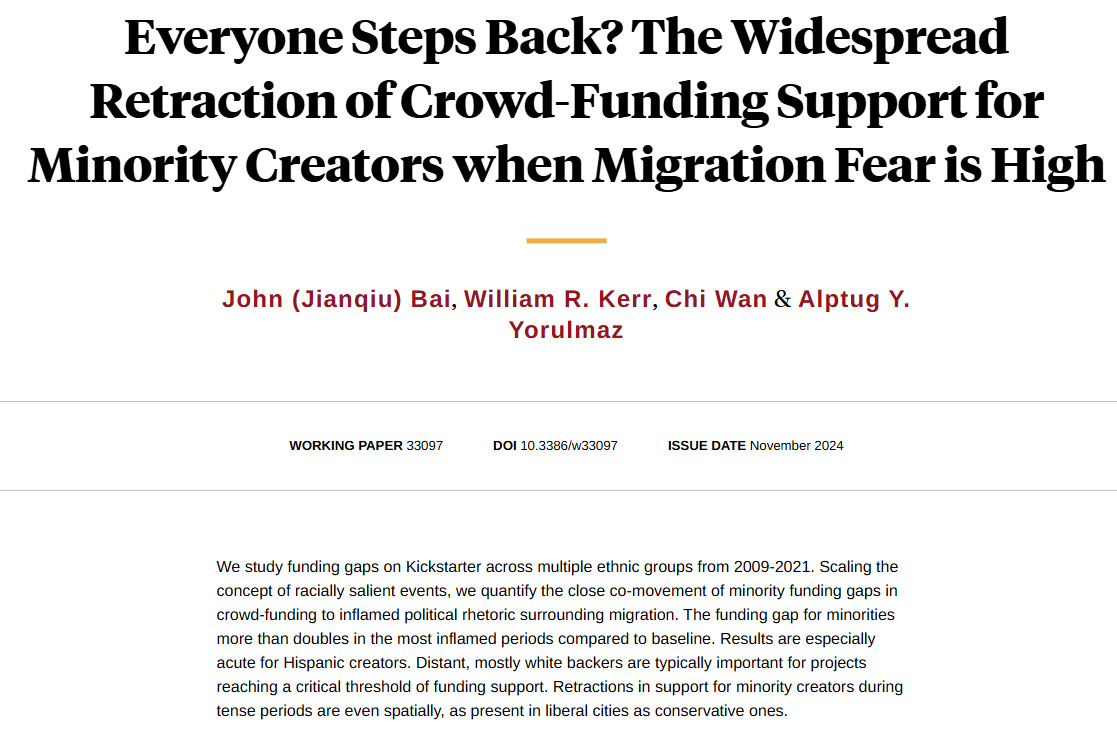
Inflamed political rhetoric surrounding migration can double the funding gap experienced by minorities on crowd-funding sites, from John (Jianqiu) Bai, @william_r_kerr, Chi Wan, and Alptug Y. Yorulmaz https://t.co/9u4b06BEBP
Today, we publicly unveiled Ghost-X, which just won a critical US Army contract.
Faster, longer, stronger, harder. Watch till the end if you want to see what a backpackable drone with laser target designation and four precision guided munitions looks like in action.
In 2019 Esther Duflo was awarded the prize in economic sciences for her work fighting poverty. She was the second woman and youngest person to be awarded the prize in economic sciences.
In October we will be announcing this year's laureates.
Learn more: https://t.co/uKHe2lSm7B
Ex-ante regulations aimed at pushing a technology towards one path or another are not as effective as ex-post adjustments in the face of uncertainty, from @joshgans https://t.co/UbkoIsKn64
Resembling the fury of a raging sea, this image from our @NASAHubble telescope actually shows a bubbly ocean of glowing hydrogen gas. Learn more about the Omega Nebula — and download the full-size image for your background: https://t.co/GwJl5awQMU