Iranian-American women's health/human rights physician, TED(+MED)-ster, creative curator, novelist, single mom, feminist, find me on that blue place/same handle
In this article Narges Bajoghli and I argue that the war has brought about a generational change in Iran’s leadership, bringing to the fore men with different experiences and outlook on state, society and foreign policy. This new generation is now confident that it ways has won significant strategic wins which it intends to translate not only into a new regional order but also a new domestic order and social contract with the population.
The scale of the war and it took for Iran to survive it and fore the U.S. into a stalemate has also changed Iranian society in profound way. Social grievances remain but will express themselves in this new context. We explain why pre-war ways of understanding Iran don't explain it anymore.
“The emergent Islamic Republic will remain highly authoritarian. But the categories that Western analysts have often used to describe the Islamic Republic’s various factions—hard-liner versus moderates, ideologues versus reformists—will be less accurate than ever. The new Islamic Republic’s priorities, and how it pursues them, will be shaped by the specific experiences of its two wars with the United States and Israel: the losses Iran sustained, the confidence its leadership gained, and the new social contract the fighting has made necessary and possible.”
https://t.co/RATaDcKLBK
Amazing! The House just passed a War Powers Act resolution to end the Iran war! It must now go to the Senate, but it won't need a signature from Trump.
This is the furthest any WPR has gone against the Iran war!
A major defeat for those who wish to continue the war, although it doesn't automatically force Trump's hand.
Several Republicans broke with Trump to get this passed:
Massie,
Fitpatrick,
Davidson, and
Barrett.
Several organizations deserve massive credit for this key win:
@justfp
Action Corps
@FCNL@NIACouncil@demandprogress@PeaceAction
Iran will not hand Trump a victory picture, because they are Iran.
And Trump will not settle for anything short of the appearance of victory, because he is Trump.
If such ambiguity could perhaps have been manufactured in the early days of the war, it becomes far harder as the ceasefire drags on and the reality sets in that the campaign failed to achieve its stated objectives. The longer this persists, the more difficult it becomes to create a situation in which both sides can plausibly claim success.
That leaves the administration facing two deeply unattractive options: launch a military move and declare victory, or continue waiting for internal developments inside Iran that are unlikely to materialize on their own.
Strategic Deadlock
#IranWar
There are two options for Trump in this scenario. One is to make deal, and yes, in that case Iran will get paid.
Option two is regime change via a large scale invasion of Iran, much bigger than Iraq, and against a foe that will fight to the death. (While also lobbing missiles and swarms of drones against US assets in the region as well as against U.S./Israel allies.)
And it would still not guarantee a positive outcome for the U.S. or the region. Not sure Trump has conceptualised this.
Shocking report by @NickKristof on rape & other sexual assault & torture of #Palestinians detained by Israeli authorities. Will there ever be accountability for these crimes?
https://t.co/a8cbqQgmtb via @NYTOpinion
57% of Israelis believe Israel has not won any war since October 7, not against Hamas or Hezbollah or Iran.
This is a direct rebuke of Netanyahu as Mr. Security. Despite this, he still has a solid base, but he is still not polling well enough to win. https://t.co/jDv9X1RaeQ
Iran’s latest AI Lego video marks a significant pivot. Instead of taunting the US military, it reflects a new chapter in which Tehran will seek peace by reaching out directly to the American people, bypassing the US government. It's a mirror image of the US strategy of the past decades.
Some of the lines are quite noteworthy and will likely resonate with the anti-establishment sentiments prevailing among American youth in particular:
"I love the constitution, the way it was meant. But not the way your leaders bypass consent..."
بر اساس گزارش تازهٔ صندوق کودکان ملل متحد @UNICEF، در اثر ممنوعیت آموزش دختران، #افغانستان تا سال ۲۰۳۰ با کمبود بیش از بیستهزار معلم و بیش از پنجهزار کارمند صحی زن مواجه میشود و تعداد دختران محروم از تعلیم به بیش از دو میلیون بالغ میگردد.
با اظهار نگرانی عمیق از این بابت، خاطرنشان مینمایم که دوام ممنوعیت آموزش و بسته بودن درب مکاتب و پوهنتونها به روی دختران، باعث تضعیف توانایی ملی، احتیاج شدید و وابستگی افغانستان به خارج خواهد شد.
ضمن اینکه آموزش همگانی را حیاتی میدانم، بار دیگر تاکید میکنم که باید هرچه زودتر درب مکاتب و پوهنتونها به روی دختران گشوده و با فراهم شدن زمینهٔ تعلیم و تحصیل برای جوانان، اعم از دختر و پسر، مشکلات و احتیاجات کشور با دست توانای فرزندان آن حل و مرتفع گردد و افغانستان از احتیاج بیرونی رهایی یابد.
@UN
There is a name for boarding a ship and abducting innocent civilians in international waters, @BBCWorld. Its not called 'interception'. The word is piracy.
Araghchi’s tweet reflected an understanding in Tehran, likely based on what they heard from Pakistan, that if they took a positive step by opening Strait of Hormuz, US would reciprocate by lifting the blockade. But Trump kept the blockade in place, and through his many tweets, suggested that Iran was surrendering on the nuclear issue.
This has only fed Iran’s suspicions about Trump and that Islamabad like Geneva is a diplomatic ruse before another military attack. The door to diplomacy is not closed, but it has now become considerably more difficult. Deliberately or not, Trump has undermined diplomacy and raised likelihood of more war.
Ahead of the Islamabad Talks
A. Negotiations will be difficult. However, it’s important to recognize that this time the administration is bringing in Vice President Vance, who has a clear political interest in preventing a renewed escalation. Beyond domestic politics, Washington is acutely aware of the consequences of a breakdown: a major shock to global energy markets and highly problematic military options, ranging from strikes on civilian infrastructure to the risks of ground operations. In other words, both political incentives and strategic risks are pushing the U.S. toward avoiding collapse of the talks.
B. The gaps between the parties remain significant. Iran’s leadership is unlikely to concede on its missile program, and certainly not on its right to enrich uranium. In any scenario involving full sanctions relief, the issue of the 60% 440 kg enriched uranium stockpile will likely become a central sticking point.
C. The Strait of Hormuz issue is largely behind us. By effectively acknowledging Iran’s control over the strait, the U.S. has helped solidify this reality. Iran can already begin to reap the associated economic benefits. However, any expectation in Washington that Tehran will make concessions on force buildup or strategic capabilities is likely misplaced.
D. While the current ceasefire is temporary, the costs of the war and, critically, the growing recognition in Washington that regime change is not achievable and that enriched uranium cannot be eliminated through military means, may soften the U.S. negotiating position. Unlike previous rounds (e.g., Geneva), the administration’s ability to credibly threaten war has diminished. From Tehran’s perspective, they have already endured the worst.
E. Iran’s economic situation is dire, worse than before the war. Economic relief is therefore a critical priority for Tehran. That said, it is doubtful that Iran would trade core regime pillars for economic concessions
F. One of Iran’s most significant achievements, especially given that it stepped back from insisting on a permanent ceasefire (assuming there are no undisclosed understandings about extending the truce or U.S. recognition of its right to enrich), is the apparent U.S. willingness to engage in negotiations based on Iran’s 10-point framework.
G. This is notable because the gap between Iran’s 10 points and the administration’s 15-point framework remains substantial. The central question is whether Washington is prepared to move closer to Tehran’s positions, particularly on uranium enrichment and missile capabilities. These issues will be decisive not only for the negotiations, but for whether the conflict resumes.
H. Who Really Wants the Deal?
It is important to recognize that the push for negotiations originated in Washington. In practice, it was the Trump administration that shaped, if not dictated, the proposal conveyed via Pakistan for a two-week ceasefire. This matters because it suggests that the administration is entering the talks with a strong desire to reach an agreement quickly.
I. That does not mean Iran lacks interest, far from it, given its economic situation, but the sense of urgency appears to be more pronounced on the U.S. side
The bottom line is that current negotiations are not driven by optimism, but by a shared interest in avoiding further losses rather than securing victory.
#IranWar
The ceasefire doesn’t mean Trump backed off on his threat to commit war crimes—he’s been committing war crimes since the first day of the war.
Turning a two week ceasefire into a lasting peace deal will take a diplomatic miracle, but that’s just what the Iranian people deserve.
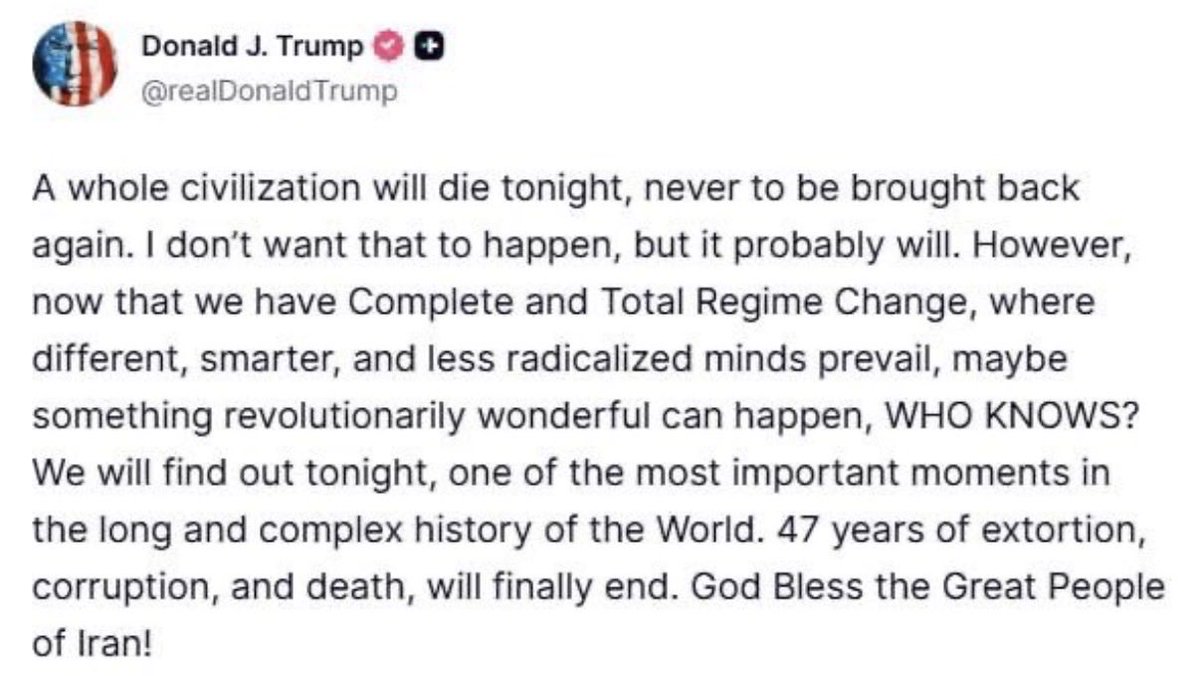
The threat is grotesque to the say the least. But civilizations don’t die with bombs and Iran’s civilization has endured and survived larger challenges than this through the millennia. It will survive and outlast Trump
The inflammatory use of language like the “destruction of a civilization” even if mere rhetorical tactic is morally wrong, illegal and counterproductive..The Iranian regime’s sole goal is its own survival. The Iranian people are fighting to keep and revive their civilization.
Striking Iran’s civilian infrastructure will hurt the Iranian people more than it would hurt the Islamic Republic. The Islamic Republic is an ideological mafia and simply doesn’t care if Iran’s civilian infrastructure is obliterated as long as it can stay in power.
From the perspective of Iran’s current leadership, the familiar cycle of escalation–ceasefire–renewed escalation is unlikely to repeat itself in this round of conflict.
Tehran appears to assess that this campaign will conclude the broader confrontation, not merely pause it.
Accordingly, Iranian decision-makers are likely to prefer continued fighting over a ceasefire that would only serve as a prelude to a future round of hostilities.
Absent guarantees that address their core strategic conditions, Iran has little incentive to bring the current campaign to an end.
While Iran may not have determined the timing of the conflict’s onset, it is intent on shaping the conditions under which it ends.
Until those conditions are met, Tehran is prepared to sustain the confrontation and absorb costs, operating under the assumption that a war of attrition works to its advantage, particularly given the significant economic and systemic pressures imposed on the region and the global system, not least through disruptions tied to the Strait of Hormuz.
Moreover, with the reactivation of the so-called “Axis of Resistance,” Iran is not acting solely on its own behalf. It is also constrained by its commitments to allied actors across the region. As such, any ceasefire, from Tehran’s perspective, cannot be narrowly confined to the Gulf theater alone.
Under these conditions, Iran is likely prepared to continue the current campaign for weeks, and potentially months, if necessary.
#iran