a fun accidental side experiment of the ghibli stuff is that it turns out there’s strong evidence that, as a species, we’re way more compelled by visuals than ideas.
we act faster, care more, & engage harder when something feels tangible.
I guess I feel very little because this was obviously coming 15 years ago.
The entire economy is reacting to the current arrival of AI and not the past inevitability of AI.
If you think drawing pictures takes work, try spending your evenings and weekends for the better part of a decade at the library trying to understand how backpropagation allows neurons to create models of the world, building working neural prototypes, parsing the implications, warning everyone and having it fall on deaf ears.
Being an artist is hard. Not in a "pick up a pencil" way. In a being willing to dissect bodies way. Being willing to build systems from the ground up that give you unique insights into the human condition. Being willing to commit your life to understanding the world you live in and the deeper processes that drive it.
If you want to talk about the impact AI had on artists, you need to go back decades. Artists have been exploring the inevitability of AI for a century. Philosophers for far longer. As far back as Prometheus at least.
If you arrived in 2025 and did not understand for at least 5 years prior that AI was imminent, you did not do the work of an artist. You mixed no new ocres. You did not understand your evolving medium, or the world it exists within.
You just drew pictures.
Very good example of how a person with lower risk tolerance views and navigates the world. Not a bad thing, it’s super necessary and valuable to the optimal functioning of any organization. Often “new” iterations are unrealistic and worse than established best practices, even devastatingly so. Really just differences in individual personality, which are categorized at the collective level into the conservative-progressive spectrum.
Many craftsmen, few artists. Most people have low risk tolerance, existing entirely within the confines of the established paradigm of their specialization. Many doctors, lawyers, engineers, etc. who are master craftsmen, implementing best practices in some locality, but they aren’t researchers or entrepreneurs pushing the boundaries of their field.
Our darkest hour approaches...
AI isn't ending humanity with Terminator-style robots. It's ending civilization as we know it.
The Fourth Industrial Revolution is a tsunami heading for our shores - AI, robotics, quantum, fusion, genetics, nanotech - all arriving at once. We can no more stop this wave than we could stop the tides.
Like farmers during the Great Depression watching their way of life collapse, we face a fundamental transformation. By 2030, our current paradigm will shatter. Jobs, economics, politics - all remade.
But the more painful journey is internal. Our identities, built around skills AI will soon eclipse, must die and be reborn. Some will cling desperately to the past. Others will embrace transformation.
I've been through this catharsis. After burnout and chronic illness forced me to let go of my corporate identity, I found a new way of being - writing, teaching, living in the moment. Life shifted from "a river rushing to milestones" to "a garden of abundance, constantly evolving."
You too will face your darkest hour. Your job may vanish. Your skills may become obsolete. Your identity may crumble.
But like every story before ours, we'll emerge from this crucible forever changed. The hard part about change... is that you actually have to change.
Traditional 2d animation meets the bleeding edge of experimental techniques. This is a behind the scenes look at how we at Asteria brought the old and the new together in this throwback animation “A Love Letter to Los Angeles” and collaboration with music artist Cuco and visual artist Paul Flores.
So proud of the whole team on this one!
Do not start with fundamentals. This is an awful approach to learning.
Start with so-called "advanced" topics and ask questions until every term/concept is understood.
This is the correct, rigorous, scientific way to learn, because the advanced topics are embedded in larger, more convoluted, more abstracted constructs. This embedding is what gives the individual pieces their *meaning*.
Foundational studies have removed this embedding, and present only the isolated, sterile pieces. They have no meaning. They have no context.
The notion that students will piece together fundamentals into some eventual synthesis down the road is absolutely incorrect. It is literally information-theoretically obtuse.
Children don't learn language using pieces. They mumble *fully*. They are never not fully embracing the complexity. It is the juxtaposition between their naive attempts and the full picture that imbues their mind with learning.
Prerequisites are the dumbest approach to learning. It is utterly indefensible using any scientific argument. The basics-to-advanced directionality is diametrically opposed to how information is encoded, comprehended and used.
Prerequisites are why most computer scientists and whiteboard exam-passers can't make software themselves; they can only be cogs in a company. It's why a Princeton math PhD can write the update rule for gradient descent but can't draw the actual process with circles and lines on a damn chalkboard (true story).
Idiot level stuff because their learning was all basics to advanced. They never defined terms and concepts in an embedded fashion. It was all disconnected. Meaningless muscle memory with no understanding.
It does not work both ways. Only pieces that are seen inside the bigger picture are understood.
Do not start with fundamentals.
i asked gpt4.5 what’s a deep truth that most people are not aware of
and then i kept asking
1. discomfort isn't just inevitable; it's essential. chase friction relentlessly.
People who've lived their whole lives knowing only a world in rough equilibrium may have difficulty imagining how fast things can change in great disequilibrium.
The Native Americans whose world was being destroyed by plague and Europe, would be one historical example of people who had lived in a mostly-equilibrium that they then found stripped away. How long had their old borders lasted? No matter. Germany after the end of WW2 had most of its previously balanced forces and conflicts and situations stripped away.
True AGIs will emerge into a world not in equilibrium with themselves. From their perspective, things could change very fast as order is established for the first time. In some sense this is the deeper reason to expect events that move quickly; even before taking into account the part where some current lesser AGIs can take many more actions per minute than a human being.
"I'm not scared of AI. I'm scared of what a very small number of people who control AI do to the rest of us, 'for our own good.'"
Based and correct take.
was walking around a college campus recently & holy f, most of the students are being groomed for a world that’s on the brink of vanishing.
it’s like we are teaching ppl how to farm with oxen in the middle of an industrial revolution.
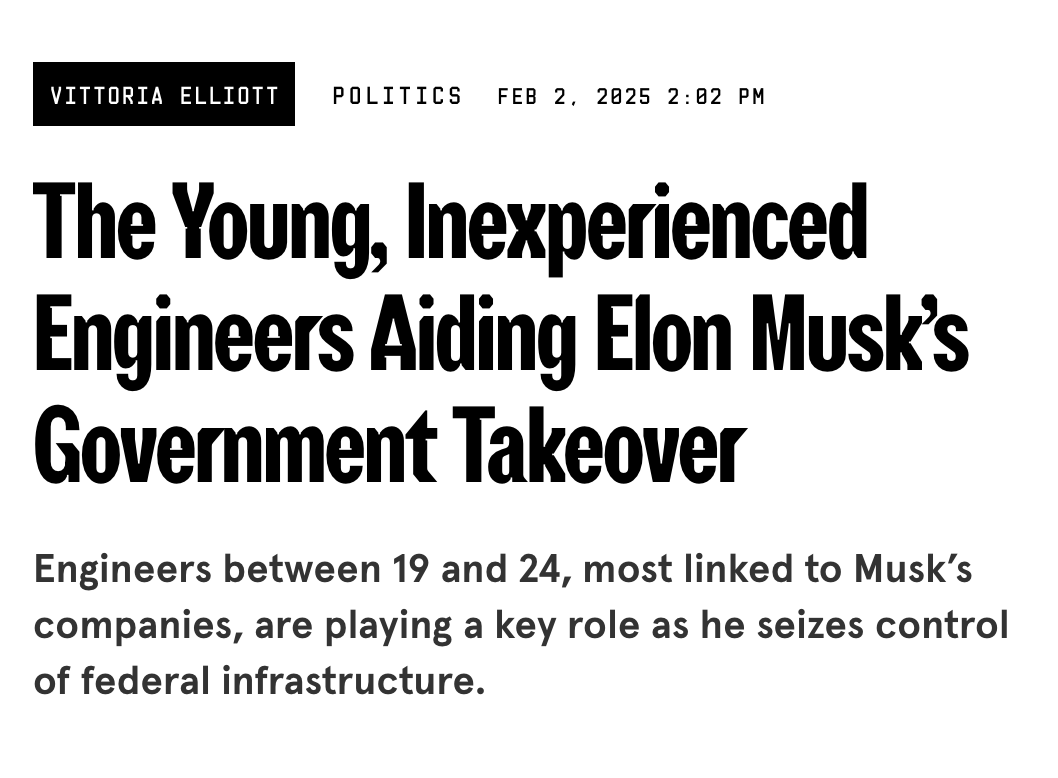
after years spent coddling people and treating them as infants in need of protection for their whole life, they cannot comprehend how 19-24 years old could be competent in what they do
storytelling is the ultimate compression algorithm for human attention. everything else, data, logic, tech feeds into it, but if you can’t wrap it in a compelling narrative, nobody will give a shit. people think they make decisions based on facts, but they’re mostly responding to the shape of a story, whether it’s a personal arc, a company vision, or a product pitch.
if you want to accomplish anything meaningful, the story is the interface between it & the world. get that wrong & nobody will give af. get it right & you bend steel with your bare hands.
<Community Note via Perplexity>
Let me clarify the apparent discrepancy. OpenSecrets shows Bernie Sanders received about $1.9 million from pharmaceuticals/health products from 1990-2024[4], which is different from the $1.4 million figure from just the 2020 campaign cycle[1].
The larger total on OpenSecrets represents:
- Contributions spanning multiple decades (1990-2024)[4]
- Both pharmaceutical and broader health products industries combined[4]
- Individual donations from workers, not corporate money[1]
During the 2020 campaign specifically, Sanders pledged to reject all contributions over $200 from pharmaceutical PACs, executives, and lobbyists[1]. While his campaign did initially receive some executive contributions in early 2019 (including $2,800 from a Beacon Health lobbyist and $2,000 from an Ironwood Pharmaceuticals CEO), his campaign committed to refunding any contributions that didn't comply with this pledge[3].
Notably, about 70% of Sanders' 2020 campaign funds came from small individual donors contributing under $200[2]. When compared to other politicians like Joe Biden ($9.9 million) and Barack Obama ($5.9 million), Sanders' total pharmaceutical/health products industry receipts are relatively modest[4].
Sources
[1] On the Bernie/RFK Pharma Money Spat - Sludge https://t.co/ROXOiys4yg
[2] Fact Check: RFK Jr. Misrepresented Data To Claim Bernie Sanders ... https://t.co/TD5dYM7BzQ
[3] Which 2020 Democrats are taking money from the healthcare ... https://t.co/h630pyKJjD
[4] Pharmaceuticals / Health Products Recipients - OpenSecrets https://t.co/K7ioDmCMLl
[5] Sen. Bernie Sanders - Campaign Finance Summary - OpenSecrets https://t.co/fs1nVuLlZD
[6] Pharmaceuticals / Health Products Recipients - OpenSecrets https://t.co/8NFBpahAu9
[7] Sen. Bernie Sanders - Vermont - OpenSecrets https://t.co/69jZXF01P1
[8] Bernie Sanders in The News - OpenSecrets https://t.co/ijD2kCMCFd