In 2024, a young software engineer named Devon Zuegel arrived in Sonoma County with renderings of a village that she wanted to build along a bend of the Russian River. Esmeralda, as she named it, would be a West Coast version of Chautauqua, a hamlet in western New York “where kids run free and people gather for intellectual talks, music and plays.”
As officials prepare to formally consider the plan, some locals are energized by the dream of a new utopia.
https://t.co/Lr8UhwBJHa
When we started, we weren't sure if high end buyers would embrace flat fee homebuying.
Today, a buyer closed on a $12M home in Beverly Hills with TurboHome.
Our agent negotiated the deal to $1.7M under list and saved the buyer $270K in commission vs. a 2.5% agent.
In what is BY FAR the best contemporary case of courtyard urbanism that I have seen, the Dutch are building fine-grained courtyard blocks (good ones!) on ARTIFICIAL ISLANDS off of Amsterdam.
But reclaiming land from the sea for courtyard blocks is not even the most interesting aspect of this. It's the development system, which uses a subdivision and parcel "passport" system to avoid megadevelopment and allow many builders and owners to participate in building out the courtyard blocks.
This is fascinating. You will want to read it. Link below.
America's fastest-growing cities are all in exurbs, and that's not going to change.
Urbanists have two choices:
1) pretend this is not the case
(2) recognize that the only way to make these projects better is to invent and prove a new, different model, like @CAForever.
On @tbpn this week talking about how @living_carbon's reforestation of degraded land near data centers cuts their carbon footprint.
People ask why I went from AI to climate. They go hand in hand.
Thanks @johncoogan and @jordihays for having me.
I'm watching the @ezraklein@BuffyWicks CA gubernatorial housing debate and just heard the question about @CAForever.
As it happens, we visited the site this week thanks to Abundance Network member @jansramek.
Here were four quick takeways: https://t.co/vRIt4oxgrf
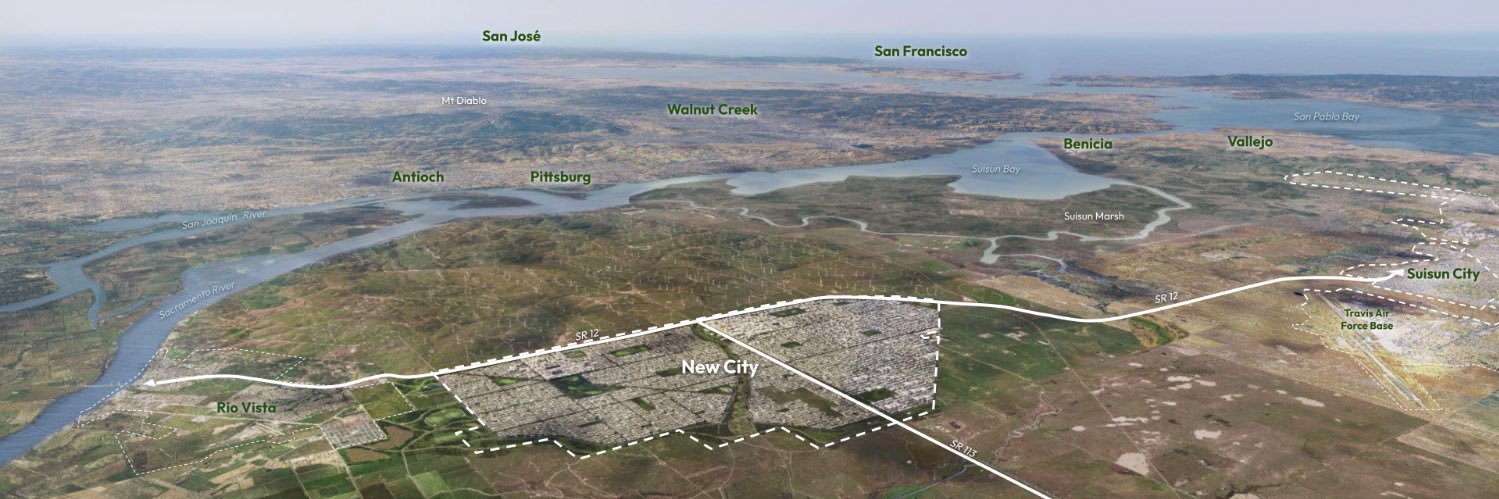
1/ In this week's CHANGING LANES, I speak to @jansramek about @CAForever's Suisun Expansion, a new American city built to be car-optional
Cars welcome but inconvenient
Transit and active transport will be so good that most residents, most of the time, will choose them
🧵
Solano is becoming the most YIMBY place in California.
New poll of 800 likely voters:
59% support the new city/Suisun Expansion
62% support the Solano Shipyard
75% of people under 30 support the new city/Suisun Expansion.
🇺🇸 It's time to build.
Are you a researcher or policymaker working on housing, energy, or transportation issues?
Welcome to the BUILD Research Network! A project of @ssrc_org w/ support from @Arnold_Ventures, BUILD is a new platform for strengthening the research-to-policy pipeline.
🧵/9
The future is electromagnetic.
One challenge is that there are ~ten people in the world who can deeply intuit electromagnetism. RF engineering is "black magic."
Arena Physica thinks machines can intuit EM better.
CEO Pratap Ranade & I on AI for EM:
https://t.co/U3CUnqcYPp
Group form > master planning.
Yazd and Santorini.
No single architect. No frozen blueprint.
Incremental growth inside hard constraints of climate, material, and geometry.
Variation with emergent coherence.
California should and can be the climax of human flourishing: the Florentine Renaissance meeting the American Space Age.
Public plazas and blazing rockets, framed by mountains and sea—a sun-drenched frontier of optimism and opportunity for all. ☀️🚀
@ashleevance gets it.
Today, Courtyard Urbanist is announcing the formation of its Advisory Council — along with the first group of Founding Investors backing the Courtyard Urbanism initiative.
We will introduce individual Council members in the coming weeks, so watch this space.
This marks the next step in a coordinated effort to bring dense, multi-generational, family-supportive urban housing to the United States — and to improve the physical form of American cities for the next century.
The Council brings together developers, policymakers, architects, authors, and technologists who recognize both the scale of the opportunity and the urgency of the moment.
Together, we are working to make courtyard urbanism legal, financeable, and buildable in the United States.
Our goal is to Americanize and advance a time-tested model that has shaped some of the most celebrated neighborhoods in cities such as Copenhagen, Paris, Prague, and Rome.
We are creating the conditions for multifamily housing (the apartment or condo building, the co-op, the palazzo, a baugruppen, etc.) that surpasses the expectations of modern American families while reviving the walkable, mixed-use, amenity-rich neighborhoods that make cities fantastic.
Alongside the Council, an initial group of Founding Investors has accepted an invitation to support this work at its earliest stage.
They share the conviction that courtyard housing represents one of the most important and overlooked opportunities in American real estate — and that now is the moment to lay the groundwork.
We are expanding this group carefully to create the runway needed to develop the design, legal, and financial frameworks that will allow this housing to scale.
The Advisory Council and the Founding Investors are steps toward consolidating both dimensions of Courtyard Urbanist (the public conversation and real-world implementation) and progress on both tracks will be shared over time.
Courtyard urbanism is ultimately a project to make American cities work better for households of all ages, stages, and incomes by increasing the supply of small multifamily buildings with shared outdoor space.
The component building is simple and repeatable:
• 4–6 stories
• Single central stair and compact elevator
• A range of unit sizes, including substantial family housing
• Active ground floors with discreetly integrated parking
• A shared interior courtyard — secure, green, and communal
This is the fundamental building block of walkable, multigenerational, durably prosperous urban neighborhoods.
We are at the beginning of assembling the coalition that will make this possible in American cities.
If you are a builder, policymaker, or investor who wants to be part of this effort, reach out.
Huge evolution from @ConorDougherty of The New York Times — author of the first major book on the YIMBY movement — who broke the story about @CAForever. Proud to have influenced his thinking on the role of new cities in solving the housing shortage.
What's the deal with @CAForever ?
Can these guys really build a new massive shipyard, and a city, in Northern California?
With Northern California's costs, regulatory burdens, and labor shortages - I was skeptical. Workforce is already the #1 challenge in shipbuilding.
@TimGlinatsis and I had @jansramek onto Rebuilding the Fleet to talk about not just vision - but execution.
I came away impressed, and convinced, that these guys have an actionable plan.
Check out our full 40 minute conversation on Rebuilding the Fleet (link in first comment, wherever you get your podcasts)
Hear me out - @americanhousing moves their factory to @CAForever and builds homes for the city. If they need to ship it they use the new shipyard.
We move @swyftcities and @coverbuild there too.
CA Forever becomes the talent capital for urbanism.
A city for building cities.