Earlier this summer, we raised $50M from Google Ventures for our Series A. This is a unique moment (for 🇺🇸) for two reasons:
1️⃣ This is the fist time U.S. shipbuilding as an industry has a new company, focused on building a ship product, with the capital and team to do so.
2️⃣ Google Ventures’ entry reminds us that, in the defense tech renaissance, much of democracy’s best talent and capital has remained on the sidelines. No longer.
We owe a ton of thanks to our existing investors - all of whom participated in the Series A - the rapidly growing Blue Water Team, and to our very understanding families.
We will work relentlessly.
Now check out this dope picture of our hardware on the salt water - more content coming soon.
We are proud to announce our Series A. @GVteam and @davemuni - with all Blue Water insiders joining - have led a $50M round that allows us to deliver for our customers and our country. 🇺🇸
We are not slowing down.
We have used the last year to hire the best robotics engineers in Boston, build a team of veteran shipbuilders, and open a third office in Washington D.C. We are testing on the salt water on ship-scale hardware. We are building capability to attack America's shipbuilding crisis at its core.
This round allows us to build our first full ship and keep pace with a Navy customer that demands speed. We will double down on our fully autonomous design, deepen relationships with our 50+ suppliers, and deliver mass-producible ships to the U.S. Navy and future customers.
Thanks to our incredible employees, their families, and to our investors. All of us know this is only an early chapter in the story of America's maritime industrial renaissance. Much work lies ahead. 🛠️
Damn the torpedoes.
@Sethwinterroth@smarcus@rylanhamilton@Turnip #shipbuilding
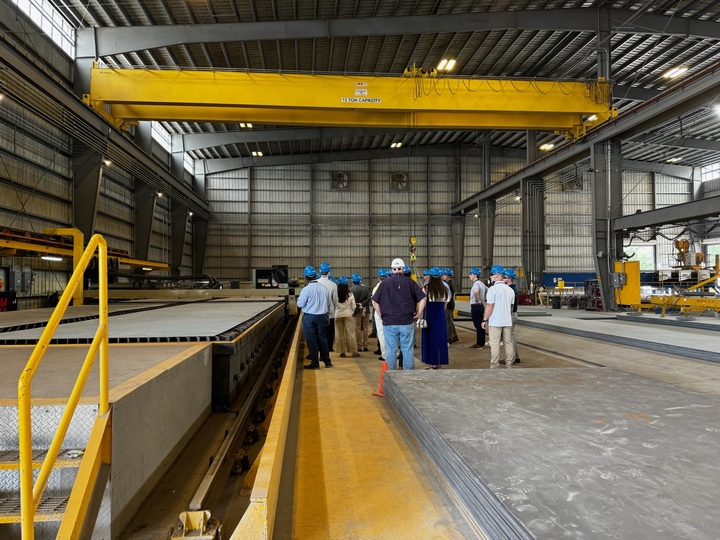
NAIA was proud to partner with @BlueWaterShips in New Orleans to give our members a firsthand look at building next-generation autonomous maritime capabilities with help from innovative companies like @ValstadShip and @tulipinterfaces within the walls of one of the great Bayou builders, Conrad Shipyard.
The future growth of the maritime industry requires more capacity, bolder innovation, and stronger partnerships like what is happening in Louisiana today.
We look forward to continuing to work with Blue Water Autonomy and our members and partners to rebuild American shipbuilding.
🇺🇸 Blue Ops, a maritime division of Red Cat Holdings (@RedCatHoldings) is ramping into full-rate production of the Variant 7 (V7) unmanned surface vessel (USV).
"This platform brings together U.S. boatbuilding expertise, a modern tech stack that was designed and developed domestically, and a defense-ready supply chain for customers who cannot compromise on origin, reliability, or adaptability. We designed Variant 7 to be built at scale and configured for the missions our customers face."
- Barry Hinckley, President of Blue Ops
Learn more >> https://t.co/K3Wq5usc52
Last week, we convened leaders from industry and government to showcase something special in South Louisiana.
At Conrad Shipyard, @newindustrials and Blue Water Autonomy Inc. showed off everything from the serial production of the Navy's Yard Repair Berthing and Messing Barges (YRBMs) to innovative programs like our Liberty Class. ogether, these efforts demonstrate how America's next generation of maritime capability is being built with the support of legacy shipyards like Conrad.
These facilities represent not only our maritime heritage, but also the foundation of our maritime future.
As we approach America’s 250th anniversary, it’s encouraging to see renewed investment and focus on strengthening the nation’s shipbuilding industrial base. Building the future fleet will require more capacity, more innovation, and stronger collaboration across the entire ecosystem.
A key part of that future is autonomy—not as a replacement for the workforce, but as a force multiplier.
Technologies like @ValstadShip can weld ship sections at speeds that exceed traditional methods, helping create a steady flow of fabricated components. The result is greater efficiency, less downtime, and more productive shipbuilders who can focus on the high-value work that only people can do.
At the same time, platforms like @tulipinterfaces are helping connect shipyard operations in real time—linking teams, suppliers, inventory, and manufacturing processes into a unified digital ecosystem. Better visibility and communication mean faster decisions and more efficient production.
When these technologies work alongside the expertise of the shipyard workforce, they accelerate the construction of the vessels our nation needs.
Thank you to everyone who joined us. It was an honor to showcase what this means for the future of American shipbuilding and to collaborate with NAIA, Conrad Shipyard, and all of the partners who helped make the event possible.
#Sail250
#Louisiana
@russvought@SenTedCruz@DavieDefense@POTUS “China and Russia are kicking our ass in the Arctic. That is not acceptable. We are going to be building icebreakers right here in Galveston and Port Arthur.”
The military employs thousands of public affairs officers, many in uniform, who do little but publish poorly written press nobody reads and bend over backwards to help the MSM undermine the nation while purposefully ignoring independent journalists.
Start being useful or shut it down.
Bobby shows how to do the former.
U.S. Army secretary personally tested a laser that shoots drones for $3 a shot at White Sands. The Army confirmed this technology is real, tested, and coming to five bases in 2026.
https://t.co/8d4wPHRTdD
👀👀“There’s a lot of concern from the major naval shipbuilding shipyards in the United States about, ‘Well, why aren’t you just giving those orders to us?’” the official said.
“We just doubled the shipbuilding budget [of] … the United States Navy. They are already one to four years behind schedule on every major program. If I just keep giving them money, they’re just going to go farther and farther behind. This is the only way to shake up the paradigm.”
China’s autonomous tractor goes viral! 🚜
China’s aging rural population and labor shortages are forcing a rethink in agriculture, and the answer may already be working the fields.
The Honghu T70 is a fully electric, autonomous tractor developed in China. It’s a production-ready machine already in use across Hebei Province, with nationwide rollout planned.
The T70 can autonomously complete the entire farming cycle, ploughing, seeding, spraying, and harvesting, without a driver.
It collects real-time data on soil composition, moisture, and crop health, navigating with centimeter-level precision using China’s satellite system. 📡
It’s fully electric, charging via grid or renewables, making it well-suited for rural regions.
If deployed at scale, small farms could be managed by a single person with a fleet of robots, helping China reduce dependence on imported Western machinery and opening export markets in Southeast Asia and Africa.
With over 20% of the national workforce still in agriculture, automating rural labor could free up millions for cities and industry.
~~
♻️ Join the weekly robotics newsletter, and never miss any news → https://t.co/GoA3ZuwWF9
Unmanned warships only way to get firepower to sea this decade at scale that deters China…
See the recent news on Navy’s progress on procuring these systems here:
https://t.co/mgLusAQzos
The rapidly aging manned fleet of destroyers, SSGN cruise missile boats, and cruisers means the capacity of the Navy to put ordinance on China is rapidly atrophying to a nadir in the next year to two.
Taking 3 or more years to put to sea a newly commissioned warship, means only rapidly produce and minimal crew/maintainer needs of unmanned platforms the only way to recover lost firepower at sea.
For a deeper analysis of the current Navy build plan - Golden Fleet - see the substantive report here:
https://t.co/tyQ5TprFdz
For a strategic discussion on how the Navy can employ a balanced fleet of large warships augmented with a numerous and widely dispersed unmanned fleet see the book:
https://t.co/NSos4bXxIm
Modern shipbuilding breaks when information gets trapped between suppliers, shipyards, and disconnected systems. Distributed manufacturing only works when every team is operating from the same real-time picture.
That’s why partnering with @tulipinterfaces was an easy decision.
We weren’t looking for another software vendor. We were looking for infrastructure that could connect our vendors, facilities, and production teams into a single operational layer. Tulip gives us the visibility and coordination needed to move faster across a highly distributed manufacturing environment—from suppliers to shipyard execution. This is bigger than a partnership announcement. It’s part of a broader effort to modernize how American ships get built.
This week, Blue Water, Tulip, and several partners will be at Conrad Shipyard for the #Sail250 celebrations and demonstrating what the next generation of American shipbuilding looks like. We’re looking forward to sharing more in the weeks and months ahead as this collaboration continues to take shape.
Correction: Dozens of U.S. companies have been invited to the qualifier. Several int'ls signal the intent to onshore. The US is brimming with talented new entrants determined to scale best-in-class weaponry. POTUS' budget request is critical to the pivot. https://t.co/AhTBcfs2DQ
China Now Controls 70% of Shipbuilding: Can the U.S. Make a Comeback?
1⃣The History of the Shift in Shipbuilding
2⃣The BRS Report Data
3⃣Criteria for Shipbuilding Success
4⃣The U.S. Situation
5⃣The Future
Video: https://t.co/6PDq708O8u
If this doesn’t spike your blood pressure…
If it doesn’t make you want to kick a door off its hinges…
If you’re not on your feet right now chanting
USA
USA
USA
You’re either dead inside or Canadian. Probably both.
Forget all that Navy SEAL nonsense. Go join the US MERCHANT MARINE!
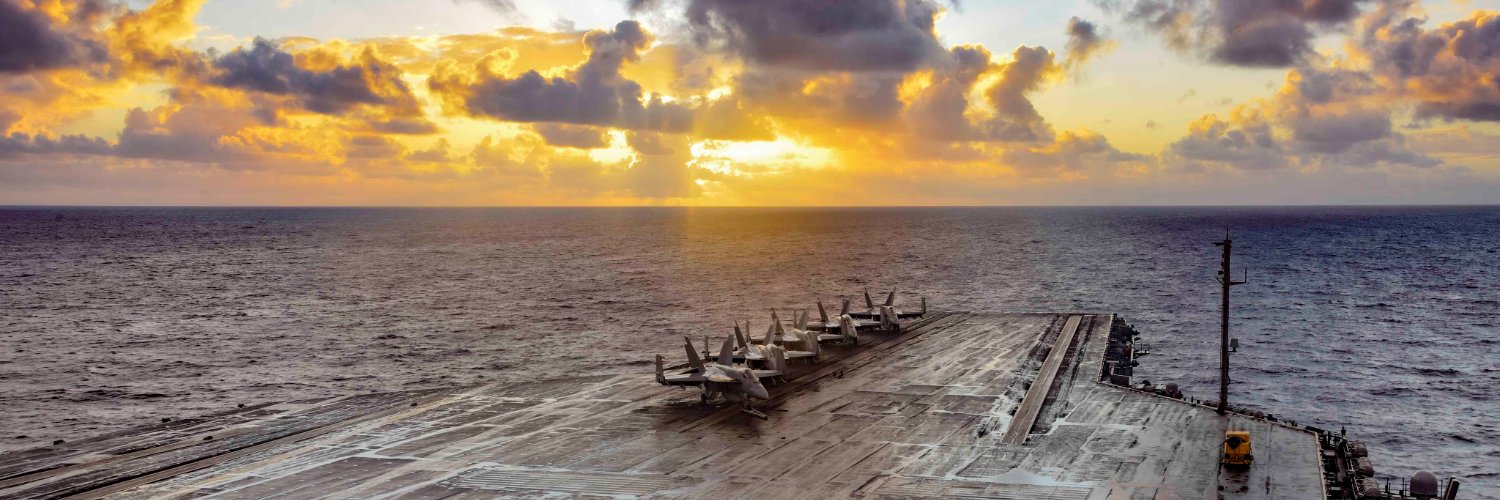
Capt. Christopher “Chowdah” Hill, the Commanding Officer onboard the USS Dwight D. Eisenhower (CVN-69) during her deployment to the Red Sea against the Houthis in 2024 and Interim Commander of the USS Harry S. Truman (CVN‑75) once again during combat operations in the Red Sea in early 2025, has been approved for promotion to Rear Admiral. Congratulations to Captain Hill and the other twenty-two captains frocked to Rear Admiral!!!
We discovered something mind-blowing about robotic shipbuilding.
Profiles (like the bulb flat pictured here in a grid pattern) are basically never straight when they arrive, requiring all manner of labor-intensive tricks to get good fit-up before welding - strongbacks, dogs, clamps…
But what if you could use robots to do this instead?
We had long theorized that this should be possible, but we just proved it - this in-progress panel was assembled using only the force of the robots to correct significant warping in the material.
It’s an open area of development for us, but by pre-scanning parts prior to assembly we should be able to automatically compensate for warping (within limits) to get picture-perfect robotic assembly every time.
Latest shipbuilding numbers are out from BRS and they are not good.
China had gone from 51% in 2022 to 70.9% in 2025.
That is from 2,107 ships to 4,055.






![AustinEGray's tweet photo. 👀👀“There’s a lot of concern from the major naval shipbuilding shipyards in the United States about, ‘Well, why aren’t you just giving those orders to us?’” the official said.
“We just doubled the shipbuilding budget [of] … the United States Navy. They are already one to four years behind schedule on every major program. If I just keep giving them money, they’re just going to go farther and farther behind. This is the only way to shake up the paradigm.”](https://pbs.twimg.com/media/HJuikPhXQAEgSUF.png)





