Object tracking explained in 3Blue1Brown style.
Learn about the tracking loop, kalman filters, why occlusion breaks and one way to fix it.
Try it out https://t.co/GPplmZJxmX
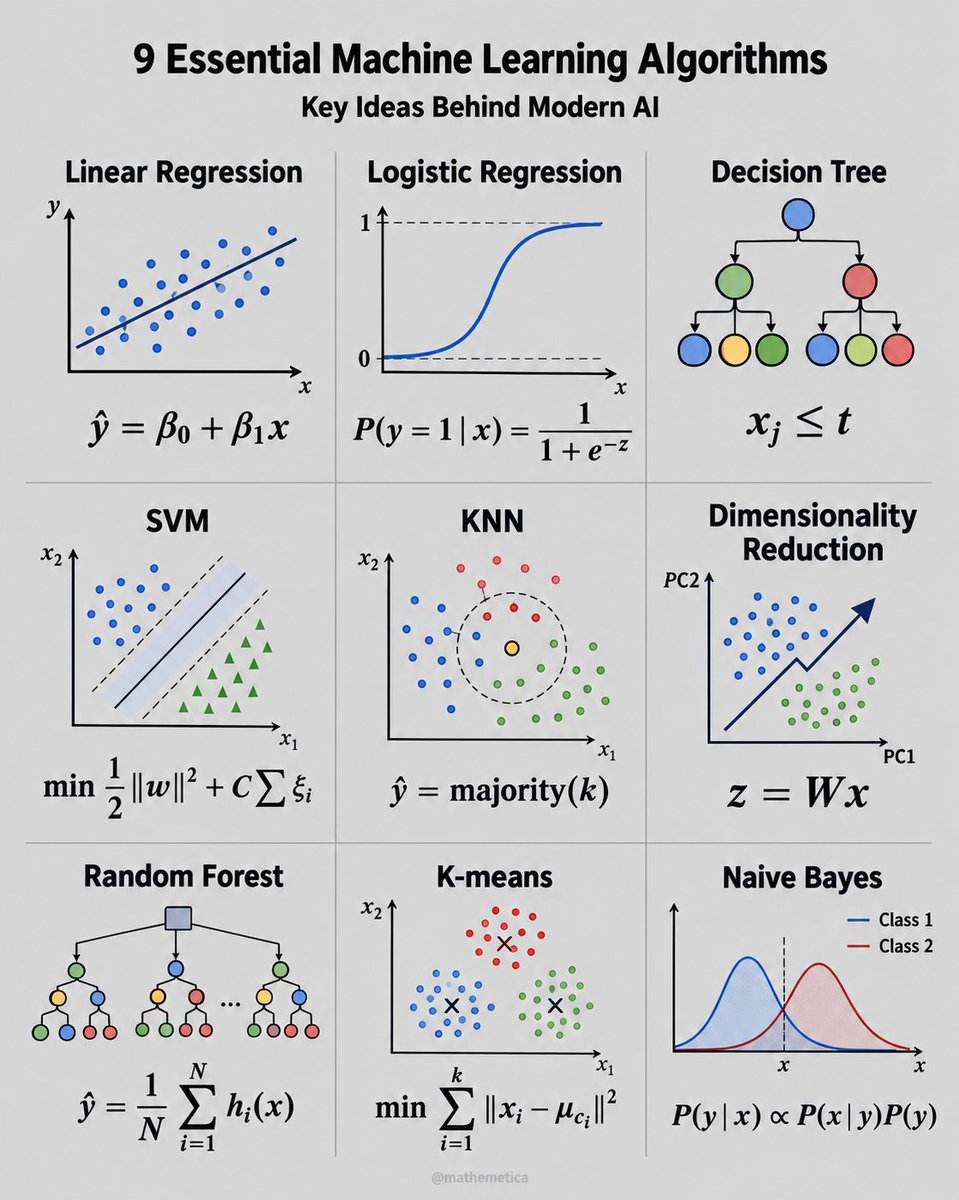
These 9 algorithms are why your phone predicts your next move.
- Linear Regression finds the best line through data points.
- Logistic Regression turns numbers into probabilities.
- Decision Trees classify by asking sequential questions.
- SVM draws the widest gap between classes.
- KNN lets closest neighbors vote.
- Dimensionality Reduction keeps only what matters.
- Random Forest averages many trees.
- K-means finds natural groups in data.
- Naive Bayes multiplies probabilities for quick classification.
Fourier wrote the equivalent sine-and-cosine series in 1822 while analysing the flow of heat.
The family {eⁱⁿˣ : n ∈ ℤ} consists of the simplest oscillations that close after one turn of the circle.
Any 2π-periodic square wave is the sum of these oscillations, the weight of each being the inner product
cₙ = (1/2π) ∫₋π^π f(x) e^{-i n x} dx.
Only odd integers receive non-zero weight, and those weights diminish like 1/n. Finite sums already recover the flat stretches, yet they ripple past every jump - the Gibbs overshoot that survives in the limit.
The right-hand rule defines the orientation of a three-dimensional Cartesian coordinate system. Pointing the right-hand fingers along the positive x- and y-directions makes the thumb indicate the positive z-direction, giving the relation x̂ × ŷ = ẑ.
The same convention determines positive rotation about an axis. Point the right thumb along the positive direction of the axis; the direction in which the fingers curl defines positive rotation around that axis.
🚨 THIS $5 BOARD IGNORES GRAVITY - STAYS LEVEL NO MATTER HOW YOU TILT IT 🤯
Arduino + MPU6050 gyro + servo gimbal. PID loop reads tilt 100x/sec and counter-rotates instantly.
Top = 360° continuous servo, Bottom = 180° servo. This is how satellite dishes and camera gimbals stay locked.
Same boy. Same weight. Different result. ⚖️
That’s the Power of Pressure.
Pressure is not force.
Pressure = Force ÷ Area(P = F / A )
His weight F barely changes.
What changes is the area that weight is spread over.
One paper cup → tiny contact area → huge pressure → cup collapses.
Several cups and a plate on top → much larger area → pressure per cup drops → they hold him.
The plate matters. It spreads the force so no single cup takes the full load.
This is why:
• a sharp knife cuts, a blunt one doesn’t
• heels sink in sand, flat shoes don’t
• a bed of nails works, one nail doesn’t
Force stays. Area decides the damage.
Power of physics 🧪
My first day in Rwanda 🇷🇼 and I’m not disappointed at all!
Whenever I travel, I feel it’s important to understand the history of the country to truly understand its people. My visit to the Kigali Genocide Memorial was deep, powerful and emotional. ❤️🇷🇼
I want to say sorry for what happened to my Rwandan brothers and sisters. No words can ever change the past, but seeing what Rwanda has built and how the country continues to move forward is truly inspiring.
I met your President a long time ago, but after seeing and understanding more about Rwanda’s journey, I have an even deeper respect for the way these difficult matters have been handled.
Respect Rwanda. 🇷🇼❤️
The past must never be forgotten, and the future must always be protected.
#Rwanda #Kigali #NeverForget #Peace #Unity
La función de los spoilers no es frenar el avión, estás equivocado.
Y no te voy a mentir, yo también pensaba lo mismo.
Al fin y al cabo, cuando se despliegan aumentan la resistencia aerodinámica y también contribuyen a reducir la velocidad.
Pero esa no es su función principal.
Bernoulli’s principle connects pressure, velocity, and energy in a flowing fluid.
Where the flow speed increases, the static pressure decreases, and where the flow slows down, the static pressure increases, provided the conditions for Bernoulli’s equation are satisfied. This pressure difference is one of the key pieces in understanding how aerodynamic lift is produced by wings. The same principle also appears throughout fluid dynamics, from aircraft and birds to flowing water and ventilation systems.
A science teacher from east China's Ji'an City recently led teachers and students from across the country to design and build heavy-lift water rockets using basic materials, with all 17 rockets successfully launched.
Resistor, capacitor, diode, optocoupler… schematic symbols matched with the real parts. Worth a save for your next circuit diagram. 🔧
Symbol ↔ real part, lined up: resistor, inductor, diode, transistor, transformer, relay, optocoupler.
Need prototyping or small-batch? Seeed Fusion 👉
https://t.co/vk9XULLhRj
Which one do you work with most?
#Electronics #PCB #PCBA
Developers keep getting rejected in tech interviews despite having 5 frameworks on their resume.
The reason? They know how to use tools, but not what the tools actually do.
When an app returns stale data from an API call 🔄:
• A framework developer checks if they used the right React hook ⚛️.
• A foundational developer checks HTTP request headers 🌐, browser caching ⚡, and API response payload integrity ⚙️.
Frameworks change every 2 years. Syntaxes evolve. AI handles boilerplate.
What doesn't change is fundamental architecture—HTTP protocols, client-server communication, caching strategies, and data flow.
If you want to future-proof your dev career, master the underlying mechanics before chasing the next trending library.
Knowing the fundamentals is the fastest shortcut to senior-level engineering. If you're ready to bridge the gap between syntax and true system architecture, check out our IT Fundamentals Course: https://t.co/drNCm8Od8C
#SoftwareEngineering #WebDevelopment #TechCareers #TechWorldWithNana
15 Ways to Master Mechatronics
1. Learn Arduino
Master digital and analog inputs/outputs
Interface sensors and actuators
Control motors and relays
Build a solid embedded systems foundation
2. Understand Electronics
Voltage
Current
Resistance
Ohm’s Law
Power and basic circuits
Every mechatronic system starts with electronics
3. Learn CAD Design
SolidWorks
Fusion 360
Onshape
Design before you build
4. Build Real Projects
Robotic arms
Mobile robots (rovers)
Automation systems
The fastest way to learn is by building
5. Learn Programming
Python
C++
Arduino IDE
Write code that brings machines to life
6. Understand Sensors
Ultrasonic sensors
Encoders
Limit switches
IMUs
Cameras
Sensors are a robot’s eyes and ears
7. Learn How Motors Work
Servo motors
Stepper motors
DC motors
BLDC motors
Motion is the heart of mechatronics
8. Master Troubleshooting
Check wiring first
Check power second
Check software third
Learn to debug systematically
9. Learn Basic Mechanics
Gears
Torque
Bearings
Linkages
Mechanical design is just as important as code
10. Use a 3D Printer
Prototype parts quickly
Test ideas faster
Improve your engineering workflow
11. Study Industrial Automation
Conveyor systems
Factory robots
PLC programming
Industrial sensors
Learn how modern factories operate
12. Build a Robotic Arm
Combine mechanics
Electronics
Programming
Control systems
One project that teaches almost everything in mechatronics
13. Learn From Failure
Broken designs
Wiring mistakes
Bad code
Failed prototypes
Every mistake makes you a better engineer
14. Document Everything
Wiring diagrams
CAD models
Schematics
Notes
Version control
Professional engineers document everything
15. Never Stop Building
Stay curious
Keep experimenting
Keep improving
Learn from every project
Experience compounds over time
Mechatronics Formula:
Mechanics + Electronics + Programming + Control Systems + Automation = Mechatronics
The best way to master mechatronics isn’t by reading about it - it’s by building, breaking, fixing, and building again.
🧵 Gradient descent is just following the steepest slope.
Picture yourself standing on a foggy hillside at night. You cannot see the valley, but you can feel the ground under your feet.
At every step you simply move in the direction that drops the fastest.That is all gradient descent does: it follows the local slope of the loss surface until it reaches a low point.
Here is the classic picture of that idea. A ball rolling downhill on a 3D loss landscape, always taking the steepest path available.