We’re releasing a broad range of new mathematical results produced by an internal frontier model.
We’ve been consulting with the independent Advisory Group on Mathematics and Artificial Intelligence at the Institute for Advanced Study, and we have drawn on their advice and public recommendations to inform how we release these results.
https://t.co/7N6TPlft1P
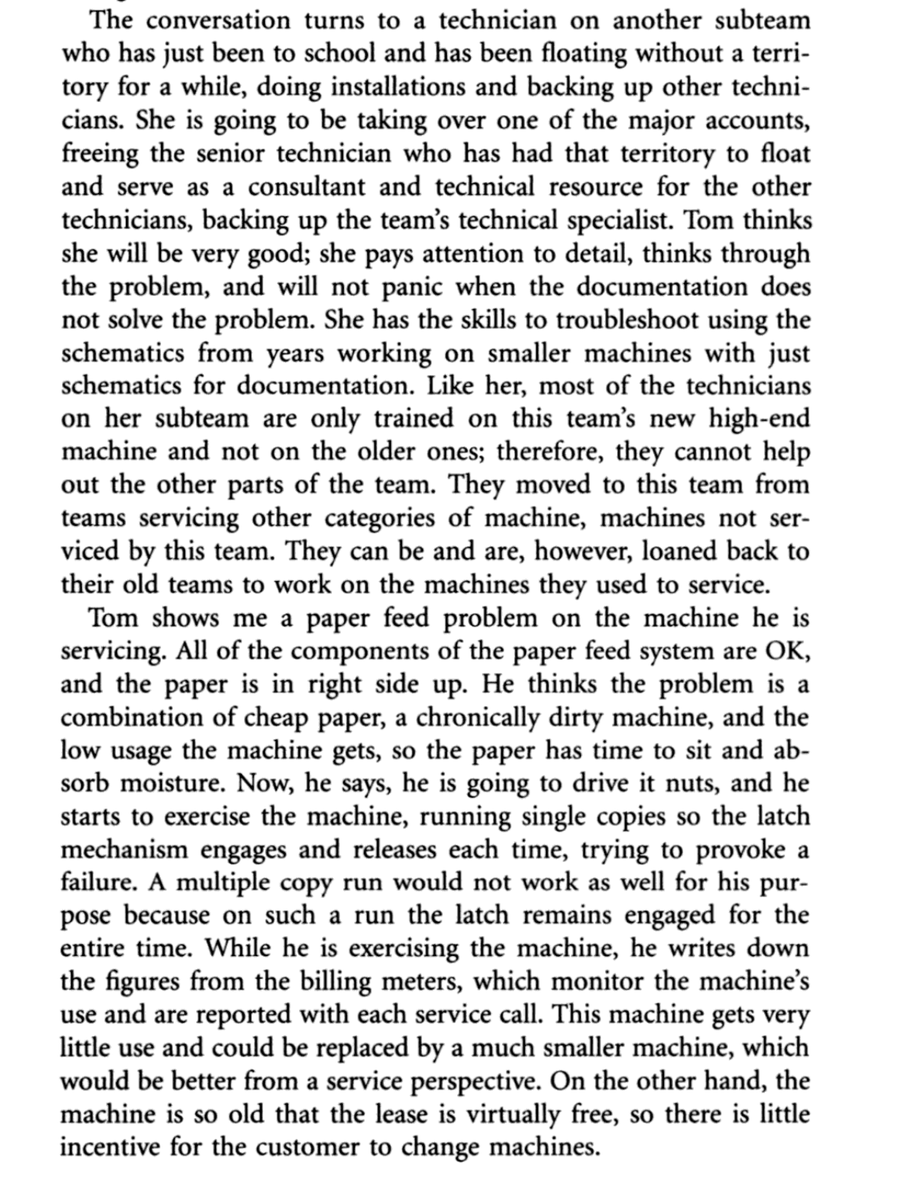
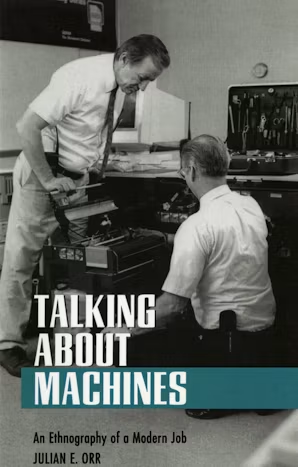
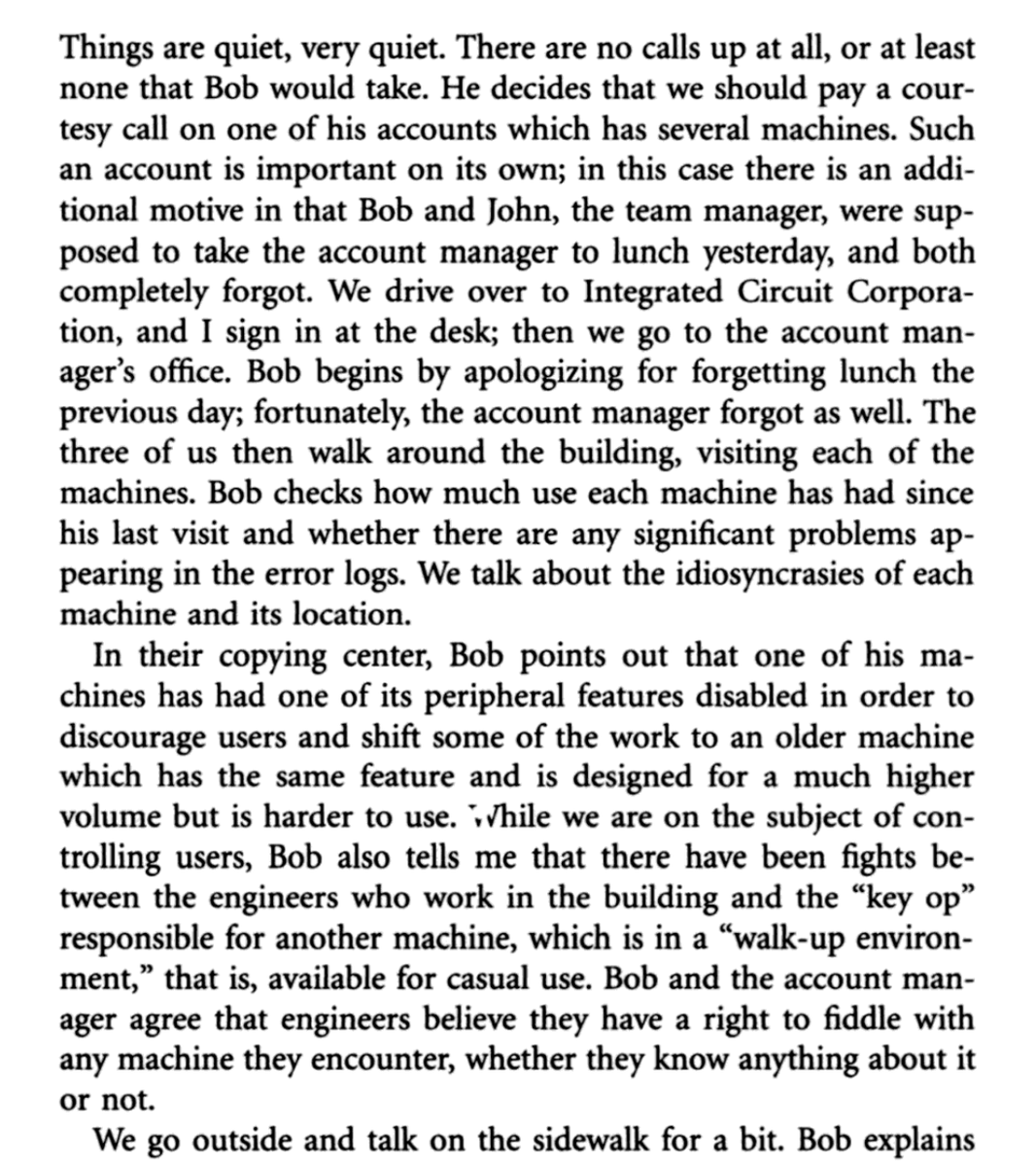
When people talk about AI easily replacing workers, I think about this ethnography of copier repair technicians in the 1990s.
You see how work is complicated and improvised by workers and informal and badly documented.
(But eventually technology did largely eliminate this job)
AI Drug Discovery Is Becoming a Bottleneck Trade
I get excited when an industry starts going through a real regime change. AI drug discovery (“AIDD”) increasingly looks like one of those moments.
Two things are happening:
1/ Upstream: the frontier AI labs are piling in.
2/ Downstream: The supply chain is clearly moving.
Supply-chain checks suggest the upstream picks-and-shovels of discovery and early preclinical R&D are starting to feel the increase in experimental volume.
DNA → protein → assays → sequencing → automation → preclinical testing
Names across that stack include $TWST , @GenScript , $ILMN , $TXG , lab-automation vendors and CROs.
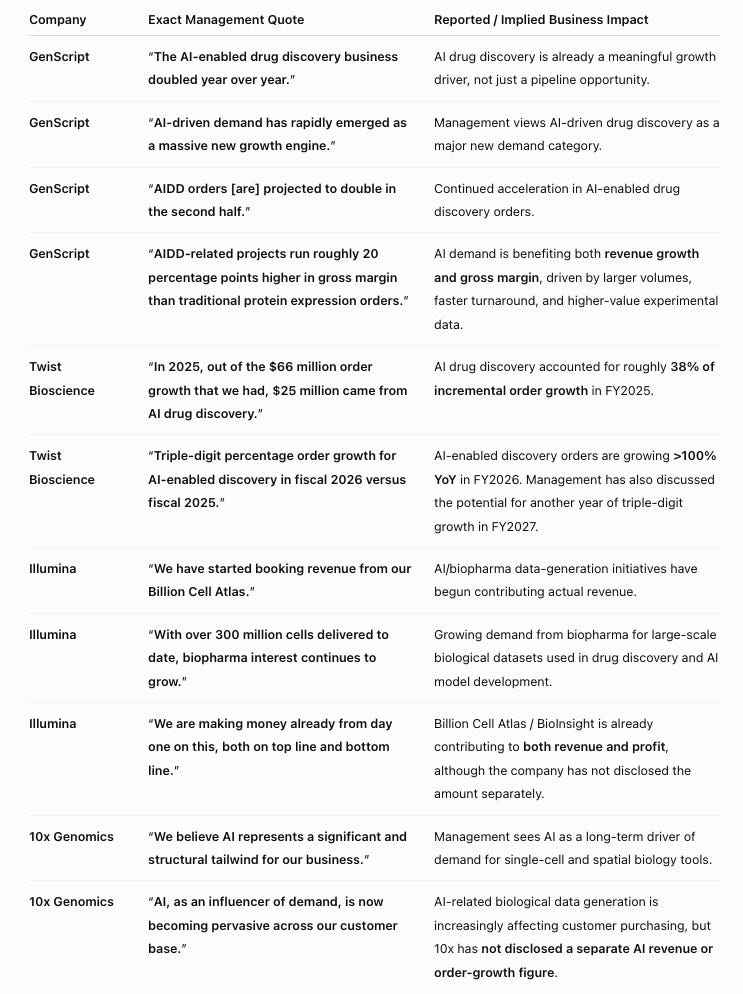
$TWST expects triple-digit percentage growth in AI-enabled drug-discovery orders in FY26, and another year of triple-digit order growth in FY27.
@GenScript's AIDD business doubled YoY in 1H26. Its current platform advertises industrial-scale validation of 4,000+ designs/day, with integrated sequence-to-data workflows. Our channel checks suggest the ramp is moving even faster: roughly 8,000 designs/day currently, with a path toward ~16,000/day by YE26.
---
Why does AI drive more wet-lab demand?
1/ AI makes hypothesis generation almost free → way more shots on goal.
The bottleneck is moving from expert-driven design to biological validation.
2/ AI models need continuous experimental feedback — and both good and bad data are useful.
Traditionally, only the highest-conviction A+ candidates might get pushed into expensive validation. With AI, even the B/C candidates can be valuable because failed experiments generate training data.
@GenScript has said its sequence-to-binding workflow can return data in 4–7 days, and that faster cycle times matter because AI models depend on continuous experimental feedback.
@Anthropic is a clean example. @claudeai designed 1,320 protein binders. @adaptyvbio converted those digital sequences into DNA, expressed the proteins and tested binding. Only 354 actually bound. And the 966 failures are not wasted. They are useful negative labels: what does not express, what does not bind, what has poor affinity. Those results help train the next model iteration.
3/ Wet labs are no longer just making drugs. They are making training data.
$TWST / @GenScript increasingly look like biological data foundries.
$TWST explicitly talks about generating model-ready data from AI-designed sequences. In some workflows, the customer may care less about receiving the physical protein than about getting structured experimental results back into the model.
Traditional drug discovery asks: “Does candidate X work?”
AI drug discovery also asks: “What can this experiment teach the model?”
---
TAM of AIDD
If AI is simply a better R&D tool, the relevant spending pool is the $300–400B of annual global pharma R&D. If AI meaningfully increases the number of viable drug programs, the opportunity is larger because it expands downstream demand for DNA synthesis, protein production, assays, and preclinical work.
Near term, we can also size demand from AI-company spending. If Anthropic reaches $80B of ARR in 2026 and spends just 1% on AIDD, that alone would imply ~$800M of annual investment.
---
Trade setup
This is a trade that could have long legs. It’s hard to really stop working until PhaseI/II results (2028+)
It smells a lot like the bottleneck trade we just saw in semis: GPUs → HBM → networking → power/cooling. In biology, It basically follows the drug discovery process downstream: AI models → designs → DNA/protein → assays → preclinical capacity.
After the upstream picks-and-shovels, animal testing could become the next bottleneck. Monkey prices are already near prior highs and CRO capacity is tight. AIDD pushing more candidates into preclinical development would only add demand.
?? But clinical trials are still the bottleneck?
This is the biggest pushback I keep coming back to. No matter how fast discovery becomes, drugs still need to go through preclinical → Phase I → Phase II → Phase III → approval. You still need patients, time and capital.
But that doesn’t mean the bottleneck trade won’t work. More viable candidates — especially with higher success rates — still means more demand throughout the development process.
And who knows: clinical trials themselves may eventually be optimized by AI.
?? What breaks the trade?
Near term, the picks-and-shovels trade breaks if experimental budgets stop growing, AI-generated designs don’t translate into useful wet-lab hits, or capacity catches up too quickly.
Longer term, the thesis breaks if AI drugs look great in discovery / Phase I but fail at normal rates in Phase II/III. That is why Phase II matters so much.
?? Milestones
Late 2026–2027: first Isomorphic-designed drugs enter human trials; more AI-native programs move into IND-enabling work / tox.
2028–2030: clinical trial results start telling us whether AI-designed drugs actually perform better than conventional drugs.
Calling all the "bottleneck bros". :) @jukan05@zephyr_z9@aleabitoreddit@ParadisLabs
+++
More comprehensive analysis: https://t.co/vaTuiyyYB6
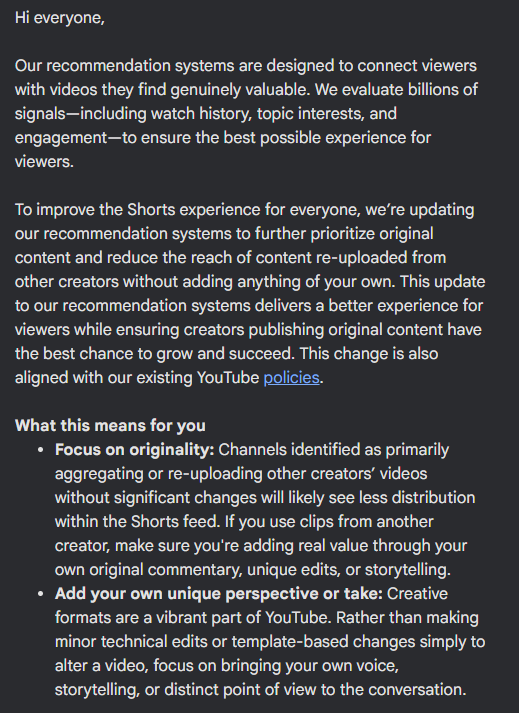
🚨 MAJOR ANNOUNCEMENT: YouTube will start prioritizing original content and reducing re-uploads (RIP clipping)
YouTube has just announced one of the most impactful changes to its short-form algorithm. Its recommendation systems (the algorithm) will start to further prioritize original content and reduce the reach of content re-uploaded from other creators without adding anything of your own.
They highlight this shift toward originality, where channels with primarily re-uploaded content will see less distribution within the Shorts feed.
It also seems like they’re really trying to put the focus on content with real value, while highlighting that YouTube doesn’t want as many “minor technical edits” or “template-based” changes. Which is basically all that clipping was in this industry.
Overall, while this will piss off some people whose entire careers were built on the premise of other people’s content (mostly clippers), the change itself is amazing and will finally address the overall quality issue we’ve been seeing.
Meta Chief AI Officer Alexandr Wang on why your product can be better and still lose, because perception is more real than reality:
Most founders assume the best product wins. Build something that works, prove it with data, and customers will see it.
Wang says that assumption breaks down when you sell to large organisations.
"Probably a lot of the companies that you all have worked with, they're very data-driven companies. It feels like the truth makes its way... everybody serves a shared sense of reality and whatnot. That's not true at most large companies and also not true within the government, unfortunately."
So what do they run on instead? Perception.
"At a lot of large customers, perception is more real than reality. The reality is just so ugly most of the time that very rarely do people actually confront reality, and most of the time they just sort of choose to believe the perceptions that they live in."
That is how a better product loses. If buyers aren't judging reality, being better in reality isn't enough. The deal goes to whoever owns the perception.
Wang spells out what this means for anyone building or selling to enterprises:
"If you end up doing enterprise sales or you end up building enterprise products... just as much as your job is to improve the reality, it is to shape the perception."
The product still matters, but by his reckoning, it's only half the job.
One company he singles out for mastering the other half is Palantir:
"One of Palantir's superpowers is that they shape the perception better than most other technology companies do, because I think they view themselves... it's like a combination of a sort of acting troupe combined with a software company."
And @alexandr_wang means it literally:
"They literally give an acting book to all of the new hires, or they did for a very long time."
A software company that trained its people in performance. That tells you how seriously Palantir took the perception half of the job.
I left Silicon Valley 6 years ago
Why?
Because it's a monoculture
The most extreme group think of any place on the planet
Show up to a dinner party and everyone is in tech
So what do they do? They start stack-ranking each other
And it's a totally ordered set: being founder of co $100B market cap > founder of co with $50B market cap > managing partner of tier 1 venture firm > hired CEO of $50B public co > founder of $10B co > etc etc
Pure toxicity that nerfs creativty
And then as a corollary, people are especially afraid to speak truth to power as everyone knows their place in
"The Hierarchy"
Reject this nonsense. Stay weird. Think independently. Be honest with yourself. Have fun.
New view from space!
We captured this image of the Chinese Space Station as it passed over the coast of Hawaii.
At 12 cm/px resolution, we can see the expected T-shaped configuration of the CSS, with its solar array wings deployed and all science modules visible: Tianhe, Wentian and Mengtian.
Can the US build a DJI? We bought a 2019 Mavic Mini and a 2023 Mini 4 Pro, tore them down in our hardware lab, and put them under a bench microscope to find out.
What we found: https://t.co/2nxcHd8cSF.