Terence Meets the Machine Elves: A visual replication of the DMT breakthrough experience generated through a bespoke generative media pipeline.
built in collaboration with: @noonautics & @alieninsect
👁️
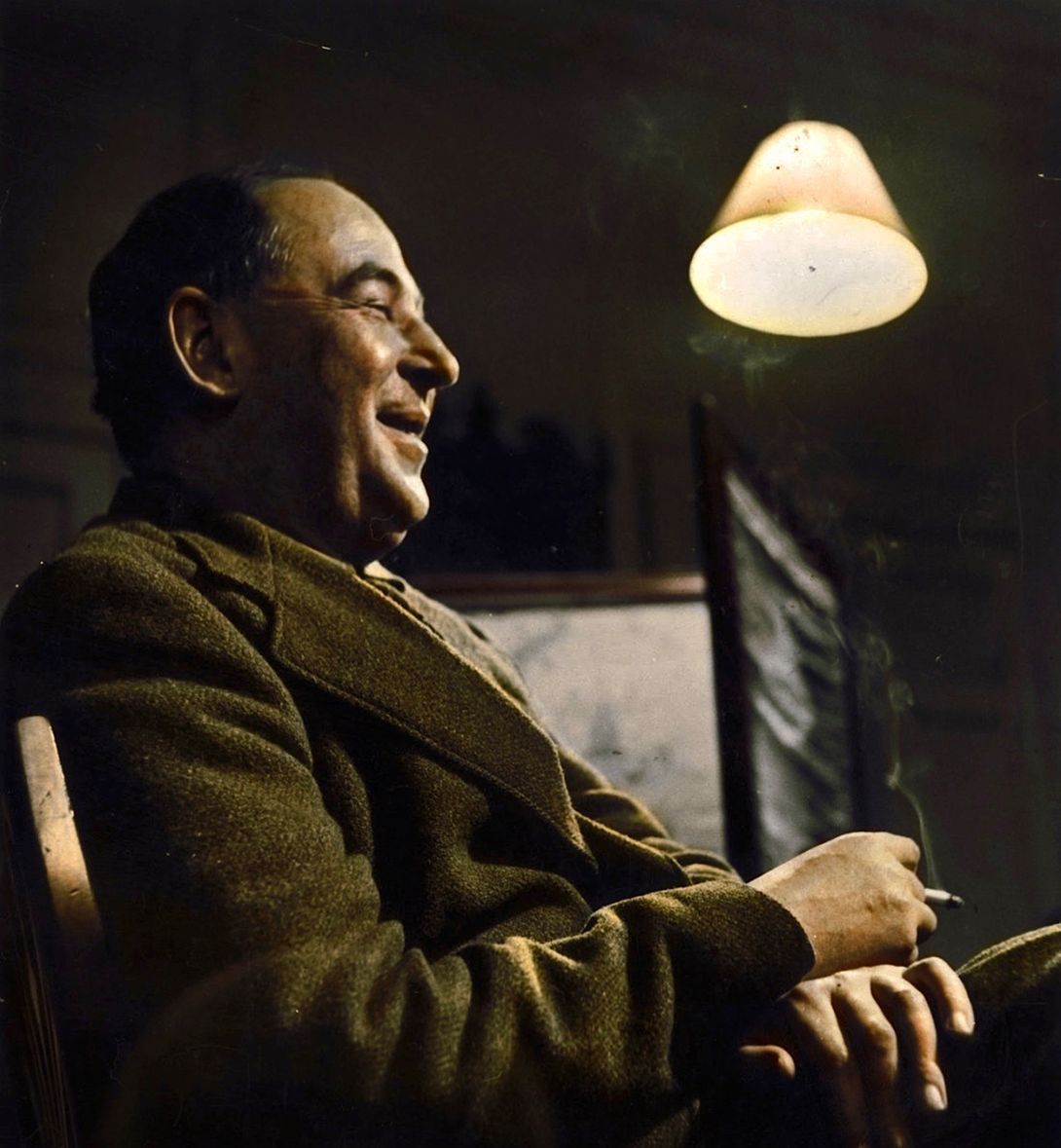
In 1962, C.S. Lewis was asked to name the books that most influenced his life philosophy.
The list he came up had many classics, but also some lesser known gems. Here’s his list:
Dr. James pennebaker spent 30 years studying why some people recover from trauma and others don't.
He found the same pattern in every person WHO healed.
It had nothing to do with therapy or time.
Medicine ignored it. His patients didn't. 🪡
Tim Dillon: “This is one of the bleakest periods I’ve ever lived through.”
“You’re more alone.”
“You have less hope.”
“We’re in multiple wars.”
“And it’s the most technologically advanced time that we have.”
“But in order to enjoy it, you have to be a sociopath.”
“You have to be unbothered by seeing a 2-year-old that Israel lit on fire, and you have to swipe without thinking about it and go right to DoorDash.”
“We are all being trained to be sociopaths.”
“No one believes life is better than it was in 2010.”
“People had a social life.”
“Young people felt more hope about the future.”
“They haven’t been fully sucked into phones.”
“People aren’t quite addicted to rage yet. Social media hasn’t programmed our minds.”
“People can still go on a date and talk to a woman.”
“They don’t have to goon for eight hours in their room and then read about Hitler.”
“Nobody looks at 2010 and goes, whoa, that time sucked.”
“None of these advancements make anyone’s life better.”
“The Palantir thing is that everybody’s gonna join the military.”
“We’re all gonna fight a bunch of wars.”
“We’re gonna make the country safe, but we’re gonna do it in a way that takes away all of your personal autonomy and freedom.”
“As soon as you’re 18 years old, you’ll be in the military and you’re gonna fight who we want you to fight.”
“The jobs available are gonna be the ones we tell you that you qualify for.”
@TimJDillon
This 16-min lecture on "Black Scholes model" by Nassim Taleb will tell you more about quant trading than a 2 month internship at Goldman Sachs or JPMorgan.
Bookmark it & watch today,no matter what. It’s the most productive way to start your week. Then read article below.
A community college professor taught the same study skills lecture for 30 years, and the video quietly became one of the most watched educational recordings on the internet.
His name is Marty Lobdell. He spent his career as a psychology professor watching students fail not because they were lazy, but because nobody had ever taught them how their brain actually works under the pressure of learning something hard.
The lecture is called "Study Less Study Smart." Over 10 million views. Passed around in Reddit threads, Discord servers, and university study groups for over a decade. And the core insight buried inside it has been sitting in cognitive psychology research for years, waiting for someone to explain it in plain language.
Here is the framework that completely changed how I think about effort.
Your brain does not sustain focus the way you think it does. Studies tracking real students found that the average learner hits a wall somewhere between 25 and 30 minutes.
After that, efficiency doesn't just decline. It collapses. You're still sitting at your desk, still looking at the page, but almost nothing is going in.
Lobdell illustrated this with a student he knew personally. She set a goal of studying 6 hours a night, 5 nights a week, to pull herself out of academic probation. Thirty hours of studying per week. She failed every single class that quarter.
She wasn't failing because she lacked effort. She was failing because she had confused time spent near books with time spent actually learning. The 25-minute crash hit her at 6:30pm every night. She spent the next five and a half hours sitting in the wreckage of her own focus and calling it studying.
The fix sounds almost too simple. The moment you feel the slide, stop. Take five minutes. Do something that actually gives you a small reward. Then go back. That five-minute reset returns you to near full efficiency. Across a six-hour window, the difference is not marginal. It is the difference between thirty minutes of real learning and five and a half hours of it.
The second thing he taught destroyed something I had believed about how memory actually works.
Highlighting feels productive. Going back over your notes and recognizing everything feels like knowing. But recognition and recollection are two completely different cognitive processes, and your brain is very good at making you confuse them.
You can see something you've read before and feel completely certain you understand it, even when you couldn't reconstruct a single sentence from memory if the page were blank.
He proved this live in the room. He read 13 random letters to his audience. Almost nobody could recall them. Then he rearranged the same 13 letters into two words: Happy Thursday. The whole room got all 13 without effort.
Same letters. Same count. The only thing that changed was meaning.
The brain stores meaning. Not repetition. The moment new information connects to something you already understand, the retention changes entirely.
This is what the cognitive psychology literature calls elaborative encoding, and it is the mechanism underneath every effective study technique.
The third principle was the one that hit me hardest, and the one almost nobody applies.
Lobdell cited research showing that 80 percent of your study time should be spent in active recitation, not passive reading. Close the material. Say it back in your own words.
Teach it to someone else, or to an empty chair if no one is around. The struggle of retrieval is where the actual learning happens. Reading your notes again is watching someone else do the work.
His parting line has stayed with me longer than almost anything else I have read about learning.
He told the room that if what he shared didn't change their behavior, they hadn't actually learned it. It would just live in their heads as something they had heard once and felt good about.
He was right. And most people leave every lecture exactly like that.
The students who remember everything aren't putting in more hours.
They stopped confusing the feeling of studying with the fact of it.
Listening now to the Japanese Edo period melody HonShirabe used as a meditation by Zen monks to explore the deep spiritual sound/silence of both shakuhachi & player. Here, it's performed by shakuhachi master Kōhachiro Miyata from his 1977 Lp 'Shakuhachi,The Japanese Flute' Enjoy!
The full playlist for Christina Hendrick's four-hour "Shoe Pop Dream Gaze" DJ set:
"Broken Heart" – Spiritualized
"Yes (Love Theme From Lost River)" – Chromatics
"Drink I'm Sippin On" – Yaeji
"Hug Of Thunder" – Broken Social Scene
"How Can I Make It Ok?" – Wolf Alice
"New Song" – Warpaint
"Pa Pa Power" – Dead Man's Bones
"Machinist" – Japanese Breakfast
"Michael Mann" – Youth Team
"Heartbeats" – The Knife
"Thunder" – Catnapp
"Ivo" – Cocteau Twins
"Joseph Porter" – The Deadly Syndrome
"The Birds" – Rick Cuevas
"I Do You" – Anna of the North
"Cruel Summer" – Bananarama
"The Day We Met Never Ended for Me" – Talvi
"Crazy For You" – Causeway
"Los Ageless" – St. Vincent
"The Judge" – Desire
"Waxwing" – Sorry
"Dance While You Shoot" – Noga Erez
"Ghost" – Halsey
"Boys of Summer" – Esper Star
"West Coast" – Lana Del Rey
"Hell Is Round The Corner" – Tricky; Martina Topley-Bird
"Gooey" – Glass Animals
"(The Forgotten People)" – Thievery Corporation
"God" – Tori Amos
"The Ghost Inside" – Broken Bells; Danger Mouse
"She Bangs the Drums" – The Stone Roses
"I Did It!" – Kitten
"Can I Call You in the Morning?" – The Beaches
"Heavy Metal Heart" – Sky Ferreira
"Horse Pills" – The Dandy Warhols
"Lover I Don't Have to Love" – Bright Eyes
"Velvet Morning" – The Verve
"Love Is a Big Light" – The Stevenson Ranch Davidians
"In The Morning I'll Be Better" – Tennis
"Girl Of The Year" – Beach House
"Rescue" – The Asteroid No.4
"Vapour Trail" – Ride
"First Love/Late Spring" – Mitski
"Crazy for You" – Slowdive
"Half Silences" – Loma
"Waiting Game" – BANKS
📸: Phillip Gutgesell / The MAT Magazine
I thought everyone got chills from music, but only about 50% of the population experiences this phenomenon, called Frisson.
Those of us who feel it "have more neural fibers linking our hearing center to our emotion center."
These brains are wired for intense musical highs and are often creative and curious. Have you experienced this?
This is one song (Sailing by Christopher Cross) that always gives me chills. Do you have others?