I can never not think of the children. Alone and trapped. Under the rubble in Gaza. Sitting in ICE cages. In a room on Epstein Island. At the bottom of a Congolese Coltan mine. I always think of the fear. Think back to those moments where fear engulfed you as a child; how traumatizing it was.
It is always the children who suffer the most; alway the first robbed of life. Alway the first these corporate death machine and empires feed on to sustain themselves.
Think of what kind of a world we leave behind for them; think of what kind of a world it is built and sustained through their blood, exploitation and abuse.
How sickened and revolted we should be. The children are always ours, every single one of them, all over the globe— as Baldwin said.
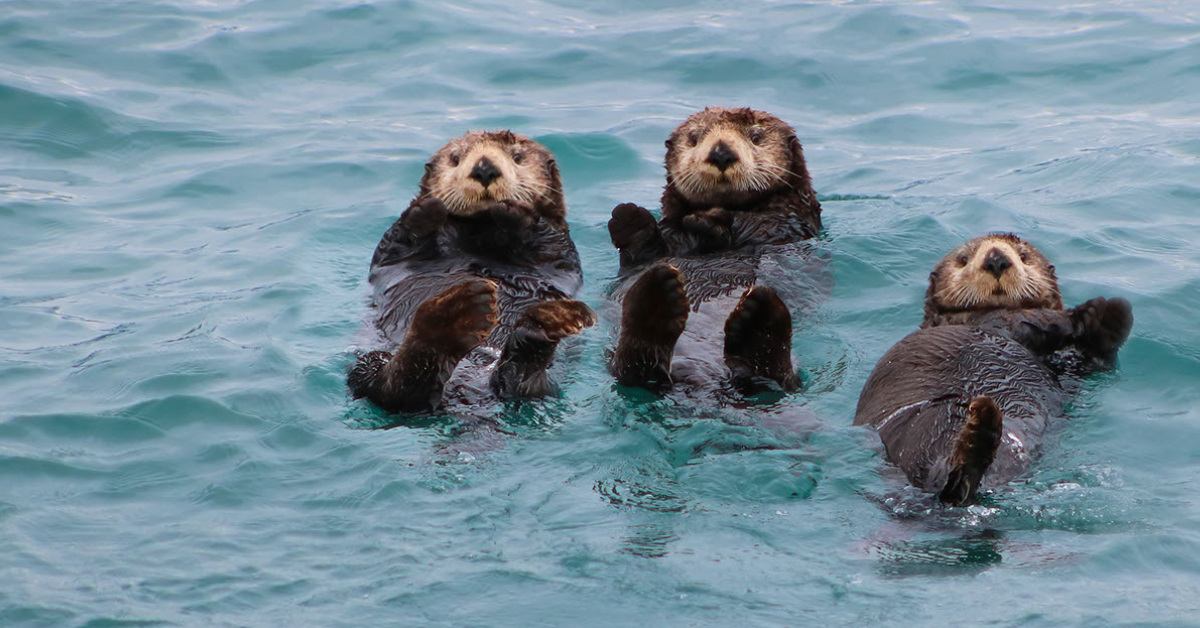
The sea otter was once worth more dead than almost any other animal on the Pacific coast.
Its fur is some of the densest of any mammal, reaching roughly one million hairs per square inch in some areas. During the maritime fur trade, Russian, British, American, and Indigenous hunters working within colonial trade systems killed sea otters across much of their range.
By the early 1900s, a population once numbering in the hundreds of thousands across the North Pacific had been reduced to scattered remnants.
Along the California coast, one surviving group of roughly 50 animals was documented near Big Sur in the 1930s. Hunting protections allowed that remnant population to begin a slow recovery. Today, approximately 3,000 southern sea otters live along the central California coast.
And it turns out, those otters are worth way more alive than dead.
Sea urchins eat kelp. When urchin populations become extremely abundant and leave their hiding places to graze openly, they can strip a kelp forest down to bare rock, creating what ecologists call an urchin barren.
Kelp forests are among the most productive marine environments on Earth. They provide food, shelter, and nursery habitat for fish, invertebrates, marine mammals, and seabirds. They slow waves, influence coastal chemistry, and absorb carbon as they grow.
Sea otters interrupt the destruction.
Otters have extremely high metabolisms and may consume around a quarter of their body weight in food each day. Their diets vary by location and individual, but many eat sea urchins along with crabs, clams, snails, mussels, and other invertebrates.
Where otters prey heavily on urchins, they can prevent them from becoming abundant and fearless enough to mow down entire kelp forests. The effect can ripple through the ecosystem, increasing the habitat available to scores of other species.
This is why sea otters are called a keystone species.
California's kelp forests are still under pressure. Marine heat waves, disease, expanding urchin barrens, and the otters' limited geographic range have left large areas without enough predation to restore balance.
Three thousand otters are doing real ecological work, but there aren't enough of them, in enough places, to do all of it.
The Interior Department has canceled a rule meant to protect plants and animals that are determined to be threatened with extinction, the latest step by the Trump administration to dismantle key provisions of the landmark Endangered Species Act at the behest of industry. https://t.co/mXxrdQgPW6
Here's how to donate to First Nations that have been forced to flee their homelands due to the widespread wildfires.
Please share!
(Info from Indigenous Climate Action)
Before you stands a thing of metal and wheels that looks like you but does not blink, whose hunger is both absent and endless, and you trumpet a challenge it cannot hear and brace your tired muscles against its relentlessness because someone must, and there is only you.
Someone should invent a self-replicating machine that removes pollution from the air and produces food and oxygen. Oh shit hang on, that's just a tree.
🎥 “Who else is leading a cause that we will glorify in retrospect, but is being vilified in the present?”
Speaking at the Nelson Mandela Foundation’s Global Leadership Forum, New York City Mayor Zohran Mamdani drew a direct line from Mandela’s refusal to abandon the Palestinian cause to the fight for global solidarity and Palestinian freedom today.
Recalling how Mandela was branded a terrorist and pressured to renounce his principles, Mamdani asked: “Who are we treating today the way Madiba was treated before history declared him a messiah?”
Citing Omar El Akkad’s book on the genocide in Gaza, “One Day, Everyone Will Have Always Been Against This,” Mamdani said “justice is not measured by where we stand after history has issued its verdict. It is measured by where we stand when the verdict is still being rendered.”
“Why must Doctor Hussam Abu Safiya wait more than 18 months for freedom in Israeli detention,” he asked, “after the world watched him be kidnapped as he left his hospital?”
“Why must we wait to practice solidarity until it no longer costs us anything?”
@NYCMayor | @cspan (Full speech available at the link below)
“Humans caused this” no. humans have lived alongside and even grew ecosystems for hundreds of thousands of years. What has caused this is European-driven and influenced settler-colonialism and mass industrialization. There’s no way around that.
I searched a Gaza war crimes archive for my family.
I quickly realized I wasn’t using it the way most people would. I wasn’t browsing it as an activist, researcher or journalist.
I was looking for my family.
My heart sank as I filtered the archive by the dates we lost them and searched for someone I loved.
I found footage I hadn’t seen before of the bombing of the Church of St. Porphyrius, where my cousin Soliman was killed.
I searched for the day my great aunt Elham was murdered, and the day Nahida and Samar Anton were killed by Israeli snipers at the Holy Family Catholic Church.
Eyewitnesses told us Elham was crushed by an Israeli tank. I have graphic photographs of her body that were sent to me by church workers in Gaza, but I found no footage of what happened.
It made me wonder how many people died without leaving behind any visual record.
The realization stayed with me.
Here was a digital graveyard where pieces of my own family history are preserved for journalists, historians, truth seekers and, undoubtedly, those seeking to exploit or consume human suffering.
I know I won’t be the only person to experience this. Other Palestinians searching for loved ones almost certainly will too. But it struck me that this is a form of grief that could scarcely have existed before our time.
It’s a form of grief I never imagined could exist.
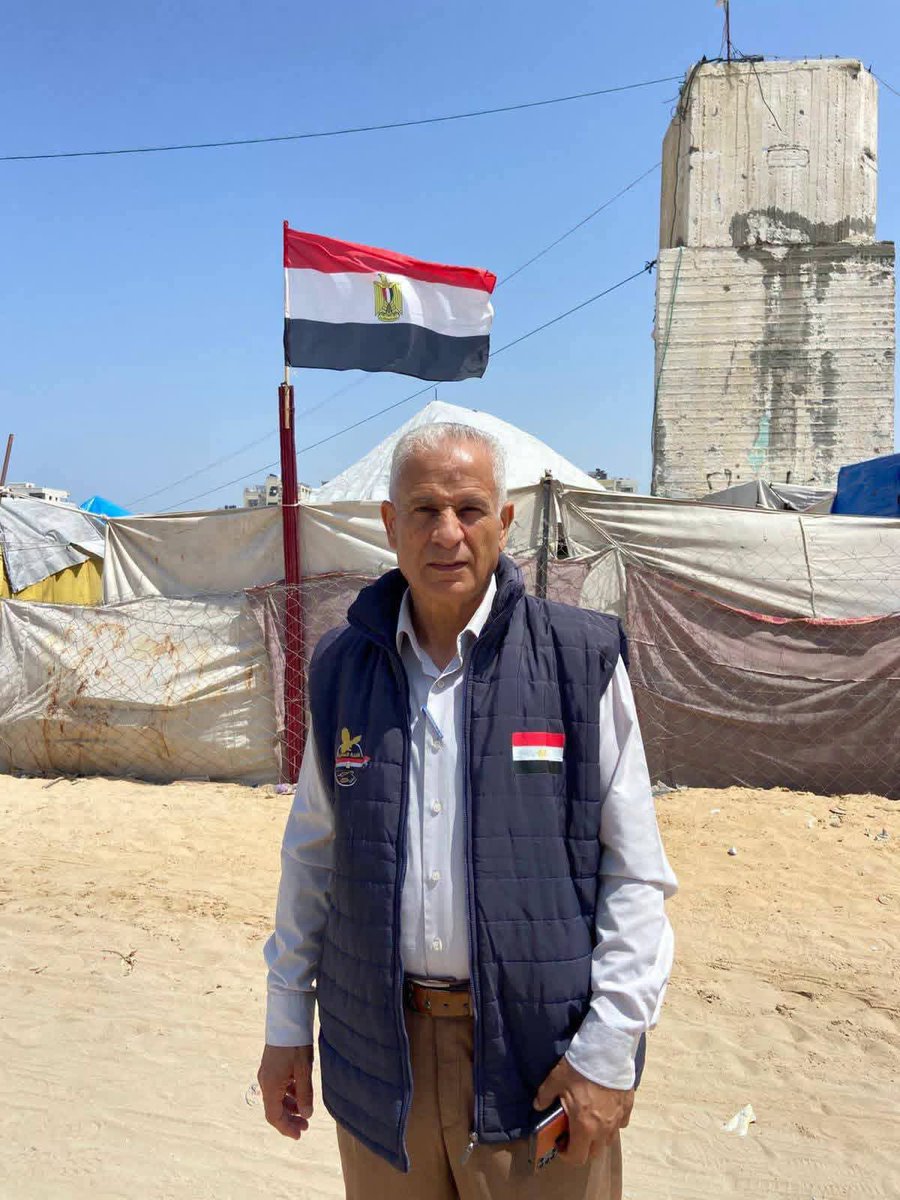
⚠️The Egyptian Relief Committee in Gaza had been organizing public screenings of World Cup matches for displaced families across the Strip. About an hour before today’s Egypt-Argentina match, Israel killed the committee’s public relations director in a strike on his vehicle. Two others, including a child, were also killed.
Visiting Venice changed Claude Monet's life
By 1908, he had spent forty years teaching the world to see light. He was 68, in poor health, and losing faith in his own work. He had just abandoned his water lily paintings, discouraged after a trusted advisor questioned whether anyone would even want them. The man who had founded Impressionism, whose 1873 canvas "Impression, Sunrise" had given the entire movement its name, was convinced his best days were behind him...
His wife, Alice, suggested a trip to Venice. Monet resisted. The city had been painted to death by Canaletto, Turner, and Whistler, and he had always insisted, "I will not go to Venice." It was, he said, "too beautiful to be painted."
He went. And the moment he arrived, standing before the light on the water, he exclaimed: "It is too beautiful to be painted! It is untranslatable!"
Within days he could not stop working. He fell into a fierce daily rhythm, painting the Doge's Palace, the churches, and the palazzos along the Grand Canal at the same hours each day, chasing the shimmer of Venetian air on stone and water. In just over two months he began 37 canvases. His wife wrote home that she was overjoyed to see him so impassioned again, doing beautiful work, and something other than "those same old water lilies."
In a letter to a friend, Monet wrote: "My enthusiasm for Venice continues to grow, and it saddens me that the moment is coming when I must leave this unique light."
He never returned. His beloved Alice died a few years later, and for a long time he could not bring himself to finish the Venice canvases. But when he did, and when they were finally shown in Paris in 1912, they were a triumph.
And the trip had given him back something he thought he had lost: the discouraged old man who had walked away from his water lilies went home and took them up again, and spent his final years creating the enormous, luminous Nymphéas, the paintings the world now loves most.
Sometimes the thing that revives us is an unexpected encounter with beauty we almost talked ourselves out of. He nearly didn't go. It turned out to be the doorway to his greatest work...
"A Child’s View of Gaza" No 12
One of many drawings by the children of Gaza (2011) that Jewish organizations pressured an Oakland children’s museum to cancel. Community leaders say the shutting down of the exhibition was the result of a disturbing — and well-funded — campaign to silence Palestinian voices across the US.
I'll be re-posting all the drawings over the next couple of weeks, we'll have our own exhibition for them.
Israel assassinated Mohammad al-Wahidi, the manager of the Egyptian Relief Committee in Gaza.
The strike was carried out just one hour before Egypt’s World Cup match began. The committee had been organizing public screenings of World Cup matches for displaced families across Gaza.
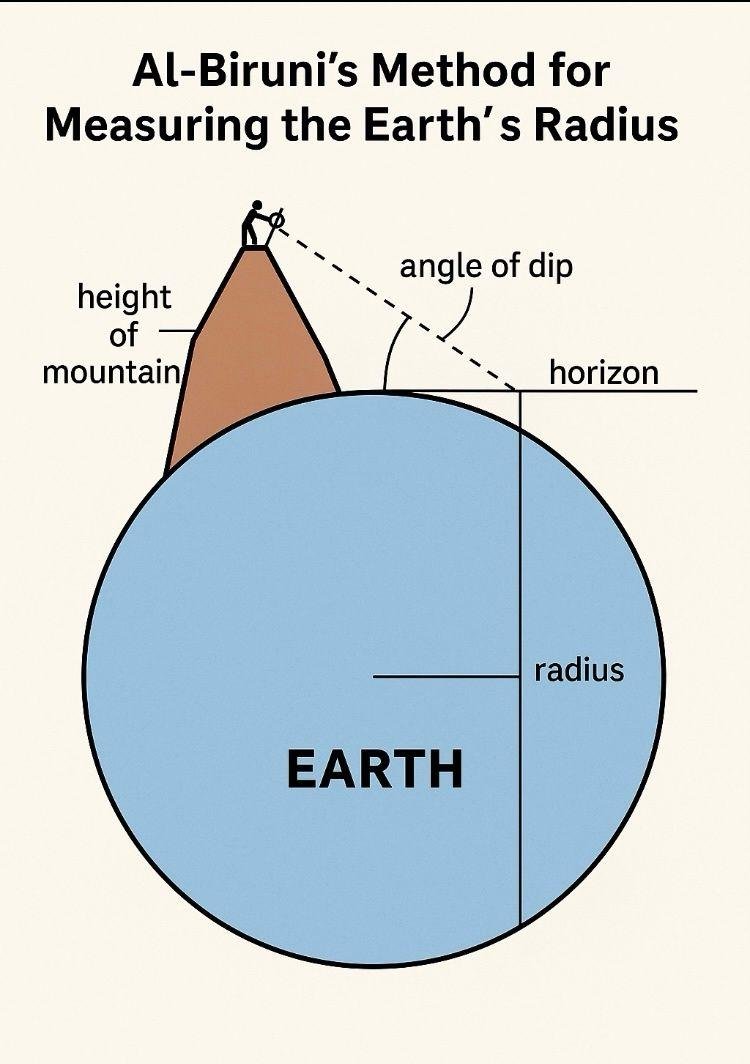
✨In the 11th century, the famous Muslim polymath Al-Biruni figured out the Earth's radius using nothing more than a mountain and a bit of trigonometry. 📐
The insight was brilliant:
Stand on a mountain, and the horizon dips below the horizontal. That dip isn't an optical illusion; it's a geometric signal. It creates a right triangle where the mountain's height (h) and the Earth's radius (R) are the only variables.
Measuring the mountain's height without climbing down:
He used a simple trigonometric trick: from two points on the plain, he measured the angle to the peak. Knowing the distance between those points, he calculated the mountain's height with a formula surveyors still use today:
H = D / (cot A1 – cot A2)
From the peak, he measured the dip angle to the horizon: α = 34′ (just over half a degree):
R = h * cos(α) / (1 - cos(α))
How did he compute the cosine of such a tiny angle?
Without modern calculators, he used a sophisticated technique: he started with the known value of cos(60°) and used the half-angle formula to work his way down to the required value for his 34′ angle.
He calculated the Earth's radius as 6,340 km. The modern value is 6,371 km.
An error of less than 1%. In 1030 CE.
Canada built bridges for bears, and the bears used them.
So did wolves, cougars, elk, moose, lynx, wolverines, bighorn sheep, black bears, deer, and almost everything else trying to cross one of the busiest highways in the Rockies.
The Trans-Canada Highway cuts through Banff National Park for 82 km. For decades, it did what highways do: split habitat in half, severed migration routes, isolated populations, and turned animal movement into roadkill.
So Parks Canada tried something that sounded ridiculous to a lot of people at the time: they built wildlife bridges and tunnels.
They look nice, but they're far from a decoration. Forested overpasses wide enough for grizzlies and elk. Dark underpasses for cougars and black bears. Fencing along the highway to keep animals off the pavement and guide them toward safe crossings.
At the time, critics called it a waste of money and editorials opined that animals would never use them.
Fortunately, animals don't read opinion pieces. Since monitoring began, wildlife have used Banff’s crossings more than 250,000 documented times.
Grizzlies took years to trust them. Elk started testing them while they were still under construction. Different species chose different designs: grizzlies and elk tended to prefer wide, open overpasses, while cougars and black bears often used narrower underpasses.
The results were not subtle. Wildlife-vehicle collisions dropped by more than 80% overall. For elk and deer, they dropped by more than 96%.
Banff now has one of the most studied wildlife crossing systems on Earth, and countries around the world have looked to it as a model.
Out on YT today! "Comfortably Numb Re-Imagined" - the song and full visual release - is now live on all platforms.
From us to you - the people, a reflection on memory, dignity, and truth.
WATCH -- https://t.co/idYWohBGB6