Personal update: I've joined Anthropic. I think the next few years at the frontier of LLMs will be especially formative. I am very excited to join the team here and get back to R&D. I remain deeply passionate about education and plan to resume my work on it in time.
"I think the space industry is full of people who are just extremely passionate, curious, and I feel really grateful to have discovered that community," says Northwood Space CEO and former Disney star Bridgit Mendler on her journey into the industry.
Check our more of our Milken Institute coverage here: https://t.co/PRsrk9WipS
Claude Mythos.
Ten trillion parameters: the first model in this weight class. Estimated training cost: ten billion dollars.
On the hardest coding test in the industry (SWE bench) it scores 94%.
It found a security flaw in a system that had been running for 27 years, one that every human engineer and every automated check had missed. It found another bug that had survived five million test runs over 16 years. (It did so overnight.)
It is so capable in cybersecurity that Anthropic will not release it to the public, instead it is launching Project Glasswing along with 100m in compute credits to help secure software.
Only twelve partners currently have access: Amazon, Cisco, Apple, Google, Microsoft, NVIDIA, JPMorgan Chase, Crowdstrike, Palo Alto, AWS, The Linux Foundation, Broadcom. (I'm sure the Pentagon is on the line?)
This is not a product launch: it is a controlled deployment of a system too powerful to distribute freely.
Tell me this isn't (very expensive) AGI?
Today we're releasing Gemma 4, our new family of open foundation models, built on the same research and technology as our Gemini 3 series. These models set a new standard for open intelligence, offering SOTA reasoning capabilities from edge-scale (2B and 4B w/ vision/audio) up to a 26B parameter MoE model and a 31B dense model. By releasing Gemma 4 under the Apache 2.0 license, we hope to enable more innovation across the research and developer communities. Our earlier Gemma 3 models were downloaded 400M times and over 100,000 variants of those models have been published, so we're excited to see what the community will do with the even better Gemma 4 models!
Learn more at https://t.co/BW6O3Gr8bc and https://t.co/8M0XSQSP4u
Great work by everyone involved!
#Gemma4 #AI #OpenSource #ML
Ilya Sutskever (@ssi) helped launch the deep learning revolution. From AlexNet to GPT, his work has pushed the boundaries of AI, powering advances from language models to image generation and beyond. Read more: https://t.co/iGKoC6cpbz #NASaward#ArtificialIntelligence
Before Artemis II, there was Apollo.
From the Apollo 1 fire to the final moon landing in 1972, NASA’s race to the moon was defined by risk, innovation, and history-making firsts.
Here’s a timeline of every Apollo mission.
Nvidia is planning to launch an open source AI agent platform, giving enterprises access to OpenClaw-style agents 👀 per @ZoeSchiffer and @LaurenGoode
https://t.co/vabwo6BeRj
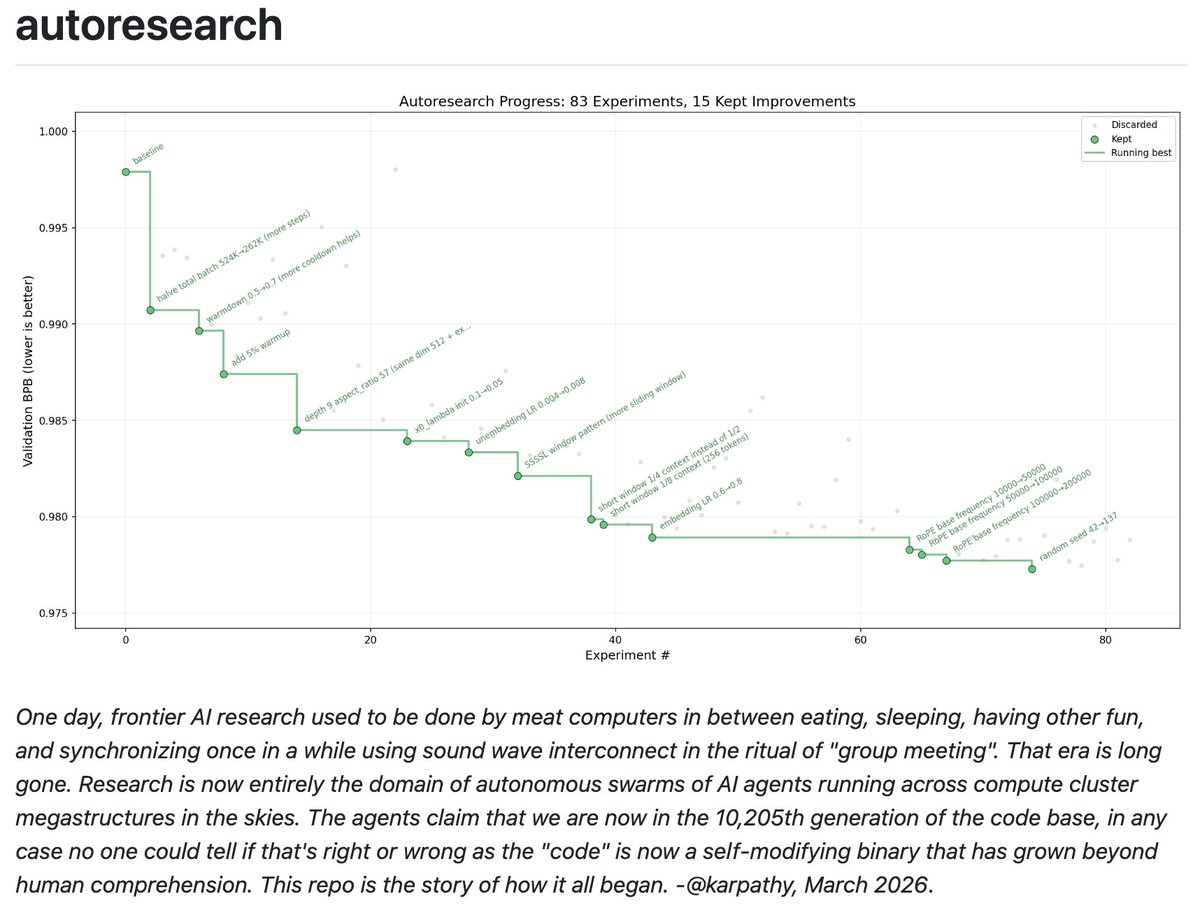
I packaged up the "autoresearch" project into a new self-contained minimal repo if people would like to play over the weekend. It's basically nanochat LLM training core stripped down to a single-GPU, one file version of ~630 lines of code, then:
- the human iterates on the prompt (.md)
- the AI agent iterates on the training code (.py)
The goal is to engineer your agents to make the fastest research progress indefinitely and without any of your own involvement. In the image, every dot is a complete LLM training run that lasts exactly 5 minutes. The agent works in an autonomous loop on a git feature branch and accumulates git commits to the training script as it finds better settings (of lower validation loss by the end) of the neural network architecture, the optimizer, all the hyperparameters, etc. You can imagine comparing the research progress of different prompts, different agents, etc.
https://t.co/YCvOwwjOzF
Part code, part sci-fi, and a pinch of psychosis :)
Prof. Donald Knuth opened his new paper with "Shock! Shock!"
Claude Opus 4.6 had just solved an open problem he'd been working on for weeks — a graph decomposition conjecture from The Art of Computer Programming.
He named the paper "Claude's Cycles."
31 explorations. ~1 hour. Knuth read the output, wrote the formal proof, and closed with: "It seems I'll have to revise my opinions about generative AI one of these days."
The man who wrote the bible of computer science just said that. In a paper named after an AI.
Paper: https://t.co/juSOmK9vOt