Read Margaret-Anne Storey's paper on cognitive and intent debt.
AI can add more than technical debt: it can erode understanding and intent.
If we can't explain why the system behaves the way it does or confidently change it later, have we truly accelerated anything?
Read Margaret-Anne Storey's paper on cognitive and intent debt.
AI can add more than technical debt: it can erode understanding and intent.
If we can't explain why the system behaves the way it does or confidently change it later, have we truly accelerated anything?
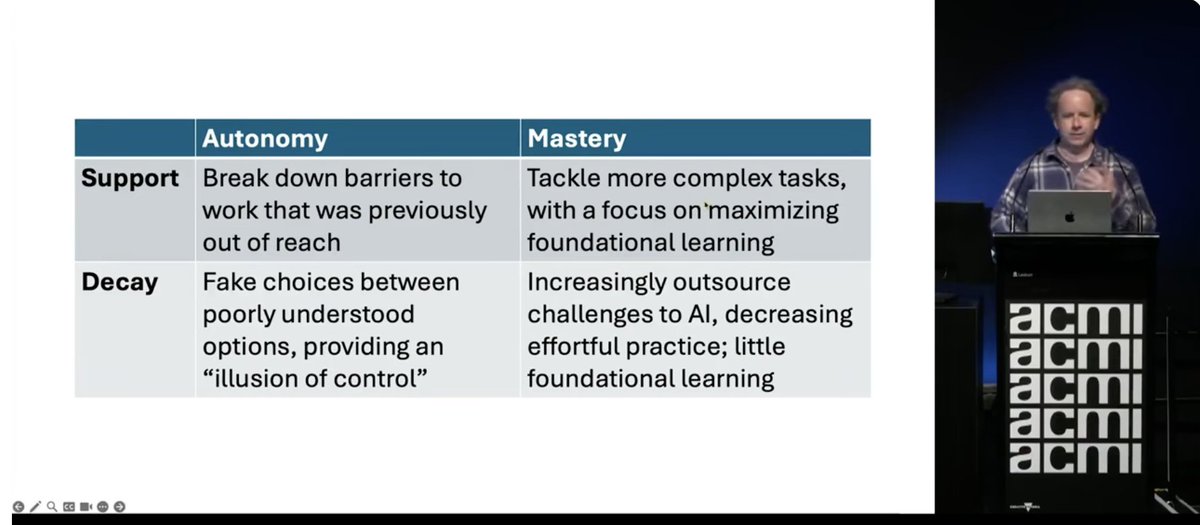
"Mastery is not about creating more outputs or products. It is about building genuine ability. AI can either decay or support human mastery.
The people selling you AI models & your bosses at work don’t care about your mastery. They will put you in the decay world every time."
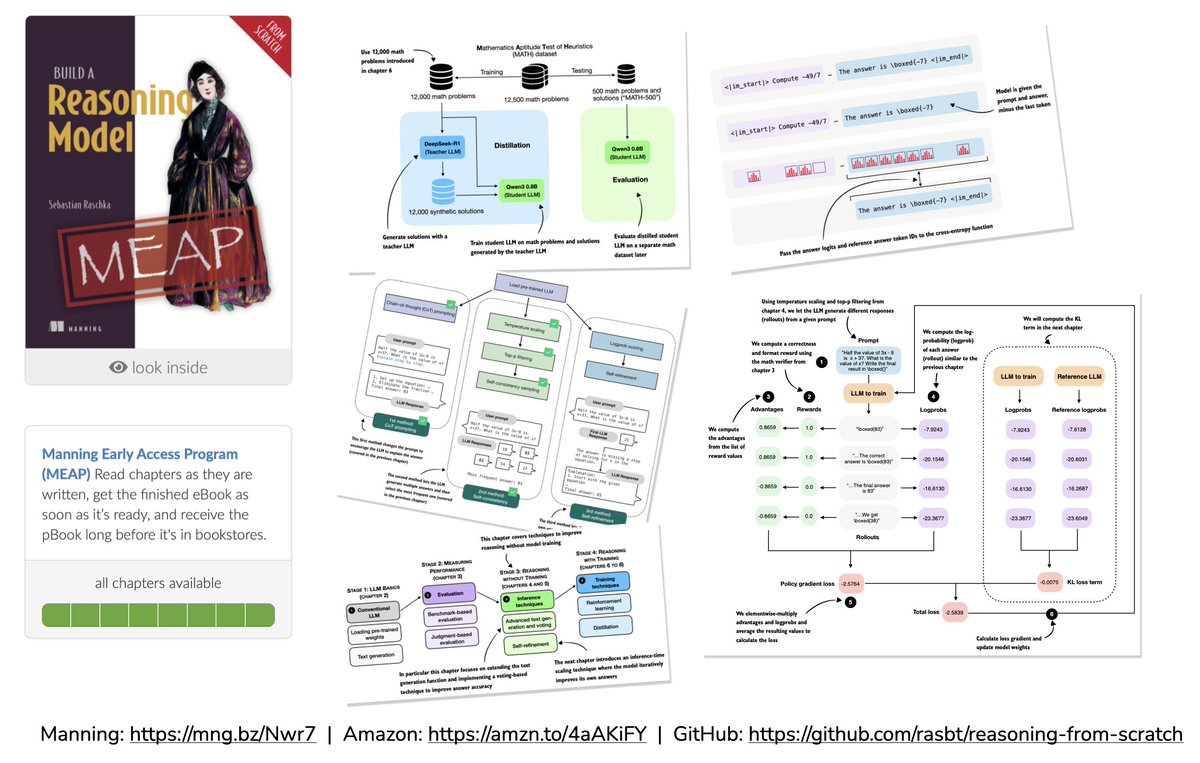
It’s done.
All chapters of Build A Reasoning Model (From Scratch) are now available in early access.
The book is currently in production and should be out in the next months, including full-color print and syntax highlighting.
There’s also a preorder up on Amazon.
PSA: If you've been running out of Claude session quotas on Max tier, you're not alone. Read this.
Some insane Redditor reverse engineered the Claude binaries with MITM to find 2 bugs that could have caused cache-invalidation. Tokens that aren't cached are 10x-20x more expensive and are killing your quota.
If you're using your API keys with Claude this is even worse. This is also likely why this isn't uniform, while over 500 folks replied to me and said "me too", many (including me) didn't see this issue.
There are 2 issues that are compounded here (per Redditor, I haven't independently confirmed this) :
1s bug he found is a string replacement bug in bun that invalidates cache. Apparently this has to do with the custom @bunjavascript binary that ships with standalone Claude CLI.
The workaround there is to use Claude with `npx @anthropic-ai/claude-code`
2nd bug is worse, he claims that --resume always breaks cache. And there doesn't seem to be a workaround there, except pinning to a very old version (that will miss on tons of features)
This bug is also documented on Github and confirmed by other folks.
I won't entertain the conspiracy theories there that Anthropic "chooses" to ignore these bugs because it gets them more $$$, they are actively benefiting from everyone hitting as much cached tokens as possible, so this is absolutely a great find and it does align with my thoughts earlier.
The very sudden spike in reporting for this, the non-uniform nature (some folks are completely fine, some folks are hitting quotas after saying "hey") definitely points to a bug.
cc @trq212@bcherny@_catwu for visibility in case this helps all of us.
If you're using Claude Code, it's worth checking your token usage.
There are reports of cache-related bugs that may silently increase costs (up to 10-20x).
https://t.co/SBMXOSoiOx
Today, Project Zero released a 0-click exploit chain for the Pixel 9. While it targets the Pixel, the 0-click bug and exploit techniques we used apply to most other Android devices.
https://t.co/tMhM7OFLBp
AI is so smart, why are its internals 'spaghetti'? We spoke with @kenneth0stanley and @akarshkumar0101 (MIT) about their new paper: Questioning Representational Optimism in Deep Learning: The Fractured Entangled Representation Hypothesis. Co-authors: @jeffclune@joelbot3000
If you want to know more about how Google Flights works, airline tickets, and why it is super complicated to deal with all the constraints and the combinatorial combinations, I highly recommend this set of slides by Carl de Marcken, one of the co-founders of ITA software, which Google acquired and became one of the underpinnings of Google Flights.
(Sorry for the http rather than https Link: Carl's domain doesn't appear to support https)
https://t.co/iQgSXyP6D0
# on shortification of "learning"
There are a lot of videos on YouTube/TikTok etc. that give the appearance of education, but if you look closely they are really just entertainment. This is very convenient for everyone involved : the people watching enjoy thinking they are learning (but actually they are just having fun). The people creating this content also enjoy it because fun has a much larger audience, fame and revenue. But as far as learning goes, this is a trap. This content is an epsilon away from watching the Bachelorette. It's like snacking on those "Garden Veggie Straws", which feel like you're eating healthy vegetables until you look at the ingredients.
Learning is not supposed to be fun. It doesn't have to be actively not fun either, but the primary feeling should be that of effort. It should look a lot less like that "10 minute full body" workout from your local digital media creator and a lot more like a serious session at the gym. You want the mental equivalent of sweating. It's not that the quickie doesn't do anything, it's just that it is wildly suboptimal if you actually care to learn.
I find it helpful to explicitly declare your intent up front as a sharp, binary variable in your mind. If you are consuming content: are you trying to be entertained or are you trying to learn? And if you are creating content: are you trying to entertain or are you trying to teach? You'll go down a different path in each case. Attempts to seek the stuff in between actually clamp to zero.
So for those who actually want to learn. Unless you are trying to learn something narrow and specific, close those tabs with quick blog posts. Close those tabs of "Learn XYZ in 10 minutes". Consider the opportunity cost of snacking and seek the meal - the textbooks, docs, papers, manuals, longform. Allocate a 4 hour window. Don't just read, take notes, re-read, re-phrase, process, manipulate, learn.
And for those actually trying to educate, please consider writing/recording longform, designed for someone to get "sweaty", especially in today's era of quantity over quality. Give someone a real workout. This is what I aspire to in my own educational work too. My audience will decrease. The ones that remain might not even like it. But at least we'll learn something.
Animals and humans get very smart very quickly with vastly smaller amounts of training data.
My money is on new architectures that would learn as efficiently as animals and humans.
Using more data (synthetic or not) is a temporary stopgap made necessary by the limitations of our current approaches.
@BerislavB Parkirajte ovdje https://t.co/HnHy0vHf3t, i onda linijom 1 do centra (linija 1 ima interval od 10-20min).
@Stanivukovic_D pošto se već referišete na Ljubljanu, ugledajte se na njihov P&R sistem. 🚌🚴🚗
When @benfeifke gave Polars a try, it was because of its speed benefits; he now shares the other reasons that drove him to make a permanent switch away from Pandas.
https://t.co/iX3D0BPEUS
NEW: Today we release a 'Critical Field Guide for Working With Machine Learning Datasets' by @SarahCiston. It's a practical guide to navigating datasets. If you're an engineer, designer, journalist artist, or a student who uses datasets, it's here for you. https://t.co/o4lKcsn569