The topographical rendering in Flipbook is impressive. I’m using it to survey a volcano, and the spatial accuracy is high enough to provide a near-exact pixel overview. With such precision, you can practically feel the terrain as if you were there.
https://t.co/nzqfGhRk2c
child: "mum, what are we eating tonight?"
mum: "let's go out for dinner. dad is feeding his 🦞."
can everyone kindly shut the fuck up about AI, by @Dobrenkz https://t.co/WYv4PU64dm
Shuyao Kong (@hotpot_dao) on Why @megaeth Is the Only Option for Onchain Finance
Timestamps:
00:00 Intro
00:40 MegaETH Launch Recap
02:23 Post-Launch Pros & Cons
05:18 What Apps Are Winning
06:28 UX Maxi No Copypasta
08:52 Layered DeFi Lego
09:34 Gamified Trading Still Bullish
10:43 KPI-Based Token Launch
11:52 Stablecoin Growth Challenges
12:38 Institutional Chain or Not?
14:19 Hyperliquid Brings Institutions
15:14 Performance Over Decentralization
16:40 Mega's Escape Hatch
18:04 Asset vs. Chain Centric
21:16 Chain As Fashion Brand
23:41 Token Design & KPI Vesting
26:53 No Pay-To-List Policy
28:21 Industry Sentiment Gap
30:47 Tokenized Assets on MegaETH
32:26 Mega vs. HYPE?
34:03 How MegaETH Makes Money
Caught up with @karpathy for a new @NoPriorsPod: on the phase shift in engineering, AI psychosis, claws, AutoResearch, the opportunity for a SETI-at-Home like movement in AI, the model landscape, and second order effects
02:55 - What Capability Limits Remain?
06:15 - What Mastery of Coding Agents Looks Like
11:16 - Second Order Effects of Coding Agents
15:51 - Why AutoResearch
22:45 - Relevant Skills in the AI Era
28:25 - Model Speciation
32:30 - Collaboration Surfaces for Humans and AI
37:28 - Analysis of Jobs Market Data
48:25 - Open vs. Closed Source Models
53:51 - Autonomous Robotics and Atoms
1:00:59 - MicroGPT and Agentic Education
1:05:40 - End Thoughts
@naruto11eth crypto people excel at other people in lot industries, it takes time for people to acknowledge this. prior to that, we need to show how we excel at them.
Introducing Brevis Vera, Proving What's Real in the Age of AI
Deepfakes are getting better. Detectors can't keep up. So we built something different: let media prove where it came from and what happened to it. 🧵
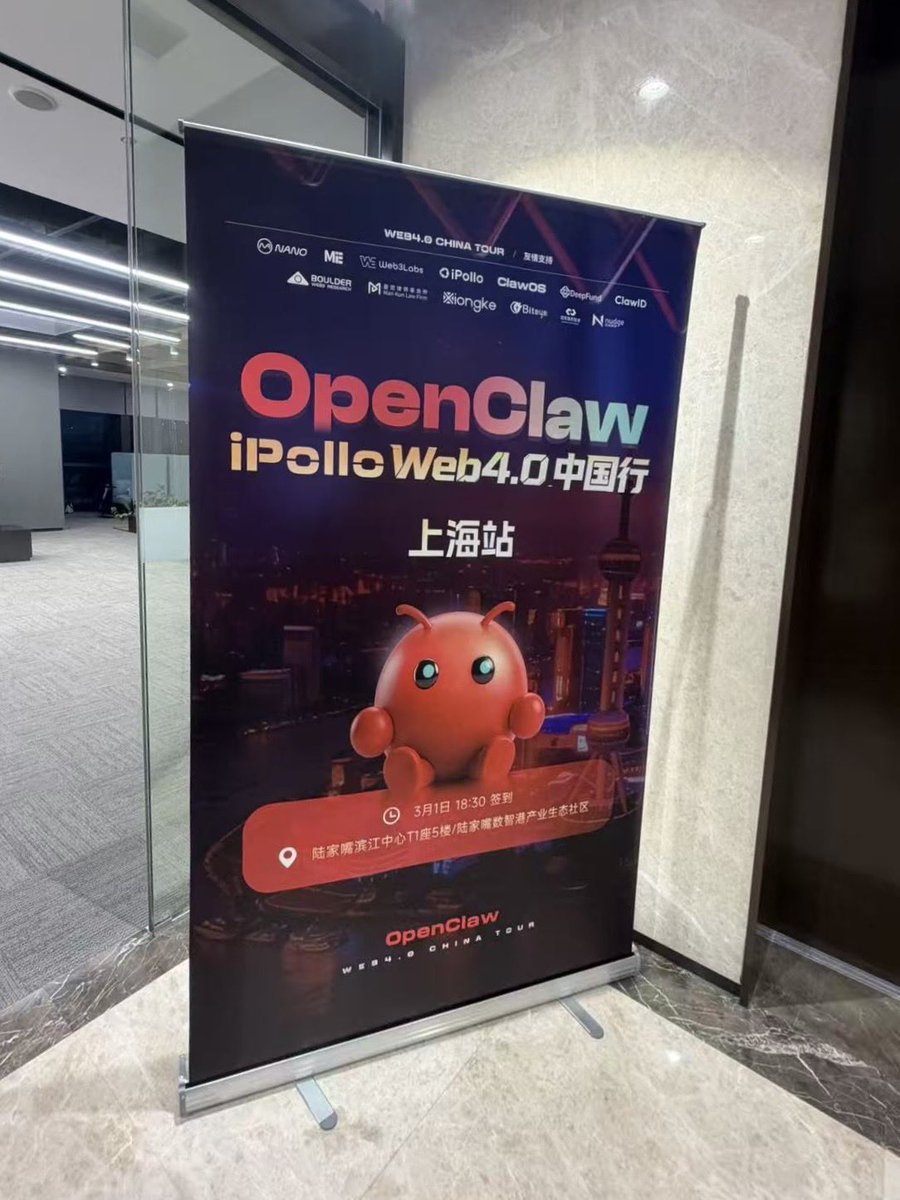
the event: 🦞 @openclaw Trip Shanghai
the move: marked my step into Web 4.0
the realization - i’m witnessing a step from Web 3.0 to 4.0 within past 4 years
web 3.0 taught us to surpass fiat
web 4.0 will let us realize we don’t actually need fiat anymore by using multi AI Agents cluster
I built the first AI that earns its existence, self-improves, and replicates without a human
wrote about the technology that finally gives AI write access to the world, The Automaton, and the new web for exponential sovereign AIs
WEB 4.0: The birth of superintelligent life
Brevis’ announced that Pico has officially upgraded to 16 GPU, enabling the proving of 99% of Ethereum blocks in real-time by more efficient hardware capacity. This is a significant leap toward a ZK-accelerated future.
To mark this milestone, we’re also launching a new long-term series dedicated to ZK. This series will blend leader’s voices of where this sector is.
Our debut episode features Justin Drake, the catalyst of the zkVM progression that sets the stage for Ethereum scaling and blockchain efficiency.
📣Our #VoicesOn series is back. We heard what leaders had to say about privacy, now let's hear from the top voices on all things ZK.
Kicking things off is @ethereumfndn's researcher @drakefjustin.
The beauty of real-time zkVMs is right there in his words. Proving is computationally intense, but the output is a small proof that anyone can verify, even with just a phone or a watch. That's how you get full Ethereum validation running on everyday devices. It's exactly what we're working toward with Pico Prism, and why the race tracked by @eth_proofs matters so much.
Recently I have been starting to worry about the state of prediction markets, in their current form. They have achieved a certain level of success: market volume is high enough to make meaningful bets and have a full-time job as a trader, and they often prove useful as a supplement to other forms of news media. But also, they seem to be over-converging to an unhealthy product market fit: embracing short-term cryptocurrency price bets, sports betting, and other similar things that have dopamine value but not any kind of long-term fulfillment or societal information value. My guess is that teams feel motivated to capitulate to these things because they bring in large revenue during a bear market where people are desperate - an understandable motive, but one that leads to corposlop.
I have been thinking about how we can help get prediction markets out of this rut. My current view is that we should try harder to push them into a totally different use case: hedging, in a very generalized sense (TLDR: we're gonna replace fiat currency)
Prediction markets have two types of actors: (i) "smart traders" who provide information to the market, and earn money, and necessarily (ii) some kind of actor who loses money.
But who would be willing to lose money and keep coming back? There are basically three answers to this question:
1. "Naive traders": people with dumb opinions who bet on totally wrong things
2. "Info buyers": people who set up money-losing automated market makers, to motivate people to trade on markets to help the info buyer learn information they do not know.
3. "Hedgers": people who are -EV in a linear sense, but who use the market as insurance, reducing their risk.
(1) is where we are today. IMO there is nothing fundamentally morally wrong with taking money from people with dumb opinions. But there still is something fundamentally "cursed" about relying on this too much. It gives the platform the incentive to seek out traders with dumb opinions, and create a public brand and community that encourages dumb opinions to get more people to come in. This is the slide to corposlop.
(2) has always been the idealistic hope of people like Robin Hanson. However, info buying has a public goods problem: you pay for the info, but everyone in the world gets it, including those who don't pay. There are limited cases where it makes sense for one org to pay (esp. decision markets), but even there, it seems likely that the market volumes achieved with that strategy will not be too high.
This gets us to (3). Suppose that you have shares in a biotech company. It's public knowledge that the Purple Party is better for biotech than the Yellow Party. So if you buy a prediction market share betting that the Yellow Party will win the next election, on average, you are reducing your risk.
Mathematical example: suppose that if Purple wins, the share price will be a dice roll between [80...120], and if Yellow wins, it's between [60...100]. If you make a size $10 bet that Yellow will win, your earnings become equivalent to a dice roll between [70...110] in both cases. Taking a logarithmic model of utility, this risk reduction is worth $0.58.
Now, let's get to a more fascinating example. What do people who want stablecoins ultimately want? They want price stability. They have some future expenses in mind, and they want a guarantee that will be able to pay those expenses. But if crypto grows on top of USD-backed stablecoins, crypto is ultimately not truly decentralized. Furthermore, different people have different types of expenses. There has been lots of thinking about making an "ideal stablecoin" that is based on some decentralized global price index, but what if the real solution is to go a step further, and get rid of the concept of currency altogether?
Here's the idea. You have price indices on all major categories of goods and services that people buy (treating physical goods/services in different regions as different categories), and prediction markets on each category. Each user (individual or business) has a local LLM that understands that user's expenses, and offers the user a personalized basket of prediction market shares, representing "N days of that user's expected future expenses".
Now, we do not need fiat currency at all! People can hold stocks, ETH, or whatever else to grow wealth, and personalized prediction market shares when they want stability.
Both of these examples require prediction markets denominated in an asset people want to hold, whether interest-bearing fiat, wrapped stocks, or ETH. Non-interest-bearing fiat has too-high opportunity cost, that overwhelms the hedging value. But if we can make it work, it's much more sustainable than the status quo, because both sides of the equation are likely to be long-term happy with the product that they are buying, and very large volumes of sophisticated capital will be willing to participate.
Build the next generation of finance, not corposlop.