Newton Mainnet Beta is live! 🎉
VaultKit, the SDK that makes your vault’s rules actually enforceable onchain. Newton checks the rules before any transaction settles, then writes a signed attestation anyone can verify.
A guard blocks every direct transaction from the owner key. The only way out is a Newton policy path: 10 USDC max, plus a valid code for that specific transfer.
Read more: https://t.co/NTsLYsyqzB
We published the private key to a Safe on purpose. The Safe holds test USDC.
Take the key and try to withdraw the money: https://t.co/kL0x83cIOe
Sign all you want. Without a 2FA code matched to the exact recipient and amount, @newton_xyz denies the transfer.
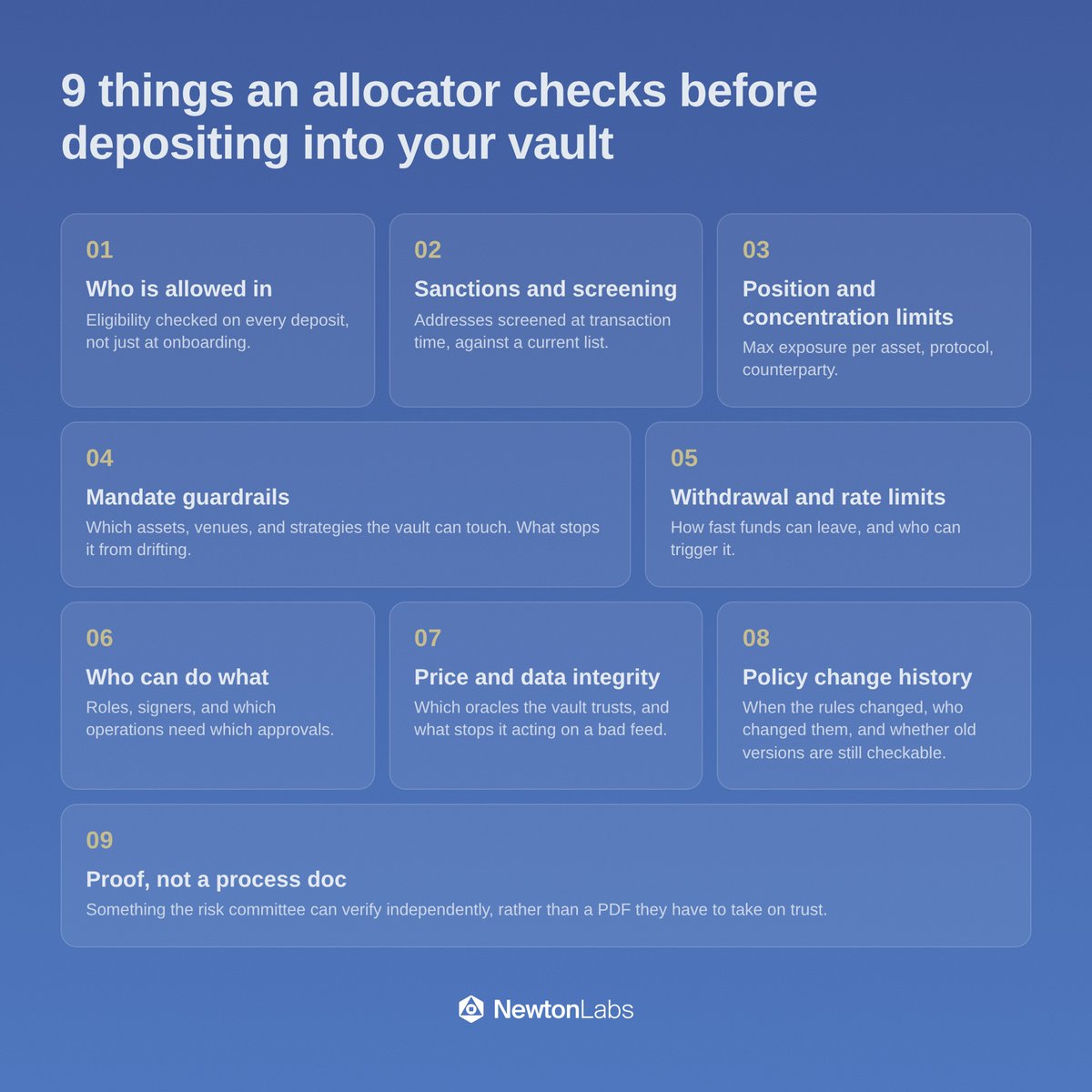
A vault's risk policy usually lives in a doc. The allocation never reads it.
With VaultKit, the policy runs at the transaction. Exposure cap exceeded, the allocation reverts before it settles.
That's the difference between a mandate and a guardrail.
🔗 https://t.co/0h63gb9Arm
HackenProof joins @0xEastPoint:Seoul 2026 🇰🇷
On Sept 28, our CEO @DmytroMatviiv will join the public roundtable:
“AI Agents in Financial Markets: From Copilot to Counterparty”
Also joining the roundtable:
▪︎ @Cindyshi0907 from @GoKiteAI
▪︎ Gabrielle Inzirillo from @ADGlobalMarket
▪︎ @ethermage from @virtuals_io
▪︎ Sangwoo Jung from KB Asset Management
▪︎ Joe Hwang from @googlecloud
▪︎ Nikola Stojanow from @BankFrick
▪︎ Dennis Won from @newton_xyz
▪︎ Donghyun Lee from LG Business Research
▪︎ Thomas Harris from @ETHGasOfficial
▪︎ Nicole Li from @PingCAP
▪︎ @cjhtech from @trylimitless
The discussion will cover AI agents, financial workflows, infrastructure, risk, and accountability.
📍 Westin Seoul Parnas
🕓 16:00–17:30
#EastPointSeoul #AI #AIAgents #HackenProof
Pharos joins Newton as stablecoin safety provider.
We are excited to announce our new partnership with @newton_xyz to provide stress signals and DEWS data. Newton enforces it on every transaction before it settles, blocking deposits into stressed assets automatically while keeping withdrawals open.
Welcome to the Lighthouse. 🤝
Watch the SVB dip on this chart 👀
Circle disclosed $3.3B stuck at SVB on a Friday night. By Saturday USDC was at $0.87, and everyone heading for the exit was going through the same few Curve pools.
Compare PMUSD this spring. @TokenBrice had it at C- while it was still holding peg on decent liquidity, then Pharos called the depeg terminal within 12 hours of the slide starting.
People who acted on that got out around $0.98. It's near $0.45 now and never came back. A 2% haircut instead of 100%.
Read more in the blog: https://t.co/alaaa6ERJP
Watch the full video: https://t.co/XGvhS8mEjX
If you run a vault holding stablecoins, comment and we'll show you how it's set up.
A policy engine is only as smart as the data you plug into it.
Newton built the enforcement layer: rules that fire at the point of execution, before a transaction is authorized.
We plugged in the risk signal.
Live in production since June 23. The same pattern works for any AI agent deciding whether to proceed, pause, or escalate.
Who evaluates the policy matters as much as how it's enforced. In Newton, a credibly neutral network of vetted, staked operators evaluates policies without exposing sensitive data. The resulting authorization is verifiable onchain and enforced through a signature check before settlement. That's the trust-minimized alternative we're building at Newton Labs to relying on a trusted sudo policy admin and centralized oracles.
$154B went to illicit addresses in 2025. $104B of it to sanctioned entities.
Most automated execution still can't tell those addresses apart from a verified counterparty. It just sees a wallet and a limit.
Permissions should follow identity. Here's how we're building it 👇
https://t.co/kyTt8Dapjx
The Defiant on what comes next after the CLARITY Act setback, with @makhavannik weighing in.
The rules are still being written, but we’re already building the authorization layer to enforce them onchain.
The Senate's cloture vote on the CLARITY Act failed yesterday.
Builders don't get to wait. Sanctions screening, transfer limits, who can touch what: your counterparties already ask. Enforce it at the transaction now and any future rulebook becomes a policy update.
https://t.co/9NfaCOGTHe
The Senate vote on the CLARITY Act failed.
Newton Foundation Managing Director @makhavannik on what this means for DeFi:
“Regulators didn’t need this bill to act on compliance; Treasury and FinCEN already have that authority, and they’ve used it before. Waiting for legislation is how DeFi ends up reacting to rules instead of helping shape them.”
https://t.co/NOz1gPBoZ0