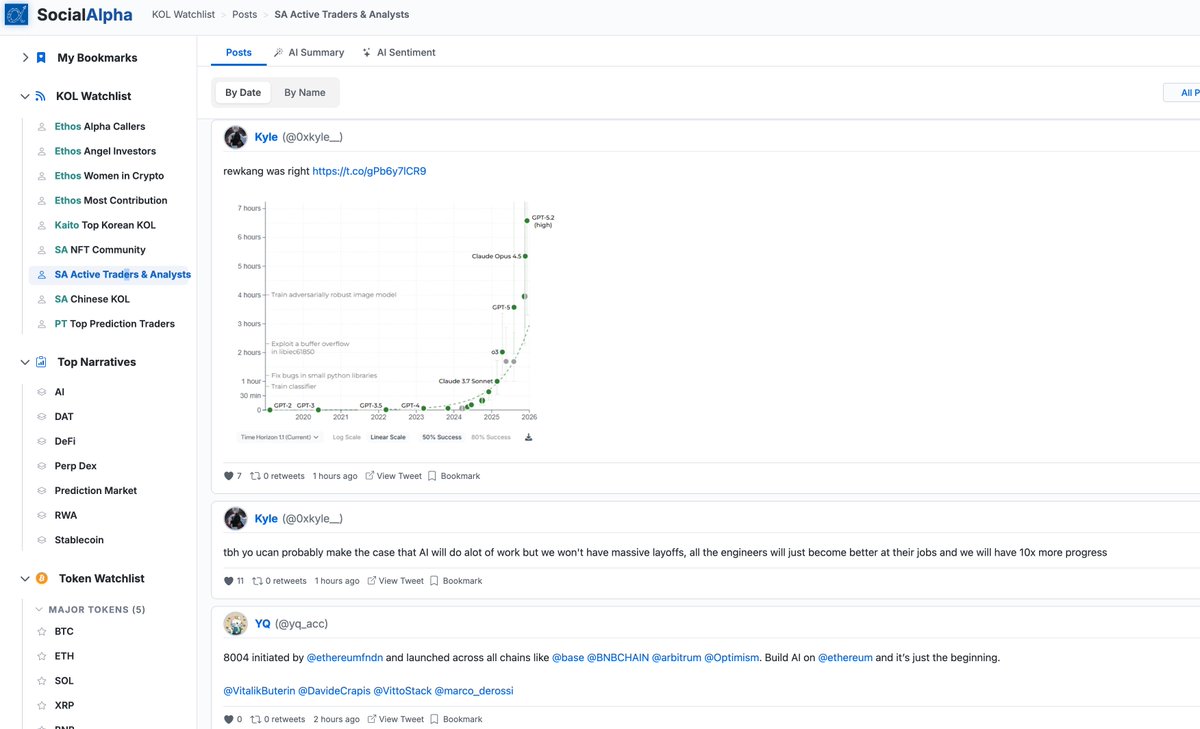
Just made every features on https://t.co/aF4t9Vwrds free to use for everyone, you just need to register. It's a hobby project of mine, and I use it everyday to gain insights from active CT traders, hope it can be useful to others too.
刚刚把 https://t.co/aF4t9Vwrds 上的所有功能都开放给所有人免费使用了,你只需要注册就行。这个是我的业余vibe code项目,自己每天都会用它来从活跃的加密推特(CT)交易员那里获取最新观点,希望它对其他人同样有用. 🫡
- $AAOI at $12B
- $SIVE at $2B
- Foci at $2.8B
- Shunsin at $2B
Usually the best risk/reward to me currently. Lot of my answers before like $AXTI already 10x’d, so different lineup this time.
$AAOI due to absurd H1 2027 revenue projections from capacity ramp, doing everything from laser fab to assembly in America.
$471M/month… that’s in 2027, the TAM increases exponentially in 2028.
$SIVE is also ramping absurdly high, 77% revenue pipeline growth of the entire company’s history to ~$799M
Primarily from photonics… in a single quarter. And they’re projecting 60% gross margins off that.
Foci - $NVDA / $TSM primarily FAU supplier and bottleneck for COUPE. Genuinely not sure how this is $2.8B.
BOM share for their passive components + FAU are massive in 2028. Just a bit early H1 2026.
Shunsin - Legit you see Foxconn get CPO/photonics related orders over and over for $NVDA and others.
Just nobody knows the packaging/testing gets done by Shunsin.
A lot of contracts are also under Shunsin’s subsidiary too.. so markets/algorithms don’t know what’s coming imo.
Runner up is $XFAB, they’ll probably be central to EU CHIPS act 2 for silicon photonics at ~$1.5B MC.
And of course SiC/GaN foundries should go brr with 800vdc push by Nvidia.
Especially if they’re the only high volume one in United States per Dpt. Of Commerce.
And it’s such a low price/book ratio so you’re kinda getting the company upside for free, while US Gov/EU Gov subsidize their capex.
Top 10 Active Trader's Perspectives (https://t.co/aF4t9Vwrds recap) 2026.5.30
1. Ai 姨 (@ai_9684xtpa)【Crypto whales rotate into US tech】
Core idea: Ai 姨 highlights a large trader rotating into US tech after closing profitable ETH/BTC shorts, opening roughly $31.86M in 10x long positions on Microsoft and Oracle.
Why it matters: The move signals that some crypto whales are treating liquid AI-linked US equities as higher-conviction trades than crypto beta. Cross-asset flows like this matter because large players can quickly shift leverage between crypto and equities, creating unexpected liquidity and momentum effects.
Original: https://t.co/4YNof7oJbh
2. Ignas | DeFi (@defiignas)【ETH-native stablecoin idea】
Core idea: Ignas proposes that the Ethereum Foundation acquire Liquity and launch a BOLD-style stablecoin backed by ETH collateral to reduce DeFi’s reliance on USDC.
Why it matters: The idea is strategically bullish for ETH: a native stablecoin could deepen ETH demand and embed it more directly into DeFi’s monetary plumbing. But it would also raise serious questions around governance, peg stability, regulatory pressure, and whether the Ethereum Foundation should play that kind of active market role.
Original: https://t.co/hgagLhUzAT
3. Jrugs (@jrugss)【Hyperliquid as Binance 2.0】
Core idea: Jrugs criticizes Hyperliquid as “Binance 2.0,” arguing that much of the appeal is regulatory arbitrage rather than true technical innovation.
Why it matters: His warning is that strong branding can obscure structural risks: centralization, FDV vs circulating supply narratives, and temporary legal windows. For traders, the key question is whether Hyperliquid’s current edge is durable product-market fit or a regulatory gap that could close quickly.
Original: https://t.co/uqB0KZb49Y
4. Yuyue (@yuyue_chris)【CEX-brokerage integration is inevitable】
Core idea: Yuyue argues that CEXs integrating with brokerages is inevitable as CRS data-sharing and regulated rails become harder to avoid.
Why it matters: In his view, exchanges that refuse brokerage connectivity and compliant RWA access will lose share to platforms that support fiat, regulated rails, and on-chain securities. The broader trend is clear: crypto liquidity is moving closer to compliance, stablecoins, and tokenized TradFi access.
Original: https://t.co/2dGr69DPgE
5. The DeFi Investor (@thedefinvestor)【DeFi revenue signals】
Core idea: The DeFi Investor points to real adoption metrics: EtherFi Cash generating over $10M in annualized revenue on modest card volume, and Aave V4 TVL rising 150% in 30 days.
Why it matters: These are early signs that DeFi products can produce recurring revenue beyond pure token speculation. If cards, lending, and protocol upgrades continue to scale, DeFi’s strongest narrative becomes less about “number go up” and more about sustainable financial business models.
Original: https://t.co/v2zS2E0cHB
6. ton (@tontheneko)【Scammer-dev reputation layer】
Core idea: ton proposes a community-maintained database tracking scammer developers and recurring rug patterns.
Why it matters: The idea reflects a practical defense layer for crypto: crowd-sourced reputation, pattern recognition, and grassroots education. As teams recycle old exploit playbooks and over-index on PR, users need better shared memory to avoid getting farmed repeatedly.
Original: https://t.co/Fg7F5eQjJS
7. Evan (@evan_ss6)【Valuation model satire】
Core idea: Evan uses satire to mock extreme model outputs, joking that a “quantum computer” fair-value model prices SOL at $0.
Why it matters: The joke lands because it exposes a real problem: models can look precise while missing narrative, liquidity, reflexivity, and market structure. Quantitative frameworks are useful, but crypto valuation still cannot be reduced to simulation outputs alone.
Original: https://t.co/Aoa8yEMmZF
8. Serenity (@aleabitoreddit)【AI hardware supplier cycle】
Core idea: Serenity argues that semiconductor and supply-chain suppliers such as Foxconn and Win Semi may be front-running a multi-year AI hardware supercycle.
Why it matters: The thesis is that downstream demand and foundry scaling through 2028 could drive a sustained supplier upgrade cycle. If this plays out, capital may keep rotating toward hardware, AI infrastructure, and eventually tokenized exposure to real-world tech assets.
Original: https://t.co/bhD8e7ofwv
9. Taiki Maeda (@taikimaeda2)【MSTR as BTC flow risk】
Core idea: Taiki Maeda flags that MSTR’s mNAV breakeven could change the market’s view of institutional BTC flows, especially if selling BTC for cash becomes economically rational.
Why it matters: The point is that concentrated holders can become market structure risks. When entities like MSTR or major ETF vehicles shift behavior, BTC liquidity and price action may be driven less by retail sentiment and more by institutional balance-sheet decisions.
Original: https://t.co/1Dm2FZLjMf
10. 0xWizard (@0xcryptowizard)【AI alerts as trading edge】
Core idea: 0xWizard shares an AI-driven alert system tested with Opus 4.8 and GPT-5.5, showing better-than-random accuracy and strong signal capture, while still needing improvement on timeliness.
Why it matters: The practical takeaway is that AI research and alert stacks can compress information advantage for traders who operationalize them well. But the edge is fragile: overfitting, delayed signals, and signal decay become bigger risks as more market participants adopt similar tools.
Original: https://t.co/3eJkimXqXp