Finding clinical signals in large-scale health sensing data streams is quite challenging. We introduce a biomarker discovery framework that pairs hypothesis generation with adversarial validation to discover rigorous digital biomarkers alongside human experts. Read more: https://t.co/w1vKjAA5kw
In a recent study, pupils using AI saw their average homework score rise by 18% across all subjects after six months. But come exam time, the same students scored 20% below their classmates who had not called on AI’s help. We analyse the data https://t.co/1v1MoCuaXz
We are proud to release the world's first virtual cell -- a multi-modal, multi-scale, dynamic, and stateful world model of the cell, the first step toward an AI-driven Digital Organism (AIDO).
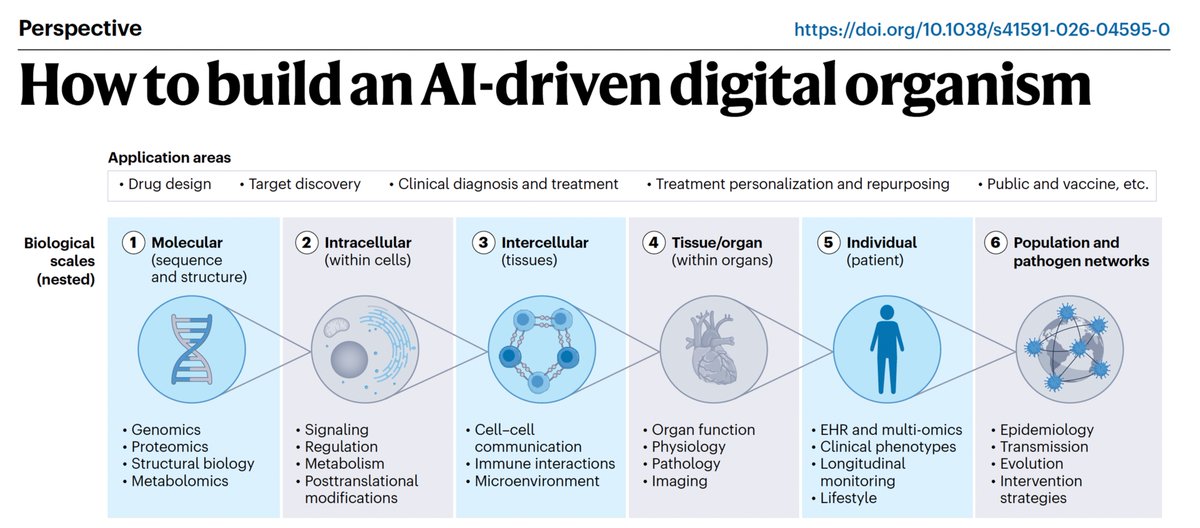
Manipulating biology in the real world is complex; Eran Segal & colleagues envision an #AI-driven digital organism – a system of integrated multiscale #foundationmodels – detailing how to construct and use it to advance biomedical research.
https://t.co/aQdgAPAGmR
🧬 Scientists reconstructed the first complete diploid human genome — full chromosome sets from both parents, revealing 15% more DNA, including regions linked to cancer & neurological disease. Led by @JohnsHopkins, @NHGRI & @NIST.
🔗 https://t.co/veQV7Zk0Jl
#Genomics#Biology
A new Nature Methods paper shows what “alignment” could look like for protein design.
ProteinDPO takes the preference-optimization idea used in LLMs and applies it to proteins: instead of only generating sequences that look plausible, the model is trained to prefer sequences with better experimentally measured fitness.
The results are striking:
• Better stability prediction than vanilla ESM-IF1 and standard fine-tuning
• Generalizes from small monomeric proteins to antibodies and large protein complexes
• Identified 27 stabilizing H5N1 HA designs from only 45 tested variants
• Improved melting temperature by up to 32°C on a 2024 H5N1 strain
Protein generation is moving from:
“Does this sequence look like a protein?”
to
“Does this protein actually perform better in the lab?”
Biological foundation models may be entering their own alignment era.
The path to preventing Type 2 diabetes and prediabetes across the lifespan, and when glucose intolerance crops up, to achieve remission
https://t.co/HGcGoNM2O4
@Dr_Birkenfeld@NatureMedicine@uktuebingen
How to Spend Your Oracle Budget: Practical Guidance for Protein Structure Prediction Models
1 Biological oracles (e.g., MD stability, wet-lab assays) can detect and correct protein structure prediction failures, but they are expensive; this paper asks a practical question: given a fixed number of oracle calls N, which guidance method should practitioners use to return a batch of K improved structures?
2 The study provides a systematic, budget-aware benchmark of four oracle-guidance strategies on Boltz-2: Best K-of-N sampling, inference-time FK-steering (SMC-style resampling), fine-tuning via DPO, and O3 (Optimisation Over Outputs), which is applied to protein structure prediction here for the first time.
3 Key finding across two targets and two oracles: there is no universal winner across all budgets and oracle types. Method choice depends strongly on oracle-call budget and on whether the oracle provides informative intermediate-time signals during diffusion sampling.
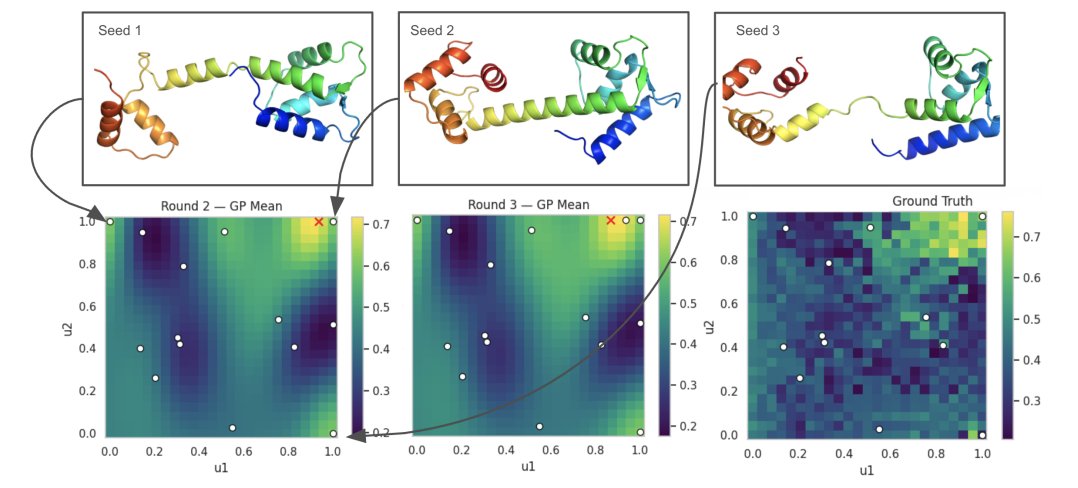
4 O3 is most effective when oracle calls are scarce. It builds a low-dimensional “example-defined” latent subspace from a small set of high-scoring seed generations, then runs Bayesian optimisation (GP surrogate + acquisition) inside that subspace to spend the remaining oracle budget efficiently.
5 Practical engineering details for making O3 work with Boltz-2: the generation process is converted to a deterministic probability-flow ODE (and stochastic SE(3) augmentation is disabled) so that the optimiser can reliably map a latent point to a single structure for scoring.
6 On calmodulin (PDB 1CLL) with a TM-score oracle against the crystal structure, O3 is the only method that meaningfully beats Best K-of-N at low budgets (N ≤ 100). As N increases up to 1000, FK-steering and online DPO steadily improve, but O3 remains strongest in the evaluated low-to-mid budget range (mean-of-K plateauing around ~0.81).
7 The paper dissects why O3 works: (a) even random search restricted to the O3 subspace improves over Best K-of-N, showing the subspace itself is valuable; (b) Bayesian optimisation further improves over random search within that subspace; (c) the best subspace dimension d is budget-dependent, reflecting a trade-off between expressivity (larger d) and optimisation difficulty (higher-dimensional BO).
8 FK-steering improves with budget on TM-score because it can exploit intermediate denoising steps: higher reward scaling (λ) increases performance but likely reduces diversity; and for fixed N, allocating more resampling steps (larger N/K) can help at higher budgets.
9 DPO results highlight an important operational distinction: online DPO (interleaving sampling, scoring, and updates) improves with N, while offline DPO (one fixed scored dataset) largely plateaus. The implication is that on-policy resampling/adaptation is a major driver of gains under fixed oracle budgets, but DPO needs substantially larger budgets to become competitive.
10 On the larger, likely out-of-distribution complex (PDB 9EEH) with a reference-free MolProbity-based validity oracle, trends shift: O3 is best on mean-of-K at most budgets, but max-of-K can favor stochastic sampling baselines (Best K-of-N) at high N; FK-steering performs poorly because MolProbity is dominated by local-geometry noise until late denoising steps, making intermediate oracle calls weakly informative.
📜Paper: https://t.co/porJ9PtAMX
#ProteinStructurePrediction #DiffusionModels #BayesianOptimization #Boltz2 #DPO #SequentialMonteCarlo #ComputationalBiology #MachineLearning
Validation of the importance and heterogeneity of our organ and tissue aging by histopathology
—our organs age at very different rates (clocks)
—this can be detected via blood tests
—the blood test clocks predicted 8 diseases indexed to organ accelerated aging
—from 25,000 tissue samples , 40 tissue types, nearly 1,000 individuals
@NatureMedicine@abila_ernesto
https://t.co/n8SsmgF6Ep
Did you know? Your Flex #singlecell workflow can already capture protein, not just RNA. Signaling activity, post-translational modifications, functional cell state, and more. All in the same run. Learn more > https://t.co/FhH27cJ76Z
Models trained using genetic markers + gene expression + phenotypes can be better predicting phenotype solely from genetic markers than models trained using only genetic + phenotype data from the start. Kontolati et al, out two days ago. https://t.co/g9MxsVn2pi
Models trained using genetic markers + gene expression + phenotypes can be better predicting phenotype solely from genetic markers than models trained using only genetic + phenotype data from the start. Kontolati et al, out two days ago. https://t.co/g9MxsVn2pi
AI has created a 21st-century hyperabundance of potential new drugs and biological hypotheses, but we are still using 18th-century style animal testing.
Instead, @Vivodyne is evaluating drugs in living human tissues at industrial scale.
Excited to continue working with Vivodyne as they iterate on their 'Virtual Human' data center, where we can predict treatment response.
Scientists have created the first comprehensive map of the human vagus nerve, tracing thousands of individual nerve fibers stretching from the lower brain stem to all major organs.
The map might help scientists and doctors more precisely stimulate the nerve as a potential treatment for conditions such as epilepsy, stroke, and inflammatory diseases.
Learn more: https://t.co/XRHfmivUjk @NewsfromScience
The Mathematics of Large Language Models — A Readable Guide to LLMs, Transformers, Diffusion, Neural Networks, and Generative AI: https://t.co/LpHsnlyQme