End of an era. @steveubl has been a fantastic leader and I'm so grateful for the support he provided to me personally and the confidence he placed in our team. Very proud of the progress we've made on important issues impacting patients and our health care system.
PBMs treat their contracts like fight club—they won't talk about them.
In a conversation with @Merck CEO Robert M. Davis, @mcuban broke down the lack of transparency from PBMs, and how patients, employers and taxpayers continue to pay the price.
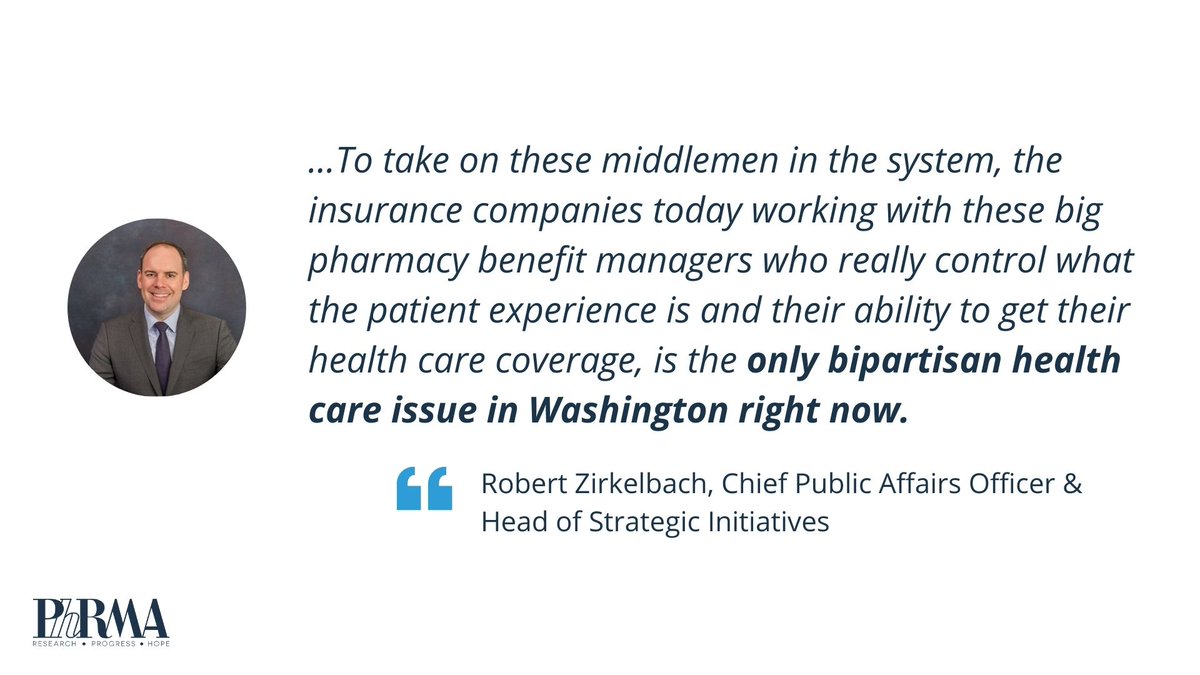
Today, @robzirk joined the @RCPolitics team to discuss the upcoming election, the latest voter priorities and key findings from their new survey. Watch the full webinar here: https://t.co/2QwYir4i48
The IRA is just beginning to go into effect, but it is already resulting in significant unintended consequences for Medicare beneficiaries. New surveys reveal how insurers and their PBMs will limit treatment options for seniors. https://t.co/0oU5BON543
Don’t be fooled by today’s announcement on the government-set prices for 10 innovative medicines.
The government arbitrarily set prices for these medicines to drive headlines ahead of the election. Let’s take a look at what’s already happening in the market:
-Since the start of the Medicare Part D program, plans have negotiated rebates and discounts for 99% of the most commonly used brand medicines.
-In fact, 9 of the 10 medicines in today’s announcement already have rebates that are at least equal to the average brand rebate in 2021.
-And 3 of the 10 had estimated rebates that exceed 60% of their list prices.
These negotiations are already happening, but patients often aren’t seeing the savings because middlemen like PBMs and insurers don’t share the savings with patients. Instead of lowering patient costs at the pharmacy counter by requiring middlemen to share the savings, the administration chose to put the government between patients and their medicines.
The IRA is even making this problem worse. Seniors are already seeing higher costs and significant disruptions in their health care coverage as a result of the flaws in the IRA.
I sat down with @Nicole_DeFeudis to talk about the flawed and political government price-setting process and the need for PBM reforms like sharing the savings with patients at the pharmacy.
Read the interview with @endpts here: https://t.co/PvJEKUKYSU
In about 15 minutes executives from the big 3 PBMs will face the House Oversight committee.
Earlier this morning we exclusively reported that committee investigators found PBMs increase costs and take away choices for patients.
https://t.co/XAufEC0zs7 via @WSJ
PBMs and health insurers decide what medicines you can get, and they set the price you pay at the pharmacy. At the same time, over half of every dollar spent on medicines goes to these middlemen and others. Find out more: https://t.co/oYxOLXn1jg
Another day, another damning report on the havoc caused by the largest PBMs. It shouldn’t be a surprise that voters across the country want policymakers to hold PBMs accountable.
The FTC just released an interim report on pharmacy benefit managers, the dominant middlemen who hike the cost of prescriptions, including overcharging patients for cancer drugs. 1/13
Great conversation recently at @FTLive’s US Pharma and Biotech Summit with @mroliverbarnes, @EMDSerono’s Terri Stewart and @EricGascho about policies like government price setting that put R&D and patient access in jeopardy, especially in an election year. #FTPharma
Five questions for today’s hearings with UnitedHealth CEO Andrew Witty, including if their size is safe for the country + if their for-profit mindset is good for patients. $UNH
https://t.co/2Oxr52mZah
UnitedHealth Group is the biggest employer of doctors and the largest health insurer. Its holdings are vast. Know what else United owns? A bank. It’s called Optum Bank. And it's had problems. 🧵
Every time new medicines are approved, insurers say they can’t afford to cover them and use that as an excuse to deny people access. Why is @SenSanders giving insurers a free pass instead of holding them accountable so that insurance works like it should?
Again, @SenSanders is attacking an innovative company to advance a political agenda instead of addressing the real cause of affordability challenges. Policymakers should be encouraging new medicines that improve health and avoid the most expensive parts of our health care.
We can help patients and lower costs by:
1. Getting rebates to patients
2. Fixing misaligned incentives in the market
3. Stopping insurers from denying patient access to innovative medicines that treat & prevent disease
Get the facts here: https://t.co/ktchPk2xPD
The Top Pharmacy Benefit Managers of 2023: Market Share and Trends for the Biggest Companies—And What’s Ahead
DCI's latest #PBM data, along with a preview of the next few years.
@CVSHealth $CVS @ExpressScripts $CI @OptumRx $UNH
https://t.co/2769lM7NcR
https://t.co/2769lM7NcR