Exercise burns 500 extra calories. Your body compensates by spending 500 fewer. Net change: zero. A foundational study by @HermanPontzer measuring 332 adults across five populations proved the math behind weight loss doesn't work the way we've been told.
Ponzer and his team used doubly labeled water to measure total energy expenditure and accelerometry to track physical activity in adults from Ghana, South Africa, Seychelles, Jamaica, and the United States. This method captures actual metabolic rate over 7-10 days in free-living conditions, not lab-based estimates.
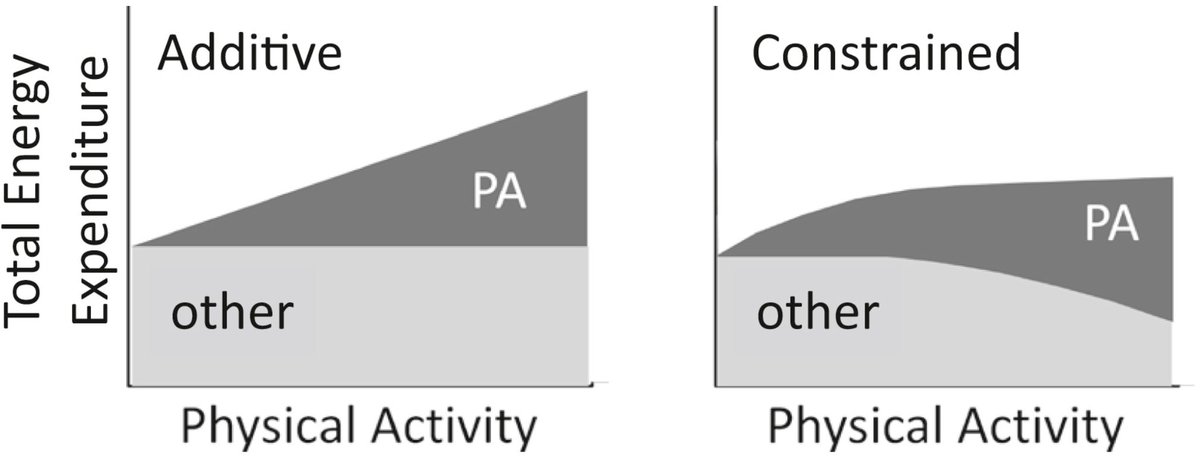
The standard additive model predicts that total energy expenditure increases linearly with physical activity. Burn 200 more calories moving, spend 200 more calories total. That's the assumption underlying most weight loss and obesity prevention strategies.
The data revealed something different. After adjusting for body size and composition, total energy expenditure was positively correlated with physical activity at low-to-moderate activity levels. But in subjects with higher physical activity levels, total energy expenditure plateaued. The relationship wasn't linear. It was constrained.
This supports a constrained total energy expenditure model: the body adapts metabolically to maintain total energy expenditure within a narrow range when physical activity increases beyond moderate levels. The metabolic response to activity isn't passive addition. It's active compensation.
Two variables appeared to modulate this response: body fat percentage and activity intensity. Higher body fat was positively related to total energy expenditure, while higher activity intensity was inversely related to total expenditure after controlling for activity volume. The body's adaptive mechanisms aren't uniform across metabolic phenotypes.
The compensation mechanisms likely involve reductions in basal metabolic rate, thermic effect of food, or non-exercise activity thermogenesis. When physical activity energy expenditure increases substantially, other components of daily energy expenditure decrease to keep total expenditure stable.
This has direct implications for weight loss interventions. Exercise programs that substantially increase physical activity may not produce the caloric deficits predicted by additive models because the body compensates by reducing energy expenditure elsewhere. The expected 1:1 relationship between activity and expenditure breaks down at higher activity levels.
The plateau doesn't mean exercise is ineffective. Physical activity produces metabolic benefits independent of energy balance, including improved insulin sensitivity, mitochondrial function, and cardiovascular health. But using exercise as the primary driver of caloric deficit faces a biological constraint that most public health models don't account for.
The constrained model also explains why cross-population studies consistently find that more active populations don't have proportionally higher total energy expenditure. If compensation occurs above moderate activity levels, highly active hunter-gatherer populations and sedentary Western populations can show similar total daily energy expenditure despite vastly different activity patterns.
The decisions about exercise intensity, volume, and metabolic context (body composition, dietary intake) interact with constrained energy expenditure in ways that aren't captured by simple calorie-counting models. The body regulates total energy expenditure as a managed system, not a passive ledger.
Public health strategies built on additive energy expenditure models assume a biological response that doesn't match observed physiology. The constrained total energy expenditure framework suggests that preventing weight gain requires addressing both sides of energy balance, and that increasing activity alone may not produce the metabolic effects predicted by conventional models.
🔔 Stones that ring like bells?
In Egypt’s Libyan desert, some rocks don’t sound like stone when struck… they ring like metal
It’s not magic: their dense, stressed structure lets them vibrate like a bell.
A female Swan who fell ill and was taken to an animal hospital for treatment. This is the moment she was reunited with her partner, from whom she'd been separated for 3 weeks. Such a touching moment. 🦢❤️
This Cantareel performance is straight-up hypnotic 🔥
An “inside-out hurdy-gurdy” with that rich, droning sound and beautiful crank-driven melody — pure medieval magic in action! The way it fills the room is next-level 🎶
Obsessed with these unique folk instruments lately.