I made a visualization of EIP-8288 aka "recursive mempool aggregation," my new favorite EIP of all time because it perfectly encapsulates the thesis of the "cryptographic world computer" -- a system whose scalability *increases*, not decreases, with the level of decentralization.
In a previous tweet I explained how EIP-8288 achieved this seemingly impossible feat, but one gif is worth a thousand words.
Essentially, EIP-8288 leverages Ethereum's decentralized mempool as a parallel ZK proving cluster. Clients send signatures and proofs to the mempool, which over multiple rounds progressively aggregate them into fewer and fewer proofs, until the block builder finally aggregates them into one SINGLE proof.
This design accomplishes five things at once:
- The more nodes we add to the decentralized mempool, the more signatures/proofs Ethereum can process as a whole. This is obvious if you look at the animation and imagine more nodes in the mempool ring, which would "fan out" to more signatures/proofs.
- By aggregating over multiple rounds (aka "recursive aggregation"), the bandwidth consumed by proofs remains constant for each node even as the network processes more proofs. As a result, the network stays decentralized even as capacity increases.
- By aggregating proofs before one final aggregation by the builder, as opposed to requiring the builder to aggregate everything, the network can process more proofs without increasing hardware requirements for the builder.
- By aggregating everything to a single block-level proof, validators can verify thousands of signatures/proofs by checking just one aggregated proof. Hardware requirements for validators can therefore stay low, keeping the network decentralized.
- By aggregating not just native signatures but also STARKs, Ethereum can support any signature scheme by wrapping them in STARKs.
So once again, this is how Ethereum will:
- scale to process tens of thousands of PQ and private transactions per second
- charge a tiny amount of gas to validate each txn, even though the original signature/proof may be huge (up to hundreds of KBs in size)
- all while decentralizing even MORE.
You are not bullish enough.
smart accounts but make it ✨frames✨
get your post-quantum(SPHINCS) secure account now.
ERC-8286 playground is live on 8141 Hegotá testnet!
https://t.co/xt1KzTNP3q
Powered by @ethrex_client
Post Quantum by @riva_labs
#TigerShroff: A video purportedly shows the three assailants firing towards the actor and his car.
Extremely disturbing visuals. Such a relief to know that he is safe. 🙏
It’s not a dumb question. There’s a technical reason behind it.
Computers use binary, which works naturally with powers of 2:
8 → 16 → 32 → 64 → 128 → 256 → 512 → 1,024.
Each step doubles the number of possible storage units, making memory chips and storage architectures easier to design and organize.
Could manufacturers make a 150GB or 300GB drive? Absolutely. There’s no rule against it.
But standard capacities based on powers of 2 are convenient for designing memory systems, while manufacturing economics, chip configurations, and product segmentation also influence what gets sold.
So it’s engineering first, with a bit of marketing layered on top.
Ordered food on @Swiggy today and ran into an unusual situation.
The delivery executive’s vehicle broke down midway, so I went to meet him and collected my food myself.
But here’s the catch: neither of us could figure out how to mark the order as delivered.
Shouldn’t there be an option for customers to manually confirm delivery in such situations?
Seems like a simple but useful feature to have, @Swiggy.
The “Reverse Engineer Anything” repo has MNCs nervous—and for good reason. AI is shrinking months of analysis into hours, making complex systems easier to understand, replicate, and improve.
🔗 https://t.co/14PesHf88X
#AI#ReverseEngineering#OpenSource#Innovation
Announcing Zypherpunk!
We are calling up builders, researchers, and creators to come and shape the future of Zcash.
Our aim is to create an entry point for new talent in Zcash, where they can learn, contribute, meet like-minded people, and also get rewarded for their efforts.
Dozens of developers are already contributing via Zypherpunk with projects like thus-spoke-zakura, and more are being created as we speak.
We will be focused on the following:
- building more projects like thus-spoke-zakura collaboratively with developers
- creating content and media that accelerates developer-focused education for Zcash
- events and meetups that bring more high-quality technical talent to Zcash
- hackathons to identify the next big projects for Zcash and help them find the right partners for mentoring, funding, etc.
The encrypted money for humanity needs the brightest minds of our generation building for it.
If this sounds interesting to you, please fill out the form to join our Discord below 👇
I run load tests across 200+ services at Prime Video. Here's what breaks first during a gameday.
It's never the service you tested last month.
It's always the dependency nobody thought to check. 🧵
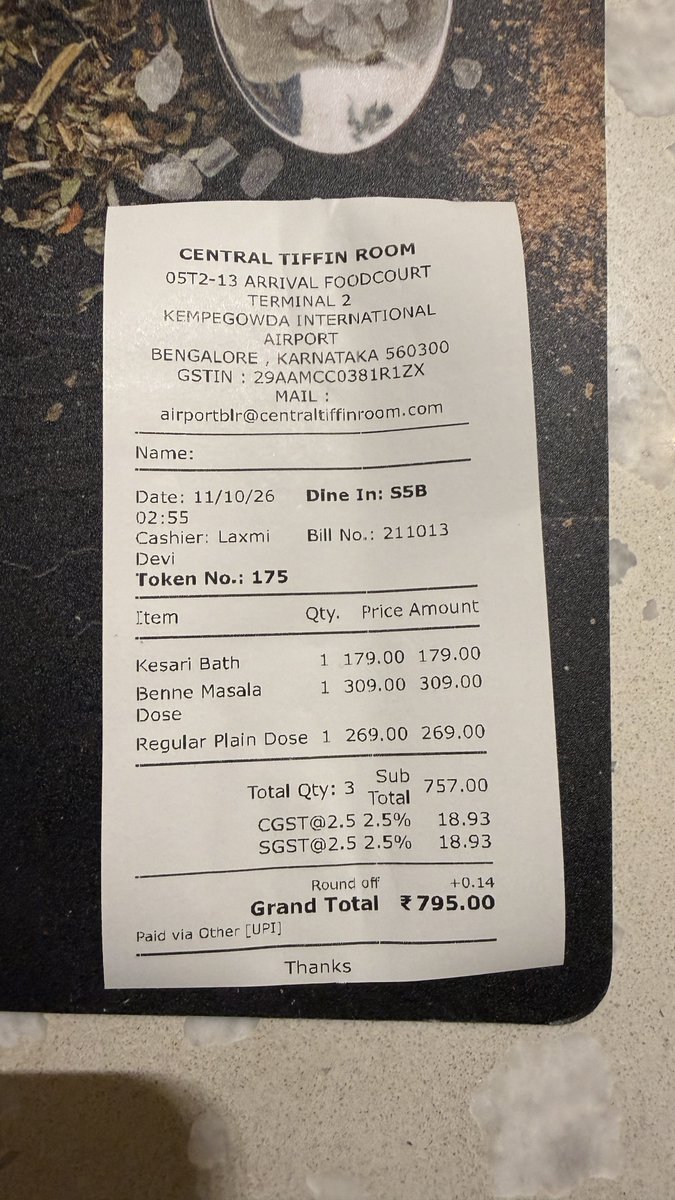
Went to CTR last night and the dosa prices nearly gave me a heart attack.
I'm so used to darshini prices in Bangalore that seeing what the same dosa costs here made me question my life choices.
Mr. Musk, yes, no billionaire should dictate a nation’s policy - Indian or American.
India must welcome competition in satellite internet, from Indian and global providers, whoever offers the most practical and affordable last-mile solution for those in remote regions. In countries with lower per-capita incomes, satellite internet must be affordable too. High subscription fees and equipment costs risk putting it beyond the reach of ordinary households. Connectivity must bridge the digital divide, not create a new one.
India knows our networks and spectrum are strategic infrastructure, not merely commercial assets. India’s national security safeguards are non-negotiable.
Every country makes choices based on its own interests. Those in the West cannot preach free markets while practicing protectionism at home. USA imposed 100% tariffs on Chinese EVs to protect its domestic industry, just as India takes measures to protect its own domestic manufacturers. Both India and the US have restricted Huawei over security concerns. One cannot demand a level playing field from others only when it suits its own agenda.
Indians will internally debate, question and address our strengths and shortcomings as a democratic country.
Take BharatNet, India’s programme to bring broadband to village-level local bodies. We will question why, as the CAG’s 2026 audit report found, the programme is struggling to meet its original objectives. Why were only 33.2% of service-ready Gram Panchayats operational, despite ₹39,888 crore being spent? At the same time, we know to appreciate our telecom sector and regulations, which has made internet data among the world’s most affordable, bringing millions online.
India is a democracy, not a colony. We welcome the world, but we, the Indian people, will decide our own future - not Western vested interests, their double standards or any billionaire - Indian or American.