Excited to share STAR-MD: a scalable autoregressive diffusion model that generates stable, high-quality protein MD trajectories at microsecond timescales, where existing methods fail catastrophically.
Accepted at ICLR 2026! Links and details in the thread 🧵👇
1/7
Today, we're announcing a new partnership with @GSK! This is another step toward our mission: enabling every scientist to reshape biology and build a healthier, more sustainable future. We cannot wait to see what GSK’s scientists build with our models.
Today we're excited to announce a major collaboration with @TakedaPharma to deploy our frontier models across their entire organization.
Takeda scientists now get access to BoltzMol-1, BoltzProt-1, and fine-tuned models for biomolecular modeling and design.
Amazing to see the great reaction to BoltzMol-1 and BoltzProt-1 and all the scientists that have already started using these models through the API. To share more details and celebrate the launch, we are organizing events in Boston, San Francisco, and London, join us!
- Boston, today at 4pm: https://t.co/GqelhVCevp
- San Francisco, Monday at 5pm: https://t.co/DTXLK9akFl
- London, July 2nd: https://t.co/2Fka6iN7oJ
I'm incredibly proud of our team for shipping BoltzMol, BoltzProt, and our new API. Both models delivered experimentally validated hits for over 50% of the targets we tested. They're also an architectural step change: no longer a single neural network run end-to-end, but pipelines of multiple models that require complex orchestration and large GPU fleets to run at scale. We put in long engineering hours to build the infrastructure needed to get these pipelines into everyone's hands. We can't make it free, but we worked hard to make it a cost-effective choice, and accessible to everyone.
A lot of things being announced today - but really worth highlighting our first small molecule design model - BoltzMol-1
BoltzMol-1 comes with a lot of great experimetnal validation, being able to find good hits for a number of really challenging targets, many outside the data
We are releasing a blog post to highlight some of the challenges in classifying binders from denovo design models and to propose a more rigorous evaluation protocol from what we often observe in the field (including our own past work)!
https://t.co/6Fz2yUqWn3
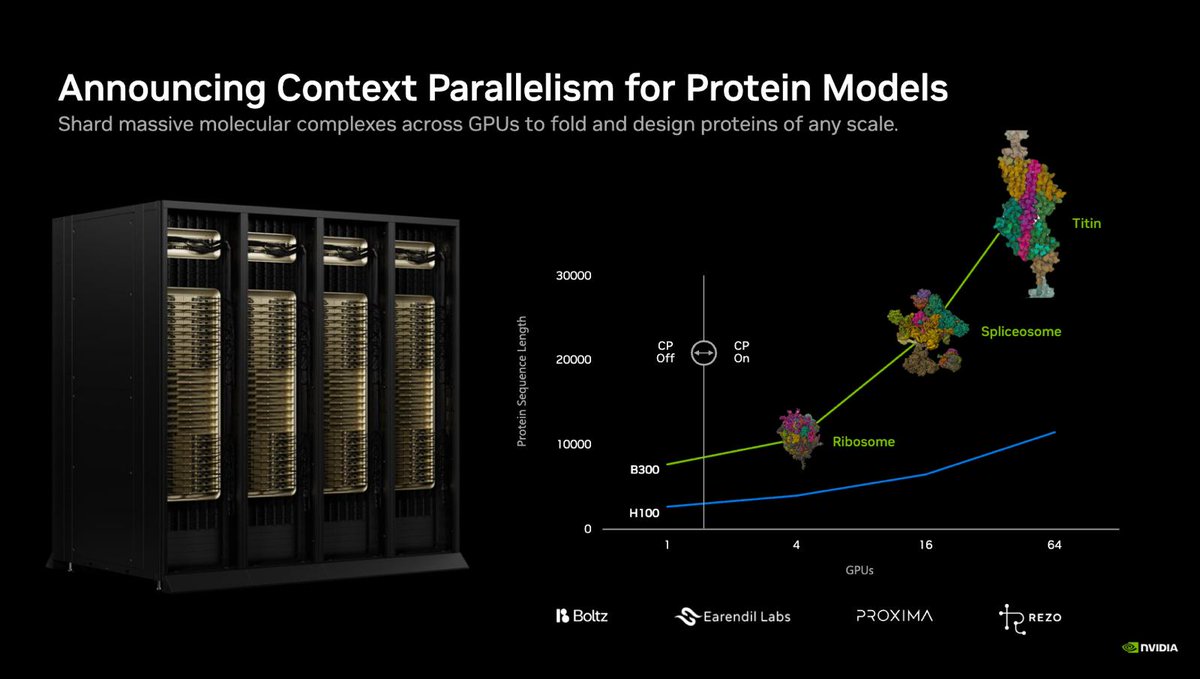
It has been great to collaborate with the @NVIDIAHealth team on adding Context Parallelism to the Boltz models! Announced in the keynote at #GTC, @NVIDIA showed you can now scale up Boltz-2 to predict structures up to 30k residues (up from ~2k)! 🤯 This opens the door to a number of very cool new applications, although performance starts to drop around 3-4k residues because the current models have only been trained on smaller crops. Try it out at: https://t.co/AuN3yzxsIp 🧬
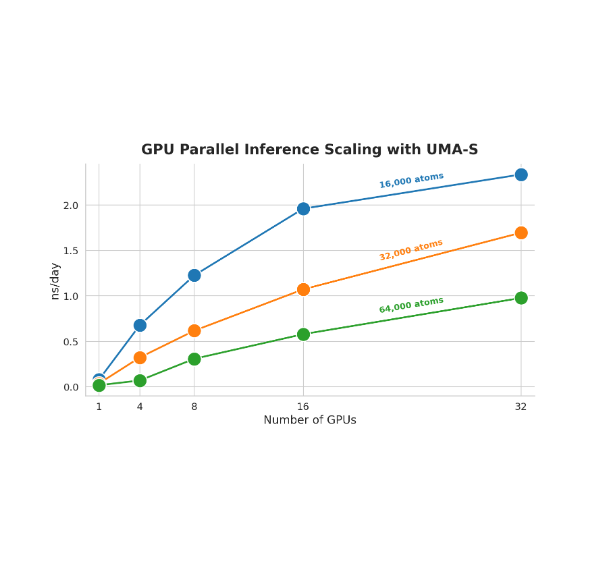
UMA-S 1.2 is here! ~50% faster, ~40% more accurate on Open Molecules test set, and expanded data coverage for catalysts (oxides and interfaces), molecules, and polymers! We hope this release addresses a number of items on the collective wish list (definitely not all 😜).
🧵1/6
Wrote some notes on how we went from O(N^2) attention -> KV Cache -> Cache memory bottlenecks -> Multi Head Attention Variants -> DeepSeek's MLA algorithm
https://t.co/P9X2fsVq8q
🚨Excited to share our recent preprint: "MATRIX: A Multimodal Benchmark and Post-Training Framework for Materials Science"! 🧪
Pre-print: https://t.co/KwBYcIqaoH
Dataset/Models on HuggingFace: https://t.co/cp9poG3BfU
https://t.co/HF9nYBckBC
(1/6)
🧬 Protein Autoregressive Modeling (PAR), ByteDance Seed
We introduce PAR, the first multi-scale AR framework for protein backbone generation.
Autoregressive modeling of 3D protein structures has long been considered difficult.
Here’s how we make it possible with PAR. 👇
https://t.co/VYN6PJim2p
Excited to share STAR-MD: a scalable autoregressive diffusion model that generates stable, high-quality protein MD trajectories at microsecond timescales, where existing methods fail catastrophically.
Accepted at ICLR 2026! Links and details in the thread 🧵👇
1/7
STAR-MD is joint work with Yuxuan Liu, Yuning Shen (@YuningShen1), Rob Brekelmans (@brekelmaniac), Pan Li (@PanLi90769257), and Quanquan Gu (@QuanquanGu) at ByteDance Seed, Georgia Tech, and UCLA.
Big thank you to ByteDance Seed for supporting this research!
6/7