Eric Schmidt says war is no longer constrained by humans. It's AI vs AI.
“No human can plan a battle… without reinforcement learning.”
The real conflict lives in data centers and drone swarms. No human can follow it in real time.
Great research on open-source by @Harvard:
- $4.15B invested in open-source generates $8.8T of value for companies (aka $1 invested in open-source = $2,000 of value created)
- Companies would need to spend 3.5 times more on software than they currently do if OSS did not exist
I suspect that these numbers and impact are even greater for AI than for software (would be great to study!)
To be clear: Nandan Nilekhani is awesome, and he's done far more for India than any of us can imagine through Infosys, UPI, etc. But he's wrong on pushing Indians to ignore model training skills and just focus on building on top of existing models. Essential to do both.
🚨NEW: Trump announces "Project Stargate," a plan for the US to invest $500B in American AI infrastructure. It will be a Joint Venture with OpenAI, Oracle, and Softbank, and other investors will come later. They're starting with a data center in Texas. More details to come soon.
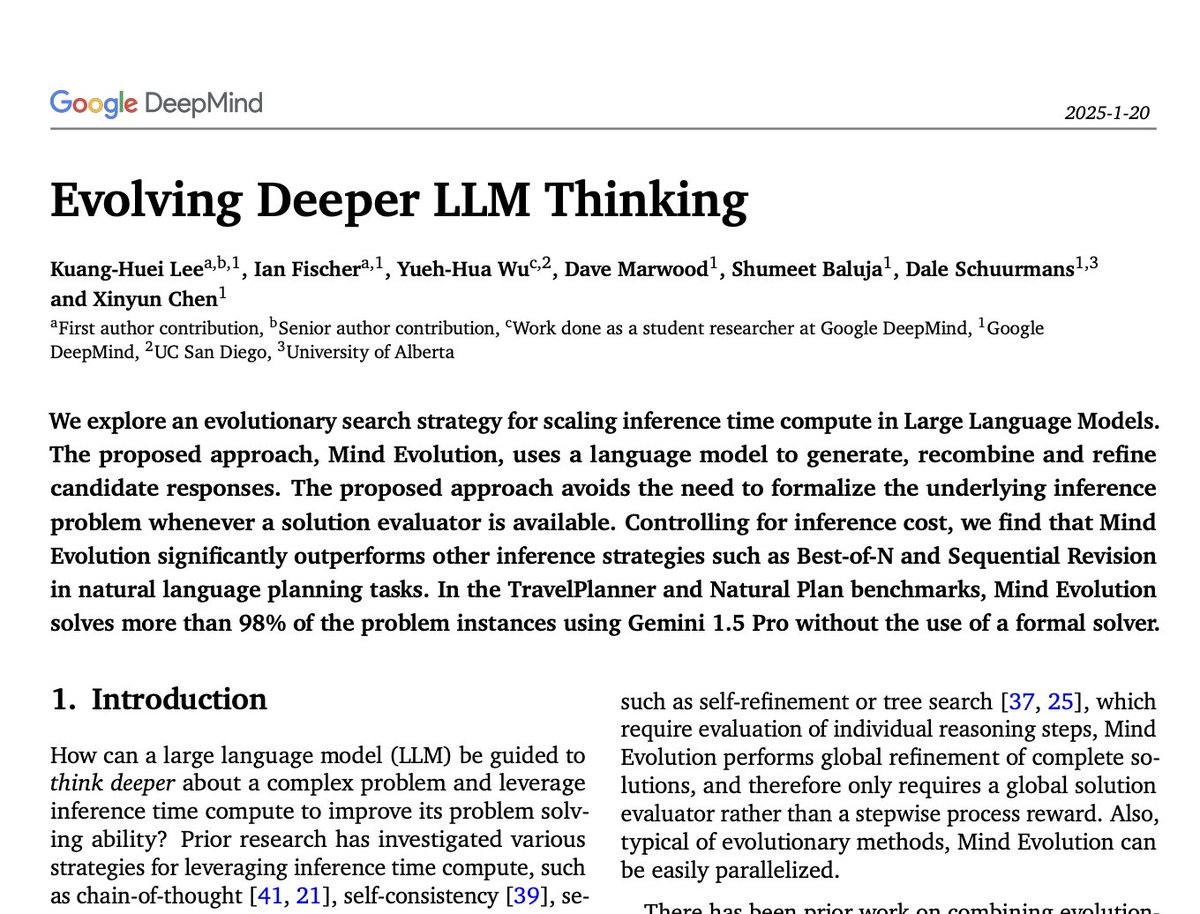
Google presents Evolving Deeper LLM Thinking
Controlling for inference cost, we find that Mind Evolution significantly outperforms other inference strategies such as Best-of-N and Sequential Revision in natural language planning tasks. In the TravelPlanner and Natural Plan benchmarks, Mind Evolution solves more than 98% of the problem instances using Gemini 1.5 Pro without the use of a formal solver.
HUGE: DeepSeek R1 from China reaches o1 level performance! Most important paper of 2025.
They show that using pure RL using GRPO can teach models to reason better and better with more tokens: the first at this scale.
Here are the 4 top research learnings from the paper:
1/5
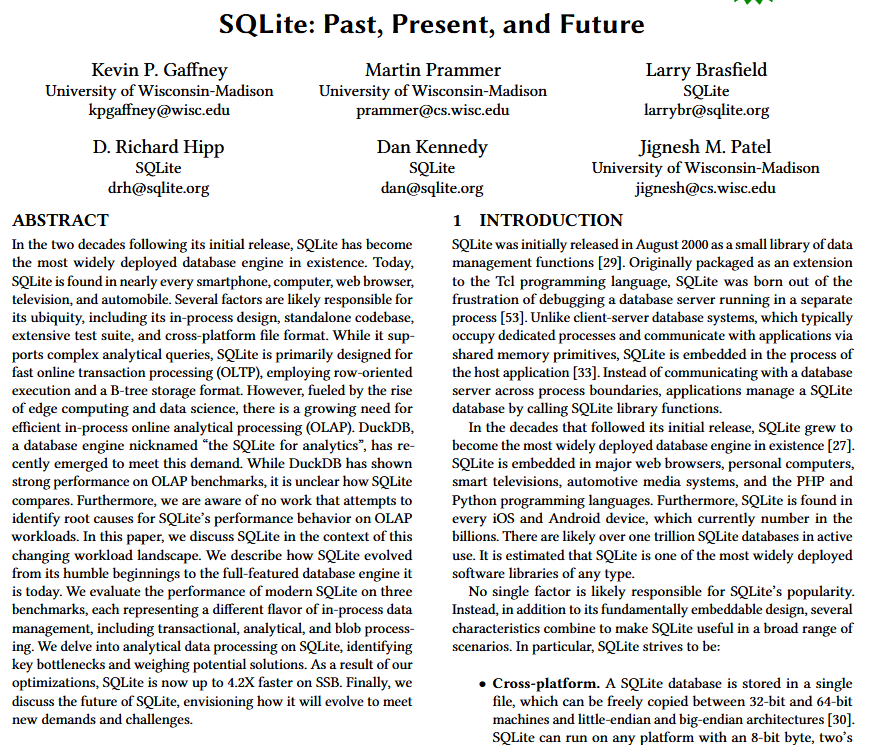
SQLite is the most widely deployed database in the world, running on devices as ubiquitous as phones and TVs and as mission-critical as aircraft software. But how did it get there, and where is it going next?
I love this paper because it gives both a historical perspective on SQLite and an honest look at its advantages and shortcomings. SQLite originated 25 years ago as a small package of data management functions for Tcl, but rapidly evolved into a full-fledged transactional database. It became enormously popular for three big reasons:
- It’s embedded and self-contained. Uniquely among major databases, SQLite runs inside your application's process instead of on a separate server. It’s distributed as a single C file that compiles to less than 750 KiB. This lets SQLite run in resource-constrained environments where a conventional database would be unworkable.
- It’s cross-platform. A SQLite database is stored in a single file that can be freely copied across almost any machine, regardless of architecture. In embedded systems where custom architectures are everywhere, this is a huge advantage.
- It’s reliable. SQLite has a stunning 600 lines of test code for every line of SQLite code, covering all sorts of rare crashes and failure conditions. This is huge for mission-critical systems.
What’s interesting about SQLite is that while it was designed for transactional workloads, it’s increasingly used for analytical (OLAP) workloads just because it’s lightweight and easy to add to a data science library. Smart database researchers saw this trend and built an embedded analytics-focused database, DuckDB , which has also become very popular. A big chunk of the paper is devoted to a performance comparison of the two, and the differences are striking:
- On transactional workloads containing mostly small reads and writes, SQLite is 10-60x faster than DuckDB.
- On analytical workloads consisting of large scans, aggregations, and joins, DuckDB is 30-50x faster than SQLite.
This shows how important it is to pick the right system for your workload! Interestingly, the authors propose some optimizations for SQLite based on ideas from DuckDB, like using Bloom filters to speed up big joins. These make SQLite up to 4x faster on some analytical queries, though it’s still an order of magnitude behind DuckDB. Hopefully cross-pollination between databases continues to improve them all in the future!
The cryptoeconomy has been technically feasible for a while. It just became politically feasible.
All payments use stablecoins.
All companies raise online.
All accounting goes onchain.
All systems are go.
Starship is the first ever rocket design capable of making life multiplanetary.
Becoming multiplanetary is a milestone that, if achieved, would fit in the top 10 biggest events in the evolution of life.
And it would greatly extend the lifespan of civilization, enabling a far greater understanding of the universe.
The Overton Window has been smashed.
If everything is now legal[1], many startups will try raising funds by issuing tokens as explicit cryptoequity.
As context, the SEC distorted the market for the last decade by forcing founders to obscure the obvious analogy between tokens and equity.
But there is nothing *morally* wrong with moving equity from spreadsheets and NASDAQs to blockchains.
Indeed, from a *technical* perspective it’s far better to represent equities onchain. You can hold them in a wallet, price them with an API call, and track them on an explorer. You can also easily issue dividends, execute buybacks, and manage vesting schedules.
And from a *financial* perspective, there is no contest between the global market of crypto investors and the local market of any given city.
But that shouldn’t mean short-term behavior. Founders can (and should) implement lockups, drag along, cosale rights, and the like. All these conventions align long-term interests of investors and founders.
You could get there by using AI to translate a typical Series A package into a set of smart contracts. And exchanges should step up to help retail by clearly identifying assets that implement long-term, value-aligning lockups.
At least, that’s the responsible game plan for using new technology to fund actual companies. I hope we use our powers responsibly, and will fund projects in this space as we gain more legal clarity.
But we may *finally* enter the long-overdue age of the cryptoequity.
[1]: Obviously this is a rhetorical overstatement. It’s not literally the Purge. But as with the uncensoring of X, there is an enormous range of new things that is now apparently permissible to do — some good and some bad. And a risk-tolerant community will surge into that space to explore what’s possible.
This is one of the downsides of regulating by enforcement. All the SEC did was shoot at good people rather than make good rules. Perhaps the moment was simply beyond their capabilities, and the regulation will de facto fall to the crypto exchanges.
In other words: we don’t yet have rule-of-law. All we have is rule-of-code. And that may be how it lands up.
Marc Andreessen (@pmarca) is a prominent Silicon Valley entrepreneur, investor, technologist, and co-founder and general partner at Andreessen Horowitz. In this @UncKnowledge discussion, Andreessen reflects on his journey—from growing up in rural Wisconsin to founding Netscape and developing one of the first commercial internet browsers in his twenties to playing a pivotal role in shaping both Silicon Valley and national politics.
The interview also delves into the technological and political evolution of Silicon Valley and Andreessen’s own shifting political affiliations from left to right, along with his vision for leveraging technology to drive societal progress, the role of innovation in addressing energy challenges, border security, and national defense.
Andreessen also discusses @DOGE, a policy initiative focused on government efficiency (and the strategy DOGE may use to accomplish its goals), his “Techno-Optimist Manifesto,” and the imperative for revitalizing the US military’s technological capabilities to maintain global competitiveness. Watch the full episode of Uncommon Knowledge with host Peter Robinson (@P_M_Robinson) here:
Peter Thiel’s advice to his younger self: “Value substance over status”
“One of the resolutions I came up with a number of years ago was to always value substance over status… I think if I’m honest about it, too much of [what I did] was driven by prestige and status—and not quite enough by the substance of really trying to learn things.”
Thiel continues on to explain that seven months into working at a prestigious law firm after graduating from Stanford Law School, he had a “quarter-life crisis” and quit.
“All you had to do was go through the front door, but peoples’ identities get so wrapped up in the things they compete for that it was inconceivable for people to actually do that.”
When he reflects on how he ended up in this situation, Thiel says:
“I think I had taken too many of these shortcuts of valuing what was prestigious and conventional over what I really wanted to do.”
Video source: @StanfordLaw (2014)
Finally, an open-source, enterprise-grade RAG solution!
If you don't want to send your data to OpenAI or any external servers...👇
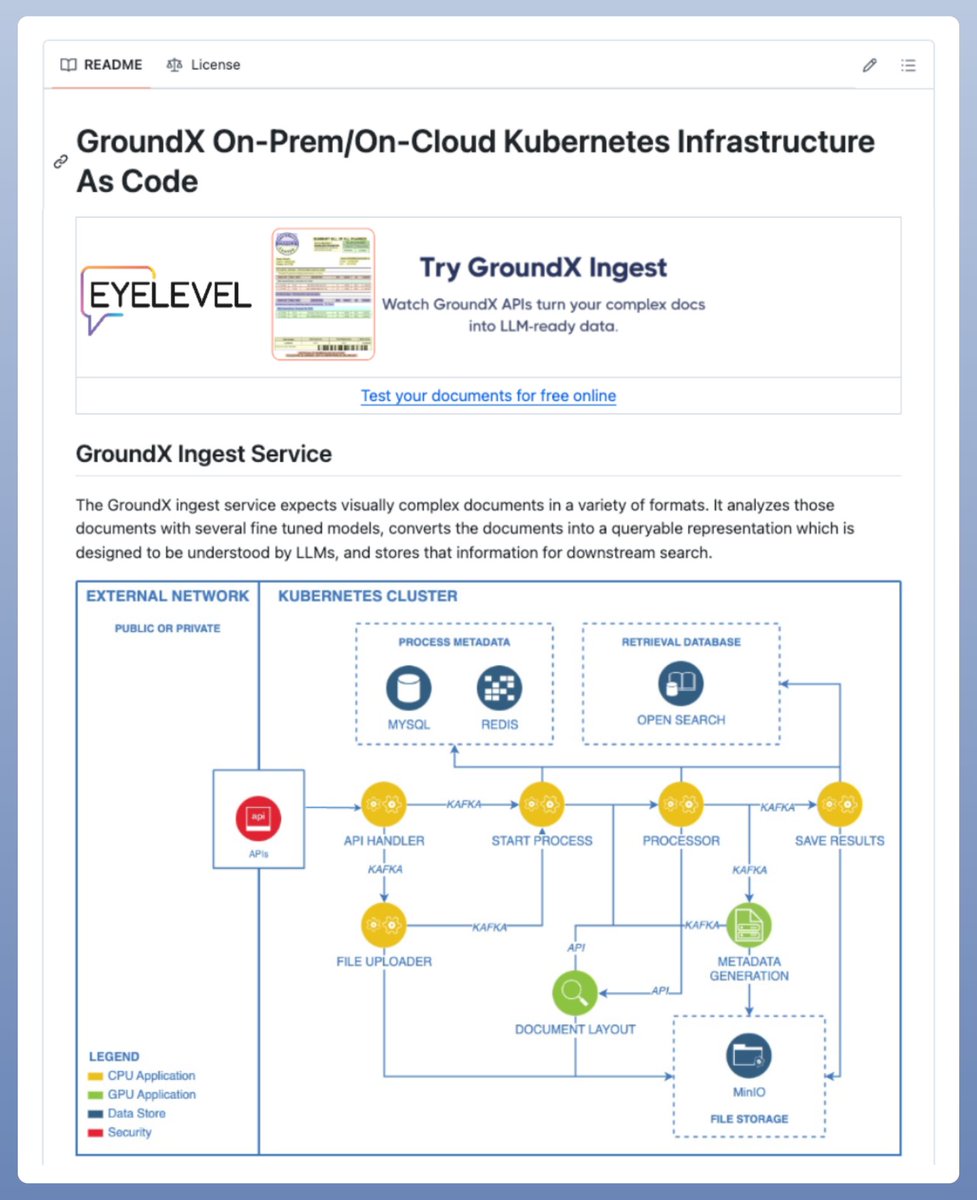
Try GroundX On-Prem, the ultimate secure and scalable RAG solution that you can even run in a submarine without internet.
GroundX is designed to process complex, real-world documents, that can have images, tables, and flowcharts along with regular text.
What makes it a game-changer:
🐍 Great Python SDK
⚙️ Compatible with any Kubernetes setup
🔒 Secure storage for data and vectors
🤖 Ingest service fine-tuned on 1M+ documents
📜 Supports hybrid RAG pipelines effortlessly
GroundX consistently beats leading RAG tools when it comes to handling complex, large-scale documents.
🎯 Trusted by Air France & Samsung, with over 2 billion tokens ingested.
I have shared link to their GitHub repo in the next tweet!