this is just the most ridiculous AI application i've ever seen lol
a Peter Thiel-backed startup that makes AI collars for cows is now worth $2 billion
and the more I read about it the cooler it gets. here's how it works:
every cow wears a solar-powered collar that talks to a network of radio towers and an app on the farmer's phone
instead of building physical fences, the farmer draws the fence on a map in the app, and the collar keeps each cow inside that invisible line using GPS
when a cow drifts toward the edge, the collar plays a sound to steer her, and a gentle vibration tells her which way to go.
it's like how a car beeps as you back up toward a wall
the cows learn the cues in a few days
so now a rancher can move an entire herd to fresh grass by sliding the fence on a map, without driving out to open a single gate
and that same collar is reading each cow's body the whole time.
it takes five readings per second on every animal, so the AI can catch a cow that's sick, injured, ready to breed, or about to give birth before a person would ever notice walking the field
so it's basically like WHOOP for cows too lol
and they gave the AI behind it the perfect name: the Cowgorithm
it's been trained on more than 7 billion hours of real cow behavior, which is why Halter calls the data its real asset and moat.
they know what a normal cow looks like better than anyone, so they can flag the odd one out instantly
it's already on more than 1M cattle across New Zealand, Australia, and a bunch of US states.
California even used it on public land to graze cattle in patterns that clear dry brush and slow down wildfires
costs about $5 to $8 per cow per month
a job that used to mean barbed wire, gates, and driving the fields all day is now mostly 1 person on their phone
Key to winning:
Choose to be positive and grateful. Then, just keep at it. Time is the great compounder and will do the rest.
So many people just don’t have the discipline to stay positive and grateful. Then time compounds the bitterness instead.
5 organisations reimagining breast cancer care in India - from radiation-free early screening and personalised treatment decisions to offering dignity in care, making breast cancer support and screening more accessible and comfortable. https://t.co/vRO0U1JOqu
Tired: Monday
Wired: Moonday
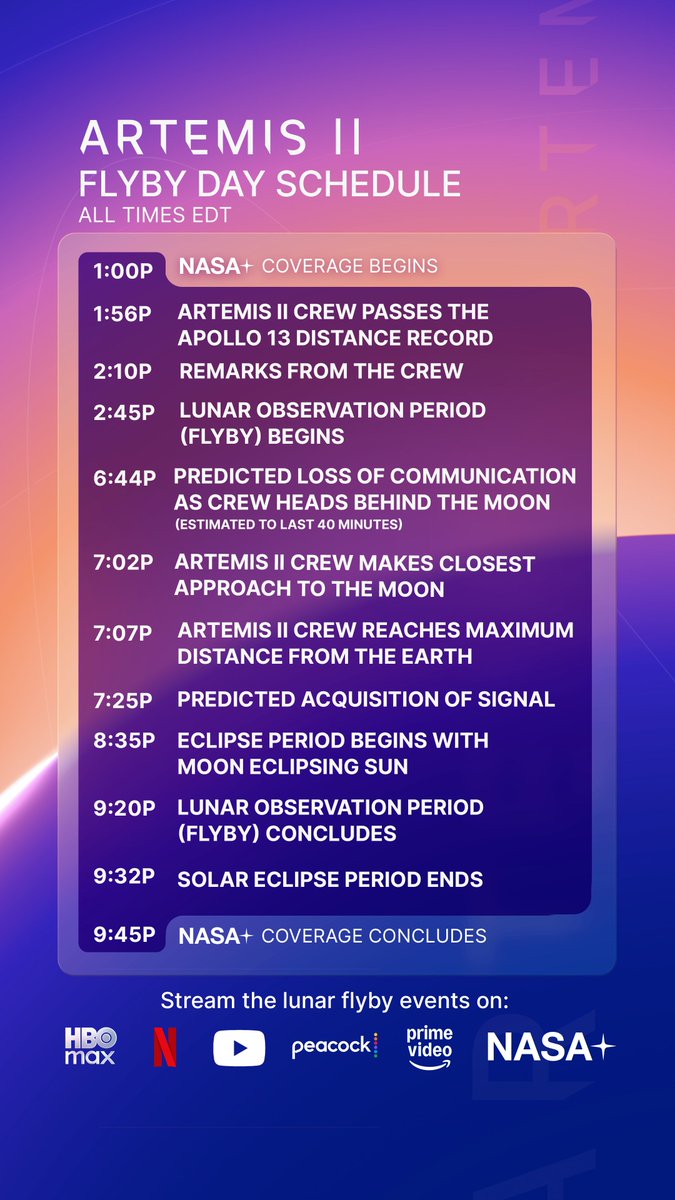
Today our Artemis II astronauts fly around the Moon! Tune in, starting at 1pm ET (1700 UTC) as they view parts of the Moon never seen by human eyes.
Watch it live with us: https://t.co/fAg0bGAqEc
Not all processing makes food worse. That idea sounds good in theory, but it ignores how the real world works, especially in a country like ours.
Take milk. Before Louis Pasteur, milk was one of the most dangerous everyday foods. Pasteurisation dramatically reduced diseases transmitted through milk, including tuberculosis caused by Mycobacterium bovis. It quite literally saved lives. Today, it allows fresh milk to travel safely from villages to cities, reaching millions of families every morning.
Now think about India. We are a nation of 1.4 billion people. Our food is seasonal. Our climate is harsh. Our supply chains are stretched. Without drying, fermenting, freezing, milling, fortifying, or pasteurising, how many people in Mumbai, Delhi, Bengaluru or Pune would reliably get safe food every single day?
Food security is not a luxury here. It is stability. It is independence. It is dignity. We are not dependent on other nations for our essentials largely because we built processing capacity alongside agriculture. Wheat becomes flour. Milk becomes powder. Tomatoes become pulp. Grains are stored safely for months. That is not “making food worse.” That is making food available.
Of course, there’s a difference between responsible processing and ultra-processed excess. The conversation should be nuanced. Processing that improves safety, shelf life, nutrition, and access is not the enemy. In many cases, it is the reason food reaches your plate at all.
Food, by nature, is perishable. Until we build cold chains and logistics that can move fresh produce instantly and flawlessly across a subcontinent, processing remains essential.
The question isn’t “Is processing bad?”
The better question is: What kind of processing serves public health, farmers, and consumers?
In a country like India, that distinction matters.
At Deccan Gymkhana Pune - 25th Edition of the NECC $75K ITF Women's Tournament 2026.
Past winners include Aryna Sabalenka (2015) and Emma Raducanu (2019).
@SabalenkaA@EmmaRaducanu
The recipe is simple: Do what most people avoid. Wake up early. Focus deeply. Move your body. Eat real foods. Obsess over one thing. Go on adventures. Read old books. Be present. Be kind. Have difficult conversations. Love ferociously. Simple is beautiful.
If you take money out of a business as dividends, the effective tax rate is 52% (25% corporate tax + 35.5% on personal income). Through capital gains, it's just 14.95% (with cess).
Why does this matter? Here’s what you should know if you invest in IPOs.
If you're an investor (especially a VC), the math is simple: reduce corporate tax by showing minimal profits or losses. Spend (Burn) on acquiring users, build a growth narrative, and then sell shares at a higher valuation while paying much lower tax.
This spending also makes it harder for competitors to survive. To be clear, we're not discussing R&D spending here, which, incidentally, is very low in India (0.7% of GDP).
What's often overlooked is that VCs are essentially playing a tax arbitrage game. Look at most VC-backed businesses listed in the last few years, the reason they show little or no profit is partly due to this. Once you run a business this way, it's extremely difficult to switch.
Every startup that's 7-8 years old from the time of raising the first round faces constant pressure from VCs for an exit. With almost no M&A opportunities in India, IPO is often the only way out.
The government probably designed this tax arbitrage to incentivize companies to spend money and not just accumulate and distribute. But I'm unsure if the balance is correct. I think it's also creating businesses that aren't very resilient. One prolonged market downturn, and many of these unprofitable companies would struggle to survive.
Two things that make this more interesting:
Unprofitable growth gets valued at much higher multiples than steady profits. A company doing ₹100 cr revenue with 100% growth might get 10-15x, while a profitable one with 20% growth gets 3-5x. So VCs aren't just saving on tax; they're in essence creating a 3x higher exit valuation.
If you're competing against someone burning cash, you almost have to match it to defend market share, even if you don't want to, because of the quirks I mentioned above.
I think this is superb advice. Worth a careful read:
Michael Milken – Lessons on Money, Family, and Success
(Forum for Family Asset Management, Milken Conference, Mexico City –
paraphrased notes)
Spend time with your kids — you’ll pay for it (for better or worse) either now or
later.
Think about how you measure meaning and success in your children and
grandchildren. Give them purpose.
For children raised in very successful households, it’s often hard to emulate
success — especially financial success.
Most successful people are too busy to see their kids and grandkids. That
absence shows up later in life.
The center of success is the ability to dream.
Real success is the freedom to live your life.
The financial media is obsessed with lists. Forbes today is mostly about
ranking wealth by dollars.
There are countless stories of wealthy people who never had a good day with
their kids.
You’re only as happy as your least happy child — think about that often.
He shared a story about a wealthy Chicago family whose fortune was divided into 1/13th shares after one heir demanded his part. That decision ended up dividing the entire family.
Be careful not to do something that provides financially but destroys the
family.
The most important thing to teach children is financial literacy.
The greatest failure among wealthy families is not providing financial literacy to their members.
Example: an extremely wealthy Latin American family where the
great-grandfather is still alive — his mindset is completely different from that of his great-grandchildren.
In Asia, inheritance traditionally went only to men — that has changed in
recent decades.
Recommended reading: Economic Mobility Program – Invest in America.
Example: Apollo bought the Venetian Hotel and gave all 7,000 employees
stock. They paid a dividend the first year through a recap — everyone saw it as a “Christmas bonus.” The next year, when there was no dividend,
employees were upset. No one had explained the difference between a
dividend and a bonus.
The biggest mistake over the last 50 years has been financial illiteracy — not understanding the business or the source of wealth. Families and employees both need to learn this.
Best example of a united family: an Austrian family that’s 11 generations old. They own a resort used only by the five branches of the family. Ownership
rotates every three years. To be invited when your branch isn’t in charge, you
must get along with the others.
No matter how much you build or earn, what truly matters in the long run is
your relationship with your kids and grandkids.
Define what success means to you — it’s what makes you happy.
Entrepreneurs don’t just build companies; they can build nations or religions.
One of the most successful entrepreneurs in history is Lee Kuan Yew.
It’s not about how many things you own.
If you’ve never been responsible for making payroll, your view of the world is very different.
Hug your kids and grandkids. Let everyone find their own path.
Children growing up around success feel enormous pressure. Remind them
how valuable they are.
Let kids make mistakes when the stakes are low — not high.
Era of Healthy Aging - Measuring and Managing Antioxidant Levels. Samsung Galaxy Watch8 series measures an Antioxidant Index - based on carotenoid levels in the skin - to assess fruit and vegetable intake within seconds. #Samsung https://t.co/zYupRn9EEC
Major life cheat code: Learn to work without validation. Write when nobody’s reading. Build when nobody’s watching. Train when nobody’s cheering. It doesn’t take talent. It just takes courage. Those with the courage to work in the dark will eventually shine in the light.
Underrated life hack: Being boring in the right ways. Go to bed early. Wake up early. Eat simple foods. Save money. Exercise. Read old books. Avoid drama. These aren’t flashy, but the ordinary will compound into a life that feels extraordinary. Boring is seriously underrated.
Bad bosses are a boon to a growing economy. They contribute by pushing talented individuals out of corporate slavery to start their own ventures and create jobs https://t.co/hhoODVgu7i #entrepreneurship
Underrated life skill: Changing your mind. It's proof that you value growth over ego. Letting go of a belief you once defended is a display of rare maturity in the modern age. Most people invest more in their pride than their future. Don’t be most people.
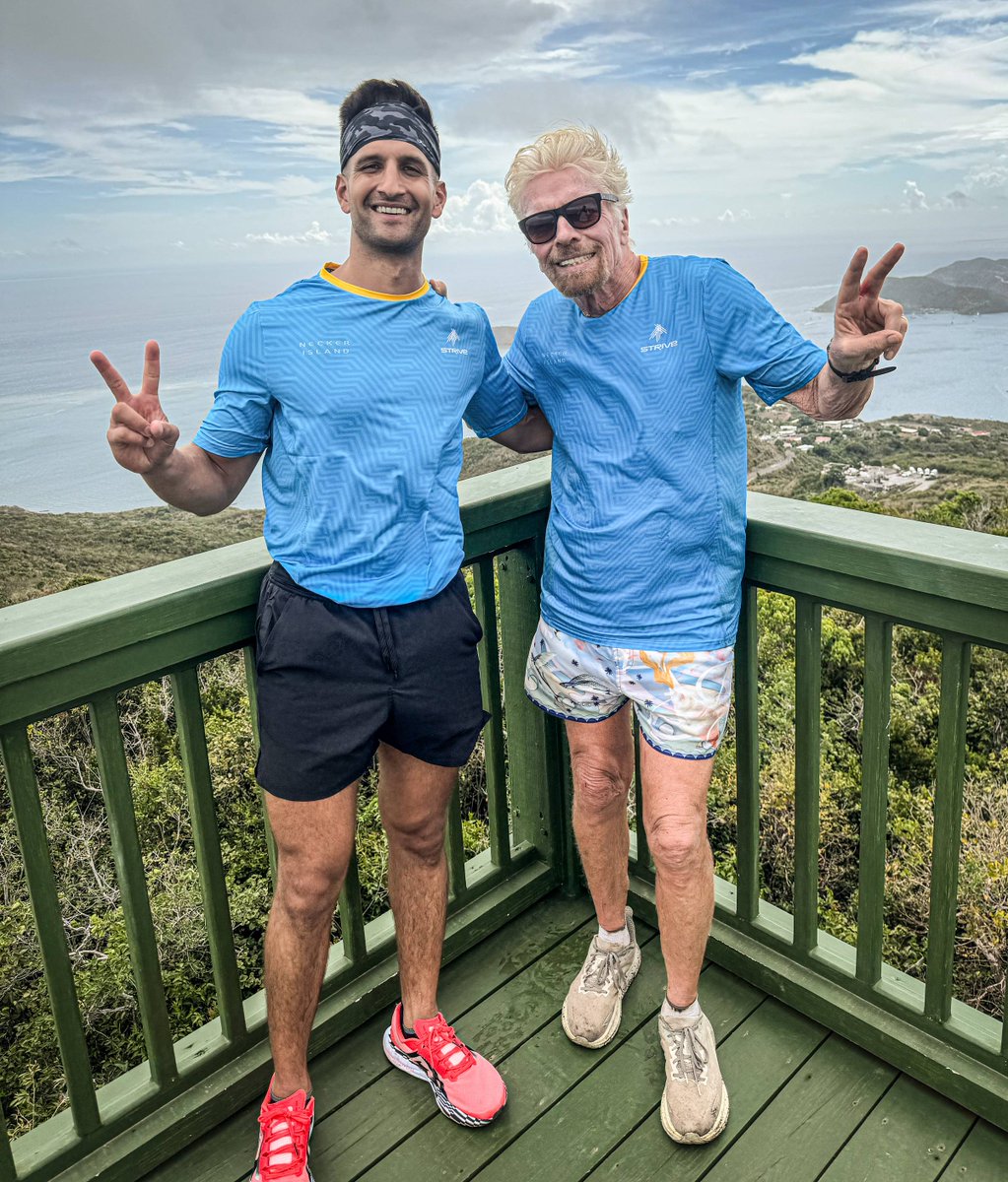
I just co-hosted a retreat with Richard Branson on Necker Island.
Here are 7 powerful learnings from the week:
(warning: long post, bookmark this)
1. You’re judged by your peaks, not your sums.
One of the highlights of the experience was getting to spend time with Adam Grant, an author whose work I have admired for more than a decade.
During a discussion he led, he talked about changing his mind on the importance of brute force hard work.
His message was simple, but powerful:
You’re judged by your peaks, not your sums.
In other words, it’s not about your sheer output, but about the quality of your output. It’s a power law.
I wrestle with this topic a lot, because part of me still thinks that focusing on sums is what allows you to increase the likelihood of producing impressive peaks.
Upon reflection, I think my model has adapted:
Create a lot at first. This allows you to refine your thinking. To earn your intuition. Then, slowly start to focus your creation on the most interesting opportunities.
Sums first, peaks later.
2. We need to look back more often.
The entire retreat was built around a series of physical challenges. The most significant was a 2 mile open water swim from Necker Island to nearby Moskito Island.
As someone who has never swam more than a couple of laps in a pool, let alone in open water, this was terrifying to me.
Once I got comfortable with the safety precautions—dozens of kayakers in the water, wearing an inflatable safety buoy—I decided to give it a shot.
After about 30 minutes of swimming, I grabbed my safety buoy and paused to take a look at my target. I felt my heart sink. It was so far away. I felt the panic set in. It was too far. I was never going to make it.
But then I turned my head and looked back. My starting place was way off in the distance behind me.
Suddenly, I felt rejuvenated. I’d made serious progress. I just had to keep going.
So, I put my head down and kept swimming. 1 hour 35 minutes later, I walked onto the beach at Moskito Island—exhausted, but thrilled.
It was a lesson for life:
If you find yourself discouraged by the daunting journey ahead, look back. You may have a long way to go, but you’ve come much farther than you realize.
When your head tells you that you’ve got nothing left, you probably have another 50% left to give if you tap into your heart. Keep going. You can do it.
3. Most people don’t know what they want.
I remember seeing this viral tweet from Naval:
"The only real test of intelligence is if you get what you want out of life."
My view is that there’s actually a more important foundational layer:
The only real test of intelligence is if you know what you want out of life.
I’m constantly blown away by how rare it is that someone can clearly articulate what they want their life to look like.
From college graduates just starting out to billionaires we write books about, very few have taken the time to answer that foundational question.
What do you want out of life?
Once you answer that, you can create a plan and take action to get there. But if you never answer the question, you may climb to the top of a mountain only to realize you never wanted to be on it in the first place.
4. Intuition is earned.
There was a lot of talk about the value of intuition in business. Not overthinking decisions. Allowing your gut to guide you in the big moments.
But one silent theme I noticed:
Very few people appreciate just how much of that intuition is honed through thousands of hours of experience.
Intuition is earned, not given.
You aren’t born with good business instinct. You build it through reps. Through showing up when nobody’s watching. Through taking action.
Anyone can become a great business decision maker, but few are willing to put in the work to make those decisions look effortless.
5. Stop doubling down on a losing hand.
Escalation of commitment is a human tendency to continue down a given path even when facing increasingly negative outcomes rather than adjusting course.
An observation on extraordinary entrepreneurs:
They avoid the trap. They cut the line. They never double down on losing hands.
In many ways, it’s about a willingness to be wrong. If you fear embarrassment, you’ll stick to a losing plan. If you embrace it, you’ll adapt.
6. Vulnerability is contagious (and breeds strength).
In a group setting with 30+ high performers, it’s easy to imagine people hiding their insecurities to try to impress others in the group.
But early in the retreat, a few people opened up to share the raw stories of their journey, struggles, and challenges.
Leading with vulnerability, rather than bravado, immediately created a ripple effect throughout the group. Everyone let their guard down. No pretenses. No masks.
We all assume that covering our insecurities is the way to be strong, but it couldn’t be further from the truth. Opening up about these insecurities breeds strength. It encourages others to do the same and brings everyone together in a web of support and love.
No one has it all figured out. We’re all struggling through this journey together. When you open up more, you start to struggle a bit better.
7. Maybe you can have it all.
I gave a talk about The 5 Types of Wealth during the retreat. The next morning, Richard Branson pulled me aside to tell me that it had him thinking about his life.
My response to him was direct:
“I think you’ve lived by these principles without having a name for it.”
He seems to have designed a life of abundance across all five types of wealth:
• Freedom to pursue interesting projects
• Deep, loving connection with his family (many of whom were there during the retreat!)
• Purpose-driven pursuits
• Health and vitality (he kicked my butt in the bike ride!)
• Financial success
While I’m sure there were times when it wasn’t perfectly in balance, he clearly never turned anything off for extended periods. He understood that anything above zero compounds. And now, he’s living the rewards of those actions.
For me, and many others, it was an inspiring example:
Maybe you can have it all.