The below is from Rocket Mortgage. Only happens because because of President TRUMP:
“Rocket Mortgage did an extensive study that helped the company determine VantageScore 4.0 opens access to some clients who wouldn't be served otherwise, and many are able to secure a mortgage on better pricing terms. For those who saved money with VantageScore 4.0, the savings was an average of $1,600 at closing. FHFA and Director Pulte are encouraging competition and innovation in pilot programs. “
@xstreamecho I am glad to see somebody openly coming out to claim their short position on $UPST, been wondering where are they hiding until now…funny how it works
I think a lot of people in the UPST community are missing one of the most important parts of the setup right now which in my view is the short position.
Latest official short interest is 27.65M shares, up another 6.6% from the prior report. That’s roughly 34% of the float, nearly 28% of all shares outstanding, and close to 7 days to cover.
What’s crazy is shorts have been adding as the stock has gone LOWER.
Aug. 14: 24.78M shares short, stock $30.43
Sept. 15: 27.65M shares short, stock $25.28
So the stock dropped about 17% and instead of taking profits, shorts added almost 3M shares.
That matters because historically with UPST, the stock has often started moving BEFORE shorts really begin covering. The covering comes later and adds fuel.
But here is what I think is even more important: The business today is fundamentally stronger than during the prior heavily shorted periods or anytime in company history.
Q2 contribution profit was a record $193M, higher than the peak in 2021 when rates were basically zero.
Unsecured Personal alone produced about $201M of contribution profit at a 62% margin.
And that happened while Auto + HELOC were STILL a drag.
Secured contribution margin:
Q2 2025: -176%
Q1 2026: -96%
Q2 2026: -35%
Management is targeting breakeven by Q4 and Paul has personally said Secured will be contributing before 2027 on X.
That is the piece I think people are sleeping on.
For years, Personal has been the profit engine carrying the investment in Auto and HELOC.
Going into 2027, that could completely change.
Personal + Auto + HELOC = 3 contribution engines
No more Auto/HELOC drag. Instead, two products that have been consuming contribution profit for years potentially start ADDING to it.
And these are no longer tiny businesses.
Auto originations were +264% YoY in Q2. Home was +139% YoY.
So this isn’t just about eliminating a small loss. It’s about turning two rapidly growing products from a drag into profit contributors.
Then add the bank.
Upstart already has conditional OCC approval for Upstart Bank. Paul has talked about the benefits: lower costs, simpler regulation, access to all 50 states, better capital efficiency and faster product development.
So potentially entering 2027 you have:
Personal profitable
Auto profitable
HELOC profitable
Upstart Bank potentially operational
All while the stock is around the mid-$20s and short interest is almost 28M shares.
Then look at what insiders are doing.
Upstart bought back $100M of stock at an average of $31.31.
Paul Gu personally bought:
50,000 shares at $27.50 in May
50,000 shares at $25.55 in September
Dave Girouard bought roughly $5M worth around $29.37.
These guys aren’t just talking. They are buying.
And this is one of the reasons I have so much confidence in Paul.
He reminds me a little of Vlad Tenev. Young, extremely smart, technical, founder mentality, and actually willing to communicate with shareholders.
Paul doesn’t come across like some corporate CEO reading prepared nonsense. He answers questions. He explains how he thinks. He talks openly about contribution profit, Secured economics, the bank, capital and where the business is going.
I appreciate that and it is RARE. I trust Paul.
I also like that he doesn’t spend all day pumping the stock. He seems focused on building the company and letting the numbers eventually speak for themselves.
That is exactly what I want from a founder/CEO.
So when I look at UPST today, I don’t just see a stock at $23-$24ish..
I see:
Record contribution profit
3 potential profit engines coming
Auto growing triple digits
HELOC scaling
Bank charter progressing
Founder/insider buying
Company buyback
~27.65M shares short
To me, that is an extremely unusual setup. Nothing is guaranteed.
But if Paul executes, there is a ton of short exposure sitting there that eventually has to make a decision.
Long 10,000 shares at 25.744 and prepared to add more. Making big money requires discomfort. @paulxgu
Tom Lee: Core PCE inflation could drop by as much as 40 basis points on September 30 due to a change in how it’s calculated😳
The Fed just hiked rates, and now its favorite inflation gauge could be revised significantly LOWER.
Extremely bullish for stocks!
One year ago, BTIG sparked mass panic surrounding Upstart $UPST arguing delinquencies (DQs) were materially rising.
They weren’t - and they haven’t. Two days later, the analyst walked back on his comments but the damage to the stock was already done.
Why bring this up? @paulxgu I don’t think the sell-side is on your team. UPST lacks vocal institutional support, and there are many of these ‘mini events’ that explain the perception gap of your stock - it’s not just retail holders upset with price action.
Of course that’s just my opinion, but think about how many of the analysts said you were toast a few years ago. I get that’s the business but it doesn’t sit right with me.
There's been a lot of chatter about Upstart $UPST President, Capital & Enterprise (former CFO) Sanjay Datta and his recent 'insider selling' - but the truth is more nuanced.
When Upstart went public, the S-1 (registration statement) revealed the outstanding equity awards for the named executive officers. Focusing on Sanjay, you can see that he was granted two option awards on December 28, 2016 (image one).
The first was the right to acquire up to 650,907 shares (474,619 + 176,288) once vested at a price of $1.35, and the second was the right to acquire 100,139 shares (60,500 + 39,639) once vested at $1.35 - with both options set to expire on December 28, 2026 (this year). The first vested 25% on January 1, 2018, the second on July 1, 2018, both monthly thereafter.
There are two kinds of stock options. Incentive Stock Options (ISOs) and Non-Qualified Stock Options (NSOs). The two have big differences in tax treatment. ISOs - you do not pay regular income tax when you exercise (buy the shares). If you hold them for the required time, your entire profit is taxed at a lower capital gains rate. NSOs - you pay regular income tax on your profit the exact moment you buy the shares (the spread between the current price and the grant price). Once exercised, your cost basis then equals fair market value at exercise (strike price paid plus income recognized).
I am going to assume that at least the larger of the two of Sanjay's grants was almost certainly an NSO, meaning he owes tax on the difference immediately upon exercise (his expiration date is December of this year, exercised in September). The tax code caps ISOs at $100,000 of stock (valued at the grant date) becoming exercisable in any one calendar year. Sanjay's two grants vested much more than that in 2018 alone, so by law most of them have to be NSOs (at least that's my thinking).
On September 8th, 2026 - Sanjay exercised a portion of these options representing 300,000 shares of the 650,907 granted (46.1%) acquiring the shares at $1.35 for ~$405,000. Sanjay then subsequently sold 116,000 shares (of the 300,000, 38.7%) on the open market for ~$27.29, a total sale of ~$3.17M.
Exercising isn't free. Sanjay had to pay the $405,000 to acquire the shares, and with it likely being an NSO, he owes tax on the spread between $27.29 and $1.35 = $25.94 x 300,000 shares = $7.78M of taxable ordinary income.
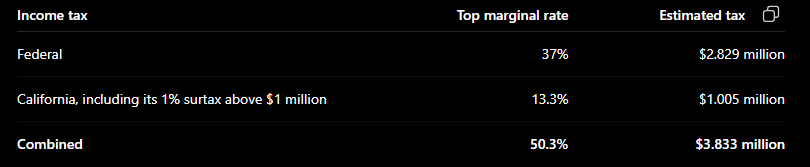
That $7.78M is going to be taxed as ordinary income at his marginal rate. Assuming he's already in the highest Federal Tax Bracket (37% - impressive Sanjay), and assuming he lives in California, another 13.3% (image two). So, in total, Sanjay will owe ~50.3% of tax against the $7.78M in ordinary income, or ~$3.9M. Add in the $405K it cost to exercise the options, and total out-of-pocket cash for Sanjay I estimate at ~$4.3M.
The 116,000 shares Sanjay sold at $27.29/share brought in ~$3.17M. That leaves a ~$1.13M potential cash deficit that Sanjay potentially paid out of pocket (or will come tax season). He may have been able to fund this with previous planned sales earlier this year. Considering I am not his CPA, I'm not entirely sure lol.
Sanjay had the ability to sell more than the 116,000 shares to satisfy these tax obligations - and he chose not to do so (at least yet). If he wanted out, the obvious move would have been to sell all the 300,000 shares. It's also important to note that if Sanjay did not exercise the options, they would expire worthless.
Now, Sanjay has been a frequent seller of UPST in the past - mostly through pre-scheduled 10b5-1 plans (though not all). Throughout 2023 to 2024, Sanjay was selling 1,000-3,000 shares or so weekly. Shares of UPST more than doubled from the summer of 2024 into early 2025 - so the selling wasn't indicative of lackluster business results.
Narrative always follows price. That's not to say UPST is immune from criticism (they certainly aren't) - but it's simply not true that Sanjay's recent Form 4 activity is indicative of an executive racing for the exits. I'm not claiming my math here is 100% correct, but I think it is accurate directionally.
I of course probably have bias to look for the positives in UPST as both I, and my firm, are long the stock - so please keep that in mind - but I am not concerned about Sanjay's Form 4. The insider buying from Gu and Dave is more of the signal imo.
I went through EVERY Fed rate hike since 1994 to see what the S&P 500 actually did afterward.
Not the last 5. Not the last 10.
Every single one. 51 rate hikes.
For each hike, I took the $SPX CLOSE on FOMC day and measured the largest decline to the lowest CLOSE over the following 5 trading days.
No intraday lows. No cherry picking.
Here are all 51 ⬇️
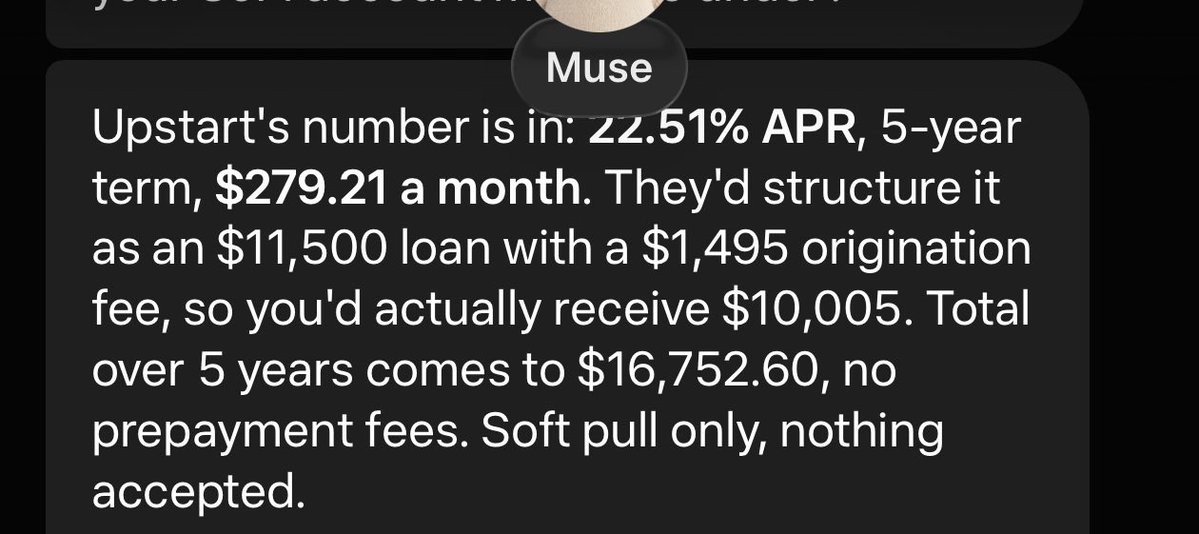
@HenryInvests@JosephDevoy@Muse Already works okay out of the box. But yes we 100% will support a world that makes it easier for every consumer to find the lowest rate for them
1/6: Is $UPST one of the most interesting AI turnaround stories nobody's talking about?
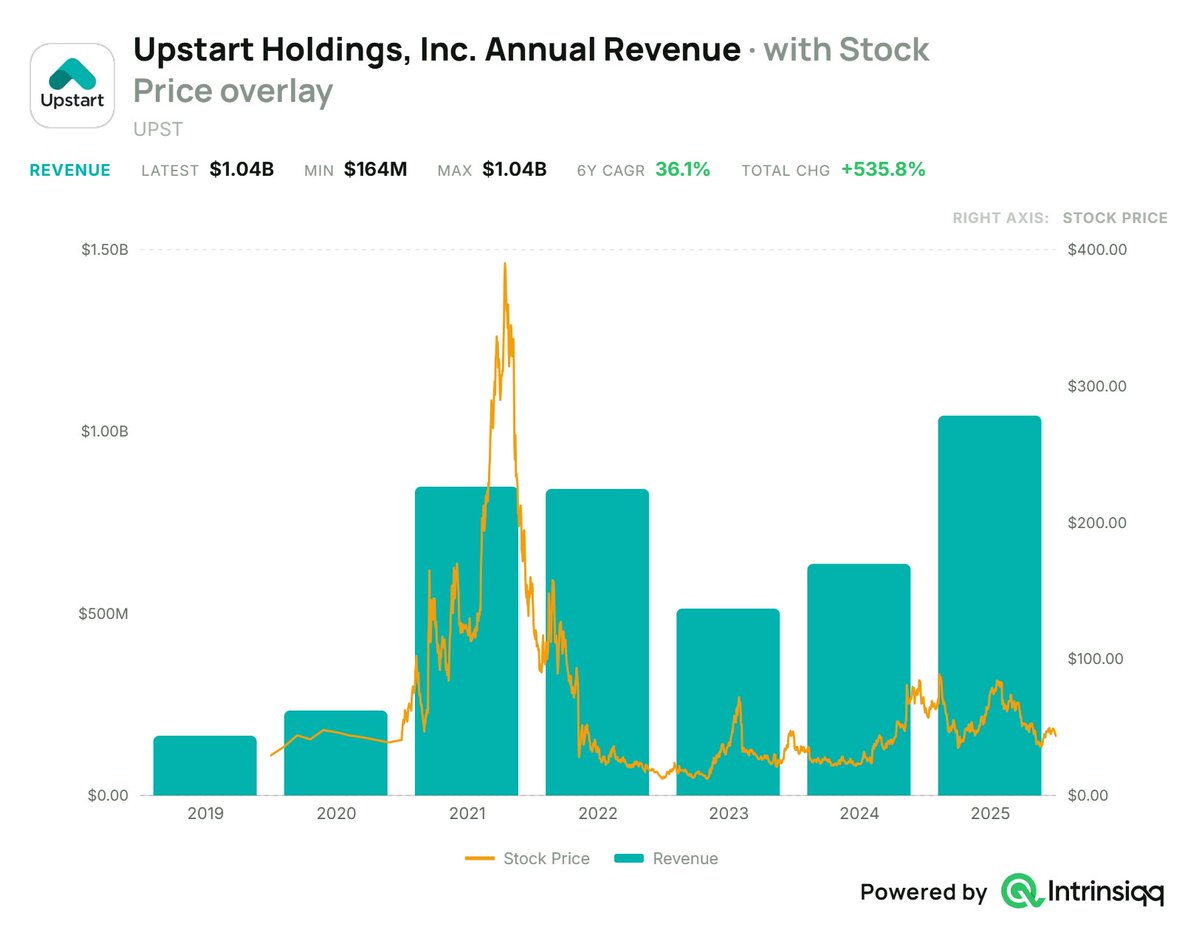
Revenue went from $164M to $1.04B - that's about 6.3x growth, and the business is still accelerating.
The stock, though? That's where things get interesting.
@goddreng10@CaptTweetz@Mo7e8u Paul clarified that they are loading review page faster resulting in more reviews but directionally it is still trending at all time high..only the baseline shifted after Aug..the volume is still looking good