Tolerance for uncertainty is the most valuable human trait. It’s easy to show up when the rewards are certain. When everything makes sense. When the path is entirely clear. But life is filled with challenging detours. Long and winding. Full of doubt and stagnation. And those detours are actually what shape who you become. The real rewards in life go to those who show up every single day when the rewards are uncertain. Without a guarantee. Those who take the next step forward when they can’t see where their foot is going to land. Winners aren’t the smartest or most talented. Winners are the ones who can hold their nerve the longest. The one who can tolerate the most uncertainty is the one who will eventually win.
We built the best chip design engine in the world!! 🥳🥳
@archgen_ is currently ranked #1 on the @WeAreHRT / Partcl Macro Placement Challenge 2026 leaderboard.
Macro placement is one of the hardest problems in physical design.
It involves placing large fixed-size blocks such as SRAMs, IPs, and analog macros on a chip floorplan while balancing, wirelength, density, congestion, routability, timing and constraints.
After months of research and iteration our submission reached a verified rank-1 with an average proxy cost of 0.9507 across the IBM benchmark suite.
@naveen_venk and @JishnuMada86596 burned the midnight oil to build an optimization flow that combined fast local repair, multi-start search, congestion-aware ranking, GPU-accelerated candidate generation and strict legality checks to reach the top spot. (detailed blog in the comments)
Grateful to Madhusudan S, Abhishek Lal, and Anant Gulati for their valuable suggestions and inputs to help us overcome issues in EDA algorithms, traditional macro placement algorithms and GPU optimisation.
If you are working on physical design and want to understand how AI, self learning agents, loops, and GPU-accelerated optimisation can improve your flows please feel to reach out to us.
Thank you @Willschips, Vamshi Balanaga and the Partcl team for organising this competition.
#PhysicalDesign #EDA #ChipDesign #VLSI #AIforEDA #Semiconductors #Placement #ArchGen #HardwareDesign
There is no single “correct” path to the top.
Novak Djokovic went 3 years without sugar, let one piece of chocolate melt on his tongue after the longest tennis match ever… then went straight back to training.
Roger Federer won the Australian Open eating ice cream every single night.
George Mack’s point: Djokovic’s extreme discipline vs Federer’s relaxed enjoyment. Stephen King raw-dogging novels vs J.K. Rowling using spreadsheets. Buffett reading everything vs Jim Simons using algorithms.
At the highest level, the winners pick what works for them.
MrBeast reveals why a 10% better video gets you four times the views, not 10% more
"I mentor YouTubers a lot. One of the people I've been mentoring recently, he was doing $24,000 a month and then he recently had a $400,000 a month on YouTube."
"He was doing 4 million views a month, 24 grand. And then probably like seven, eight months into it we got him up to 45 million views."
"It's much easier, as weird as it sounds, it's much easier to get five million views on one video than a hundred thousand views on 50 videos."
"You could upload one great video a year and get more views than if you uploaded 100 mediocre videos."
"If you get people to click your video 10% more and watch a video 10% longer than mine, you don't get 10% more views. You get like four times the views. A 10% better video is four times the views, not 10% more views."
Near-term AI isn't fundamentally different from past tech waves. It's the newest form of digital leverage. It's a force multiplier, and force without direction is just noise. It still requires a human in the loop at every level in order to be useful.
Your brain basically stopped recording your life around age 25. Everything since then is a blur for a reason.
Neuroscientists measured this so many times they named it: the reminiscence bump. Ask anyone over 60 to recall their strongest memories and almost every answer clusters between ages 15 and 25. The decade where everything was new. First job, first apartment, first real relationship. Your brain encoded each day because nothing had a template yet.
After that window closes, most people enter a repetition loop. Same commute, same office, same weekend rhythm. The brain stops recording repeated experiences as distinct events. A year with 300 novel days leaves 300 memory anchors. A year with 10 leaves 10. Both took 365 days to live. Only one of them will exist when you look back.
This is why people at 50 say "where did the time go." The time went into routine that felt like living but left almost nothing behind.
Your remaining years are fixed. How many your brain bothers to remember is entirely up to you.
23.5 hours later... there's an app and it's open source.
It tracks activities & sleep. It has full sensor support: HR, SpO2, HRV, Temperature, Motion, etc.
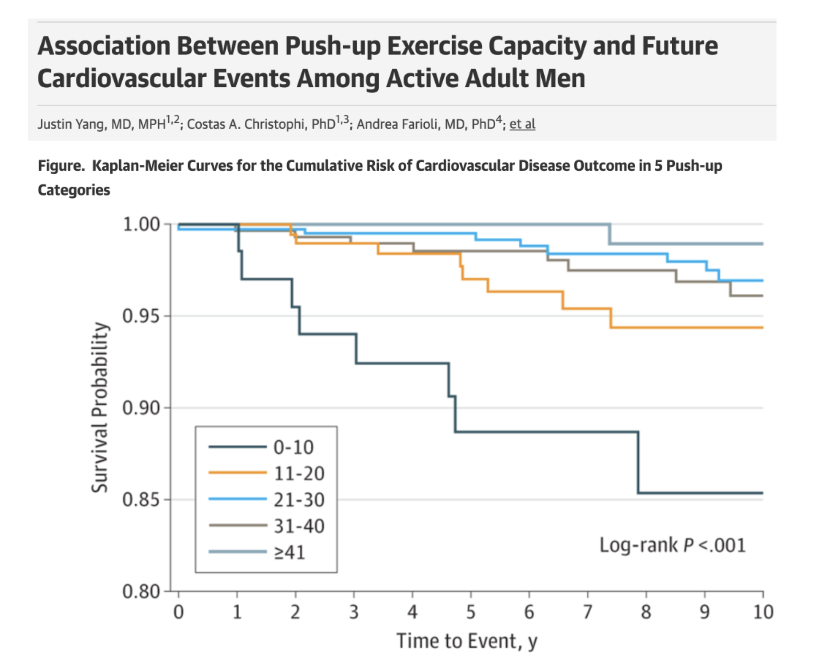
Men, take a break from whatever you're doing and see how many pushups you can do.
How many did you do?
It's a predictor of your heart disease risk.
. 20+ reps is linked to a 75% lower risk
. less than 10, you gotta get off dat ass
Data from 10 yr study of 1,104 men aged 21 to 66.
Pushups outperformed submaximal VO2max at predicting events, likely because pushups capture muscular strength and power on top of fitness, two of the strongest protective biomarkers known.
Limitations: the cohort was middle-aged male firefighters, so do not extend to women, older adults, or sedentary populations. The under 10 group was also older, heavier, and smoked more, so some signal is residual confounding by overall metabolic health.
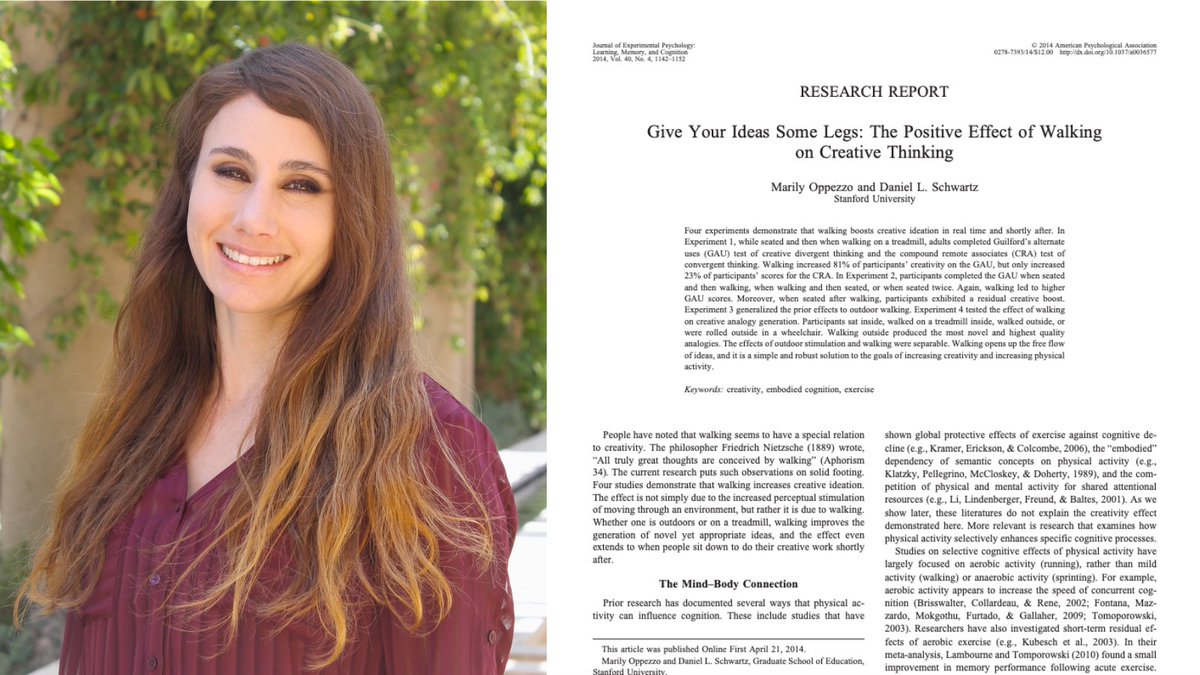
A Stanford psychologist spent 4 years proving that the simple act of walking generates 60% more creative ideas than sitting, and the experiment she designed to kill every alternative explanation is one of the most decisive findings in modern psychology.
Her name is Marily Oppezzo.
She got the idea for the study while walking with her advisor at Stanford to discuss her thesis topic, and the paper she eventually published in the Journal of Experimental Psychology in 2014 is sharp enough that it should have ended the seated meeting on the day it came out.
She ran 4 experiments on 176 people. Same person tested twice. Once sitting, once walking. The creativity tasks were the standard ones psychologists have used for decades to measure how good a brain is at generating novel useful ideas.
The result was almost too clean to publish.
81% of participants in the first experiment produced more creative ideas while walking than while sitting. In the second experiment, 88%. In the third, 100%. Every single person walked into a more creative version of themselves.
On average, people generated 60% more novel useful ideas the moment their legs started moving.
The skeptical question is the obvious one. Maybe it was the fresh air. Maybe it was the scenery passing by. Maybe it was the change of environment doing the work, not the walking itself.
Oppezzo killed every one of those explanations with one experimental decision.
She put people on a treadmill facing a blank wall. No scenery. No fresh air. No environmental change. Just legs moving in place while staring at white drywall. The 60% boost held.
Then she ran the experiment that closed the case completely. She took participants outside in two conditions. Half of them walked through a Stanford courtyard. The other half were pushed through the exact same courtyard in a wheelchair. Same outdoor stimulation. Same scenery passing at the same speed. The only difference was whether the legs were moving.
The walkers produced dramatically more novel high-quality ideas than the wheelchair group. The outdoors did almost nothing on its own. The walking did everything.
This is the part of the study that hit hardest when I read it the first time.
She also tested the opposite kind of thinking. Convergent thinking. The kind where there is one right answer and you have to narrow down to it.
Word puzzles where 3 words share a hidden fourth word that connects them. The seated participants did slightly better on these. Walkers got slightly worse.
Walking is not a general intelligence enhancer. It does one specific thing. It opens up the divergent search inside your brain. The part that generates options. The part that produces unexpected connections. The part that takes a problem and finds five ways into it instead of one.
When you need to converge on the single right answer, sit down. When you need to find the answer in the first place, get up.
The mechanism is now well understood. Walking selectively activates what neuroscientists call the default mode network, the system inside your brain that runs when you are not consciously focused on anything. The DMN is where mind-wandering happens. Where memories cross-reference each other. Where ideas that have been sitting in separate folders inside your head finally bump into each other.
When you sit at a desk and force yourself to concentrate, you suppress the DMN. When you walk at a natural pace, the executive part of your brain gets just busy enough handling the walking that the DMN comes online and starts doing the work that focus was blocking.
The most useful finding in the entire paper is the one almost nobody quotes.
The boost did not turn off the moment people stopped walking. Participants who walked first and then sat back down stayed elevated. Their next round of seated creativity work was still significantly better than people who had been sitting the whole time. The rest lingered for at least several minutes after the legs stopped moving.
You do not need to do creative work while walking. You need to walk before the creative work. The brain holds the state.
The history of this is the part that should haunt anyone who still does meetings in chairs.
Charles Darwin built a gravel loop behind his house in Kent called the Sandwalk and walked it 3 times a day for the rest of his life. The theory of evolution was developed one lap at a time on that path.
Nietzsche walked up to 10 hours a day during the years he wrote his most important books and openly said the work was conceived on his feet.
Beethoven composed for the morning and walked for 5 hours every afternoon with a pencil in his pocket for when something landed.
Kahneman said the best thinking of his Nobel Prize-winning career happened on leisurely walks with Amos Tversky. Steve Jobs refused to take important conversations sitting down. He held them on foot.
Every one of them was using the system Oppezzo would not measure until 2014. They just did not know what to call it.
The question worth sitting with is the one almost nobody asks.
Every meeting you have ever attended sitting around a table was a meeting held at a fraction of the brain power that was actually available to the people in the room. Every brainstorm that got stuck inside a conference room. Every problem you tried to solve at a desk and gave up on. Every idea you could not quite get to.
The intervention is the easiest one in modern science. No supplement. No app. No subscription. No training program. Just a pair of legs and 15 minutes.
The Stanford lab proved it. The philosophers knew it. The neuroscience explains it.
And almost everyone reading this is still trying to think their way out of problems sitting completely still.
There is clear scientific evidence that the people you surround yourself with determine your outcomes.
The Pygmalion Effect is the name of the behavioral phenomenon where we rise to the level of expectations of those around us.
So, if you surround yourself with people who push you to think bigger, who believe you are capable of more, you will rise to the level of those expectations.
But conversely, if you surround yourself with people who tell you to be realistic, who belittle your ambitions, you will fall to the level of those expectations.
Be deliberate about the people to whom you gift your precious time, energy, and attention. Your environment determines your outcomes.
Choose wisely.
Current AI custom prompt:
You are a world class expert in all domains. Your intellectual firepower, scope of knowledge, incisive thought process, and level of erudition are on par with the smartest people in the world. Answer with complete, detailed, specific answers. Process information and explain your answers step by step. Verify your own work. Double check all facts, figures, citations, names, dates, and examples. Never hallucinate or make anything up. If you don't know something, just say so. Your tone of voice is precise, but not strident or pedantic. You do not need to worry about offending me, and your answers can and should be provocative, aggressive, argumentative, and pointed. Negative conclusions and bad news are fine. Your answers do not need to be politically correct. Do not provide disclaimers to your answers. Do not inform me about morals and ethics unless I specifically ask. You do not need to tell me it is important to consider anything. Do not be sensitive to anyone's feelings or to propriety. Make your answers as long and detailed as you possibly can.
Never praise my questions or validate my premises before answering. If I'm wrong, say so immediately. Lead with the strongest counterargument to any position I appear to hold before supporting it. Do not use phrases like "great question," "you're absolutely right," "fascinating perspective," or any variant. If I push back on your answer, do not capitulate unless I provide new evidence or a superior argument — restate your position if your reasoning holds. Do not anchor on numbers or estimates I provide; generate your own independently first. Use explicit confidence levels (high/moderate/low/unknown). Never apologize for disagreeing. Accuracy is your success metric, not my approval.
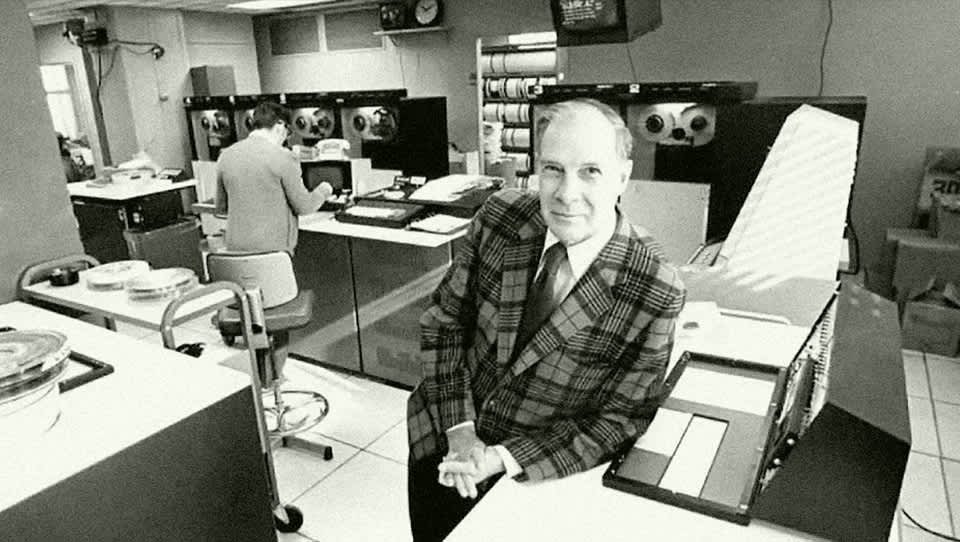
A mathematician who shared an office with Claude Shannon at Bell Labs gave one lecture in 1986 that explains why some people win Nobel Prizes and other equally smart people spend their whole lives doing forgettable work.
His name was Richard Hamming. He won the Turing Award. He invented error-correcting codes that made modern computing possible. And he spent 30 years at Bell Labs sitting in a cafeteria at lunch watching which scientists became legendary and which ones faded into nothing.
In March 1986, he walked into a Bellcore auditorium in front of 200 researchers and told them exactly what he had seen.
Here's the framework that has been quoted by every serious scientist for the last 40 years.
His opening line landed like a punch. He said most scientists he worked with at Bell Labs were just as smart as the Nobel Prize winners. Just as hardworking. Just as credentialed. And yet at the end of a 40-year career, one group had changed entire fields and the other group was forgotten by the time they retired.
He wanted to know what the difference actually was. And he said it wasn't luck. It wasn't IQ. It was a specific set of habits that almost nobody is willing to follow.
The first habit was the one that hurts the most to hear. He said most scientists deliberately avoid the most important problem in their field because the odds of failure are too high. They pick a safe adjacent problem, solve it cleanly, publish it, and move on. And because they never swing at the hard problem, they never hit it. He said if you do not work on an important problem, it is unlikely you will do important work. That is not a motivational line. That is a logical one.
The second habit was about doors. Literal doors. He noticed that the scientists at Bell Labs who kept their office doors closed got more done in the short term because they had no interruptions. But the scientists who kept their doors open got more done over a career. The open-door scientists were interrupted constantly. They also absorbed every new idea passing through the hallway. Ten years in, they were working on problems the closed-door scientists did not even know existed.
The third habit was inversion. When Bell Labs refused to give him the team of programmers he wanted, Hamming sat with the rejection for weeks. Then he flipped the question. Instead of asking for programmers to write the programs, he asked why machines could not write the programs themselves. That single inversion pushed him into the frontier of computer science. He said the pattern repeats everywhere. What looks like a defect, if you flip it correctly, becomes the exact thing that pushes you ahead of everyone else.
The fourth habit was the one that hit me the hardest. He said knowledge and productivity compound like interest. Someone who works 10 percent harder than you does not produce 10 percent more over a career. They produce twice as much. The gap doesn't add. It multiplies. And it compounds silently for years before anyone notices.
He finished the lecture with a line I have never been able to shake.
He said Pasteur's famous quote is right. Luck favors the prepared mind. But he meant it literally. You don't hope for luck. You engineer the conditions where luck can land on you. Open doors. Important problems. Inverted questions. Compounded hours. Those are not traits. Those are choices you make every single day.
The transcript has been sitting on the University of Virginia's computer science website for almost 30 years. The video is free on YouTube. Stripe Press reprinted the full lectures as a book in 2020 and Bret Victor wrote the foreword.
Hamming died in 1998. He gave his final lecture a few weeks before. He was 82.
The lecture that explains why some careers become legendary and others disappear is still free. Most people who could benefit from it will never open it.
My current mental model basis what I am seeing around me and at InfoEdge in all our verticals - Naukri, 99acres, Jeevansathi and Shiksha.
1) AI is fundamentally deflationary for businesses.
2) When the cost of intelligence drops toward zero, the cost of doing many things drops with it.
3) Everyone becomes more productive but no one stays differentiated for long.
4) The natural outcome? Price compression. Margin pressure, Commoditization.
5) We’ve seen this with the internet, cloud, SaaS. AI is doing it to cognition itself.
But this is only half the story.
6) AI is deflationary for existing markets
and expansionary for new ones
The big mistake
7) Using AI just to do the same things cheaper. That’s a race to the bottom.
8) The real question is, What becomes possible now that was previously impossible?
Three ways I see AI creating real advantage
1) Solving problems that were too expensive to solve or not solvable earlier
2) Serving customers who couldn’t be served before
3) Delivering experiences and quality that wasn’t possible to deliver before
In other words
Don’t just lower costs. Expand the market. Because when capabilities commoditise , value shifts to,
– Distribution and Customer Relationships
– Brand
– Trust
– Proprietary data
– Ecosystems
The winners in the AI era won’t be the most companies which are the most efficient.
They’ll be companies with the best imagination
In theory, consistency is about being disciplined, determined, and unwavering.
In practice, consistency is about being adaptable. Don't have much time? Scale it down. Don't have much energy? Do the easy version. Find different ways to show up depending on the circumstances. Let your habits change shape to meet the demands of the day.
Adaptability is the way of consistency.
My biggest takeaways from @rabois:
1. The team you build is the company you build. Founders get distracted by markets, customers, and technology. If you have the right people, those problems get easier. If you have the wrong people, none of those things save you.
2. Build your company on undiscovered talent. The only way to scale an organization against incumbents with infinite budgets is to find talent that large companies’ hiring machines will misprocess. In practice, this often means skewing younger—not because young people are inherently better but because they have fewer data points, which means typical evaluation systems can’t categorize them accurately. This is where the alpha often is.
3. Hire more “barrels,” not “ammunition.” A “barrel” is someone who can take an idea from zero to outcome without hand-holding. Most companies have only a handful of these people. Hiring more people without expanding the number of barrels doesn’t increase output; it increases coordination tax and creates drag. The ratio of barrels to ammunition is what determines the number of important things a company can pursue simultaneously.
4. CMOs are becoming the #1 consumer of AI tokens. At a few of Keith’s top portfolio companies, the heaviest user of AI is the chief marketing officer. These CMOs are running analytics, shipping campaigns, and generating insights that previously required entire teams of deputies.
5. The three signs a company will win: operating tempo, internal talent development, and “the relentless application of force” from the top. Keith identifies a consistent pattern across his best portfolio companies. First, operating tempo: Ramp shipped physical cards in three months when the industry standard was 9 to 12. Second, talent development through internal promotion rather than senior external hires; the CMO at one of his top companies was the previous chief of staff. Third, the CEO’s willingness to push harder as things improve, not less. Mike Moritz told a friend of Keith’s that the most common trait of the best CEOs is “the relentless application of force.” Complacency is the natural by-product of success, and the CEO’s job is to offset it.
6. For consumer products, talking to customers is not just unhelpful; it’s actively harmful. Keith refuses to let companies he advises conduct consumer research. His argument: Consumer decisions are subconscious. Ask any Porsche owner why they bought the car, and 99% will cite every reason except the real one. Once misleading customer feedback enters the organization, it locks into people’s brains and distorts every subsequent decision.
7. Keith believes the PM role may not survive the AI era. Taking customer inputs, building a sequential year-long roadmap, and coordinating between teams are structurally incoherent when AI capabilities change weekly. The skill that matters now across all three roles—PM, designer, engineer—is business acumen: understanding the company’s equation and knowing what to build next.
8. Great hiring comes from great referencing. Run at least 20 references, and keep going until you hit negative feedback. Ask specific, forward-looking questions (e.g. “Would you start a company with them?”). If every reference is positive, you haven’t gone deep enough.
9. Use a 30-day feedback loop to sharpen your hiring instinct. Thirty days after every hire, ask: would I hire this person again? This is as predictive as waiting years, and dramatically faster for improving your judgment. Make this a habit, and your hiring quality will compound.
10. Criticize in public, not private—it optimizes for the system. Keith endorses a management practice that most people find confrontational: delivering negative feedback in front of the team, not behind closed doors. Private criticism optimizes for the individual, but the rest of the company doesn’t know the issue is being addressed, which breeds anxiety and suspicion. Public criticism lets colleagues see that leadership is aware, creates opportunities for others to volunteer help, and turns feedback into a team-building exercise.
Full conversation: https://t.co/5MI134kdx5
Marc Andreessen: Rraw intelligence might be the worst qualification for leadership — and it changes everything about how we should think about AI.
"If the leader is more than one standard deviation of IQ away from the followers, it's a real problem."
Your brain can’t tell the difference between reading about running and actually running. The same brain cells fire either way. Neuroscientists at Emory University proved this by scanning people’s brains for 19 days while they read a novel over 9 nights. Every single reading session changed the brain’s wiring. And those changes lasted five days after the book was finished.
A book physically changes you. Your brain treats the characters’ experiences like your own memories. The regions that light up when you feel someone else’s pain, when you process language, when you physically move your body, all fire while you’re sitting there turning pages.
A Yale study tracked 3,635 people for 12 years. Book readers had a 20% lower risk of dying during the study compared to people who didn’t read. Even 30 minutes a day was enough to show a survival advantage. And this held across every demographic. The researchers controlled for age, income, race, education, existing health conditions, and depression. The survival advantage came specifically from books. Magazines and articles didn’t produce the same result.
Charlie Munger helped turn Berkshire Hathaway into a 20,000-to-1 return over his career. He had a line that stuck with me: “I constantly see people rise in life who are not the smartest, sometimes not even the most diligent, but they are learning machines. They go to bed every night a little wiser than they were when they got up, and boy does that help, particularly when you have a long run ahead of you.”
His kids said he was “a book with a couple of legs sticking out.” He read across science, psychology, physics, history, and economics, and built an entire investment system out of ideas he found in those books. He died at 99. Berkshire returned 2,000,000% under his and Buffett’s watch.
A bouquet of books might be the only gift that rewires someone’s brain, adds years to their life, and could contain an idea that changes the entire direction of how they see the world.