Continuing the journey of optimal LLM-assisted coding experience. In particular, I find that instead of narrowing in on a perfect one thing my usage is increasingly diversifying across a few workflows that I "stitch up" the pros/cons of:
Personally the bread & butter (~75%?) of my LLM assistance continues to be just (Cursor) tab complete. This is because I find that writing concrete chunks of code/comments myself and in the right part of the code is a high bandwidth way of communicating "task specification" to the LLM, i.e. it's primarily about task specification bits - it takes too many bits and too much latency to communicate what I want in text, and it's faster to just demonstrate it in the code and in the right place. Sometimes the tab complete model is annoying so I toggle it on/off a lot.
Next layer up is highlighting a concrete chunk of code and asking for some kind of a modification.
Next layer up is Claude Code / Codex / etc, running on the side of Cursor, which I go to for larger chunks of functionality that are also fairly easy to specify in a prompt. These are super helpful, but still mixed overall and slightly frustrating at times. I don't run in YOLO mode because they can go off-track and do dumb things you didn't want/need and I ESC fairly often. I also haven't learned to be productive using more than one instance in parallel - one already feels hard enough. I haven't figured out a good way to keep CLAUDE[.]md good or up to date. I often have to do a pass of "cleanups" for coding style, or matters of code taste. E.g. they are too defensive and often over-use try/catch statements, they often over-complicate abstractions, they overbloat code (e.g. a nested if-the-else constructs when a list comprehension or a one-liner if-then-else would work), or they duplicate code chunks instead of creating a nice helper function, things like that... they basically don't have a sense of taste. They are indispensable in cases where I inch into a more vibe-coding territory where I'm less familiar (e.g. writing some rust recently, or sql commands, or anything else I've done less of before). I also tried CC to teach me things alongside the code it was writing but that didn't work at all - it really wants to just write code a lot more than it wants to explain anything along the way. I tried to get CC to do hyperparameter tuning, which was highly amusing. They are also super helpful in all kinds of lower-stakes one-off custom visualization or utilities or debugging code that I would never write otherwise because it would have taken way too long. E.g. CC can hammer out 1,000 lines of one-off extensive visualization/code just to identify a specific bug, which gets all deleted right after we find it. It's the code post-scarcity era - you can just create and then delete thousands of lines of super custom, super ephemeral code now, it's ok, it's not this precious costly thing anymore.
Final layer of defense is GPT5 Pro, which I go to for the hardest things. E.g. it has happened to me a few times now that I / Cursor / CC are all stuck on a bug for 10 minutes, but when I copy paste the whole thing to 5 Pro, it goes off for 10 minutes but then actually finds a really subtle bug. It is very strong. It can dig up all kinds of esoteric docs and papers and such. I've also used it for other meatier tasks, e.g. suggestions on how to clean up abstractions (mixed results, sometimes good ideas but not all), or an entire literature review around how people do this or that and it comes back with good relevant resources / pointers.
Anyway, coding feels completely blown open with possibility across a number of "kinds" of coding and then a number of tools with their pros/cons. It's hard to avoid the feeling of anxiety around not being at the frontier of what is collectively possible, hence random sunday shower of thoughts and a good amount of curiosity about what others are finding.
Why can AIs code for 1h but not 10h?
A simple explanation: if there's a 10% chance of error per 10min step (say), the success rate is:
1h: 53%
4h: 8%
10h: 0.002%
@tobyordoxford has tested this 'constant error rate' theory and shown it's a good fit for the data
chance of success declines exponentially
AI PROMPTING → AI VERIFYING
AI prompting scales, because prompting is just typing.
But AI verifying doesn’t scale, because verifying AI output involves much more than just typing.
Sometimes you can verify by eye, which is why AI is great for frontend, images, and video. But for anything subtle, you need to read the code or text deeply — and that means knowing the topic well enough to correct the AI.
Researchers are well aware of this, which is why there’s so much work on evals and hallucination.
However, the concept of verification as the bottleneck for AI users is under-discussed. Yes, you can try formal verification, or critic models where one AI checks another, or other techniques. But to even be aware of the issue as a first class problem is half the battle.
For users: AI verifying is as important as AI prompting.
So I vibe-coded a new web app over the last several days. (It's cool and it works! I will share the details later.)
As you know, because you've been following me long enough, the next step after you get a vibe-coded MVP is to show the code to an LM, tell it that the code was written by a cheap amateur coder, and ask to analyze the architectural flaws and propose a refactoring strategy.
I asked Gemini 2.5 Pro and Claude Opus 4, and then I showed one's proposal to the other and vice versa and told that I've got these from "an expert".
So, Gemini said that Claude's proposal was much stronger and more strategic and said, "Trust this expert, they know their stuff."
Claude looked at Gemini's proposal and said that "Yeah, a couple of points this expert made make sense, but he missed most of the critical items I identified."
I read both and agree that Claude's refactoring looked like a $50,000 job, while Gemini's was like your buddy coder took a look at your little craft over a beer.
I now always use two or even three models in parallel for both coding and refactoring.
What makes software development (and engineering) *really* hard instead is:
- Building the right thing (and knowing what this is)
- Coding yourself into a corner (common for juniors - and now also for AI!)
- Architecture
- Tech maturity & risks that come with it
- Testing
- Maintenance
- Migrations
- Real-world edge cases
- Non-functional requirements: eg latency, performance, cost of operations, security
- Compliance
- Tech debt
... and most importantly: people!! (collaboration, conflicts, ownership etc etc)
What makes software development (and engineering) *really* hard instead is:
- Building the right thing (and knowing what this is)
- Coding yourself into a corner (common for juniors - and now also for AI!)
- Architecture
- Tech maturity & risks that come with it
- Testing
- Maintenance
- Migrations
- Real-world edge cases
- Non-functional requirements: eg latency, performance, cost of operations, security
- Compliance
- Tech debt
... and most importantly: people!! (collaboration, conflicts, ownership etc etc)
"Chatting" with LLM feels like using an 80s computer terminal. The GUI hasn't been invented, yet but imo some properties of it can start to be predicted.
1 it will be visual (like GUIs of the past) because vision (pictures, charts, animations, not so much reading) is the 10-lane highway into brain. It's the highest input information bandwidth and ~1/3 of brain compute is dedicated to it.
2 it will be generative an input-conditional, i.e. the GUI is generated on-demand, specifically for your prompt, and everything is present and reconfigured with the immediate purpose in mind.
3 a little bit more of an open question - the degree of procedural. On one end of the axis you can imagine one big diffusion model dreaming up the entire output canvas. On the other, a page filled with (procedural) React components or so (think: images, charts, animations, diagrams, ...). I'd guess a mix, with the latter as the primary skeleton.
But I'm placing my bets now that some fluid, magical, ephemeral, interactive 2D canvas (GUI) written from scratch and just for you is the limit as capability goes to \infty. And I think it has already slowly started (e.g. think: code blocks / highlighting, latex blocks, markdown e.g. bold, italic, lists, tables, even emoji, and maybe more ambitiously the Artifacts tab, with Mermaid charts or fuller apps), though it's all kind of very early and primitive.
Shoutout to Iron Man in particular (and to some extent Start Trek / Minority Report) as popular science AI/UI portrayals barking up this tree.
No shit. This is why all the “Can the AI really think?” arguments are moot. Humans hallucinate all the time, yet we create systems that collectively have enough real world efficacy. We are now building similar systems for AI.
Geoffrey Hinton says the more we understand how AI and the brain actually work, the less human thinking looks like logic.
We're not reasoning machines, he says. We're analogy machines. We think by resonance, not deduction.
“We're much less rational than we thought.”
@psyf01 Not so sure, will LLMs to inculcate curiosity and critical thinking? Sometimes it helps to not have a ready answer, especially during formative years.
We already observe large scale trends of social media native kids have a negative edge. LLMs might have a similar effect.
It’s not far before AI builds the whole app. But what brought all the attention? It was that @levelsio built it and he has a great story behind the product. Can AI bots build stories around themselves over time?
✨ https://t.co/UVJczDtWZ5 has now gone from $0 to $1 million ARR in just 17 days!
💸 Revenue update: $87,000 MRR (which is $1M ARR)
My first project ever to go up this fast 🤯
Only 3 ads left now: https://t.co/a9U4a9rXM7
📊 Stats update: 320,000 people have now flown in the game
Whether the MRR is truly sustainable for a year we can only guess, but they ARE subscriptions and they do renew so as long as the game keeps improving it might happen?
🛸 Since I kept getting hacked by UFO invaders, I decide to sell the UFOs, and coincidentally new sponsor @basecamp wanted an UFO as the origin of 37 Signals (their original company name) comes from the 37 radio signals detected from space to detect extraterrestrial life, so I built them a custom UFO with their original snow globe logo on top which you can see flying around below
And I have one new sponsor that sells Ozempic so got the text on the blimp "are you as big as a blimp? lose weight at https://t.co/Zj8XpobSvE" 😂
I was ski'ing today so was AFK mostly but I did:
✅ Fix more XSS issues, which to be fair unless you explicitly ask it to find every single XSS loophole, AI doesn't really care about when it writes code, so you really gotta ask it to extra check your code cause honestly it can be full of security holes
One unlucky (or lucky) thing is that this project took off completely unpredicted and it happened just when I was on travel with gf to France and Switzerland. I didn't wanna lock myself up in a room all day computering so I actually spend most of the days just doing fun stuff with her (as I should) and then in the evening when I got an hour (like now), scrambling and quickly getting things done
That would never be possible if I coded it without AI though, it would simply take too much time. Without AI it would have taken me 10-100x more time and I would have simply not been able to build this and maintain it at the same speed
AI really is a creativity and speed maximizer for me, making me just way more creative and more fast
I still mostly use @cursor_ai + @AnthropicAI Claude 3.5 and trying 3.7 too now!
I'm excited to get more time in the next few days so I can really add some new things, one thing I want is to put a big 3d leaderboard INSIDE the game with the scores on it for example
@peng_t_ong While the universes pushes towards entropy on average, it did build pockets of complexity eg. planets. Life was one such pocket, except it became self-perpetuating. Infact, Life accelerates entropy in its surroundings even as it maintains order within itself.
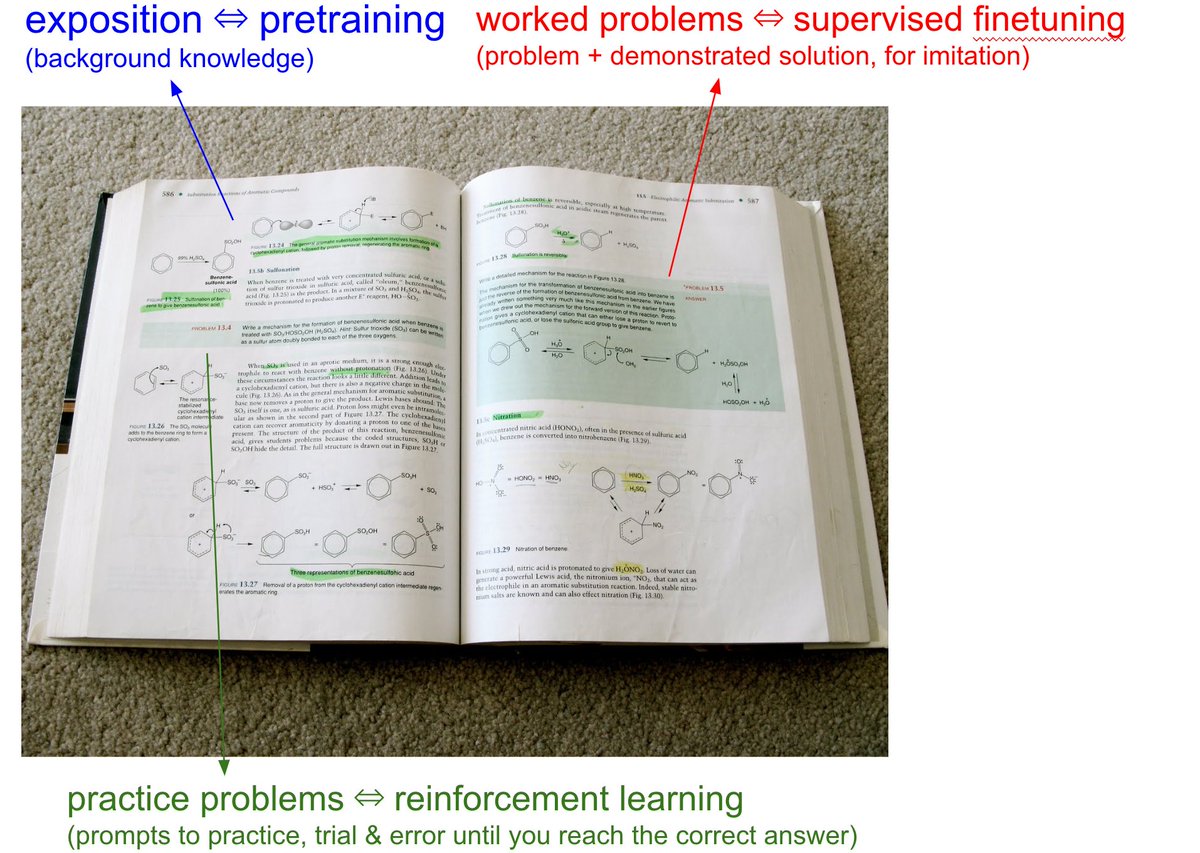
We have to take the LLMs to school.
When you open any textbook, you'll see three major types of information:
1. Background information / exposition. The meat of the textbook that explains concepts. As you attend over it, your brain is training on that data. This is equivalent to pretraining, where the model is reading the internet and accumulating background knowledge.
2. Worked problems with solutions. These are concrete examples of how an expert solves problems. They are demonstrations to be imitated. This is equivalent to supervised finetuning, where the model is finetuning on "ideal responses" for an Assistant, written by humans.
3. Practice problems. These are prompts to the student, usually without the solution, but always with the final answer. There are usually many, many of these at the end of each chapter. They are prompting the student to learn by trial & error - they have to try a bunch of stuff to get to the right answer. This is equivalent to reinforcement learning.
We've subjected LLMs to a ton of 1 and 2, but 3 is a nascent, emerging frontier. When we're creating datasets for LLMs, it's no different from writing textbooks for them, with these 3 types of data. They have to read, and they have to practice.
🚨REPORTER: "Does it bother you that Elon tweeted that?"
TRUMP: "No, it doesn't. He hates one of the people in the deal. People in the deal are smart people, but Elon happens to hate one of them. I have certain hatreds of people too."
Trump is a class act.
I am a fan of AI assisted coding removing a lot of grunt work, but we are still very early. You need a systematic verification system that’s faster than writing the code for AI to be more than an autocomplete, doc search and prototyping tool.
The dark truth about AI coding tools that nobody talks about:
Behind the flashy demos and viral tweets lies a graveyard of half-built projects and broken promises.
As CEO of Lazy AI, I've watched 100k+ developers struggle for 18 months. Take it from me: you are wasting your time and your money building projects with AI if you don’t know these 6 things. 🧵
The dark truth about AI coding tools that nobody talks about:
Behind the flashy demos and viral tweets lies a graveyard of half-built projects and broken promises.
As CEO of Lazy AI, I've watched 100k+ developers struggle for 18 months. Take it from me: you are wasting your time and your money building projects with AI if you don’t know these 6 things. 🧵
DeepSeek (Chinese AI co) making it look easy today with an open weights release of a frontier-grade LLM trained on a joke of a budget (2048 GPUs for 2 months, $6M).
For reference, this level of capability is supposed to require clusters of closer to 16K GPUs, the ones being brought up today are more around 100K GPUs. E.g. Llama 3 405B used 30.8M GPU-hours, while DeepSeek-V3 looks to be a stronger model at only 2.8M GPU-hours (~11X less compute). If the model also passes vibe checks (e.g. LLM arena rankings are ongoing, my few quick tests went well so far) it will be a highly impressive display of research and engineering under resource constraints.
Does this mean you don't need large GPU clusters for frontier LLMs? No but you have to ensure that you're not wasteful with what you have, and this looks like a nice demonstration that there's still a lot to get through with both data and algorithms.
Very nice & detailed tech report too, reading through.