Moving past conceptual roadmaps, tokenized money—via stablecoins and regulated digital deposits—is officially reshaping the plumbing of global B2B payments.
If you are attending MoneyLIVE North America, join FV Bank CEO Miles Paschini on Day 1 for an essential panel discussion:
"New Business Models: Assessing the Potential of Tokenized Money"
Alongside a group of industry leaders, Miles will break down how compliant, hybrid financial infrastructure is taking tokenized value out of isolation and embedding it directly into commercial banking workflows.
See you in Chicago!
📅 Event Details: https://t.co/KRE8OMj8bS
👥 Full Speaker Lineup: https://t.co/G8sIgp9UdT
#Fintech #Tokenization #DigitalAssets #BankingTheFuture
@yolobro@Money_LIVE_
🚨 JUST IN: JPMorgan, Citi, Bank of America and Wells Fargo are building a shared blockchain to keep deposits from leaving the banking system.
The Clearing House will run it. Target launch is the first half of 2027.
Interestingly, this appears led by being defensive rather than clients, at least according to some quotes. Bank of America's head of global payments, Mark Monaco, told the WSJ that clients aren't "beating down the door" for tokenized deposits.
The reason they're building it anyway sits in what they walked away from. A year ago this same group explored a joint bank stablecoin through The Clearing House and the operator of Zelle. They dropped it and picked a blockchain for deposits instead.
Remember deposits are money that stays still. They sit on the bank's balance sheet as a claim you hold against the bank. Stablecoins are money that moves. A bearer instrument that can leave your bank on Saturday and settle somewhere else by Sunday.
And given they're working with The Clearing House (TCH) that makes sense. Deposits can't leave a bank and go anywhere, but through clearing, banks can figure out all of the possible transactions that need to happen, and "net" them into one single efficient transaction multiple times per day. So instead of sending $10m one way, and $9m back. The banks send the difference or "net" of $1m.
But I don't get why they need a blockchain to do this?
The Clearing House already clears deposits in the USA between the member banks?
Tokenized deposits DO have demand if you talk to JP Morgan, their clients have cleared $3 trillion to date, but all cross-border. So again, what is the clearing house adding here?
Meanwhile, you have SoFiUSD which is live, and 1:1 exchangeable for its Tokenized Deposit, 24/7. Meaning, they enable instant, global exchange of dollars that can be off-ramped to any other payment system.
The US banks in the clearing house won't have that same cross-border advantage. To me, this looks like the clearing house got a tech upgrade, that maybe it didn't need?
Stablecoins are open loop. Global. 24/7. *That* is their advantage.
Tokenized deposits are 24/7 and safer. But closed loop.
These two things should co-exist not compete.
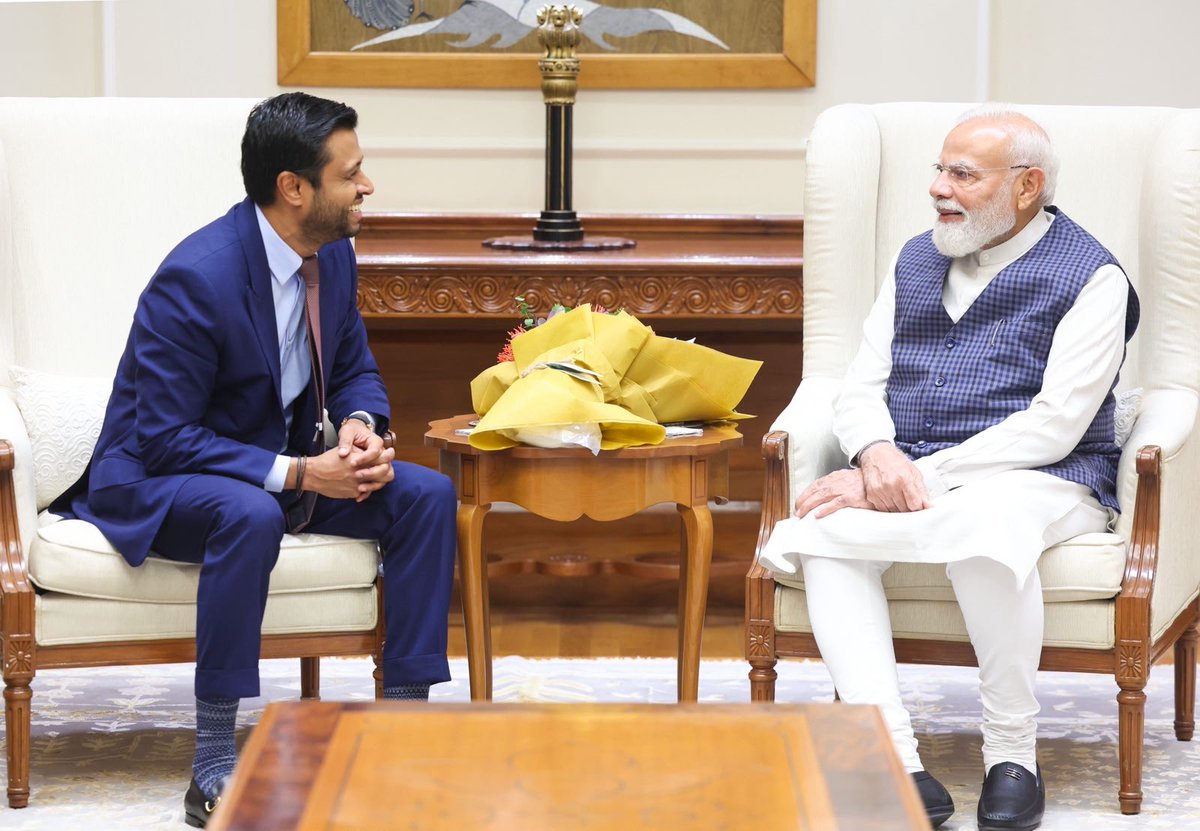
India’s digital infrastructure journey is gathering remarkable momentum.
AirTrunk has announced plans to invest around Rs. 3 lakh crore ($30 billion) in India, and develop 5 GW of data centre capacity. This is among the largest proposed investments in the country’s digital infrastructure ecosystem.
Such investments will strengthen India’s position as a global hub for cloud computing and AI, while generating employment opportunities, supporting local supply chains and accelerating innovation-led growth.
It is clear that the future of the world’s digital economy is increasingly being shaped in India!
Software going headless is inevitable in a world where agents use the tools 100X more than people do. And the reality is for a lot of software this is actually a huge boon to potential use-cases for these platforms.
Software business models have largely been predicated on selling to the number of seats that are in the company in a given function, and the usage of your software is constrained by how much people can do in a given day. This means that your technology is often vastly underutilized relative to what it actually can power for the customer.
Enter: agents. Agents can work 24/7, run in parallel, and string together work across systems. This is a big deal because now the agent can do far more than people ever could with these tools. Instead of reviewing contracts one by one, the agent will review all of them. Instead of manually moving data between marketing systems and across campaigns, the agent will let you run 10X more of them. Instead of being rate limited in a client onboarding process by human steps, agents accelerate these.
Agents end up using these underlying platforms far more than people ever did, which opens up use-cases that the platform couldn’t go after before.
Now, not every software market has the same amount of positive sum use-cases between people and agents, but I’d argue that a significant portion of systems of record, for instance, can be used far more than they are today. Your Salesforce data can be leveraged 100X more to do vastly more customer targeting and sales automation. Your documents can be turned into structured data and analyzed for insights and knowledge to automate other workflows. And so on.
Now, of course you have to find a way to make this all commercially attractive, but it’s not hard to picture the revenue from API and agent consumption on these platforms becoming a rich component of revenue streams over time. Seats for the people, consumption for the agents. Lots of upside here for the companies that embrace this trend.
I practice Transcendental Meditation and believe that it has enhanced my open-mindedness, higher-level perspective, equanimity, and creativity. It helps slow things down so that I can act calmly even in the face of chaos, just like a ninja in a street fight. I'm not saying that you have to meditate in order to develop this perspective; I'm just passing along that it has helped me and many other people and I recommend that you seriously consider exploring it. #principleoftheday
@elonmusk 🔥X just open-sourced the full “For You” algorithm.
No more black box - it’s now powered by Grok’s Phoenix AI model that predicts exactly what you’ll like, reply to, or repost.
Big transparency win from @elonmusk
The banks have it wrong on stablecoins.
Our new report is the most comprehensive model on the impact of stablecoins on the banking system and Treasury market.
- 60-70% of stablecoin growth under GENIUS will originate offshore
- Imported deposits from offshore will exceed domestic deposit migration by roughly 2:1
- Each newly minted GENIUS stablecoin generates approximately 32 cents of net U.S. credit
- Total credit expansion through 2030 is projected at ~$400 billion in our base case and ~$1.2 trillion in the bull case
- Treasury bill yields compress by 3-5 basis points, saving taxpayers up to $3 billion annually in borrowing costs
- Interest pass-through is not an existential threat to U.S. banking; it reallocates margin rather than eliminating capacity
We were early backers of @tether, @circle & @Paxos
Now every fund is bullposting stablecoin data
$300B+ stables, $33T of volume etc
But there’s been surprisingly little business analysis
Who makes money? Who doesn't? Why?
I pulled together our thinking below👇
Despite being told no, I'm open-sourcing TrustClaw.
You can now deploy a production-ready personal agent service with over 1000+ app integrations in a single command, straight to @vercel with npx @composio/trustclaw deploy
I was inspired by @openclaw to build a simple web app where anyone could create their own 24/7 personal assistant and connect it to Gmail, Google Calendar, Notion, Slack, GitHub, HubSpot, Linear… well everything, and securely through OAuth/sandbox execution.
It went viral on X, reached over a thousand users in less than 48h, and revenue began pouring in.
If you are thinking like a company, you'd probably keep that locked up. But why should I be the reason you spend another year scrolling instead of building?
So today, I'm open-sourcing TrustClaw anyway.
> 24/7 agents that act across Gmail, Notion, GitHub, Slack, Linear, Jira, and 1000+ apps
> OAuth and sandboxed execution, so users don't have to hand agents passwords or raw API keys
> Supports multiple users and authentication right outside of the box with @better_auth
Repo is open, MIT licensed.
If I were starting an AI company today, I'd clone this, pick a market, and begin shipping with Claude Code.
Honestly so excited to see what comes out of this.
Pranayama is the #1 bio hack on Earth.
It fixes depression, chronic stress, and reverses aging naturally.
Recently, I've been researching its healing benefits. What I found will blow your mind...
Here's what it is and how to perform it the right way (according to science): 🧵
How the Mind Creates Suffering According to Yoga Sutras… 🔥
Maharshi Patanjali does not describe suffering as something imposed from outside... He explains it as the result of identification with the movements of the mind.
> The mind constantly fluctuates through thoughts, memory, imagination, sleep, and perception
> These movements are called chitta vrittis
> When consciousness identifies with these fluctuations
> It forgets its own stable nature
> The Yoga Sutras identify deeper causes called kleshas
> Fundamental mental distortions that generate suffering
> Avidya… ignorance of one’s true nature
> Mistaking the temporary for permanent and the non Self for the Self
> Asmita… ego identification
> Confusing pure awareness with mind, body, and personality
> Raga… attachment
> Clinging to pleasurable experiences and fearing their loss
> Dvesha… aversion
> Resistance toward pain and unpleasant experience
> Abhinivesha… deep fear of loss and death
> The instinctive clinging to continuity of identity
> These kleshas drive reaction, attachment, fear, and karma
> Keeping the mind in constant disturbance
> Yoga does not claim the world must disappear for suffering to end
> It teaches that suffering decreases when identification with mental movement weakens
What appears as external suffering… the Yoga Sutras trace back to inner misidentification.
The mind does not only experience suffering… it continuously recreates it.
👉 Follow @_TheSanatani for more timeless wisdom of Sanatana Dharma.
👉 Join me on Telegram for all the Archives: https://t.co/NIElWWJflO
I have an intuitive hypothesis. The more time you spend in nature and observing natural things, the more will be your lifespan.
There have been scientific research like "hospital beds with a tree outside the window have lower mortality rates."
The universe wants you to observe itself. The universal consciousness (brahman) uses your consciousness (atman) to enjoy its creations.
So the more time you spend in nature being mindful, observing, and enjoying natural things like plants and animals, the more you will be kept alive.
The universe needs to understand and enjoy itself using itself - that's every conscious being including you. Animals can observe a lot more of nature but they can't appreciate.
So go out everyday to a park and have a mindful walk observing and enjoying nature. Or fill your space with nature and pets to enjoy them. Take some time to do so.
Human creations can also be enjoyed. But they only give second order effects to help you stay alive and healthy.
The best is to be Sir David Attenborough. Travel the world, see and enjoy a lot of nature and natural creations, and live up to a 100 healthy and appreciated by the rest of the universe.
Btw, if you have a doubt about my hypothesis, astronomers who do observational astronomy watching and discovering a lot of celestial objects too tend to live long and healthy lives ;)
Across time zones. Across currencies. Across borders. 🌍
From New York to Tokyo.
London to Singapore.
Dubai to Sydney.
The FV Bank VISA Debit Card lets you spend globally, seamlessly 💳
Get yours today at https://t.co/8AU7gcqemU
#VisaDebit#Global