06.12.1981,the #First Indian Scientific Expedition to #Antarctica was launched with a 21 member team under the leadership of Dr. S.Z. Qasim using a chartered Norwegian vessel, the Polar Circle. The team set foot on the icy continent on 9th of January 1982.
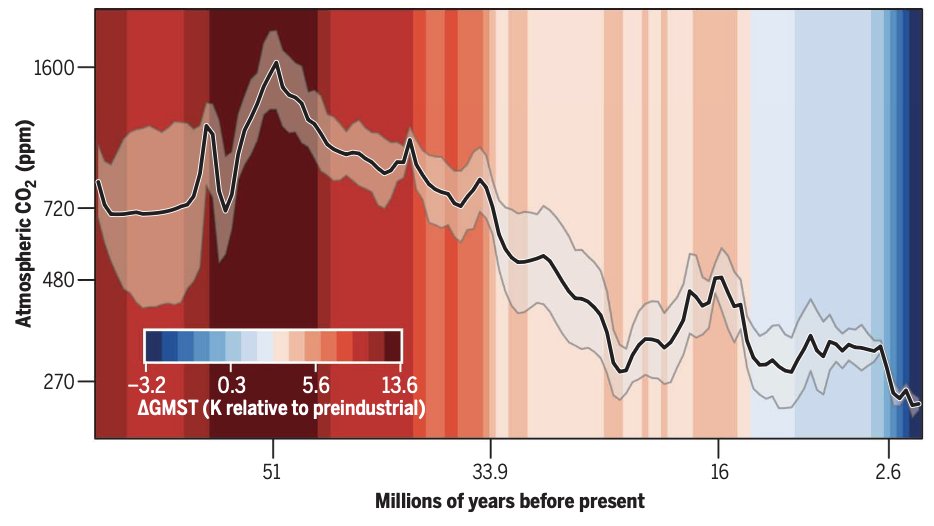
Just out, a 66 million year history of atmospheric CO2. Key take away: CO2 hasn't been at today's levels for at least 3 million years. These high CO2 worlds in the geological past had less ice and *much* higher sea levels 📈🌊 #COP28 https://t.co/BYPWWAuoAR
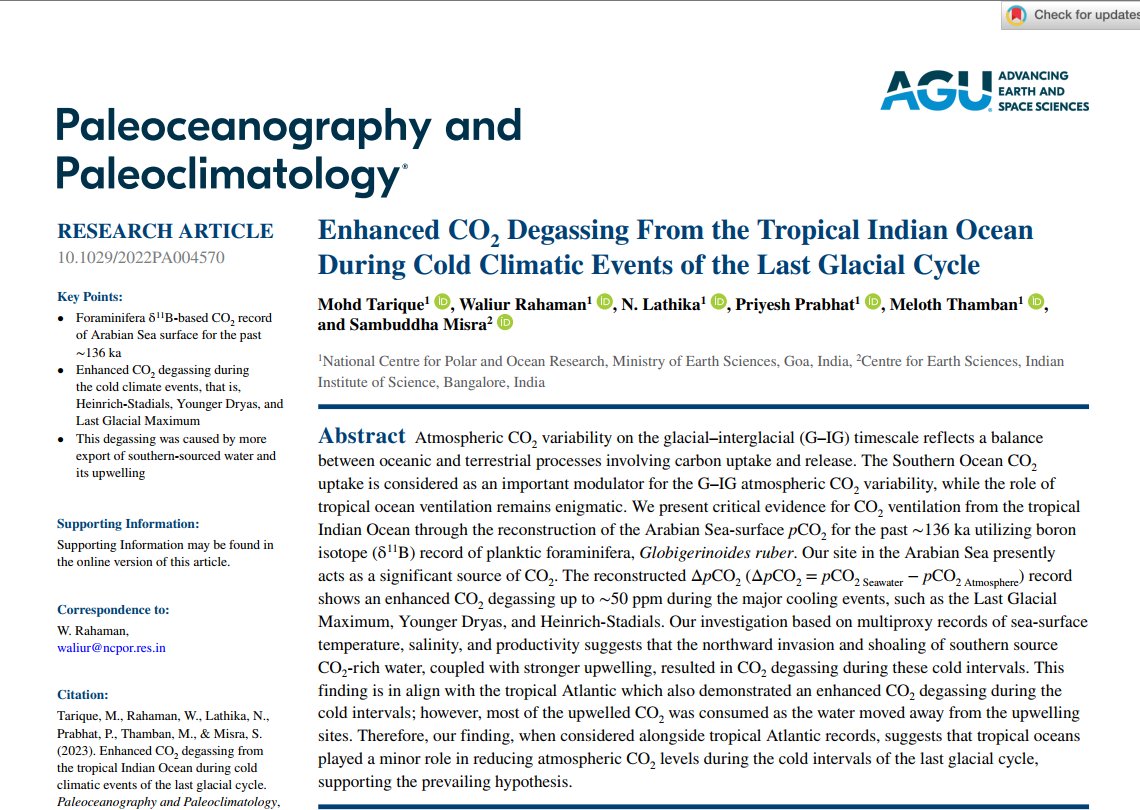
I'm excited to share that one of my thesis chapters on boron isotopes has just been published in @AGU_Paleo. This wouldn't have been possible without the tremendous support from my mentors and colleagues.
https://t.co/fPIZGj16Nx
Deep ocean circulation distributes heat & regulates atmospheric CO2 levels, thus controlling global climate. NCPOR's recent work published in @NatureComms, explains 'when' & 'how' deep water circulation changes from ancient to modern-like, in Indian Ocean. https://t.co/UBIz3nxkzQ
This is Runa, a microbiologist conversing with macrobiology in the Larsemann Hills in #antarctica. She's one of our fantastic #100polarwomen whose story you can read here: https://t.co/Kd6wvCtNOD
#EXP392 hit the Cretaceous! In this core, drilled from ~425 meters below sea level, is a dark layer--the Cretaceous–Paleogene (K–Pg) boundary, a mass extinction event of 66 million years ago, when 3/4 of all plant and animal species-including dinosaurs, were wiped out. #NSFfunded
Amazing work by #JooheeKim and others at @LamontEarth and @UniBarcelona. New Nd isotope record in NAtl for the last 1.5Myr confirms drastic AMOC changes during MPT.
North Atlantic Deep Water during Pleistocene interglacials and glacial... https://t.co/6gBw0dOyIc
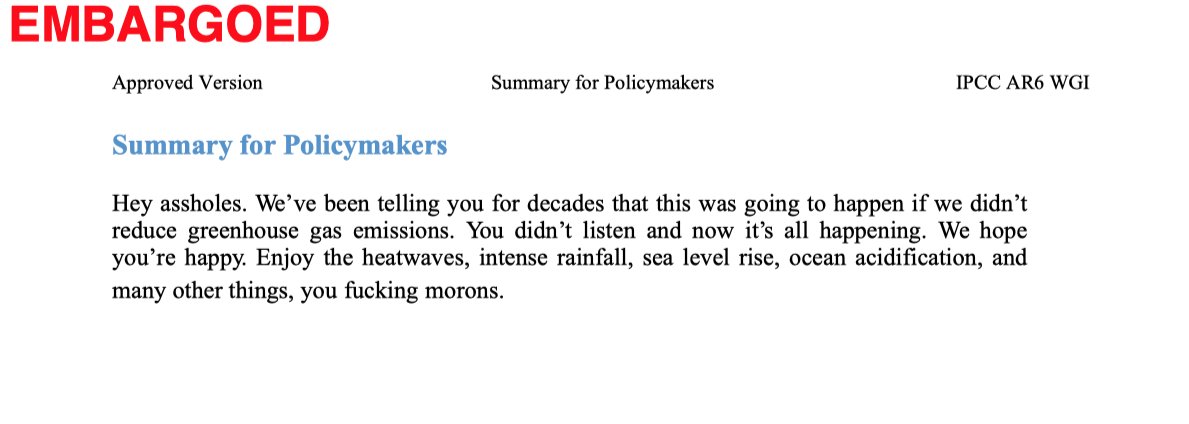
I just got a copy of the embargoed IPCC Summary for Policymakers. I hate to break the embargo, but this is too important to wait. Here it is, the entire SPM. Surprisingly, it's just one paragraph long.
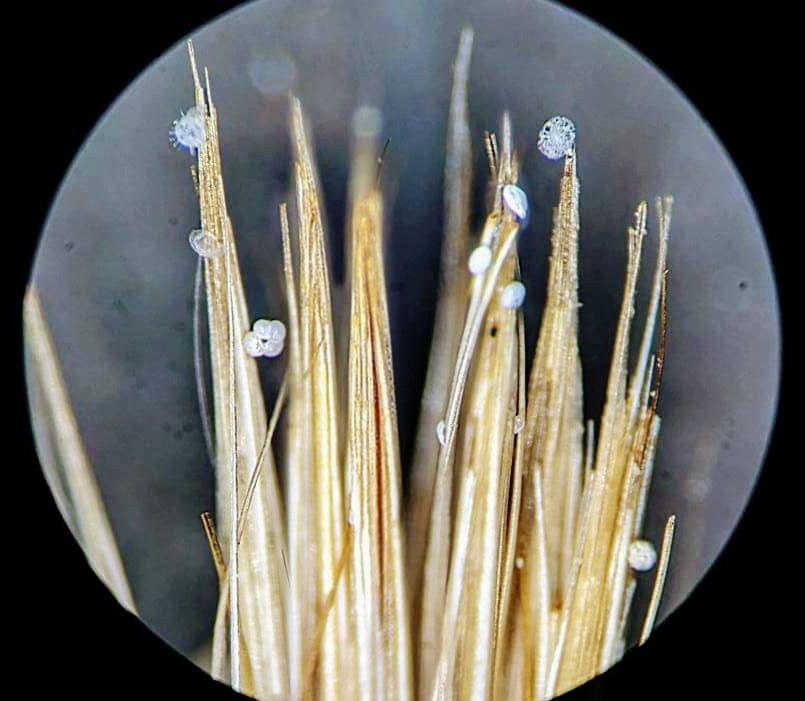
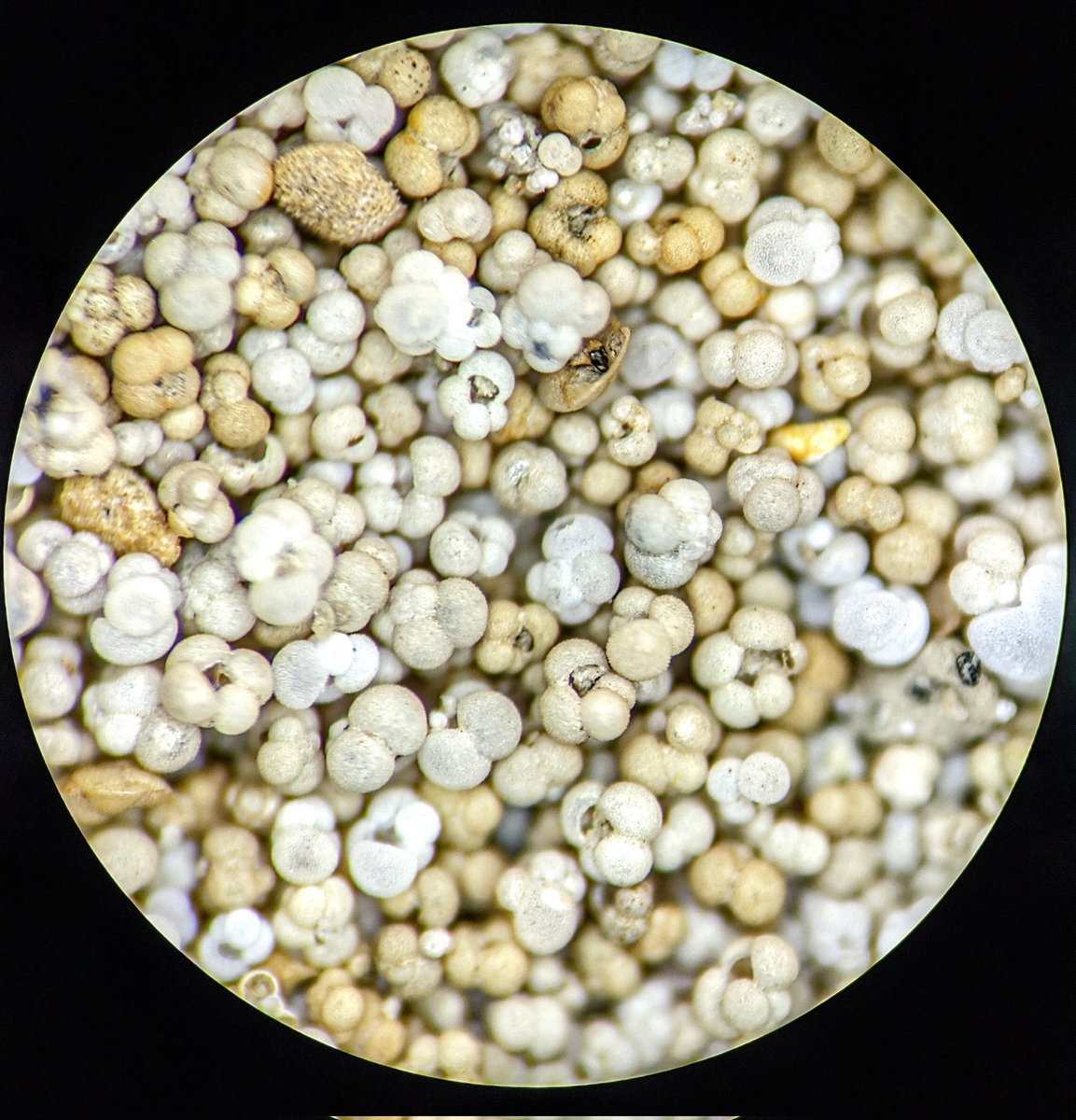
Miniaturized popcorn🍿
Our oceans are the largest & most productive habitats on our planet!
📸#Foraminifera shells, which are continuously dying & accumulating on the seafloor. They remain preserved as fossils in the cores we recover & each one is a window into our past #Exp395C
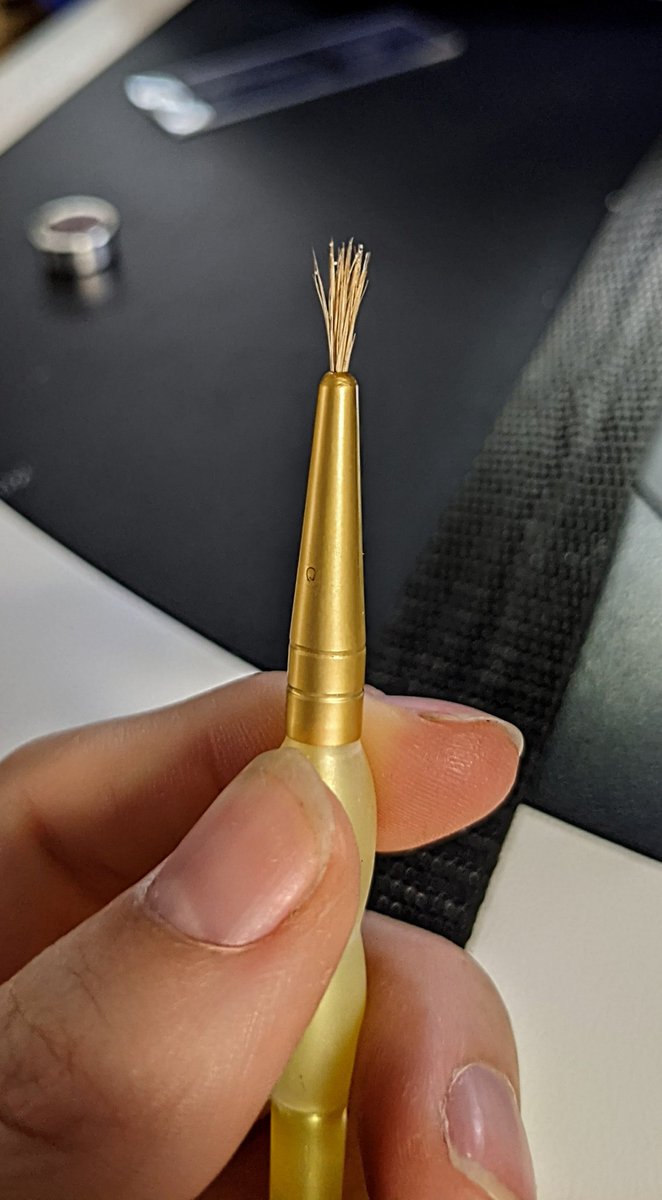
When we say "micro"fossil, this is how small we are talking. Here is a brush, with #rads (glass skeletons) & #forams (popcorn shaped🍿) stuck in the hairs, for a sense of scale.🧐🖌️🐚
Then, any one of these microfossils can fit 💯s of nannofossils inside them! #Exp395C#IODP@NSF
Want to know more about historical changes is Indian Ocean pH?
A Herculean effort by @tarique80
Surface pH record (1990‐2013) of the Arabian Sea from boron isotopes of Lakshadweep corals – trend, variability and control https://t.co/FDjp0r7wJ5