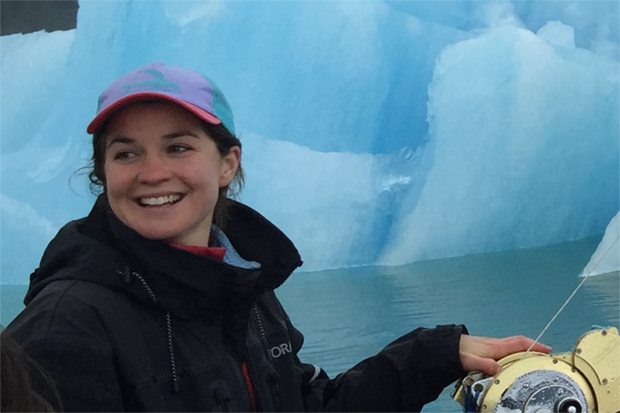
We know the #Greenland Ice Sheet is melting, but where does all that freshwater go? Beaird et al., trace freshwater with noble gases around Cape Farewell and show that meltwater to the west of Greenland moves towards the shelfbreak at depth. #AGUPubs
https://t.co/duG2b0yC8k
Our reimagining-the-leaky-pipeline-as-a-braided-river piece just came out in EOS. So privileged to get to work with @HendrattaAli and the other talented authors! https://t.co/UB62WWU8hj
To better predict sea level rise, former @NOAA Climate and Global Change Postdoc Fellow and current assistant professor at @RutgersU Dr. Rebecca Jackson wants to describe what happens where liquid ocean meets the icy underside of glaciers.
https://t.co/1fHJc3nbKm
Summer Openings for Glider Technology Camp: This August, RUCOOL will host a week-long, hands-on experience using underwater glider technologies. For more information or to apply, go to our Glider Technology Camp page.
https://t.co/VeuN53kTMV
How much Arctic fresh water participates in the subpolar overturning circulation? Recording of last week's POS webinar by @oceanslebrasi (@WHOI) is now available
https://t.co/Ru7mYd3r2T
Here are course materials for a class I taught in Spring called "Effective Computing," good for starting grad students who are not computer experts. Linux-python-git and organizational tips: https://t.co/Enqre3tn48
One of the last remaining ice tongues in Greenland, in 79N fjord (guess which latitude that’s at 😂) has been thinning for decades. @maaahge uses some very cool field data to show that warming of a particular water mass is the likely culprit. https://t.co/p4mgAB0hJl
These types of episodic events can play a role in biological production in the Chukchi during nutrient limited late summer, and may be increasing in frequency as the ice-free season lengthens
The current was susceptible to small-scale shear, baroclinic, and perhaps submesoscale instabilities. Each of these things can enhance mixing of the nutrient rich jet to the nutrient poor Chukchi!