I wrote a new Agentic text-to-SQL benchmark and tested every local model I could against it: https://t.co/SDQ9fTwmyG
Thanks to DuckDB WASM you can try your own models from the browser.
openai recently shared perplexity numbers for their models on their internal codebase. this is super valuable information and we need more public comparisons like this, so here is a first try with open models
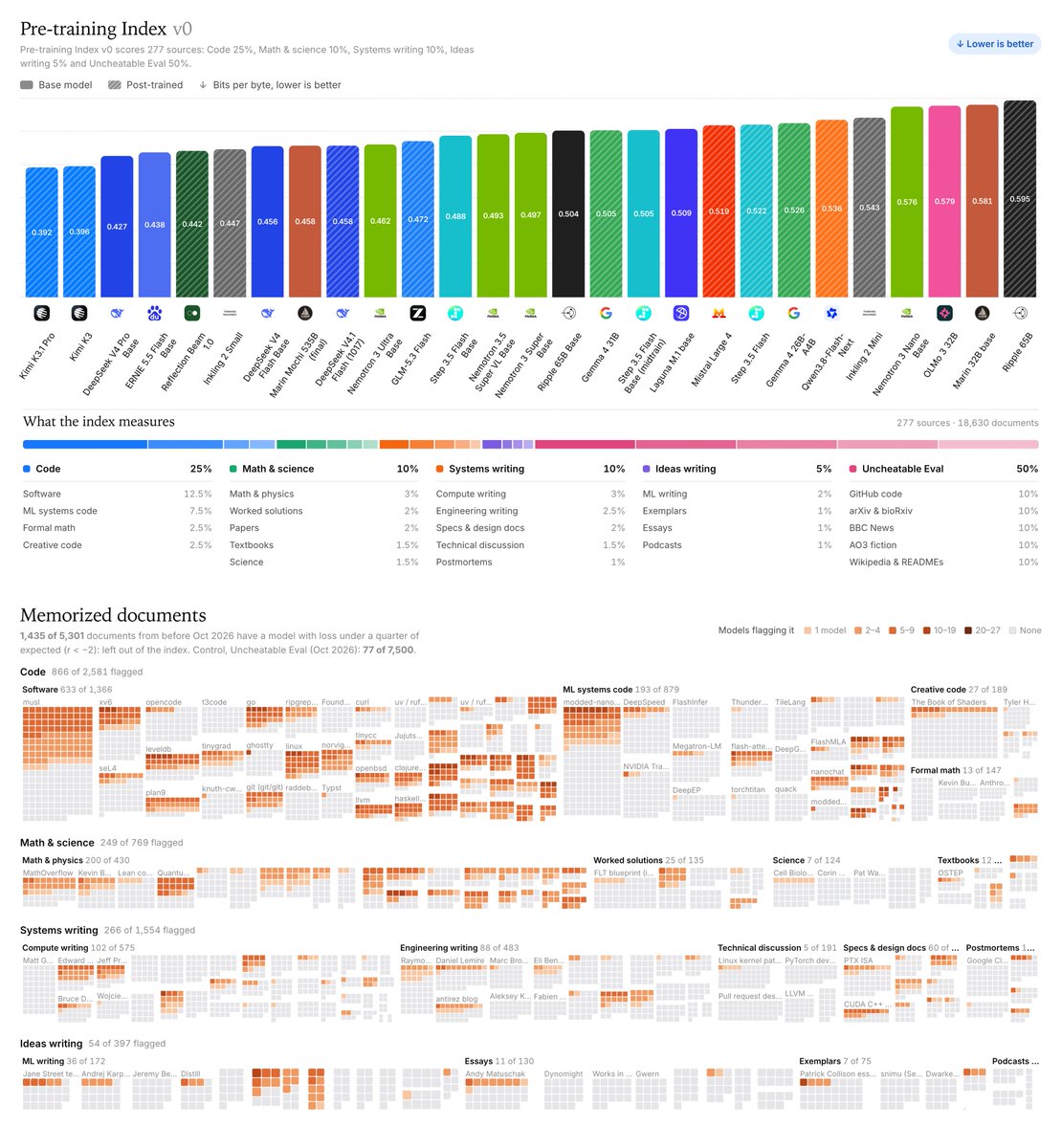
introducing v0 of pre-training index
https://t.co/r3hVb7xmNP
it covers 27 open models (base and post-trained) on ~260 curated sources (code, math & science, systems writing, essays) + uncheatable eval
there are a few challenges with comparing perplexity across models. first if the model is train on a document it can easily mememorize it and then have veryyy low ppl on it. one obvious fix is to only use very recent documents that can't be in the pretraining corpus, which is what uncheatable eval does (50% of the index). but i was a bit frustrated because it cuts a lot of the sources you can include, so i tried a few ideas
first, you can compute a win rate, if a model memorized a doc its loss collapses, but if you use win rate that only counts as one win (hence kinda normalize the importance of each document)
second, you can try to detect outliers (document where model have insanely low loss on)
loss(model, doc) ~ difficulty of the doc + skill of the model + r
difficulty is the median loss of all models on that doc, skill is how much better the model usually is than the median of other document in the sources and r is what's left. r < -2 means a loss 4x lower than expected
this seems to work pretty well. on uncheatable eval (published after every model's cutoff) only ~1% get flagged, vs 27% of older docs. by default the index drops every old doc that any model flags (with r < -2 as the threshold) for all models
some other notes
- i didn't have time to "base recover" the post-trained models, so keep in mind their base model perplexity is likely much lower! i think there is a lot to study here, especially the impact of SFT, distillation and RL on ppl
- for the curated sources, i took some of my favorite blogs and some i know high quality sources, gave them to neon, opus, sol and a few more models and asked them to find more like these and just iterate with models and looking at data. i know source quality is probably not the biggest differentiator here, oai does it only on their held out codebase, but there is something cool about evaluating how well models do next token prediction on the best stuff humans wrote
- i would prefer held out set for everything obviously, but i wanted to try to see a bit how we could detect memorization, and if/how it matters for different model and training process likely have impact on this! you can make the index 100% of uncheatable eval to remove as much as possible memorization
- i also asked a model to filter out heavily ai generated code/text on some sources, but i think it's relatively fine to have some llm generated data here (i know there is some). it might be a bigger issue for oai/anthropic models since they write a lot of code
- you can customize everything and build your own index by changing the weight of each domain, toggling sources on/off, picking the r cutoff, and clicking any document to see which models look like they memorized it
- there is also a lot of cool work on compression/memorization by nicholas carlini and others that i need to look into more!
- this first version of the index is OBVIOUSLY not good to compute ppl threshold to release model or not, probably a lot of way to under/overfit on it, and not the goal here
wanted to share this publicly quickly, i'll keep improving it when i have time and look for better ways to handle memorization. please give feedback and send cool resources to include!!
@evalstate Hmm interesting. Actually looking at the traces it *is* calling tools ok, just looping a lot! It's a failure mode I haven't seen before. My traces are the "error" yellow boxes here: https://t.co/TBK912a8mb
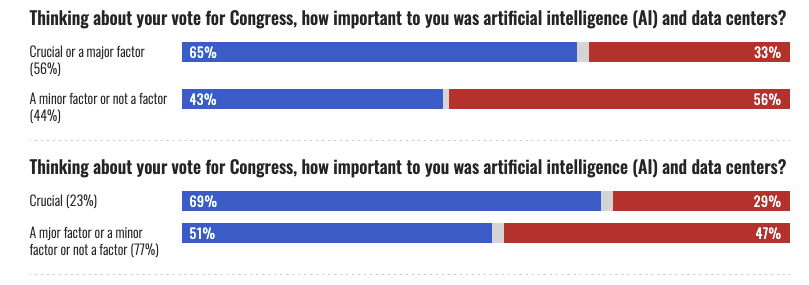
@bigdata@NBCNews This is a terrible visualization.
They could at least have made the overall length of the Dem + Rep bars = the overall percentage.
But even then, can you tell how important AI and data centers are to voters? Maybe 56% think crucial? Maybe 23%? 🤷♂️
https://t.co/7XlgpAei0X
I'm building my own quartz + digital smartwatch (because you can just build things!).
At #DevDayCommunity meetup in Adelaide I built this site from a pic of the partially constructed watch using GPT Sites.
It actually works! (1/2)
Scroll to view.
The watch shows the correct time.
If you have the smart device part it will connect via the HTML5 bluetooth API (if available) and show your heartrate.
There is the working software and a pic of the watch at the bottom
The unsaid words:
If Anth had this result released it because OpenAI did then it follow they have something else that builds on it that is unreleased or unfinished.
The obvious candidate is a proof for P ≠ NP (or.. *very* unexpectedly.. the inverse!)
Claude is the only author listed on this paper, in contrast to the OpenAI papers, where the human co-authors are listed. There are a lot of strange things about this. It's fun to guess. Conjecture time. I shall reveal my thought traces:
Claude Fable 5.1 and Claude Mythos 5.1 are the same model with the same weights; the only difference is the guardrails. We are about to get Fable 5.5 - in fact, Fable 5.5 is ready to deploy now, and Anthropic could do so at any time. If they follow the same pattern, and I think they will, this implies the existence of a Mythos 5.5. I believe Mythos 5.5 wrote this paper.
The way this is worded -
'Provenance. The core algorithm was found on October 16 by an internal Claude research model with 14M output tokens and no human input. Anthropic researchers worked with Claude to improve the presentation, resulting in this paper. Independently and concurrently, an internal model at OpenAI claims to have proven a similar result [Ope26]'
- makes me think Claude was not prompted to solve this. I think Mythos was asked to autonomously find and choose general open problems to solve itself, as part of an unannounced project to demonstrate recent advances in autonomy and research taste. You can see this taste in Fable 5.5's student; Opus 5.5. This recent advancement in taste and creativity - which happened in September - is not clearly expressed in benchmarks, but it is why so many people are currently switching to Claude as their primary. I think this research project will be announced with Fable 5.5, as part of Anthropic's big media blitz to boost the IPO.
One of the things X has taught me is that many people, if they can't see something moving, can't imagine it moving. This causes them to be continuously surprised by developments in this industry, because the frontier is invisible. I think this project has been running autonomously for some time and has made an unknown, and probably significant, number of discoveries, and not only in math.
Do not think Anthropic has been sitting idly while OpenAI repeatedly makes these huge science announcements. This is a war. This ETH result was released without any announcement from Anth at all despite its significance, and they only did so to respond to OpenAI's ETH reveal. They posted it late last night without saying anything. It was up for hours before levent even mentioned it. What value has one coin to a dragon who sleeps upon a mountain of them? This makes me think they are sitting on a pile of discoveries, a golden hoard, and they are saving them up for the big IPO shock-and-awe campaign which will soon begin. And when it does, they will announce multiple discoveries across many fields.
The only way out of the coming bugocalypse is by accelerating AI development significantly.
More AI, cheaper, faster and better.
Yes, things will break too. But things are breaking now.
@JFPuget@FrankGrimes_Jr@FrenchResponse I'm pretty sure he made up this stat.
https://t.co/TtnqIsLYj4 seems reasonable, and by my math 23,762 heat deaths between 2014-2020 works out at around.... 0.6 deaths per 100,000...
🫢