Can you accelerate queries when your data is *partially* sorted (and e.g. you don't want to have to resort it).
Yes. Qi Zhu and I explain how in: https://t.co/DXAR49dJbq
used a trick @jlongster came up with
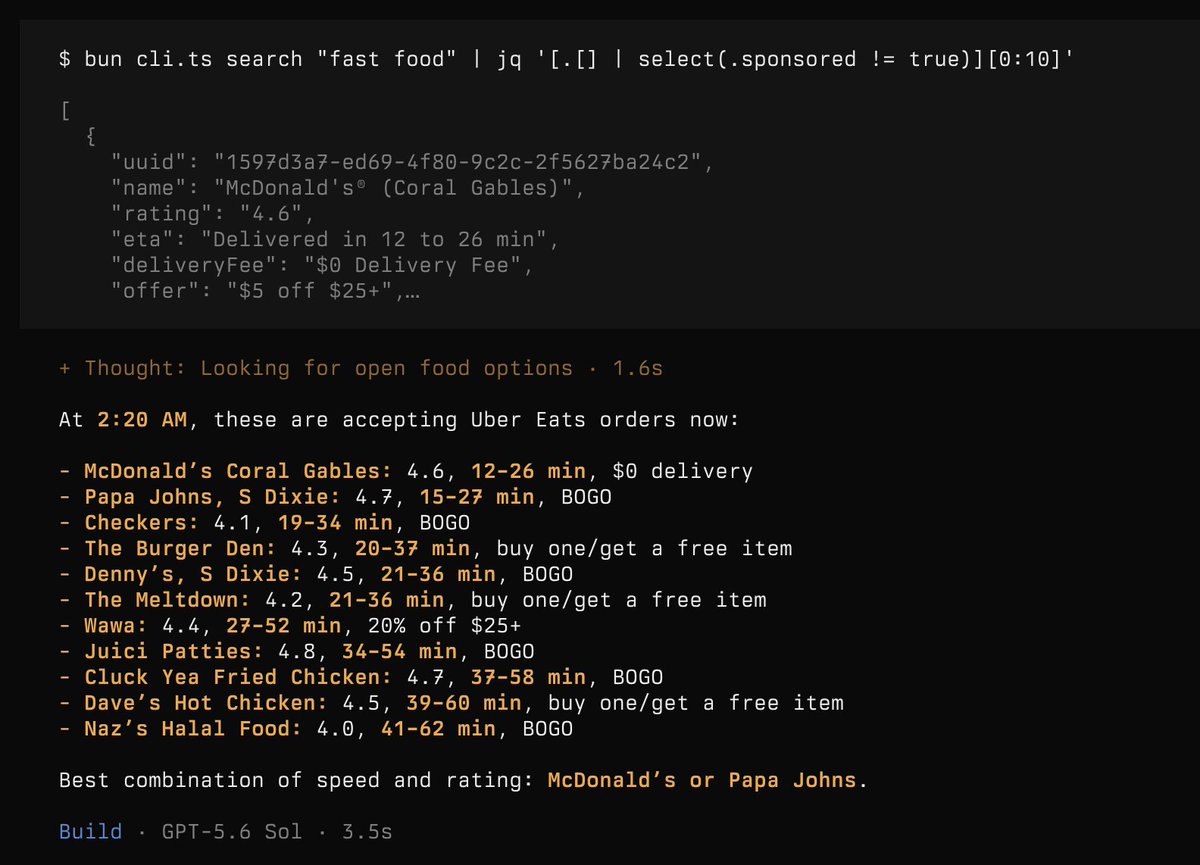
agents can control browsers but you can also ask it to record network requests into a HAR file
then it can derive a client for any website which is more efficient than browser controlling it every time
made it build a quick uber eats cli
A touching video shows a father helping his blind son follow the Portugal vs. Uzbekistan match by using a football board and guiding his hands through every play. I pray Ronaldo sees this. ❤️
diffshub[dot]com
Take any public diff from GitHub and virtualize it nearly instantly, no matter how large, with DiffsHub. Built to show off our brand new CodeView component.
To try it out, replace `github` with `diffshub` in your address bar.
If you're interested in SSD internals and how to use them efficiently, our paper, “How to Write to SSDs,” has been accepted to VLDB and is currently on the Hacker News front page. https://t.co/bwYAtPFTBg
Taking CMU or MIT's CS courses? This free guide on Modern Microprocessors is the best primer on processor microarchitecture - pipelining, superscalar, branch prediction, caches, all of it.
Originally written in 2001, just updated in 2026.
https://t.co/9sHR7ZpJcj
We’ve had on the order of 3 memory bugs in 6 years of TigerBeetle. None RCEs.
On the other hand, our own simulators have proactively found hundreds of (devastatingly catastrophic) distributed systems correctness bugs per year.
Given how hard TigerBeetle’s domain is, in terms of mission critical financial transaction processing, I’ve never for one minute believed that writing TB in a memory safe language such as say TypeScript would somehow magically (!) make any material impact compared to the 100x correctness multiplier of TigerStyle.
That’s because—rather than fall for the fallacy of composition, i.e. to see distributed correctness as a language problem—TigerStyle instead takes ultimate responsibility for the “end to end” correctness of the distributed system as a whole.
Per systems engineering, correctness is always a systems design problem. For example, how to build a reliable whole, (especially) out of unreliable parts, such as broken firmware, bitrot, programmer error etc. In other words, application of the end to end principle.
But when you TigerStyle the design in this way, the world of systems engineering also completely opens up to you and changes how you evaluate systems languages (now things like “power to grammar ratio”, or explicitness, checked arithmetic and precision become more critical and valuable to you).
Of course, it is harder to care about correctness, to take responsibility for correctness end to end.
Yes, you’re forced to begin to worry about the more serious concerns, starting with the basics of static allocation, explicit limits, assertions, deterministic simulation testing and moving to more advanced topics like protocol-awareness and storage fault-tolerance.
But then again, TigerStyle is such a force multiplier, that you achieve mission critical quality, and in less time and with greater velocity.
If you’re tired of production issues, and if you want to “engineer your engineering”, I would encourage you to lift up your thinking to the level of systems design and end to end correctness.
Start thinking about your methodology and begin embracing TigerStyle.
https://t.co/fgtyNCO7SE
Libghostty can now be used to fuzz TUIs, thanks to @owickstrom + @AntithesisHQ. They already found bugs in multiple including btop. I always imagined libghostty would be useful for testing TUIs, super happy to see this is both practical and valuable. https://t.co/02rVjF740v
This is another example of where speed matters! "Why does Ghostty need to be so fast?"
Well, if you're running hundreds or thousands of unit tests that each use a clean in-memory terminal, you want that to be fast. If you're fuzz testing and trying to push an unlimited amount of data through a terminal, you want that terminal to be fast.
So many people got hung up on "why does my terminal _GUI_ need to be fast" without connecting one more dot and realizing the GUI is only fast if the core is fast, and the core being fast unlocks a hell of a lot more.
Like this.
🔥 GitHub RCE via single git push!
CVE-2026-3854: Unsanitized push options let attackers run commands on backend servers, bypassing sandboxing (cross-tenant risk).
🔗 Learn how header injection led to full compromise → https://t.co/YzdRbikpau
Patched within hours.
Patch your Linux boxes!
https://t.co/VWOUDbLAn2 is a trivially exploitable logic bug in Linux, reachable on all major distros released in the last 9 years. A small, portable python script gets root on all platforms.
Found by the teams at @theori_io and @xint_official
More details below
https://t.co/9f6T96PvPX
We've launched a new @WebSecAcademy topic on exploiting AI-powered security scanners! Learn how to use indirect prompt injection to steal data, cause damage & trigger exploit chains!
If you market a machine that “cooks for you,” a chef will never buy it.
This is called identity threat, one of the four reasons why people resist adopting AI. @dguido breaks it down at unprompted:
if you don't know what to do on the weekend spend some time learning the @OpenComputePrj Datacenter project. basically open-source data center planning
It's a wrap at Kubecon! 1,017,490 scale to zero microVMs in a single server, cold started and resumed in ~10ms 🚀
The final count was higher, after we had huge crowds hit a button to start new ones. Next up: run a script to see how high the count will go before something crashes and burns 🙂🔥