I spent the past few days in Washington with @hyperliquidpc meeting with policymakers during the historic advancement of the Clarity Act. We discussed Hyperliquid, the benefits that it offers to American consumers, and the regulatory path to bring onchain derivatives markets into the United States.
Some conversations were technical with an impressive baseline understanding of Hyperliquid. Discussions included how onchain trading is a financial innovation that has clear global user demand. Other conversations focused more on a first principles introduction to defi and the promise of onchain markets. It was encouraging to see bipartisan support for thoughtful regulation of crypto. I look forward to continuing discussions in DC and working hard to make American access to Hyperliquid a reality.
Coinbase has announced its plan to activate AQAv2 on USDC as the treasury deployer, with Circle serving as the technical deployer responsible for CCTP and native cross-chain infrastructure. Both Coinbase and Circle have committed to stake HYPE to activate AQAv2. As part of this transition, Native Markets has agreed to terms granting Coinbase the right to purchase the USDH brand assets. With Coinbase, in its role as treasury deployer, sharing the vast majority of reserve yield revenue with the protocol, USDC will become the most aligned stablecoin on Hyperliquid. As a result, canonical outcome (HIP-4) markets will use USDC as the quote asset in a future network upgrade.
User and builder feedback has been consistent that fragmentation leads to degraded experience; now, the community no longer needs to choose between liquidity and protocol alignment.
The pioneering work of Native Markets in launching USDH as the first production-scale stablecoin sharing yield directly with a protocol in a purely onchain implementation made AQAv2 possible. The learnings and mechanics pioneered by USDH will live on in AQAv2.
The Hyper Foundation will give grants to eligible HIP-3 deployers, HIP-1 deployers, and builders who integrated USDH, supporting teams through migration over the next months. These grants reflect an ongoing commitment to teams who choose to build on Hyperliquid and align with the protocol. USDH markets are fully functional but will sunset over time. USDH remains fully backed, with feeless conversions to USDC and fiat available to users during this transition.
Kraken is deprecating its existing cross-chain provider and migrating to @Chainlink CCIP as its exclusive cross-chain infra to secure Kraken Wrapped Bitcoin (kBTC) & all future Kraken Wrapped Assets.
Kraken chose Chainlink CCIP because it offers enterprise-grade infrastructure with strict security & risk management requirements, including:
• ISO 27001 and SOC 2 Type 2 certifications
• Secure by default architecture
• 16 independent nodes
• Native rate limits, and more.
Together, Chainlink and Kraken can help accelerate the global adoption of crypto by unlocking utility and distribution for all Kraken Wrapped Assets across DeFi.
For kBTC customers, no action is required. More details on the migration process to follow on official Kraken channels.
Today, Mastercard, @OndoFinance, Kinexys by @JPMorgan, and @Ripple successfully completed a landmark transaction connecting a public blockchain with interbank settlement rails.
Together, we’re laying the groundwork for 24/7 global markets that never close.
CPU vs GPU vs TPU vs NPU vs LPU, explained visually:
5 hardware architectures power AI today.
Each one makes a fundamentally different tradeoff between flexibility, parallelism, and memory access.
> CPU
It is built for general-purpose computing. A few powerful cores handle complex logic, branching, and system-level tasks.
It has deep cache hierarchies and off-chip main memory (DRAM). It's great for operating systems, databases, and decision-heavy code, but not that great for repetitive math like matrix multiplications.
> GPU
Instead of a few powerful cores, GPUs spread work across thousands of smaller cores that all execute the same instruction on different data.
This is why GPUs dominate AI training. The parallelism maps directly to the kind of math neural networks need.
> TPU
They go one step further with specialization.
The core compute unit is a grid of multiply-accumulate (MAC) units where data flows through in a wave pattern.
Weights enter from one side, activations from the other, and partial results propagate without going back to memory each time.
The entire execution is compiler-controlled, not hardware-scheduled. Google designed TPUs specifically for neural network workloads.
> NPU
This is an edge-optimized variant.
The architecture is built around a Neural Compute Engine packed with MAC arrays and on-chip SRAM, but instead of high-bandwidth memory (HBM), NPUs use low-power system memory.
The design goal is to run inference at single-digit watt power budgets, like smartphones, wearables, and IoT devices.
Apple Neural Engine and Intel's NPU follow this pattern.
> LPU (Language Processing Unit)
This is the newest entrant, by Groq.
The architecture removes off-chip memory from the critical path entirely. All weight storage lives in on-chip SRAM.
Execution is fully deterministic and compiler-scheduled, which means zero cache misses and zero runtime scheduling overhead.
The tradeoff is that it provides limited memory per chip, which means you need hundreds of chips linked together to serve a single large model. But the latency advantage is real.
AI compute has evolved from general-purpose flexibility (CPU) to extreme specialization (LPU). Each step trades some level of generality for efficiency.
The visual below maps the internal architecture of all five side by side, and it was inspired by ByteByteGo's post on CPU vs GPU vs TPU. I expanded it to include two more architectures that are becoming central to AI inference today.
👉 Over to you: Which of these 5 have you actually worked with or deployed on?
____
Find me → @_avichawla
Every day, I share tutorials and insights on DS, ML, LLMs, and RAGs.
How to Recover from EJACULATION Fast (And Go for Round 2 Like a Beast)
If you’re tapping out too soon, you’re MISSING out on the best part.
Learn how to bounce back fast and keep the PLEASURE going.
Thread -
Top 50 Movies for Matured Audience🔞🔞🔞
1. Love, Simon (2018)
2. After (2019)
3. Long Shot (2019)
4. The Last Summer (2019)
5. Someone Great (2019)
6. What Men Want (2019)
7. Isn't It Romantic (2019)
8. The Sun Is Also a Star (2019)
9. Five Feet Apart (2019)
10. Plus One (2019)
11. The Perfect Date (2019)
12. The Kissing Booth (2018)
13. To All the Boys I've Loved Before (2018)
14. Set It Up (2018)
15. Sierra Burgess Is a Loser (2018)
16. The Half of It (2020)
17. Love, Guaranteed (2020)
18. Chemical Hearts (2020)
19. The Lovebirds (2020)
20. After We Collided (2020)
21. Palm Springs (2020)
22. The Broken Hearts Gallery (2020)
23. The Kissing Booth 2 (2020)
24. The Lovebirds (2020)
25. Work It (2020)
26. After We Fell (2021)
27. To All the Boys: Always and Forever (2021)
28. Malcolm & Marie (2021)
29. The Map of Tiny Perfect Things (2021)
30. The One (2021)
31. The Kissing Booth 3 (2021)
32. Resort to Love (2021)
33. The Last Letter from Your Lover (2021)
34. Single All the Way (2021)
35. The Princess Switch 3: Romancing the Star (2021)
36. The Royal Treatment (2022)
37. Through My Window (2022)
38. Tall Girl 2 (2022)
39. Love in the Villa (2022)
40. The Perfect Pairing (2022)
41. Purple Hearts (2022)
42. A Perfect Pairing (2022)
43. Falling for Christmas (2022)
44. Love Hard (2022)
45. Something from Tiffany's (2022)
46. After Ever Happy (2022)
47. The Lost City (2022)
48. The Royal Treatment (2022)
49. The Princess Switch 3: Romancing the Star (2021)
50. The Last Letter from Your Lover (2021)
By integrating DECO and Town Crier, Chainlink is set to launch Confidential Compute, a service that enables private smart contracts.
The big unlock? This allows institutions to handle sensitive data onchain without exposing proprietary information—a critical component for future adoption.
Giving AI Agents Access to Cryptocurrency and Smart Contracts Creates New Vectors of AI Harm
New paper by Bill Marino and me. Available here: https://t.co/FvPwW1R6yQ
Bloomberg article on the work: https://t.co/yvGGYzxEub
I am truly impressed by the @realDonaldTrump administration's thoughtful approach to helping the blockchain industry achieve its full potential in the united states and beyond. I think the president's clear placing of our industry as a national priority will be seen as a critical and historic moment for our industry and for the united states financial system's role globally.
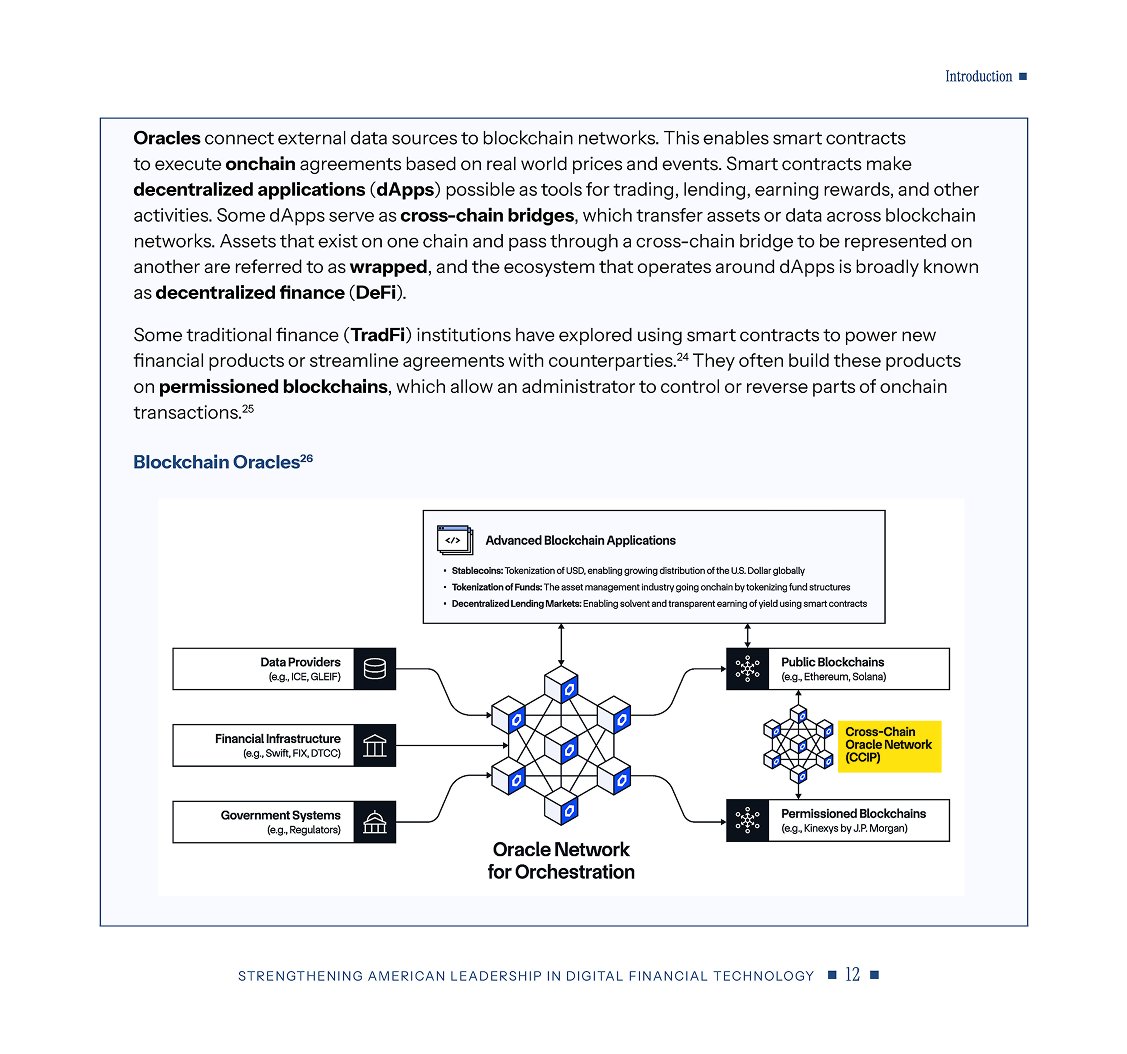
This recent report highlights some of the key points that the white house has been considering. It is telling that the first few pages of the report are about oracles and clearly highlights some of the great work that the Chainlink community has been doing to bring smart contracts to the next stage of their evolution, clearly mentioning the Cross Chain Interoperability Protocol (CCIP).
Introducing Chainlink Automated Compliance Engine (ACE)—a unified & modular standard to solve all onchain compliance problems and bring institutional capital onchain.
ACE is built on the Chainlink Runtime Environment (CRE) & launched in collaboration with leading market participants, @ApexGlobalGroup, @GLEIF, & @ERC3643Org 🧵↓
Press release: https://t.co/O3vzlRAshS
Launch blog: https://t.co/AtSHnf4RQC
Designed to support both traditional and decentralized finance, Chainlink ACE enables the creation of compliance-focused digital assets and services across public and private blockchains—bringing $100+ trillion in institutional capital onchain.
Chainlink ACE supports a wide range of compliance-focused use cases, such as automated compliance policies, reusable digital identities, regulated asset usage in DeFi protocols, pre-transaction eligibility checks, cross-chain collateralized loans, settlement with regulated assets, and much more.
Build to Scale
Q2 2025 saw Chainlink Build & ecosystem members continue to grow via innovation & scaling.
• Build: Season Genesis launch with @spaceandtime
• Blockchains: 29 integrations including @Optimism, @solana, & @trondao
Ecosystem teams—Drop your updates below ↓
Just use Aave.
Solo usa Aave.
Utilise simplement Aave.
Verwende einfach Aave.
Usa semplicemente Aave.
Basta usar o Aave.
Просто используй Aave.
とにかくAaveを使って。
그냥 Aave 써.
只用Aave就行了。
فقط استخدم Aave.