Today, we’re introducing Tribe AI’s new website and brand entity that highlights human intuition and machine intelligence into a single, cohesive mark.
Read the full story behind how it came to be: https://t.co/B9ZONE9fzf
Today we're launching a new identity for @tribe_ai , built around a belief we've held since 2019: AI doesn't transform companies. People do.
Check out the new Tribe: https://t.co/KLcGRFp1Dv
Much love to @VL and the other incredible people at @expa who made it all real.
Excited to announce our acquisition of @saidwithcandor to build the best forward deployed team in AI. We've doubled since January and are just getting started. Why we did it (and what's next): https://t.co/0WjBN3cqb0
Funny thing about VCs is they’re still talking about software when they say services. The patterns are too emergent with too much baggage.
Meanwhile, service firms like @tribe_ai are growing extremely fast and getting closer to software like subscriptions and margins every day.
We’ve added connectors for Google Workspace, Docusign, Apollo, Clay, Outreach, Similarweb, MSCI, FactSet, WordPress, and Harvey, along with plugins from Slack by Salesforce, LSEG, S&P Global, Common Room, and Tribe AI.
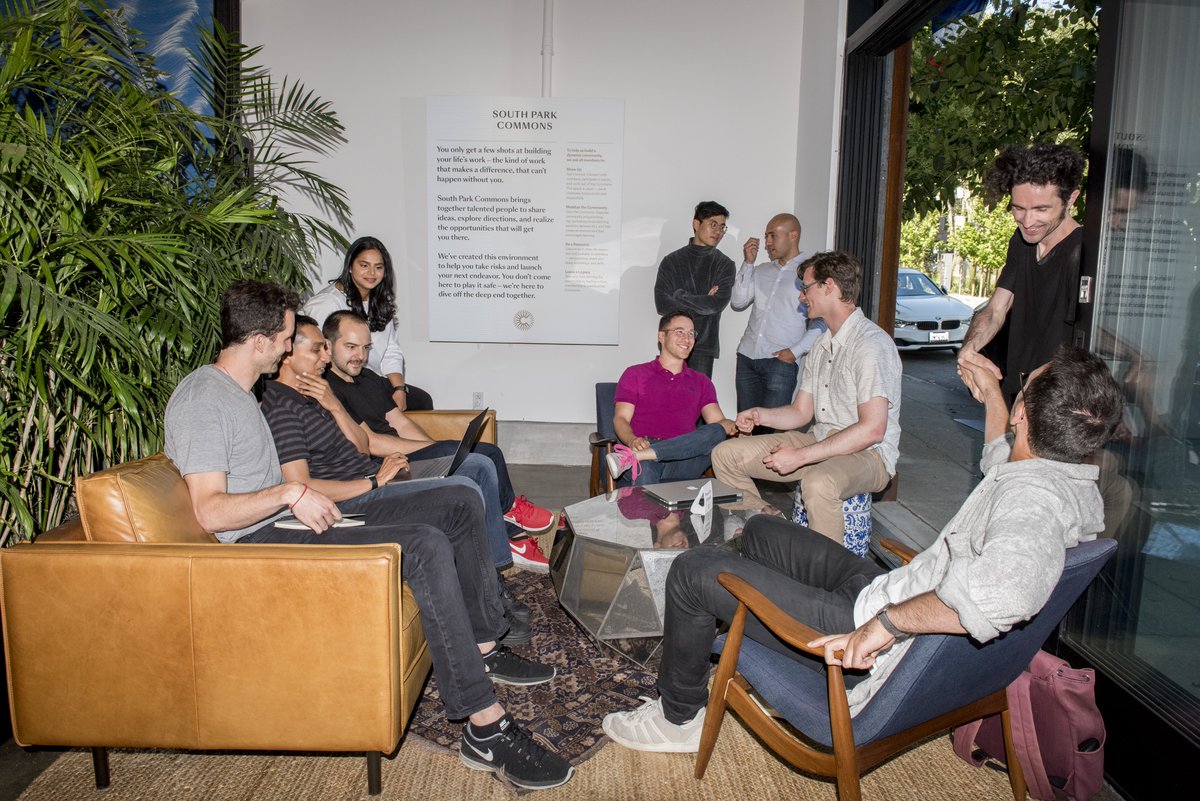
10 years ago, there were 10 people around my kitchen table. No structure, no brand, no certainty. Just a handful of builders showing up for something that yet didn’t exist.
Since then @southpkcommons has grown to over a 1000 members. Today, 25,000 people apply to SPC every year. We have offices in SF, NYC, and Bangalore.
But SPC isn’t about the numbers, it’s about the people and what emerges when they choose to show up for each other.
It looks like @anuraggoel, already successful and credible, showing up with generosity, helping others, sharing work, iterating in public. Patterns sharpened and @render was born.
It looks like @thejamescad and @dbabbs, who met at SPC to become cofounders building @tryprofound. One of the superpowers of SPC is the collision rate—not the shallow kind, but the kind that only happens when people keep showing up long enough to build trust.
It looks like @MaximilianMona, who moved out to California in an RV to be at SPC and eventually build Ironsite. That’s someone saying, with their whole life: this matters.
And it looks like @AshtonJEaton, an Olympic gold medalist, walking into SPC not for a career pivot, but for a deeper reinvention. To trade mastery for learning. Not for optics. For truth.
SPC has been designed by the community and for the community, with one goal that hasn’t changed: pay it forward. We’ve helped normalize taking time to find truly meaningful work, whatever shape that might take.
So on this ten-year anniversary, I want to thank the people who made SPC what it is.
The ones who showed up when they didn’t have a narrative.
The ones who lived in the question — and lingered in uncertainty for long enough to find out.
The ones who came back, again and again, for the work and for each other.
Happy ten years, SPC. Thank you for showing up!
I'm cohosting an AI event for devs and builders in SF on October 6 with some friends from Tribe AI and OpenAI and Women Tech Meetup.
Come hang?
Space is limited so guests will be invited to RSVP as capacity allows: https://t.co/gBu6Xyy5AG
Announcing our $7.3M seed round!
TensorZero enables a data and learning flywheel for optimizing LLM applications: a feedback loop that turns production metrics and human feedback into smarter, faster, and cheaper models and agents.
Today, we provide an open-source stack for building industrial-grade LLM applications that unifies an LLM gateway, observability, optimization, evaluation, and experimentation. You can take what you need, adopt incrementally, and complement with other tools. Over time, these components enable you to set up a principled feedback loop for your LLM application. The data you collect is tied to your KPIs, ports across model providers, and compounds into a competitive advantage for your business.
Our vision is to automate much of LLM engineering. We're laying the foundation for that with open-source TensorZero. For example, with our data model and end-to-end workflow, we will be able to proactively suggest new variants (e.g. a new fine-tuned model), backtest it on historical data (e.g. using diverse techniques from reinforcement learning), enable a gradual, live A/B test, and repeat the process. With a tool like this, engineers can focus on higher-level workflows — deciding what data goes in and out of these models, how to measure success, which behaviors to incentivize and disincentivize, and so on — and leave the low-level implementation details to an automated system. This is the future we see for LLM engineering as a discipline.
Recently, TensorZero reached #1 trending repository of the week globally on GitHub (& we're about to cross 10k stars). We're fortunate to have received contributions from dozens of developers worldwide, and it's exciting to see TensorZero already powering cutting-edge LLM products at frontier AI startups and large organizations, including one of Europe's largest banks.
We're excited to share that we've raised $7.3M to accelerate TensorZero's efforts to build best-in-class open-source infrastructure for LLM engineers (we're hiring!). The round was led by @FirstMarkCap, with participation from @BessemerVP, @bedrock, @DRWTrading, @coalitionvc, and dozens of strategic angels.
Here's a wild idea that I’ve been building for months: making tech debt a thing of the past by treating code as a disposable asset with just in time software? 🧵
The world and politics are a mess,
Focus on yourself. Love your neighbor.
Make your household, business, and life as amazing as it can be.
- Don't take in the chaotic energy of others, set your own tone.
TLDR:
-Recursive loops arise whenever capability buys more capability faster than linear.
-Hard vs. soft take‑off is governed by the exponent p and by recalcitrance terms - both are still uncertain.
-Overhangs and R&D automation could tip the system from exponential to super‑exponential - even if progress looks smooth today.
-Monitoring leading indicators and building friction (alignment checks, compute throttles) are actionable regardless of which camp (hard/soft) is correct.
O3 has me thinking about AGI’s recursive take‑off. Some quick notes:
AGI that can improve itself is the highest‑leverage loop in history. Current intelligence → better code → better intelligence. The final flywheel.
back in ’65 I.J. Good called this the “intelligence explosion” - this is still the clearest description.
The practical hedge: throttle the feedback loop until alignment keeps pace—compute caps, gradient audits, transparency by default. But this seems more and more unlikely to happen in a USA v China world
Bottom line: The future hinges on feedback strength vs. real‑world bottlenecks. Stay empirical, keep building, solve alignment in parallel and keep god in the box.