I have on good authority that GLM 5.2 is running at 120 tok/s across two networked Blackwell tinyboxes. $150k and that setup can be yours, either 2x tinybox or 1x tinybox pro. Never pay the cloud again.
It looks like we’re getting a whole range of new GPT models this Thursday:
GPT-5.6,
5.6 Pro,
and a new bidirectional voice model.
Initial tests of the voice model were outstanding, this is exactly what I had hoped for two years ago!
We’ve identified industrial-scale distillation attacks on our models by DeepSeek, Moonshot AI, and MiniMax.
These labs created over 24,000 fraudulent accounts and generated over 16 million exchanges with Claude, extracting its capabilities to train and improve their own models.
Running 24/7 without any human babysitters has been really hard
We want robots operating at all times - even at 2am, on weekends, or on Christmas Day
The robots run until their battery is low. When one heads to dock for recharging, a second robot receives a message to leave the dock and make room for the incoming robot. The first robot then autonomously docks. By the time the first robot is charging, the second is already back to work
We never want downtime. If a robot has an issue, it goes to a triage area to dock while a replacement robot swaps in from another area. This could be due to a hardware or software issue
The robots dock onto a wireless inductive charger built into their feet. They step onto a pad that charges them via coils in their feet at up to 2 kW. It takes about an hour to fully charge at roughly a 1C rate
We’re now up and running across many different use cases like this. Crazy to see it
Very interested in what the coming era of highly bespoke software might look like.
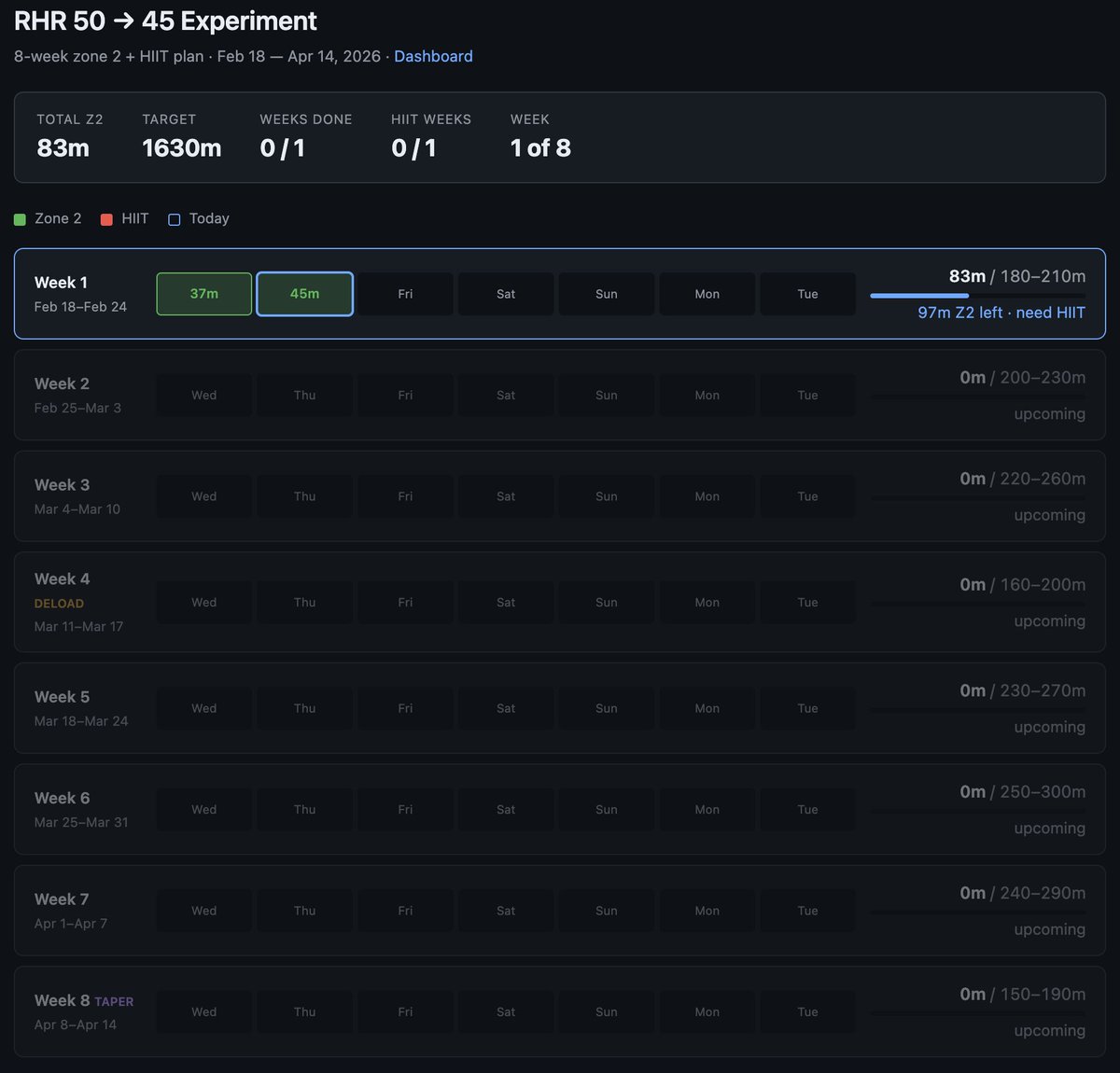
Example from this morning - I've become a bit loosy goosy with my cardio recently so I decided to do a more srs, regimented experiment to try to lower my Resting Heart Rate from 50 -> 45, over experiment duration of 8 weeks. The primary way to do this is to aspire to a certain sum total minute goals in Zone 2 cardio and 1 HIIT/week.
1 hour later I vibe coded this super custom dashboard for this very specific experiment that shows me how I'm tracking. Claude had to reverse engineer the Woodway treadmill cloud API to pull raw data, process, filter, debug it and create a web UI frontend to track the experiment. It wasn't a fully smooth experience and I had to notice and ask to fix bugs e.g. it screwed up metric vs. imperial system units and it screwed up on the calendar matching up days to dates etc.
But I still feel like the overall direction is clear:
1) There will never be (and shouldn't be) a specific app on the app store for this kind of thing. I shouldn't have to look for, download and use some kind of a "Cardio experiment tracker", when this thing is ~300 lines of code that an LLM agent will give you in seconds. The idea of an "app store" of a long tail of discrete set of apps you choose from feels somehow wrong and outdated when LLM agents can improvise the app on the spot and just for you.
2) Second, the industry has to reconfigure into a set of services of sensors and actuators with agent native ergonomics. My Woodway treadmill is a sensor - it turns physical state into digital knowledge. It shouldn't maintain some human-readable frontend and my LLM agent shouldn't have to reverse engineer it, it should be an API/CLI easily usable by my agent. I'm a little bit disappointed (and my timelines are correspondingly slower) with how slowly this progression is happening in the industry overall. 99% of products/services still don't have an AI-native CLI yet. 99% of products/services maintain .html/.css docs like I won't immediately look for how to copy paste the whole thing to my agent to get something done. They give you a list of instructions on a webpage to open this or that url and click here or there to do a thing. In 2026. What am I a computer? You do it. Or have my agent do it.
So anyway today I am impressed that this random thing took 1 hour (it would have been ~10 hours 2 years ago). But what excites me more is thinking through how this really should have been 1 minute tops. What has to be in place so that it would be 1 minute? So that I could simply say "Hi can you help me track my cardio over the next 8 weeks", and after a very brief Q&A the app would be up. The AI would already have a lot personal context, it would gather the extra needed data, it would reference and search related skill libraries, and maintain all my little apps/automations.
TLDR the "app store" of a set of discrete apps that you choose from is an increasingly outdated concept all by itself. The future are services of AI-native sensors & actuators orchestrated via LLM glue into highly custom, ephemeral apps. It's just not here yet.
I've been waiting 3 years to show you this
We just launched our 3rd-gen humanoid, but we’re already on our 7th-gen hand
Our team has quietly worked for years to approach parity with a human hand
Excited to share a sneak peek of some of the best engineering I’ve ever seen
Introducing GPT-5.3-Codex-Spark, our ultra-fast model purpose built for real-time coding.
We’re rolling it out as a research preview for ChatGPT Pro users in the Codex app, Codex CLI, and IDE extension.
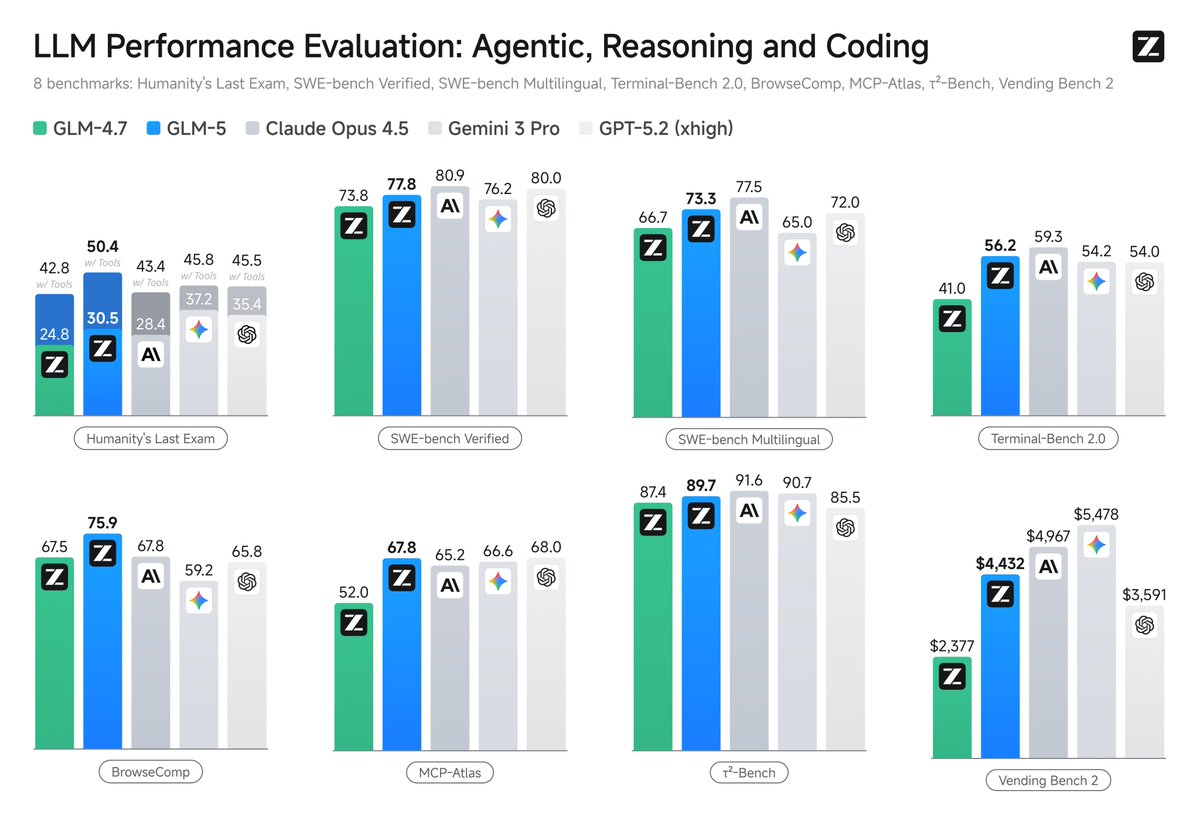
Introducing GLM-5: From Vibe Coding to Agentic Engineering
GLM-5 is built for complex systems engineering and long-horizon agentic tasks. Compared to GLM-4.5, it scales from 355B params (32B active) to 744B (40B active), with pre-training data growing from 23T to 28.5T tokens.
Try it now: https://t.co/WCqWT0raFJ
Weights: https://t.co/DteNDHjSEh
Tech Blog: https://t.co/Wxn5ARTJxH
OpenRouter (Previously Pony Alpha): https://t.co/7Khf64Lxg6
Rolling out from Coding Plan Max users: https://t.co/Nk8Y98Il7s
Your computer-use challenge is addictive. @adcock_brett
Built a general browser agent (no deterministic solvers).
Step 13 in ~2.5 minutes (video 2×).
Closing the gap now.
The effective use of agents is creating one of the widest spreads in output productivity we’ve seen on a per role basis.
We didn’t see this with chatbots previously. Chatbots probably sped up work by maybe 10-20% in most cases because they largely accelerate the research on a topic you would otherwise do in a few steps manually.
Now, with agents, you could take the exact same engineer and easily see a 5X+ difference in the amount of useful output simply based on their choice of tools and how they’ve designed their workflows. There probably hasn’t been a period in tech or where a couple decisions and changes to your process drive this much leverage.
As this continues to expand beyond coding, this will be one of the biggest shocks to the system of what work looks like in most fields. This will happen in legal, finance, life sciences, and other areas that have previously been constrained by how much information you can process or produce.
Most areas of knowledge work still imagine AI as a chatbot paradigm and not yet a full agent-executing-work-for-you paradigm. But it’s coming.
Jensen Huang said if he were a student today, he wouldn’t prioritize coding. He’d prioritize learning how to talk to AI.
Most people treat AI like Google. Type a question, get an answer, move on. Huang sees it differently. He calls it “expertise in artistry,” which sounds dramatic but makes sense when you think about it.
The real skill isn’t using AI. It’s knowing what to ask for and how to refine it. “Learning to interact with AI is not unlike being really good at asking questions.”
If you’re a doctor, can you use AI to catch diagnoses you’d miss? If you’re a lawyer, can you sharpen arguments faster than your competition? The leverage comes from pairing what you know with how well you can direct the tool.
Domain expertise multiplied by AI fluency equals amplification. Without the expertise, the AI is just noise. Without fluency, you’re leaving most of the capability on the table.
The question isn’t whether AI will replace you. It’s whether someone who knows how to use it better will.